Indonesia Nuclear Medicine Radioisotopes Market Size, Share & Growth Rate
The Indonesia Nuclear Medicine Radioisotopes Market was estimated at USD 411 Million in 2025 and is projected to reach USD 543 Million by 2032, growing at a CAGR of 4.1% from 2026 to 2032. This growth trajectory is underpinned by the rising prevalence of chronic diseases, the expansion of healthcare infrastructure, and the growing acceptance of advanced diagnostic techniques among medical professionals and patients alike. As demand for innovative imaging solutions rises, Indonesias market is poised for significant transformation.
Indonesia Nuclear Medicine Radioisotopes Market Year-wise Growth Rate and Key Drivers
This graph highlights how the Indonesia Nuclear Medicine Radioisotopes Market has steadily grown over the years, supported by major growth factors.
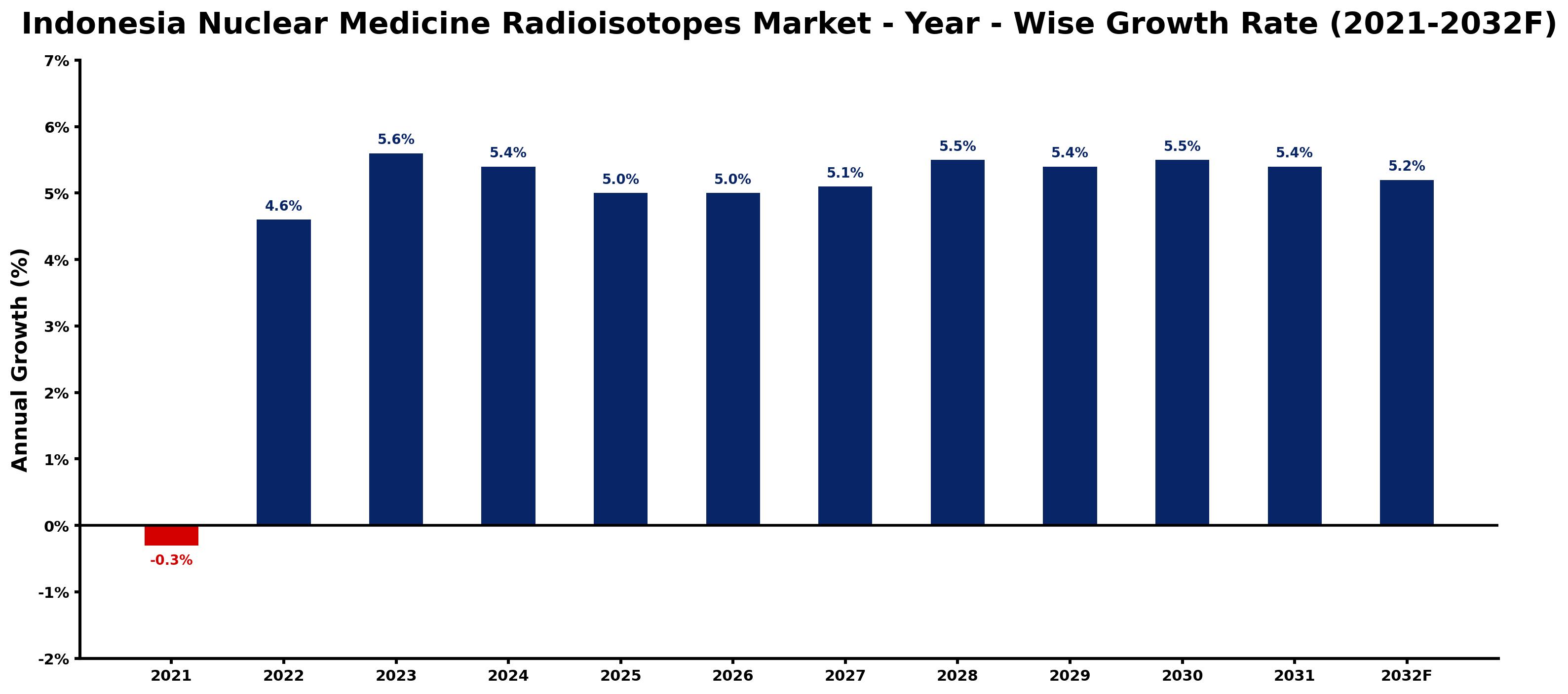
The table below presents the year‑wise growth rates along with the key drivers influencing the market
| Year | Growth Rate | Major Drivers |
| 2021 | -0.3% | Shift in healthcare funding priorities |
| 2022 | 4.6% | Rising demand for advanced diagnostics |
| 2023 | 5.6% | Increased investment in healthcare infrastructure |
| 2024 | 5.4% | Growth in private healthcare sector |
| 2025 | 5.0% | Expansion of research and development |
| 2026 | 5.0% | Technological advancements in imaging |
| 2027 | 5.1% | Growing awareness of preventive care |
| 2028 | 5.5% | Increase in aging population demographics |
| 2029 | 5.4% | Enhanced regulatory support for innovations |
| 2030 | 5.5% | growing downstream application demand |
| 2031 | 5.4% | Rising prevalence of chronic diseases |
| 2032 | 5.2% | Emergence of new treatment modalities |
Note: Market size estimations and growth projections presented in this report are based on 6Wresearch's proprietary forecasting methodology, utilizing the latest available industry data, government publications, and primary research inputs.
Indonesia Nuclear Medicine Radioisotopes Market Synopsis
Indonesia's nuclear medicine landscape is characterized by a dual-source system for radioisotope supply: imports and domestic production at the Advanced Technology Centre in Bandung. This combination not only ensures the availability of essential radioisotopes but also positions Indonesia as a key player in the Southeast Asian region.
The demand for radioisotopes has surged in recent years, driven by advancements in nuclear imaging technology and a heightened awareness of health issues. Facilities specializing in nuclear medicine have been expanding, particularly in urban and rural areas, making these essential diagnostic services more accessible to the general population.
Indonesia Nuclear Medicine Radioisotopes Market Key Takeaways
- The market is experiencing robust growth due to increasing healthcare investments and a rise in chronic illness prevalence.
- Government regulations are facilitating easier importation and distribution of radioisotopes, mitigating local supply shortages.
- Technological advancements in imaging techniques are enhancing the accuracy of diagnoses, driving further market demand.
- The aging population is a significant demographic factor influencing market dynamics, as older adults require more medical diagnostics.
- Infrastructure development in rural areas is providing broader access to nuclear medicine services, contributing to market expansion.
Evaluation of Restraints in Indonesia Nuclear Medicine Radioisotopes Market
Despite the growth potential, the Indonesia Nuclear Medicine Radioisotopes Market faces notable restraints. The high costs associated with procuring and installing advanced imaging equipment remain a significant barrier, particularly for smaller healthcare providers. Additionally, stringent regulations related to the importation and licensing of radioactive substances can complicate the supply chain. Further, there exists a shortage of skilled professionals capable of safely operating the sophisticated machinery used in nuclear imaging, which poses a challenge to service expansion.
Indonesia Nuclear Medicine Radioisotopes Market Trends
The market is witnessing a shift towards more advanced imaging techniques, such as PET/CT scans, which provide superior diagnostic accuracy compared to conventional methods. This transition is complemented by increased investments in research and development of radiopharmaceuticals, leading to the production of shorter-lived isotopes that pose lower radiation risks to patients. Additionally, the trend of incorporating automated pharmacy systems is enhancing efficiency in the production and distribution processes of radioisotopes.
Indonesia Nuclear Medicine Radioisotopes Market Opportunities
Genuine growth opportunities lie in the enhancement of domestic production capacities to reduce reliance on imports. Investing in training programs for medical professionals will also bolster the workforce capable of operating sophisticated imaging technology. Furthermore, expanding nuclear medicine services into underserved rural areas can significantly increase market reach and accessibility. The development of partnerships between public and private sectors could also facilitate innovation and investment in new technologies.
Government Initiatives in the Indonesia Nuclear Medicine Radioisotopes Market
The Indonesian government has been actively promoting healthcare infrastructure development, which includes initiatives to improve access to nuclear medicine services. Policies aimed at increasing investment in the healthcare sector have been enacted, coupled with programs designed to enhance public health awareness. Incentives for hospitals and clinics to adopt advanced imaging technologies and easier regulatory frameworks for importing radioisotopes are also part of government efforts to ensure a steady supply and improved service delivery in nuclear medicine.
Future Insights of the Indonesia Nuclear Medicine Radioisotopes Market
Looking towards the future, the Indonesia Nuclear Medicine Radioisotopes Market is expected to evolve significantly from 2026 to 2032. The continued integration of advanced imaging technologies will drive demand for radioisotopes, while the aging demographic will further necessitate enhanced diagnostic services. Investments in production infrastructure and workforce training will play a crucial role in addressing existing challenges. Overall, the market's growth trajectory appears promising as Indonesia seeks to improve its healthcare outcomes through innovative nuclear medicine solutions.
Indonesia Nuclear Medicine Radioisotopes Market Latest Developments (2025 - 2026)
Recent developments in the Indonesia Nuclear Medicine Radioisotopes Market have been marked by significant advancements in research collaborations aimed at enhancing domestic production capabilities. New policies encouraging public-private partnerships are being rolled out to drive innovation in imaging technologies. Additionally, healthcare facilities have been upgrading their equipment to accommodate new diagnostic modalities, ensuring they remain competitive in the rapidly evolving market.
Indonesia Nuclear Medicine Radioisotopes Market - Key Attractiveness of the Report
- 10 Years of Market Numbers
- Historical Data Starting from 2022 to 2025
- Base Year: 2025
- Forecast Data until 2032
- Key Performance Indicators Impacting the Market
- Major Upcoming Developments and Projects
Key Highlights of the Report:
- Indonesia Nuclear Medicine Radioisotopes Market Outlook
- Market Size of Indonesia Nuclear Medicine Radioisotopes Market, 2025
- Forecast of Indonesia Nuclear Medicine Radioisotopes Market, 2032
- Historical Data and Forecast of Indonesia Nuclear Medicine Radioisotopes Revenues & Volume for the Period 2022-2032F
- Indonesia Nuclear Medicine Radioisotopes Market Trend Evolution
- Indonesia Nuclear Medicine Radioisotopes Market Drivers and Challenges
- Indonesia Nuclear Medicine Radioisotopes Price Trends
- Indonesia Nuclear Medicine Radioisotopes Porter's Five Forces
- Indonesia Nuclear Medicine Radioisotopes Industry Life Cycle
- Historical Data and Forecast of Indonesia Nuclear Medicine Radioisotopes Market Revenues & Volume By Types for the Period 2022-2032F
- Historical Data and Forecast of Indonesia Nuclear Medicine Radioisotopes Market Revenues & Volume By Technetium-99m (Tc-99m) for the Period 2022-2032F
- Historical Data and Forecast of Indonesia Nuclear Medicine Radioisotopes Market Revenues & Volume By Thallium-201 (Tl-201) for the Period 2022-2032F
- Historical Data and Forecast of Indonesia Nuclear Medicine Radioisotopes Market Revenues & Volume By Iodine (I-123) for the Period 2022-2032F
- Historical Data and Forecast of Indonesia Nuclear Medicine Radioisotopes Market Revenues & Volume By Fluorine-18 for the Period 2022-2032F
- Historical Data and Forecast of Indonesia Nuclear Medicine Radioisotopes Market Revenues & Volume By Rubidium-82 (Rb-82) for the Period 2022-2032F
- Historical Data and Forecast of Indonesia Nuclear Medicine Radioisotopes Market Revenues & Volume By Iodine-131 (I-131) for the Period 2022-2032F
- Historical Data and Forecast of Indonesia Nuclear Medicine Radioisotopes Market Revenues & Volume By Actinium-225 (Ac-225) for the Period 2022-2032F
- Historical Data and Forecast of Indonesia Technetium-99m (Tc-99m) Nuclear Medicine Radioisotopes Market Revenues & Volume By Others for the Period 2022-2032F
- Historical Data and Forecast of Indonesia Nuclear Medicine Radioisotopes Market Revenues & Volume By Application for the Period 2022-2032F
- Historical Data and Forecast of Indonesia Nuclear Medicine Radioisotopes Market Revenues & Volume By Oncology for the Period 2022-2032F
- Historical Data and Forecast of Indonesia Nuclear Medicine Radioisotopes Market Revenues & Volume By Cardiology for the Period 2022-2032F
- Historical Data and Forecast of Indonesia Nuclear Medicine Radioisotopes Market Revenues & Volume By Thyroid for the Period 2022-2032F
- Historical Data and Forecast of Indonesia Nuclear Medicine Radioisotopes Market Revenues & Volume By Neurology for the Period 2022-2032F
- Historical Data and Forecast of Indonesia Nuclear Medicine Radioisotopes Market Revenues & Volume By Others for the Period 2022-2032F
- Indonesia Nuclear Medicine Radioisotopes Import Export Trade Statistics
- Market Opportunity Assessment By Types
- Market Opportunity Assessment By Application
- Indonesia Nuclear Medicine Radioisotopes Top Companies Market Share
- Indonesia Nuclear Medicine Radioisotopes Competitive Benchmarking By Technical and Operational Parameters
- Indonesia Nuclear Medicine Radioisotopes Company Profiles
- Indonesia Nuclear Medicine Radioisotopes Key Strategic Recommendations






































