Indonesia Nylon Filament Yarn Market Size, Share & Growth Rate
The Indonesia Nylon Filament Yarn Market was estimated at USD 276 Million in 2025 and is projected to reach USD 366 Million by 2032, growing at a CAGR of 4.1% from 2026 to 2032. This growth trajectory is fueled by the increasing demand for versatile applications in textiles and automotive sectors. The expansion of Indonesia's automotive manufacturing, along with a growing trend towards high-performance textiles for sportswear and outdoor clothing, further enhances the market landscape.
Indonesia Nylon Filament Yarn Market Year-wise Growth Rate and Key Drivers
This graph highlights how the Indonesia Nylon Filament Yarn Market has steadily grown over the years, supported by major growth factors.
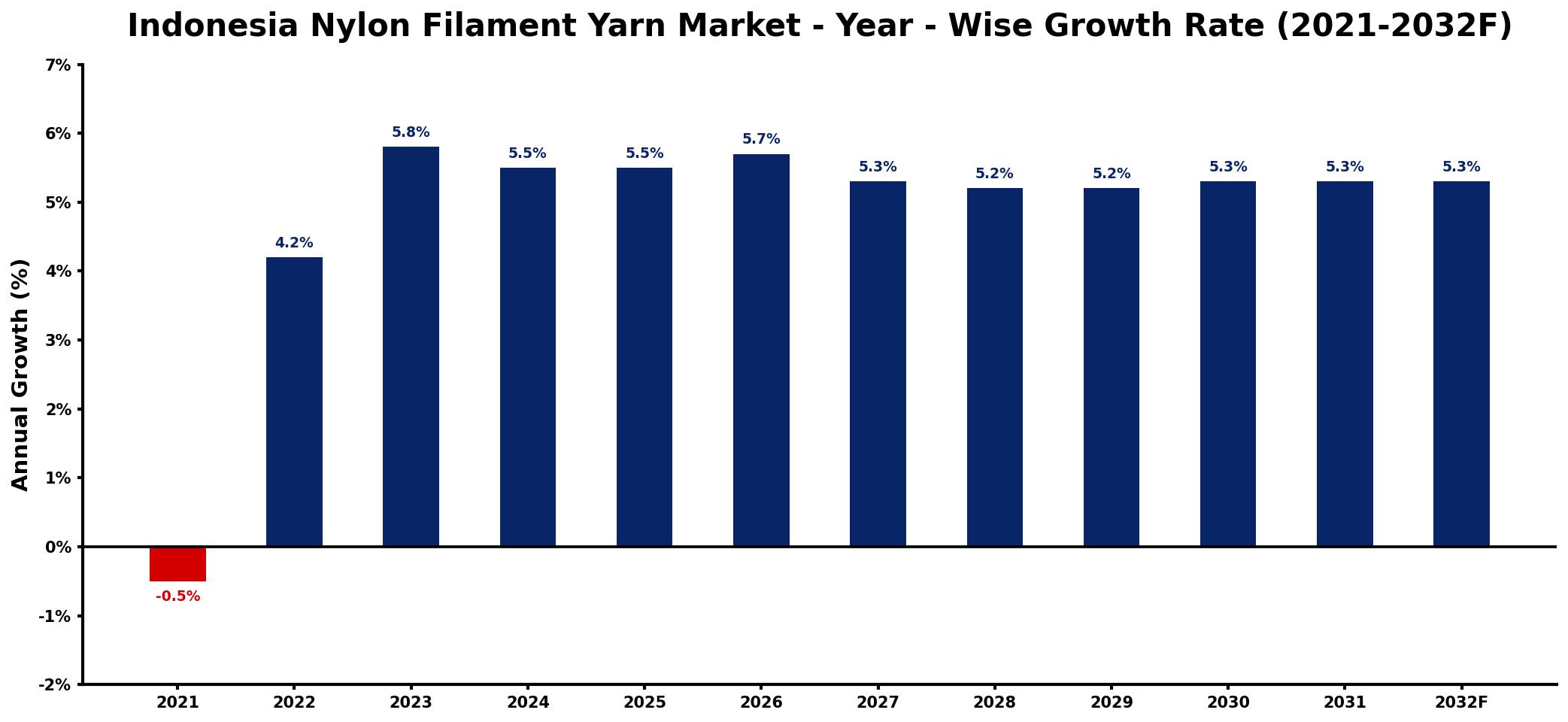
The table below presents the year‑wise growth rates along with the key drivers influencing the market
| Year | Growth Rate | Major Drivers |
| 2021 | -0.5% | Supply chain disruptions impacted production |
| 2022 | 4.2% | Increased demand from textile sector |
| 2023 | 5.8% | Growth in apparel manufacturing activities |
| 2024 | 5.5% | Expansion of export markets opportunities |
| 2025 | 5.5% | Rising investments in production facilities |
| 2026 | 5.7% | Technological advancements enhance efficiency |
| 2027 | 5.3% | Emerging applications in automotive industry |
| 2028 | 5.2% | Sustainable practices attract consumer interest |
| 2029 | 5.2% | Collaborations with fashion brands increase |
| 2030 | 5.3% | Government incentives promote manufacturing growth |
| 2031 | 5.3% | Rising disposable income drives consumption |
| 2032 | 5.3% | Global market trends favor diversification |
Note: Market size estimations and growth projections presented in this report are based on 6Wresearch's proprietary forecasting methodology, utilizing the latest available industry data, government publications, and primary research inputs.
Indonesia Nylon Filament Yarn Market Synopsis
The demand for nylon filament yarn in Indonesia is primarily driven by the textile industry, which leverages the yarn's strength and durability for various applications. With an increasing number of manufacturers turning to nylon for its superior performance qualities, the market is poised for significant growth.
Furthermore, the industrial sector is expanding, with nylon filament yarn being utilized in the production of automotive components and technical textiles. This dual focus on consumer products and industrial applications underscores the versatility and relevance of nylon filament yarn in the Indonesian market.
Indonesia Nylon Filament Yarn Market Key Takeaways
- Growing demand from the automotive and textile industries boosts market prospects.
- Nylon's properties make it a preferred choice for a variety of technical applications.
- The market is adapting to post-pandemic recovery dynamics, focusing on supply chain resilience.
- Innovation in manufacturing processes is vital to meet evolving consumer preferences.
- Government initiatives to support industrial growth further enhance market opportunities.
Evaluation of Restraints in Indonesia Nylon Filament Yarn Market
While the Indonesia Nylon Filament Yarn Market is on an upward trajectory, several factors could pose significant restraints. Intense competition from alternative synthetic fibers complicates market dynamics, as manufacturers strive to differentiate their products. Additionally, environmental concerns related to nylon production are increasingly influencing consumer choices and regulatory standards, compelling the industry to innovate sustainably. Meeting these challenges will require a strategic focus on developing more eco-friendly production methods and enhancing the value proposition of nylon filament yarn in various applications.
Indonesia Nylon Filament Yarn Market Trends
Emerging trends in the Indonesia Nylon Filament Yarn Market reflect a shift towards sustainability and high-performance applications. Manufacturers are increasingly exploring bio-based nylon alternatives and recycling methods to meet growing environmental standards. Concurrently, advancements in textile technology are driving demand for lightweight, durable fabrics, particularly in the sports and outdoor clothing sectors, enhancing overall product innovation and market appeal.
Indonesia Nylon Filament Yarn Market Opportunities
The potential for growth in the Indonesia Nylon Filament Yarn Market is significant, particularly within the automotive and outdoor apparel sectors. As more local companies embrace advanced manufacturing techniques and sustainable practices, there is an opportunity for increased investments. Furthermore, tapping into export markets may provide additional revenue streams for manufacturers, allowing them to leverage Indonesia's strategic location within the Asia-Pacific region.
Government Initiatives in the Indonesia Nylon Filament Yarn Market
The Indonesian government has been actively promoting industrial growth through various initiatives and incentives aimed at enhancing manufacturing capabilities. Policies designed to foster local production and technological advancements have created a more conducive environment for nylon filament yarn manufacturers. Furthermore, initiatives focusing on sustainability and eco-friendly practices are expected to encourage the development of innovative solutions within the sector.
Future Insights of the Indonesia Nylon Filament Yarn Market
Looking ahead to 2026-2032, the Indonesia Nylon Filament Yarn Market is likely to witness robust development, driven by ongoing industrialization and a growing appetite for innovative textile solutions. As global trends favor sustainable materials, Indonesia's manufacturers will need to adapt to changing consumer preferences while maintaining competitive advantages through technology and quality. The successful navigation of these dynamics will position the market for sustained growth and greater market share in the Asia-Pacific region.
Indonesia Nylon Filament Yarn Market Latest Developments (2025 - 2026)
In recent months, the Indonesian nylon filament yarn industry has seen a surge in investments towards research and development aimed at enhancing product performance and sustainability. Companies are exploring partnerships with technology firms to integrate smart textile innovations into their offerings. Additionally, participation in international trade fairs has increased, allowing manufacturers to showcase their products and connect with global markets, further bolstering growth prospects.
Indonesia Nylon Filament Yarn Market - Key Attractiveness of the Report
- 10 Years of Market Numbers
- Historical Data Starting from 2022 to 2025
- Base Year: 2025
- Forecast Data until 2032
- Key Performance Indicators Impacting the Market
- Major Upcoming Developments and Projects
Key Highlights of the Report:
- Indonesia Nylon Filament Yarn Market Outlook
- Market Size of Indonesia Nylon Filament Yarn Market, 2025
- Forecast of Indonesia Nylon Filament Yarn Market, 2032
- Historical Data and Forecast of Indonesia Nylon Filament Yarn Revenues & Volume for the Period 2022-2032F
- Indonesia Nylon Filament Yarn Market Trend Evolution
- Indonesia Nylon Filament Yarn Market Drivers and Challenges
- Indonesia Nylon Filament Yarn Price Trends
- Indonesia Nylon Filament Yarn Porter's Five Forces
- Indonesia Nylon Filament Yarn Industry Life Cycle
- Historical Data and Forecast of Indonesia Nylon Filament Yarn Market Revenues & Volume By Grade for the Period 2022-2032F
- Historical Data and Forecast of Indonesia Nylon Filament Yarn Market Revenues & Volume By Flat Yarn for the Period 2022-2032F
- Historical Data and Forecast of Indonesia Nylon Filament Yarn Market Revenues & Volume By Textured Yarn for the Period 2022-2032F
- Historical Data and Forecast of Indonesia Nylon Filament Yarn Market Revenues & Volume By Partially Oriented Yarn for the Period 2022-2032F
- Historical Data and Forecast of Indonesia Nylon Filament Yarn Market Revenues & Volume By Fully Drawn Yarn for the Period 2022-2032F
- Historical Data and Forecast of Indonesia Nylon Filament Yarn Market Revenues & Volume By Dyed Yarns for the Period 2022-2032F
- Historical Data and Forecast of Indonesia Nylon Filament Yarn Market Revenues & Volume By Application for the Period 2022-2032F
- Historical Data and Forecast of Indonesia Nylon Filament Yarn Market Revenues & Volume By Textiles for the Period 2022-2032F
- Historical Data and Forecast of Indonesia Nylon Filament Yarn Market Revenues & Volume By Sports Apparels for the Period 2022-2032F
- Historical Data and Forecast of Indonesia Nylon Filament Yarn Market Revenues & Volume By Sports and Adventure Equipment for the Period 2022-2032F
- Historical Data and Forecast of Indonesia Nylon Filament Yarn Market Revenues & Volume By Travel Accessories for the Period 2022-2032F
- Historical Data and Forecast of Indonesia Nylon Filament Yarn Market Revenues & Volume By Fishing Nets for the Period 2022-2032F
- Historical Data and Forecast of Indonesia Nylon Filament Yarn Market Revenues & Volume By Fabric for the Period 2022-2032F
- Historical Data and Forecast of Indonesia Nylon Filament Yarn Market Revenues & Volume By Sales Channel for the Period 2022-2032F
- Historical Data and Forecast of Indonesia Nylon Filament Yarn Market Revenues & Volume By Direct Company Sale for the Period 2022-2032F
- Historical Data and Forecast of Indonesia Nylon Filament Yarn Market Revenues & Volume By Direct Import for the Period 2022-2032F
- Historical Data and Forecast of Indonesia Nylon Filament Yarn Market Revenues & Volume By Distributors & Traders for the Period 2022-2032F
- Historical Data and Forecast of Indonesia Nylon Filament Yarn Market Revenues & Volume By Retailers for the Period 2022-2032F
- Indonesia Nylon Filament Yarn Import Export Trade Statistics
- Market Opportunity Assessment By Grade
- Market Opportunity Assessment By Application
- Market Opportunity Assessment By Sales Channel
- Indonesia Nylon Filament Yarn Top Companies Market Share
- Indonesia Nylon Filament Yarn Competitive Benchmarking By Technical and Operational Parameters
- Indonesia Nylon Filament Yarn Company Profiles
- Indonesia Nylon Filament Yarn Key Strategic Recommendations






































