Indonesia Off Road Motorcycle Market Size, Share & Growth Rate
The Indonesia Off Road Motorcycle Market was estimated at USD 472 Million in 2025 and is projected to reach USD 625 Million by 2032, growing at a CAGR of 4.1% from 2026 to 2032. This upward trajectory is primarily driven by rising disposable incomes, allowing more Indonesians to pursue their passion for off-road biking. Coupled with increasing interest in outdoor recreational activities, the market is well-positioned to capitalize on the nation's diverse and challenging terrains.
Indonesia Off Road Motorcycle Market Growth Rate Analysis (2021-2032)
The Indonesia off-road motorcycle market is on an upward path, with growth rates rebounding from -1.0% in 2021 to 4.3% in 2022, followed by notable increases of 5.4% in 2023 and 2024. This surge can be attributed to rising consumer demand fueled by an expanding middle class and a growing interest in outdoor recreational activities. Additionally, investments in infrastructure, particularly in rural areas, are enhancing accessibility for off-road enthusiasts. Looking ahead, growth is expected to stabilize around 5.4% to 5.7% from 2028 to 2032, driven by technological advancements and an ongoing shift towards sustainable energy sources, further engaging a diverse consumer base eager for adventure.
Indonesia Off Road Motorcycle Market Year-wise Growth Rate and Key Drivers
This graph highlights how the Indonesia Off Road Motorcycle Market has steadily grown over the past five years, supported by major growth factors.
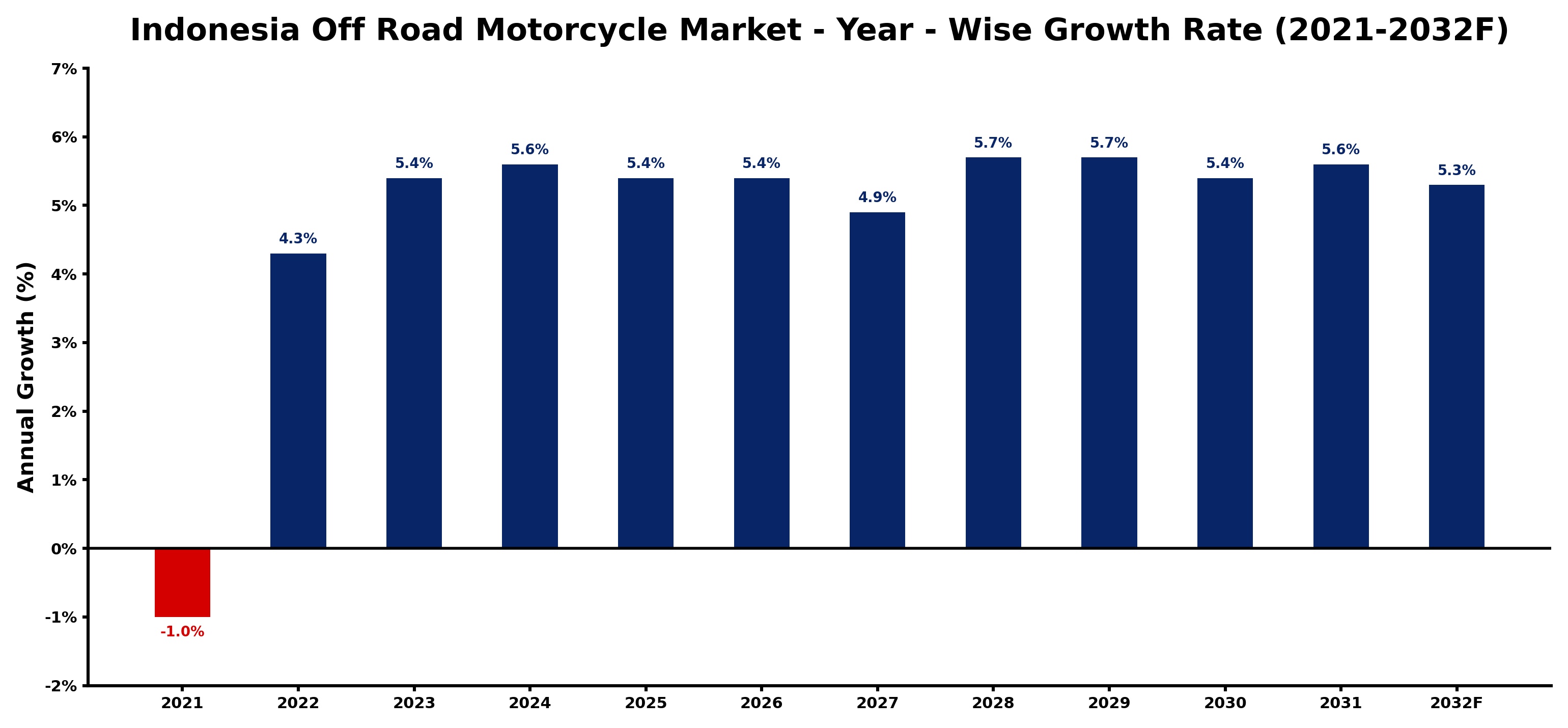
The table below presents the year‑wise growth rates along with the key drivers influencing the market
| Year | Growth Rate | Major Drivers |
| 2021 | -1.0% | Economic uncertainty limited purchases |
| 2022 | 4.3% | Adventure tourism attracted enthusiasts |
| 2023 | 5.4% | Rising disposable incomes fueled demand |
| 2024 | 5.6% | Increased urban mobility preferences emerged |
| 2025 | 5.4% | New model launches excited consumers |
| 2026 | 5.4% | Enhanced marketing strategies engaged buyers |
| 2027 | 4.9% | Rising interest in off-road activities |
| 2028 | 5.7% | Technological advancements improved performance |
| 2029 | 5.7% | Growing community events promoted engagement |
| 2030 | 5.4% | Sustainability trends influenced purchasing decisions |
| 2031 | 5.6% | Partnerships expanded distribution networks |
| 2032 | 5.3% | Customization options attracted diverse buyers |
Note - Market size estimations and growth projections presented in this report are based on 6Wresearch's advanced forecasting approach, validated with industry datasets as of June 2026.
Indonesia Off Road Motorcycle Market Synopsis
The off-road motorcycle scene in Indonesia is thriving, characterized by a rich culture of adventure and exploration. As the archipelago boasts a variety of terrains—from rugged mountains to serene beaches—riders are increasingly seeking vehicles that can navigate these landscapes effortlessly.
With affordability and performance at the forefront, off-road motorcycles have become a popular choice among both seasoned enthusiasts and newcomers alike. This market is evolving rapidly, with technological advancements enabling better features and reliability, further fueling consumer interest and demand.
Indonesia Off Road Motorcycle Market Key Takeaways
- The market benefits from a growing youth demographic eager for thrilling outdoor experiences.
- Technological advancements are making high-performance bikes more accessible and affordable.
- Financial options from manufacturers are increasing ownership rates among Indonesian consumers.
- The vibrant off-road culture, supported by the varied Indonesian landscape, drives continuous interest and participation in the sport.
- Despite challenges from the COVID-19 pandemic, the long-term outlook remains positive due to rising income levels.
Evaluation of Restraints in Indonesia Off Road Motorcycle Market
While the off-road motorcycle market is poised for growth, several constraints must be acknowledged. Rising input costs for raw materials have pressured manufacturers, making it difficult to maintain competitive pricing. Additionally, there is increasing competition from foreign markets offering cheaper alternatives, which can stifle local production efforts. Infrastructure issues further complicate access to service and spare parts, while counterfeiting remains a significant concern, potentially eroding consumer trust in the marketplace.
Indonesia Off Road Motorcycle Market Trends
A noticeable trend in the Indonesia Off Road Motorcycle Market is the growing demand for dual-sport models, which cater to both on-road and off-road riding experiences. Riders appreciate the versatility of these bikes as they transition between different terrains. Moreover, a surge in digital engagement and community-driven events—like rallies and competitions—has fostered a vibrant riding community. Manufacturers are also increasingly focusing on enhancing safety features and sustainability, aligning with global trends toward eco-friendliness and responsible riding.
Indonesia Off Road Motorcycle Market Opportunities
The market presents genuine growth opportunities through targeted marketing strategies aimed at younger demographics and first-time buyers. Innovative financing solutions can further enhance accessibility. The rise of eco-conscious consumers also paves the way for electric and hybrid models, which could attract a new segment of environmentally aware riders. Additionally, leveraging Indonesia's extensive tourism sector to promote off-road riding experiences can catalyze market growth.
Government Initiatives in the Indonesia Off Road Motorcycle Market
The Indonesian government has been actively promoting the development of the motorcycle industry through various initiatives. These include investments in infrastructure to improve road access in rural areas, which encourages off-road biking. Additionally, there are programs aimed at enhancing road safety and training for motorcyclists, which benefit the overall riding community. Such public spending and regulatory support help foster a safer, more robust off-road motorcycle culture across the nation.
Future Insights of the Indonesia Off Road Motorcycle Market
Looking ahead to 2026-2032, the Indonesia Off Road Motorcycle Market is expected to continue its upward trajectory, driven by a combination of economic growth, rising income levels, and an enduring passion for adventure among Indonesian riders. As consumer preferences shift toward more technologically advanced and sustainable vehicles, manufacturers will need to innovate and adapt accordingly. The growing community of off-road enthusiasts, alongside increasing tourism focused on adventure activities, will further stimulate demand in the coming years.
Indonesia Off Road Motorcycle Market Latest Developments (May 2025 - June 2026)
Recent trends indicate a shift toward more community-driven initiatives, with events being organized to connect riders and promote the sport. Industry stakeholders are also focusing on sustainability by introducing more eco-friendly models. Additionally, partnerships between brands and local organizations have emerged to facilitate training programs aimed at improving rider skills and safety. These developments signal a robust future for the market as it adapts to changing consumer preferences and environmental concerns.
Indonesia Off Road Motorcycle Market - Key Attractiveness of the Report
- 10 Years of Market Numbers
- Historical Data Starting from 2022 to 2025
- Base Year: 2025
- Forecast Data until 2032
- Key Performance Indicators Impacting the Market
- Major Upcoming Developments and Projects
Key Highlights of the Report:
- Indonesia Off Road Motorcycle Market Outlook
- Market Size of Indonesia Off Road Motorcycle Market, 2025
- Forecast of Indonesia Off Road Motorcycle Market, 2032F
- Historical Data and Forecast of Indonesia Off Road Motorcycle Revenues & Volume for the Period 2022-2032F
- Indonesia Off Road Motorcycle Market Trend Evolution
- Indonesia Off Road Motorcycle Market Drivers and Challenges
- Indonesia Off Road Motorcycle Price Trends
- Indonesia Off Road Motorcycle Porter's Five Forces
- Indonesia Off Road Motorcycle Industry Life Cycle
- Historical Data and Forecast of Indonesia Off Road Motorcycle Market Revenues & Volume By Type for the Period 2022-2032F
- Historical Data and Forecast of Indonesia Off Road Motorcycle Market Revenues & Volume By Dual-Sports for the Period 2022-2032F
- Historical Data and Forecast of Indonesia Off Road Motorcycle Market Revenues & Volume By Adventure Bikes for the Period 2022-2032F
- Historical Data and Forecast of Indonesia Off Road Motorcycle Market Revenues & Volume By Raid Bikes for the Period 2022-2032F
- Historical Data and Forecast of Indonesia Off Road Motorcycle Market Revenues & Volume By Motocross for the Period 2022-2032F
- Historical Data and Forecast of Indonesia Off Road Motorcycle Market Revenues & Volume By Trial Bikes for the Period 2022-2032F
- Historical Data and Forecast of Indonesia Off Road Motorcycle Market Revenues & Volume By Others for the Period 2022-2032F
- Historical Data and Forecast of Indonesia Off Road Motorcycle Market Revenues & Volume By Distribution Channel for the Period 2022-2032F
- Historical Data and Forecast of Indonesia Off Road Motorcycle Market Revenues & Volume By OEM for the Period 2022-2032F
- Historical Data and Forecast of Indonesia Off Road Motorcycle Market Revenues & Volume By Aftermarket for the Period 2022-2032F
- Historical Data and Forecast of Indonesia Off Road Motorcycle Market Revenues & Volume By Application for the Period 2022-2032F
- Historical Data and Forecast of Indonesia Off Road Motorcycle Market Revenues & Volume By Recreation for the Period 2022-2032F
- Historical Data and Forecast of Indonesia Off Road Motorcycle Market Revenues & Volume By Defense for the Period 2022-2032F
- Indonesia Off Road Motorcycle Import Export Trade Statistics
- Market Opportunity Assessment By Type
- Market Opportunity Assessment By Distribution Channel
- Market Opportunity Assessment By Application
- Indonesia Off Road Motorcycle Top Companies Market Share
- Indonesia Off Road Motorcycle Competitive Benchmarking By Technical and Operational Parameters
- Indonesia Off Road Motorcycle Company Profiles
- Indonesia Off Road Motorcycle Key Strategic Recommendations






































