Indonesia Organic Cotton Market Size, Share & Growth Rate
The Indonesia Organic Cotton Market was estimated at USD 264 Million in 2025 and is projected to reach USD 349 Million by 2032, growing at a CAGR of 4.1% from 2026 to 2032. This growth trajectory is primarily driven by a surge in consumer awareness surrounding sustainable and eco-friendly textiles. As the demand for organic cotton rises, fueled by a shift in consumer preferences towards products that are free from harmful chemicals and pesticides, local producers are increasingly focusing on organic farming practices.
Indonesia Organic Cotton Market Year-wise Growth Rate and Key Drivers
This graph highlights how the Indonesia Organic Cotton Market has steadily grown over the years, supported by major growth factors.
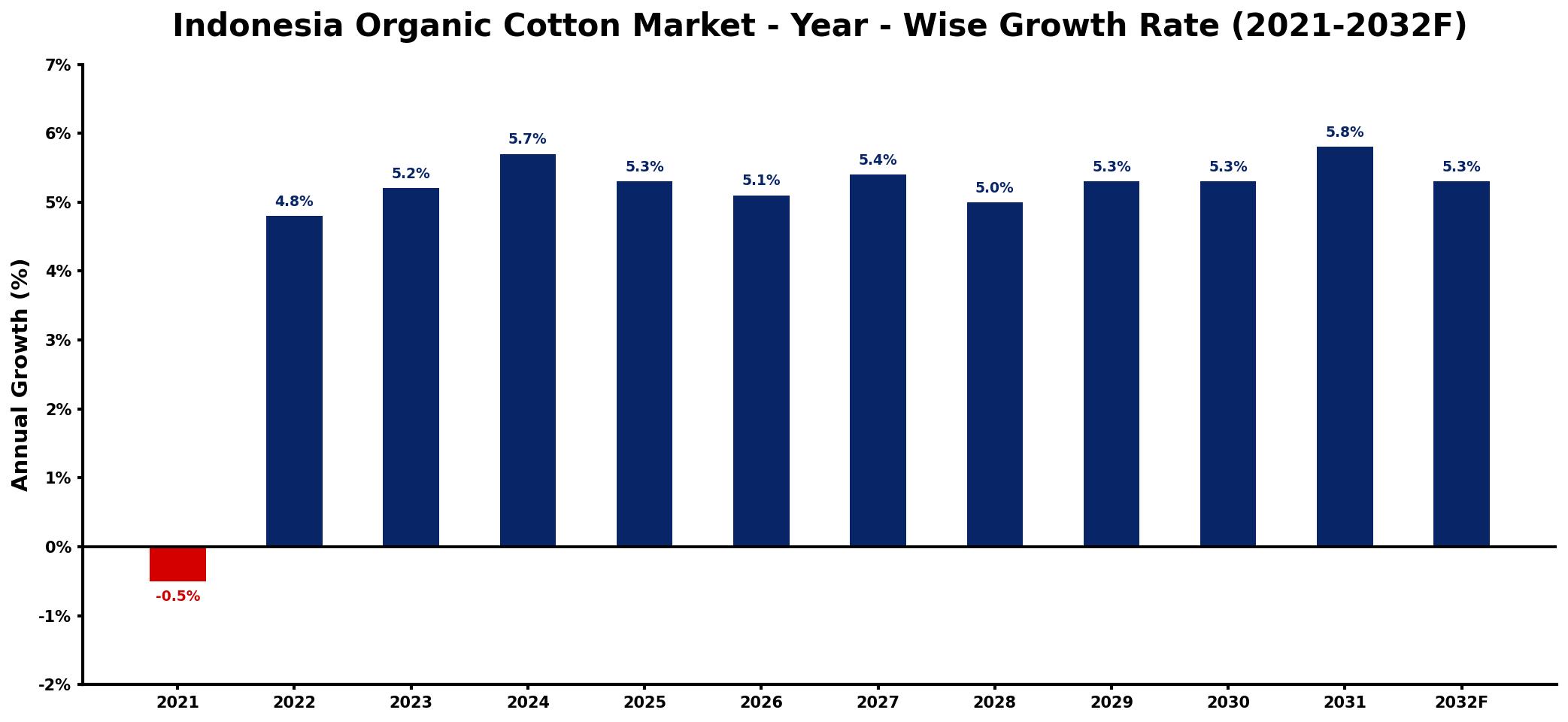
The table below presents the year‑wise growth rates along with the key drivers influencing the market
| Year | Growth Rate | Major Drivers |
| 2021 | -0.5% | decreased consumer interest sustainability |
| 2022 | 4.8% | increased investment eco-friendly textiles |
| 2023 | 5.2% | growing awareness environmental benefits |
| 2024 | 5.7% | expansion sustainable fashion initiatives |
| 2025 | 5.3% | rising demand ethical clothing brands |
| 2026 | 5.1% | enhanced supply chain transparency efforts |
| 2027 | 5.4% | stronger government support green industries |
| 2028 | 5.0% | increased collaboration local farmers networks |
| 2029 | 5.3% | growing popularity eco-conscious consumerism |
| 2030 | 5.3% | expanding retail channels sustainable products |
| 2031 | 5.8% | greater emphasis corporate social responsibility |
| 2032 | 5.3% | increased research sustainable farming techniques |
Note: Market size estimations and growth projections presented in this report are based on 6Wresearch's proprietary forecasting methodology, utilizing the latest available industry data, government publications, and primary research inputs.
Indonesia Organic Cotton Market Synopsis
The most significant force influencing the Indonesia Organic Cotton Market is the rising consumer demand for environmentally sustainable products. This growing consciousness about sustainable fashion is prompting both consumers and apparel brands to seek organic cotton alternatives.
Moreover, as the global market for organic textiles expands, Indonesia stands to benefit from its rich agricultural landscape and potential for organic cotton cultivation. However, ensuring consistent supply remains a vital aspect that stakeholders need to address to meet the burgeoning demand.
Indonesia Organic Cotton Market Key Takeaways
- The market is witnessing increased growth due to rising eco-conscious consumer behavior and demand for organic products.
- Producers are emphasizing organic farming methods, aligning with global sustainability trends.
- Supply chain consistency remains a key challenge that could impact market stability.
- The COVID-19 pandemic has accelerated the shift towards sustainable textiles, boosting market interest.
- Investment in organic farming technology is essential for supporting future growth in the sector.
Evaluation of Restraints in Indonesia Organic Cotton Market
Despite the positive outlook, the Indonesian organic cotton market faces significant restraints primarily related to supply chain reliability. The inconsistency in organic cotton supplies can be attributed to various factors, such as climatic conditions, agricultural practices, and market access for local farmers. These issues can lead to price volatility and may deter both producers and consumers from fully engaging in the organic market. Additionally, competition with conventional cotton, which is often cheaper, poses a challenge for widespread organic adoption.
Indonesia Organic Cotton Market Trends
Current trends indicate a notable shift towards sustainability in textiles, particularly among younger consumers who prioritize eco-friendly products. There's also a growing emphasis on transparency in the supply chain, with brands seeking to showcase their commitment to ethical sourcing. Technological advancements in organic farming practices, including precision agriculture and improved crop management, are paving the way for more efficient cultivation methods, ultimately increasing yields.
Indonesia Organic Cotton Market Opportunities
The most promising opportunities lie in enhancing the supply chain through collaborations between farmers, retailers, and sustainability initiatives. By investing in infrastructure and training for organic farming practices, stakeholders can increase production capacity and reduce dependency on imports. Additionally, tapping into the rising trend of eco-conscious consumerism presents avenues for brands to innovate and expand their offerings in organic textiles.
Government Initiatives in the Indonesia Organic Cotton Market
The Indonesian government has been actively promoting sustainable agricultural practices as part of its broader environmental policies. Various programs are aimed at encouraging organic farming through subsidies and grants for farmers transitioning to organic methods. Additionally, the government collaborates with local NGOs to provide education and resources that bolster organic farming practices, thereby enhancing the overall sustainability of the textile industry.
Future Insights of the Indonesia Organic Cotton Market
Looking ahead, the Indonesian organic cotton market is poised for steady growth through 2032. The increasing demand for sustainable textiles is expected to drive innovation in organic farming practices and supply chain management. As global pressure mounts for more responsible sourcing in the fashion industry, Indonesia's position as a key player in the organic cotton sector is likely to strengthen, provided that challenges related to supply consistency are effectively addressed.
Indonesia Organic Cotton Market Latest Developments (2025 - 2026)
Recent developments in the Indonesia organic cotton market reflect a growing emphasis on sustainable practices among local producers. Collaborative initiatives between farmers and retailers are emerging to enhance supply chain transparency, while new technologies are being adopted to improve crop yields. The market is also witnessing increased consumer engagement, with more brands launching campaigns to educate shoppers about the benefits of choosing organic cotton products.
Indonesia Organic Cotton Market - Key Attractiveness of the Report
- 10 Years of Market Numbers
- Historical Data Starting from 2022 to 2025
- Base Year: 2025
- Forecast Data until 2032
- Key Performance Indicators Impacting the Market
- Major Upcoming Developments and Projects
Key Highlights of the Report:
- Indonesia Organic Cotton Market Outlook
- Market Size of Indonesia Organic Cotton Market, 2025
- Forecast of Indonesia Organic Cotton Market, 2032
- Historical Data and Forecast of Indonesia Organic Cotton Revenues & Volume for the Period 2022-2032F
- Indonesia Organic Cotton Market Trend Evolution
- Indonesia Organic Cotton Market Drivers and Challenges
- Indonesia Organic Cotton Price Trends
- Indonesia Organic Cotton Porter's Five Forces
- Indonesia Organic Cotton Industry Life Cycle
- Historical Data and Forecast of Indonesia Organic Cotton Market Revenues & Volume By Type for the Period 2022-2032F
- Historical Data and Forecast of Indonesia Organic Cotton Market Revenues & Volume By Long-Staple Cotton for the Period 2022-2032F
- Historical Data and Forecast of Indonesia Organic Cotton Market Revenues & Volume By Short-Staple Cotton for the Period 2022-2032F
- Historical Data and Forecast of Indonesia Organic Cotton Market Revenues & Volume By Middle Staple Cotton for the Period 2022-2032F
- Historical Data and Forecast of Indonesia Organic Cotton Market Revenues & Volume By Extra-long Staple Cotton for the Period 2022-2032F
- Historical Data and Forecast of Indonesia Organic Cotton Market Revenues & Volume By Others for the Period 2022-2032F
- Historical Data and Forecast of Indonesia Organic Cotton Market Revenues & Volume By Quality Type for the Period 2022-2032F
- Historical Data and Forecast of Indonesia Organic Cotton Market Revenues & Volume By Supima/Pima for the Period 2022-2032F
- Historical Data and Forecast of Indonesia Organic Cotton Market Revenues & Volume By Upland for the Period 2022-2032F
- Historical Data and Forecast of Indonesia Organic Cotton Market Revenues & Volume By Giza for the Period 2022-2032F
- Historical Data and Forecast of Indonesia Organic Cotton Market Revenues & Volume By Others for the Period 2022-2032F
- Historical Data and Forecast of Indonesia Organic Cotton Market Revenues & Volume By Application for the Period 2022-2032F
- Historical Data and Forecast of Indonesia Organic Cotton Market Revenues & Volume By Apparel for the Period 2022-2032F
- Historical Data and Forecast of Indonesia Organic Cotton Market Revenues & Volume By Packaging for the Period 2022-2032F
- Historical Data and Forecast of Indonesia Organic Cotton Market Revenues & Volume By Others for the Period 2022-2032F
- Indonesia Organic Cotton Import Export Trade Statistics
- Market Opportunity Assessment By Type
- Market Opportunity Assessment By Quality Type
- Market Opportunity Assessment By Application
- Indonesia Organic Cotton Top Companies Market Share
- Indonesia Organic Cotton Competitive Benchmarking By Technical and Operational Parameters
- Indonesia Organic Cotton Company Profiles
- Indonesia Organic Cotton Key Strategic Recommendations






































