Indonesia Passwordless Authentication Market Size & Growth Rate (2026-2032)
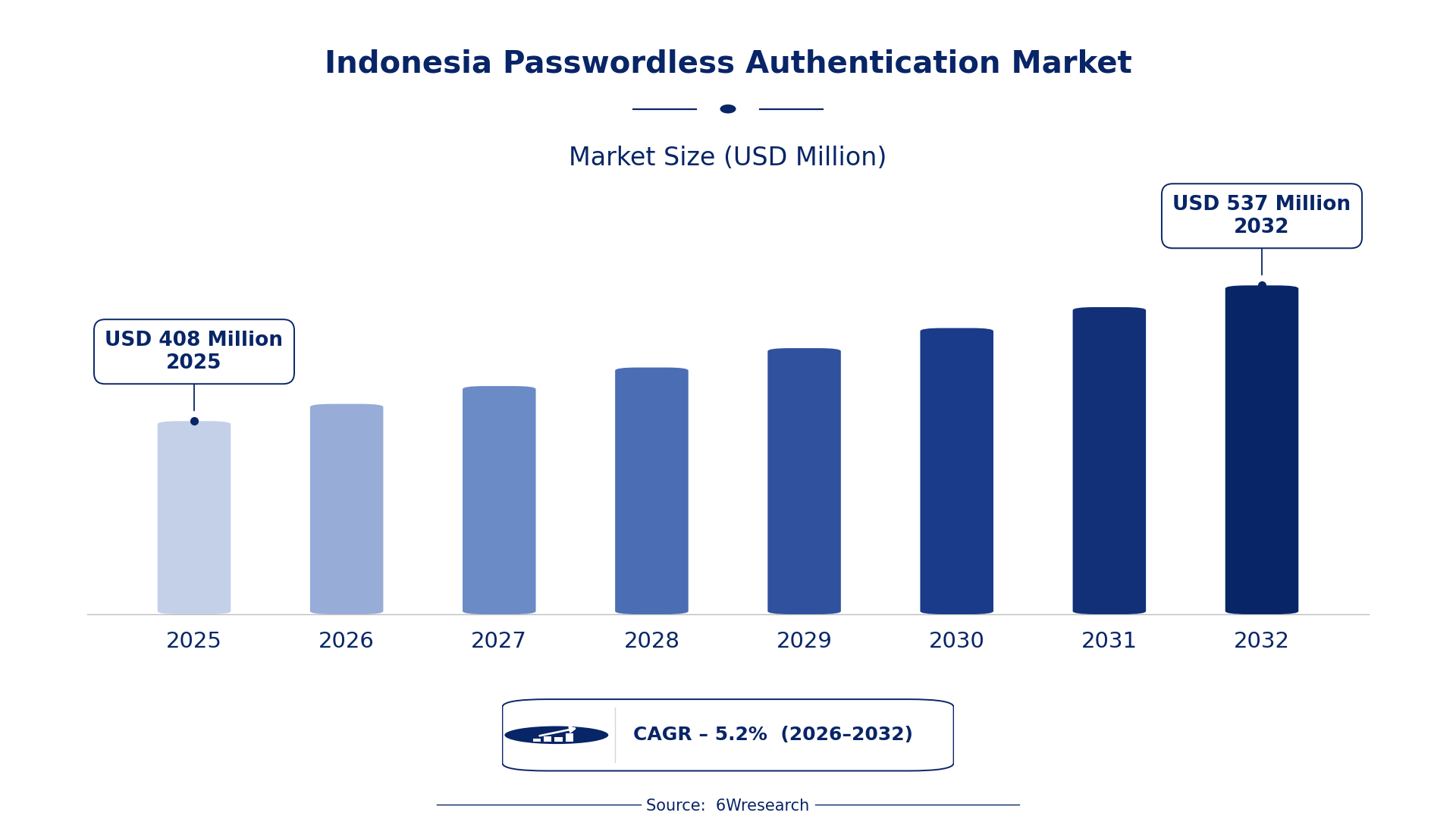
The Indonesia Passwordless Authentication Market was estimated at USD 408 Million in 2025 and is projected to reach USD 537 Million by 2032, growing at a CAGR of 5.2% from 2026 to 2032.
Indonesia Passwordless Authentication Market Synopsis
The momentum surrounding the Indonesia Passwordless Authentication Market is rapidly increasing as businesses evolve to prioritize both security and user experience. Organizations are increasingly recognizing the vulnerabilities tied to traditional passwords, pushing for more innovative solutions. As technology matures, the shift toward passwordless methods is gaining significant traction, particularly in sectors that demand high security.
Looking ahead, the Indonesian market is expected to continue expanding, fueled by an uptick in remote work and online transactions. The rising instances of cyber threats and data breaches have made passwordless solutions not just advantageous but essential for maintaining consumer trust and operational integrity.
Indonesia Passwordless Authentication Market Year-wise Growth Rate and Key Drivers
This graph illustrates the annual growth rates of the Indonesia Passwordless Authentication Market from 2021 to 2032, highlighting a steady upward trajectory and projected expansion over the forecast period.
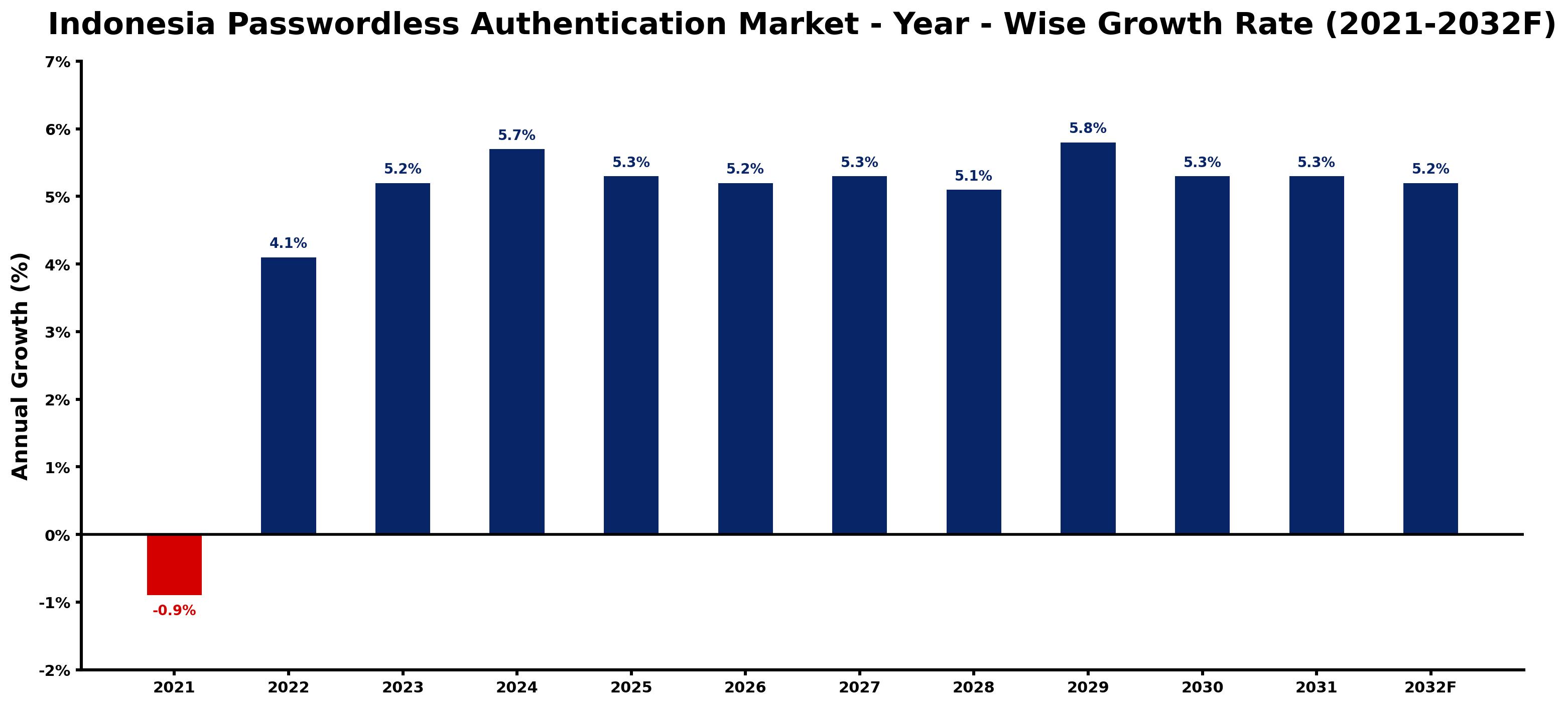
The table below presents the year‑wise growth rates along with the key drivers influencing the market
| Year | Growth Rate | Major Drivers |
| 2021 | -0.9% | Limited smartphone penetration hinders technology adoption in Indonesia |
| 2022 | 4.1% | Increased digital banking adoption by Bank Indonesia. |
| 2023 | 5.2% | Government push for stronger cybersecurity frameworks and compliance. |
| 2024 | 5.7% | Rising mobile internet penetration enhancing user authentication methods. |
| 2025 | 5.3% | Growth in e-commerce requiring secure passwordless solutions. |
| 2026 | 5.2% | Regulatory support for biometric authentication from OJK. |
| 2027 | 5.3% | Surge in online education driving passwordless identity solutions. |
| 2028 | 5.1% | Popularization of smart devices encouraging seamless authentication. |
| 2029 | 5.8% | Government campaigns against online fraud accelerating adoption. |
| 2030 | 5.3% | Local tech startups innovating passwordless solutions for businesses. |
| 2031 | 5.3% | Increased investment in fintech solutions by Indonesian startups. |
| 2032 | 5.2% | Awareness campaigns promoting secure access among users. |
Note: Market size estimations and growth projections presented in this report are based on 6Wresearch's proprietary forecasting methodology, utilizing the latest available industry data, government publications, and primary research inputs.
Indonesia Passwordless Authentication Market Key Takeaways
Below are some of the specific key takeaways from the market, including:
- The increasing adoption of biometric technologies is a primary driver for market growth.
- Smart tokens and multi-factor authentication are emerging as preferred choices among organizations.
- The COVID-19 pandemic has significantly accelerated the transition towards passwordless methods.
- User education remains a crucial factor in the successful implementation of passwordless systems.
- Interoperability challenges across platforms could hinder the seamless integration of solutions.
Evaluation of Restraints in Indonesia Passwordless Authentication Market
Despite the promising outlook for passwordless authentication in Indonesia, several hurdles impede its widespread adoption. A notable restraint is the pressing need for comprehensive user education and training. Many consumers and organizations are still entrenched in traditional password usage, creating a significant barrier to embracing new technologies. Additionally, ensuring that various systems and platforms can interoperate effectively poses technical challenges that can slow down adoption and create frustration for businesses attempting to implement these solutions.
Indonesia Passwordless Authentication Market Trends
The trend toward biometric authentication is becoming increasingly prominent, as many businesses recognize its potential to provide a user-friendly experience while enhancing security measures. Additionally, the integration of artificial intelligence and machine learning into authentication solutions is beginning to reshape the industry. These technologies can analyze user behavior and improve risk assessment, leading to more robust security frameworks. Furthermore, cloud-based solutions are gaining traction, as organizations look for flexibility and scalability in their authentication processes.
Indonesia Passwordless Authentication Market Opportunities
The growth of the Indonesia Passwordless Authentication Market presents various opportunities, particularly for innovative technology providers. Organizations that can create solutions focusing on user experience and security will find a receptive audience. Additionally, sectors like e-commerce and banking are increasingly looking for robust authentication methods to protect sensitive data and build consumer confidence. The increasing reliance on mobile applications and digital services also opens doors for tailored passwordless solutions that can enhance user trust and streamline access.
Government Initiatives in the Indonesia Passwordless Authentication Market
The Indonesian government is taking concrete steps to facilitate the adoption of passwordless authentication methods, recognizing their importance in enhancing digital security across sectors. Through policies aimed at improving cybersecurity infrastructure, the government is creating a favorable environment for businesses to implement innovative authentication solutions. Initiatives focused on educating users and organizations about the benefits and usage of passwordless technologies are also critical at this juncture.
- A national cybersecurity framework was introduced in early 2023, promoting the use of advanced authentication methods.
- An ongoing public-private partnership focuses on developing educational programs to raise awareness about passwordless authentication.
- A regulatory body is currently drafting standards for biometric authentication methods, expected to be released by mid-2025.
- Planned initiatives include a series of workshops and seminars to inform businesses about passwordless solutions, set to kick off in late 2025.
Future Insights of the Indonesia Passwordless Authentication Market
The Indonesia Passwordless Authentication Market is on a clear upward trajectory through 2032, fueled by technological advancements and increasing security concerns. As more organizations recognize the limitations of traditional password systems, the shift to passwordless solutions will likely accelerate. With user education and regulatory support, the market will mature and innovate, leading to more diverse and effective authentication options that meet the needs of a dynamic digital environment.
Indonesia Passwordless Authentication Market Latest Developments
In the past year, the Indonesia Passwordless Authentication Market has experienced notable activity as businesses and technology providers ramp up their efforts to adopt advanced authentication methods. There has been a marked increase in partnerships aimed at developing biometric solutions tailored to local needs, as well as investment in educational initiatives designed to foster acceptance among users.
- A major technology vendor announced a new biometric authentication solution tailored for Indonesian businesses, with development starting in Q2 2023 and an expected rollout by Q1 2025.
- A leading regional cybersecurity firm is currently enhancing its multi-factor authentication services, focusing on user-friendly interfaces, with updates planned for early 2024.
- In late 2023, a pilot program was launched to test passwordless solutions in the banking sector, aiming to gauge user acceptance and effectiveness.
- In Q3 2024, a series of workshops were held, engaging businesses across various sectors to educate them on the benefits and implementation of passwordless technologies.
Indonesia Passwordless Authentication Market - Key Attractiveness of the Report
- 10 Years of Market Numbers
- Historical Data Starting from 2022 to 2025
- Base Year: 2025
- Forecast Data until 2032
- Key Performance Indicators Impacting the Market
- Major Upcoming Developments and Projects
Key Highlights of the Report:
- Indonesia Passwordless Authentication Market Outlook
- Market Size of Indonesia Passwordless Authentication Market, 2025
- Forecast of Indonesia Passwordless Authentication Market, 2032
- Historical Data and Forecast of Indonesia Passwordless Authentication Revenues & Volume for the Period 2022-2032F
- Indonesia Passwordless Authentication Market Trend Evolution
- Indonesia Passwordless Authentication Market Drivers and Challenges
- Indonesia Passwordless Authentication Price Trends
- Indonesia Passwordless Authentication Porter's Five Forces
- Indonesia Passwordless Authentication Industry Life Cycle
- Historical Data and Forecast of Indonesia Passwordless Authentication Market Revenues & Volume By Offering for the Period 2022-2032F
- Historical Data and Forecast of Indonesia Passwordless Authentication Market Revenues & Volume By Hardware for the Period 2022-2032F
- Historical Data and Forecast of Indonesia Passwordless Authentication Market Revenues & Volume By Software for the Period 2022-2032F
- Historical Data and Forecast of Indonesia Passwordless Authentication Market Revenues & Volume By Services for the Period 2022-2032F
- Historical Data and Forecast of Indonesia Passwordless Authentication Market Revenues & Volume By Motility for the Period 2022-2032F
- Historical Data and Forecast of Indonesia Passwordless Authentication Market Revenues & Volume By Fixed/Rack Mounted for the Period 2022-2032F
- Historical Data and Forecast of Indonesia Passwordless Authentication Market Revenues & Volume By Mobile/Portable for the Period 2022-2032F
- Historical Data and Forecast of Indonesia Passwordless Authentication Market Revenues & Volume By Authentication Type for the Period 2022-2032F
- Historical Data and Forecast of Indonesia Passwordless Authentication Market Revenues & Volume By Single-factor for the Period 2022-2032F
- Historical Data and Forecast of Indonesia Passwordless Authentication Market Revenues & Volume By Multi-factor for the Period 2022-2032F
- Historical Data and Forecast of Indonesia Passwordless Authentication Market Revenues & Volume By End User for the Period 2022-2032F
- Historical Data and Forecast of Indonesia Passwordless Authentication Market Revenues & Volume By BFSI for the Period 2022-2032F
- Historical Data and Forecast of Indonesia Passwordless Authentication Market Revenues & Volume By IT and ITeS for the Period 2022-2032F
- Historical Data and Forecast of Indonesia Passwordless Authentication Market Revenues & Volume By Government and Law Enforcement for the Period 2022-2032F
- Historical Data and Forecast of Indonesia Passwordless Authentication Market Revenues & Volume By Healthcare for the Period 2022-2032F
- Historical Data and Forecast of Indonesia Passwordless Authentication Market Revenues & Volume By Manufacturing for the Period 2022-2032F
- Historical Data and Forecast of Indonesia Passwordless Authentication Market Revenues & Volume By Retail and Consumer Electronics for the Period 2022-2032F
- Historical Data and Forecast of Indonesia Passwordless Authentication Market Revenues & Volume By Travel and Hospitality for the Period 2022-2032F
- Historical Data and Forecast of Indonesia Passwordless Authentication Market Revenues & Volume By Other Verticals (Education; Energy and Utilities; Aerospace and Defense; Media and Entertainment; Online Gaming; and Transportation and Logistics) for the Period 2022-2032F
- Indonesia Passwordless Authentication Import Export Trade Statistics
- Market Opportunity Assessment By Offering
- Market Opportunity Assessment By Motility
- Market Opportunity Assessment By Authentication Type
- Market Opportunity Assessment By End User
- Indonesia Passwordless Authentication Top Companies Market Share
- Indonesia Passwordless Authentication Competitive Benchmarking By Technical and Operational Parameters
- Indonesia Passwordless Authentication Company Profiles
- Indonesia Passwordless Authentication Key Strategic Recommendations






































