Indonesia Perchloroethylene Market Size, Share & Growth Rate
The Indonesia Perchloroethylene Market was estimated at USD 367 Million in 2025 and is projected to reach USD 484 Million by 2032, growing at a CAGR of 4.0% from 2026 to 2032. This growth trajectory is largely fueled by rising demand from vital sectors such as automotive, textiles, and dry cleaning services. As the manufacturing sector expands in Indonesia, bolstered by an increase in population and living standards, the utilization of perchloroethylene is set to escalate significantly.
Indonesia Perchloroethylene Market Year-wise Growth Rate and Key Drivers
This graph highlights how the Indonesia Perchloroethylene Market has steadily grown over the years, supported by major growth factors.
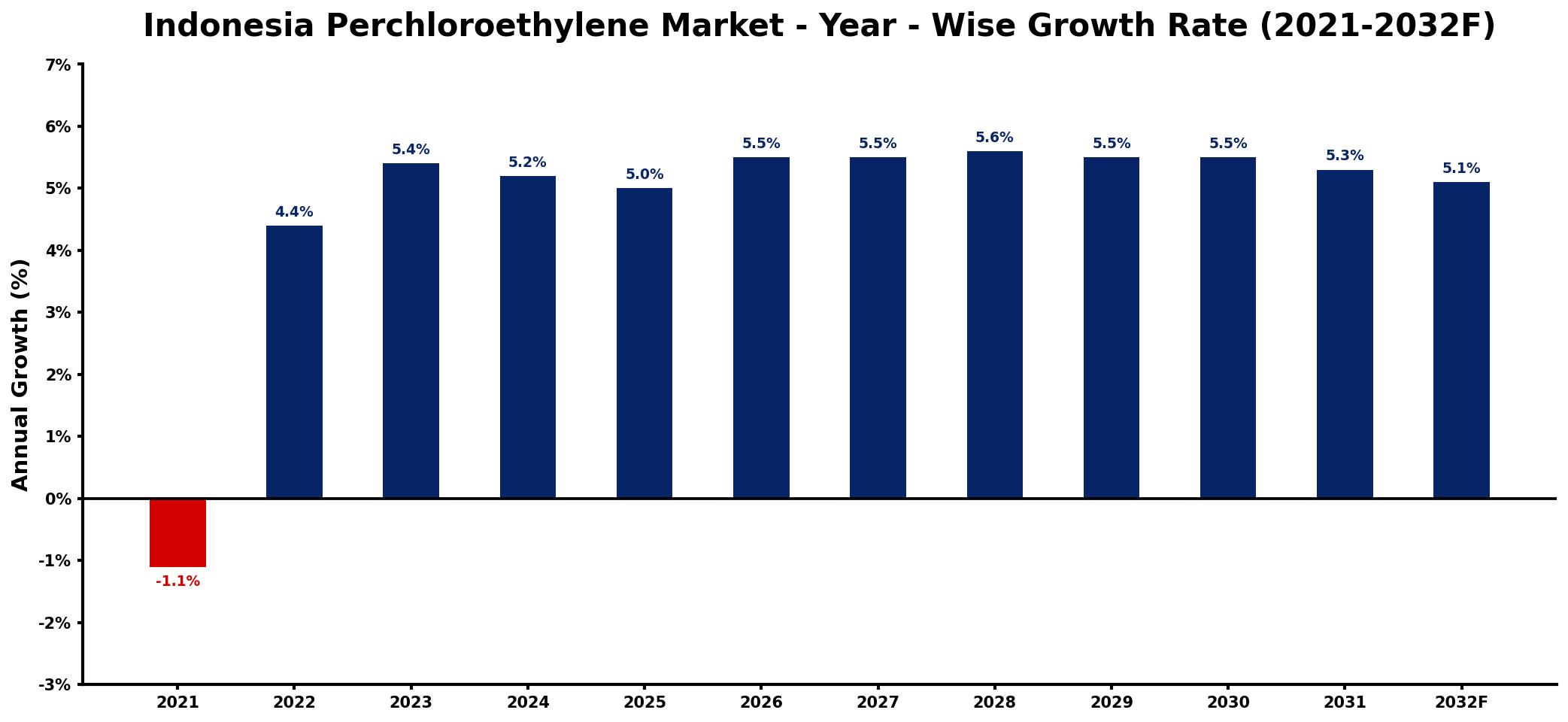
The table below presents the year‑wise growth rates along with the key drivers influencing the market
| Year | Growth Rate | Major Drivers |
| 2021 | -1.1% | decreased industrial cleaning activity |
| 2022 | 4.4% | increased demand from textile industry |
| 2023 | 5.4% | growth in automotive sector applications |
| 2024 | 5.2% | expansion of dry cleaning services |
| 2025 | 5.0% | rising investments in manufacturing |
| 2026 | 5.5% | growing awareness of solvent properties |
| 2027 | 5.5% | enhanced regulations on cleaning agents |
| 2028 | 5.6% | increased focus on environmental compliance |
| 2029 | 5.5% | growing demand for specialty chemicals |
| 2030 | 5.5% | expanding industrial usage applications |
| 2031 | 5.3% | increased adoption of industrial solvents |
| 2032 | 5.1% | rising demand for sustainable solutions |
Note: Market size estimations and growth projections presented in this report are based on 6Wresearch's proprietary forecasting methodology, utilizing the latest available industry data, government publications, and primary research inputs.
Indonesia Perchloroethylene Market Synopsis
The Indonesia perchloroethylene market has displayed resilience in recent years, overcoming initial disruptions to establish a steady growth path. Currently, the market is at a turning point, poised for substantial expansion driven by key industries that rely heavily on this solvent.
With an ever-increasing urban population and heightened consumer spending, the demand for dry cleaning services continues to surge, directly impacting the perchloroethylene market. The automotive sector is also contributing to this momentum as the adoption of precision cleaning processes becomes more prevalent.
Indonesia Perchloroethylene Market Key Takeaways
- The market is projected to witness a CAGR of 4.0% from 2026 to 2032, reflecting a robust growth outlook.
- Increasing demand from dry cleaning, textiles, and automotive industries remains a key growth driver.
- Adoption of precision cleaning methods is shaping the market dynamics favorably.
- Environmental regulations are influencing operational practices within the industry.
- Investment in manufacturing activities is expected to provide a significant boost to market demand.
Evaluation of Restraints in Indonesia Perchloroethylene Market
While the growth prospects for the Indonesia perchloroethylene market appear favorable, several restraints pose challenges. Key among these is the increasing scrutiny over environmental impacts and health safety associated with perchloroethylene usage. Regulatory frameworks are tightening, pushing businesses to seek alternative solvents and adopt sustainable practices to comply with guidelines. Additionally, the volatility in raw material prices and supply chain disruptions remain critical concerns, potentially affecting production costs and overall market stability.
Indonesia Perchloroethylene Market Trends
The market is currently witnessing several emerging trends that are shaping demand and technology. A notable shift towards sustainability is evident, as industries increasingly prioritize eco-friendly practices. This trend has prompted exploration into greener alternatives to perchloroethylene. Additionally, advancements in precision cleaning technologies are being adopted across various sectors, enhancing efficiency and effectiveness in application processes.
Indonesia Perchloroethylene Market Opportunities
The future of the Indonesia perchloroethylene market is rife with opportunities for growth and innovation. The expanding textile industry, coupled with a growing demand for high-quality dry cleaning services, presents avenues for increased market penetration. Furthermore, as industries pivot towards sustainable solutions, there is a burgeoning opportunity for the development and commercialization of alternative solvents, enabling businesses to align with market shifts and consumer expectations.
Government Initiatives in the Indonesia Perchloroethylene Market
The Indonesian government is increasingly prioritizing environmental sustainability, which has implications for the perchloroethylene market. Policies are being implemented to promote cleaner production practices and encourage investments in eco-friendly technologies. Public spending is being directed towards research and development of safer alternatives, while various programs aim to support industries in transitioning to greener solutions.
Future Insights of the Indonesia Perchloroethylene Market
Looking ahead to the period from 2026 to 2032, the Indonesia perchloroethylene market is positioned for notable evolution. As consumer awareness around sustainability rises, traditional usage patterns may shift. However, robust demand from critical sectors like textiles and automotive is likely to sustain growth. Companies that adapt to changing regulations and consumer preferences while innovating eco-friendly alternatives may find themselves leading the market in the near future.
Indonesia Perchloroethylene Market Latest Developments (2025 - 2026)
Recent developments in the Indonesia perchloroethylene market indicate a growing trend towards adopting sustainable practices in the industry. Major players are investing in research to develop eco-friendly solvents and improve waste management processes. Additionally, regulatory changes are prompting firms to reevaluate their operational strategies, ensuring compliance while maintaining competitive advantages in a rapidly evolving market landscape.
Indonesia Perchloroethylene Market - Key Attractiveness of the Report
- 10 Years of Market Numbers
- Historical Data Starting from 2022 to 2025
- Base Year: 2025
- Forecast Data until 2032
- Key Performance Indicators Impacting the Market
- Major Upcoming Developments and Projects
Key Highlights of the Report:
- Indonesia Perchloroethylene Market Outlook
- Market Size of Indonesia Perchloroethylene Market, 2025
- Forecast of Indonesia Perchloroethylene Market, 2032
- Historical Data and Forecast of Indonesia Perchloroethylene Revenues & Volume for the Period 2022-2032F
- Indonesia Perchloroethylene Market Trend Evolution
- Indonesia Perchloroethylene Market Drivers and Challenges
- Indonesia Perchloroethylene Price Trends
- Indonesia Perchloroethylene Porter's Five Forces
- Indonesia Perchloroethylene Industry Life Cycle
- Historical Data and Forecast of Indonesia Perchloroethylene Market Revenues & Volume By Type for the Period 2022-2032F
- Historical Data and Forecast of Indonesia Perchloroethylene Market Revenues & Volume By Ethylene Oxychlorination for the Period 2022-2032F
- Historical Data and Forecast of Indonesia Perchloroethylene Market Revenues & Volume By Acetylene Method for the Period 2022-2032F
- Historical Data and Forecast of Indonesia Perchloroethylene Market Revenues & Volume By Ethylene Direct Chlorination for the Period 2022-2032F
- Historical Data and Forecast of Indonesia Perchloroethylene Market Revenues & Volume By End-use for the Period 2022-2032F
- Historical Data and Forecast of Indonesia Perchloroethylene Market Revenues & Volume By Dry Cleaning Agent for the Period 2022-2032F
- Historical Data and Forecast of Indonesia Perchloroethylene Market Revenues & Volume By Solvent for the Period 2022-2032F
- Historical Data and Forecast of Indonesia Perchloroethylene Market Revenues & Volume By Others for the Period 2022-2032F
- Indonesia Perchloroethylene Import Export Trade Statistics
- Market Opportunity Assessment By Type
- Market Opportunity Assessment By End-use
- Indonesia Perchloroethylene Top Companies Market Share
- Indonesia Perchloroethylene Competitive Benchmarking By Technical and Operational Parameters
- Indonesia Perchloroethylene Company Profiles
- Indonesia Perchloroethylene Key Strategic Recommendations






































