Indonesia Pesticides Market (2026-2032) | Revenue, Industry, Value, Companies, Forecast, Trends, Analysis, Share, Size & Growth
Market Forecast By Product Type (Conventional Chemicals, Bio pesticides), By Application (Pre-Harvest, Post-Harvest) And Competitive Landscape
| Product Code: ETC338308 | Publication Date: Aug 2022 | Updated Date: Mar 2026 | Product Type: Market Research Report | |
| Publisher: 6Wresearch | Author: Ravi Bhandari | No. of Pages: 75 | No. of Figures: 35 | No. of Tables: 20 |
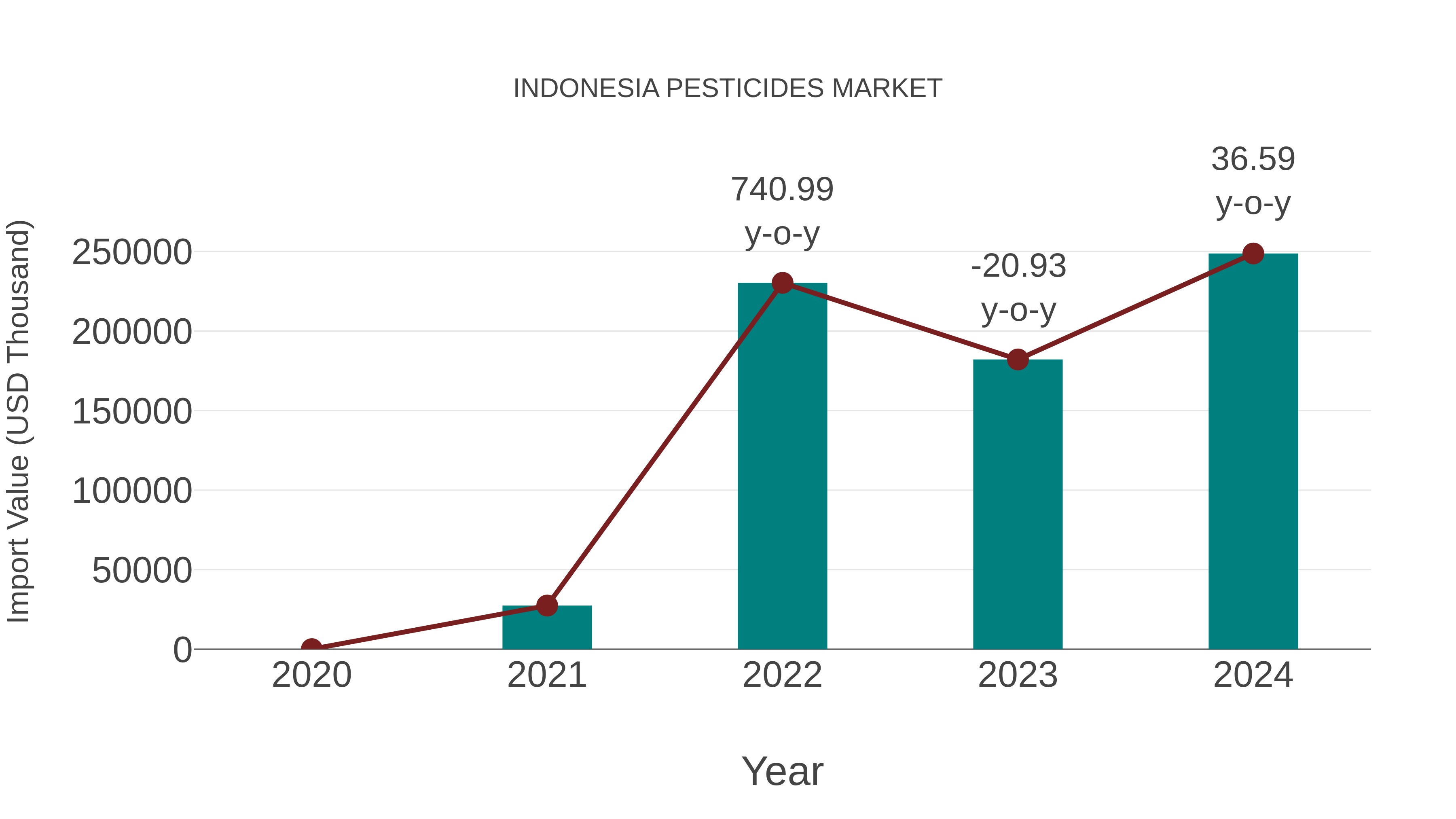
Indonesia Pesticides Market: Import Trend Analysis
Indonesia`s pesticides market witnessed a notable import trend from 2023 to 2024, with a growth rate of 36.59%. The compound annual growth rate (CAGR) for imports between 2020 and 2024 stood at 108.65%. This surge can be attributed to a shifting demand landscape or possibly changes in trade policies impacting market dynamics.
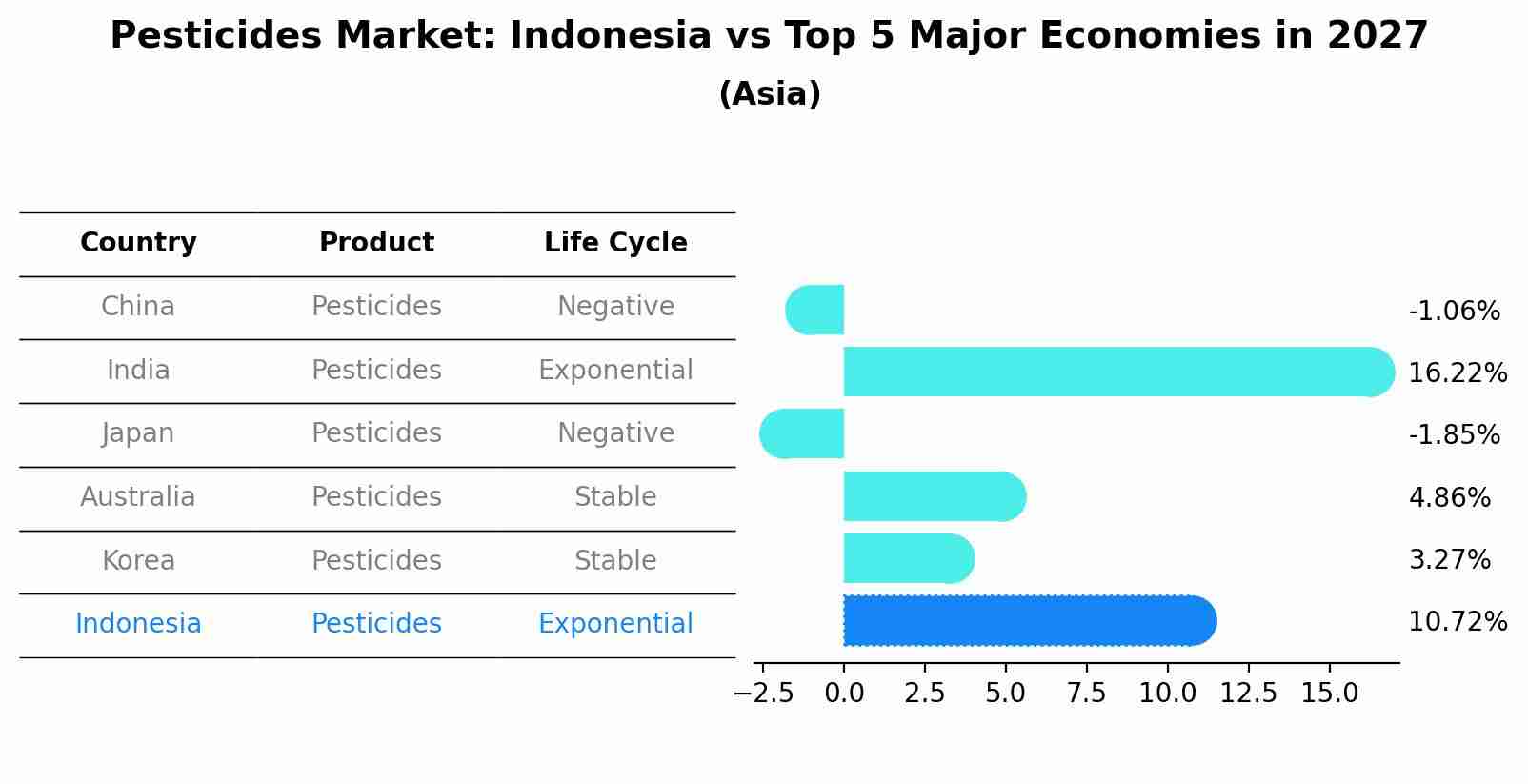
Pesticides Market: Indonesia vs Top 5 Major Economies in 2027 (Asia)
By 2027, Indonesia's Pesticides market is forecasted to achieve a high growth rate of 10.72%, with China leading the Asia region, followed by India, Japan, Australia and South Korea.
Indonesia Pesticides Market Growth Rate
According to 6Wresearch internal database and industry insights, the Indonesia Pesticides Market is projected to grow at a compound annual growth rate (CAGR) of 5.5% during the forecast period from 2026 to 2032.
Topics Covered in the Indonesia Pesticides Market Report
The Indonesia Pesticides Market report thoroughly covers the market by product type and application, providing an unbiased and detailed analysis of ongoing market trends, opportunities, challenges, and market drivers, helping stakeholders align their strategies with current and future market dynamics.
Indonesia Pesticides Market Highlights
| Report Name: | Indonesia Pesticides Market |
| Forecast Period: | 2026–2032 |
| CAGR: | 5.5% |
| Growing Sector: | Pesticides |
Indonesia Pesticides Market Synopsis
The Indonesia Pesticides Market shows consistent growth as farmers require more crop protection products, better agricultural productivity and pest control methods. The market shows a new trend as consumers now prefer environmentally safe pesticide solutions which are made from natural sources. The market develops through government policies which support farmers who work to enhance rice, oil palm and vegetable crop productivity. The sector experiences growth and sustainability through new developments in precision farming and complete pest control management methods.
Evaluation of Growth Drivers in the Indonesia Pesticides Market
Below mentioned are some prominent drivers and their impact on the market dynamics:
| Drivers | Primary Segments Affected | Why It Matters (Evidence) |
| Increasing Crop Protection Needs | Conventional Chemicals, Bio pesticides | The growing need to protect crops from pests and diseases is fueling demand for pesticides. |
| Growing Demand for Organic Pesticides | Bio pesticides | Increased awareness of environmental sustainability is pushing the adoption of bio-based pesticides. |
| Expanding Agricultural Sector | Conventional Chemicals, Bio pesticides | As agricultural sector advances, it facilitates the application of pesticides to protect crops, especially those of rice, palm oil, and vegetables. |
| Supportive Government Policies | All Segments | It is also essential for governments that provide financial support for agriculture to apply some of that encouragement to GM solutions. |
| Rising Need for High-Yield Crops | Conventional Chemicals, Bio pesticides | Increasing demand for higher crop yields to ensure food security drives pesticide adoption. |
The Indonesia Pesticides Market Size is projected to grow at a CAGR of 5.5% from 2026 to 2032. The Indonesia Pesticides Market is growing, due to growing demand for crop protection needs, government support, and rising demand for sustainable farming practices. The rising shift toward bio-based pesticides is experiencing rapid growth due to environmental protection needs and consumer preferences for organic products. The market is expanding as high-yield crop requirements drive demand for agricultural solutions. The Indonesian pesticide market continues to grow since these environmental solution needs to drive companies to adopt sustainable solutions.
Evaluation of Restraints in the Indonesia Pesticides Market
Below mentioned are some major restraints and their influence on the market dynamics:
| Restraints | Primary Segments Affected | What This Means (Evidence) |
| Regulatory Challenges | Conventional Chemicals | Stringent regulatory requirements for pesticide approval may delay market entry for new products. |
| Price Sensitivity | Bio pesticides, Conventional Chemicals | High prices of pesticides, particularly bio-based options, may limit adoption in price-sensitive markets. |
| Lack of Awareness about Bio Pesticides | Bio pesticides | Limited consumer understanding of the benefits and effectiveness of bio-based pesticides may slow their adoption. |
| Environmental Concerns | Conventional Chemicals | Overuse of chemical pesticides creates two problems for nature since it leads to ecological destruction and it generates pest resistance which decreases product marketability. |
| Resistance to Pesticides | Conventional Chemicals | The development of pest resistance to certain pesticides may reduce their effectiveness and demand. |
Indonesia Pesticides Market Challenges
The Indonesia Pesticides Industry experiences obstacles from three main factors which include regulatory requirements, environmental issues and the development of pesticide-resistant pests. The increasing cost of bio-based pesticides is hindering their broader adoption, especially in rural areas where farmers are more sensitive to prices. The market requires two main objectives to achieve its targets which involve increasing public knowledge about bio-based solutions and resolving authority constraints that delay product approvals. The market expansion will depend on the cooperative efforts between government bodies, product makers and their customers.
Indonesia Pesticides Market Trends
Here are some major trends changing the Indonesia Pesticides Market Growth dynamics:
- Shift Toward Bio-Pesticides: The demand for eco-friendly and bio-based pesticides has increased as people now understand the harmful effects that chemical pesticides have on the environment. The trend provides businesses with chances to create new environmentally friendly products which help them achieve sustainable development goals.
- Increase in Government Support for Agriculture: Government policies to support insecticides, with present implications that promote rice and oil palm's agricultural productivity, enhance the attitude of the open market towards the potential for growth.
- Technology in Pesticide Delivery Systems: The use of drones and smart spraying technologies in advanced pesticide delivery systems enables more accurate and efficient application, boosting crop yields and promoting sustainable farming.
Investment Opportunities in the Indonesia Pesticides Market
The Indonesia Pesticides Market presents several investment opportunities, including:
- Investment in Bio-Pesticide Development: The research and development investment for bio-pesticides will satisfy the rising need for environmentally friendly agricultural protection methods while creating new products for the market.
- Technology Integration for Precision Farming: Investment in precision agriculture technologies, such as drones and smart sensors, will help pesticide companies enhance the efficiency of pesticide delivery and improve crop yields.
- Public-Private Partnerships: Collaborating with government bodies to access subsidies and grants designed to support agricultural growth presents investment opportunities for both domestic and international companies.
Top 5 Leading Players in the Indonesia Pesticides Market
Below is the list of prominent companies leading the Indonesia Pesticides Market Share:
1. PT Syngenta Indonesia
| Company Name | PT Syngenta Indonesia |
| Headquarters | Jakarta Selatan, Indonesia |
| Established | 1960s (via legacy companies) |
| Website | Click Here |
A dominant force in the Indonesian agricultural sector, Syngenta operates multiple industrial facilities including a Plant Protection Research and Development Center and a specialized seed processing factory.
2. PT Bayer Indonesia
| Company Name | PT Bayer Indonesia |
| Headquarters | Jakarta, Indonesia |
| Established | 1957 |
| Website | Click Here |
Bayer Indonesia is a key player in the crop science market, maintaining dedicated supply centers for crop protection in Surabaya and Tangerang.
3. PT BASF Indonesia
| Company Name | PT BASF Indonesia |
| Headquarters | Jakarta, Indonesia |
| Established | 1976 (Global founded 1865) |
| Website | Click Here |
BASF provides a wide array of high-performance agrochemicals and agricultural solutions in Indonesia. The company is recognized for its research-driven approach, recently introducing new modes of action in insecticides to combat resistant rice pests.
4. PT Corteva Agriscience Indonesia
| Company Name | PT Corteva Agriscience Indonesia |
| Headquarters | Jakarta, Indonesia |
| Established | 2019 (following Dow-DuPont merger) |
| Website | Click Here |
Corteva Agriscience specializes in a balanced portfolio of seed technology and crop protection. In Indonesia, they are a major provider of hybrid seeds and advanced chemical solutions for weed and pest control.
5. PT Nufarm Indonesia
| Company Name | PT Nufarm Indonesia |
| Headquarters | Jakarta Selatan, Indonesia |
| Established | 1980s (Global founded 1916) |
| Website | Click Here |
Nufarm is a significant player in the Indonesian crop protection market, particularly known for its extensive distribution network that reaches deep into regional agricultural hubs in Java and Sumatra.
Government Regulations Introduced in the Indonesia Pesticides Market
According to Indonesian government data, the Indonesian government, through the Ministry of Agriculture, has implemented strict regulations and guidelines to ensure the safe use of pesticides and protect both the environment and public health. The government conducts pesticide residue tests on food products and establishes safety standards while granting licenses to pesticide manufacturing companies. The effective implementation of Integrated Pest Management (IPM) programs underscores their ability to reduce pesticide use and protect environmental resources. The Indonesian pesticides market must adhere to these standards to foster growth and sustainability.
Future Insights of the Indonesia Pesticides Market
The Indonesia Pesticide Market outlook will produce favorable outcomes from strong agriculture development where agricultural bio-pesticides are in high demand along with government support. There will be a demand from farmers for pest eradication to increase their crop yields which will drive this market forward. The agricultural industry has the potential to grow significantly due to its trend toward implementing sustainable farming practices and the demand for bio-pesticide products and precision agriculture solutions.
Market Segmentation Analysis
The report offers a comprehensive study of the following market segments and their leading categories:
By Product Type – Bio Pesticides to Dominate the Market
According to Ritika Kalra, Senior Research Analyst, 6Wresearch, Bio pesticides are expected to dominate the market due to the increasing consumer demand for eco-friendly and sustainable agricultural solutions. The demand for organic farming and sustainable practices is driving the preference for bio pesticides over traditional chemicals.
By Application – Pre-Harvest to Dominate the Market
The Pre-Harvest segment will control market share since it includes all pesticide application activities which protect crops from pests and diseases until harvest time. The segment exists as farmers need to produce maximum crop output together with superior crop quality.
Key Attractiveness of the Report
- 10 Years of Market Numbers.
- Historical Data Starting from 2022 to 2025.
- Base Year: 2025.
- Forecast Data until 2032.
- Key Performance Indicators Impacting the Market.
- Major Upcoming Developments and Projects.
Key Highlights of the Report:
- Indonesia Pesticides Market Outlook
- Market Size of Indonesia Pesticides Market, 2025
- Forecast of Indonesia Pesticides Market, 2032
- Historical Data and Forecast of Indonesia Pesticides Revenues & Volume for the Period 2022-2032F
- Indonesia Pesticides Market Trend Evolution
- Indonesia Pesticides Market Drivers and Challenges
- Indonesia Pesticides Price Trends
- Indonesia Pesticides Porter's Five Forces
- Indonesia Pesticides Industry Life Cycle
- Historical Data and Forecast of Indonesia Pesticides Market Revenues & Volume By Product Type for the Period 2022-2032F
- Historical Data and Forecast of Indonesia Pesticides Market Revenues & Volume By Conventional Chemicals for the Period 2022-2032F
- Historical Data and Forecast of Indonesia Pesticides Market Revenues & Volume By Bio pesticides for the Period 2022-2032F
- Historical Data and Forecast of Indonesia Pesticides Market Revenues & Volume By Application for the Period 2022-2032F
- Historical Data and Forecast of Indonesia Pesticides Market Revenues & Volume By Pre-Harvest for the Period 2022-2032F
- Historical Data and Forecast of Indonesia Pesticides Market Revenues & Volume By Post-Harvest for the Period 2022-2032F
- Indonesia Pesticides Import Export Trade Statistics
- Market Opportunity Assessment By Product Type
- Market Opportunity Assessment By Application
- Indonesia Pesticides Top Companies Market Share
- Indonesia Pesticides Competitive Benchmarking By Technical and Operational Parameters
- Indonesia Pesticides Company Profiles
- Indonesia Pesticides Key Strategic Recommendations
Market Covered
The report offers a comprehensive study of the subsequent market segments:
By Product Type
- Conventional Chemicals
- Bio Pesticides
By Application
- Pre-Harvest
- Post-Harvest
Indonesia Pesticides Market (2026-2032): FAQs
The Indonesia Pesticides Market is projected to grow at a CAGR of 5.5% between 2026–2032.
Bio pesticides are expected to dominate due to the growing preference for sustainable, eco-friendly agricultural practices.
Investment opportunities include bio-pesticide development, precision farming technologies, and government partnership initiatives.
Government initiatives include regulations to ensure safe pesticide use and promote Integrated Pest Management (IPM) practices to reduce pesticide dependence.
6Wresearch actively monitors the Indonesia Pesticides Market and publishes its comprehensive annual report, highlighting emerging trends, growth drivers, revenue analysis, and forecast outlook. Our insights help businesses to make data-backed strategic decisions with ongoing market dynamics. Our analysts track relevent industries related to the Indonesia Pesticides Market, allowing our clients with actionable intelligence and reliable forecasts tailored to emerging regional needs.
Yes, we provide customisation as per your requirements. To learn more, feel free to contact us on sales@6wresearch.com
|
1 Executive Summary |
|
2 Introduction |
|
2.1 Key Highlights of the Report |
|
2.2 Report Description |
|
2.3 Market Scope & Segmentation |
|
2.4 Research Methodology |
|
2.5 Assumptions |
|
3 Indonesia Pesticides Market Overview |
|
3.1 Indonesia Country Macro Economic Indicators |
|
3.2 Indonesia Pesticides Market Revenues & Volume, 2022 & 2032F |
|
3.3 Indonesia Pesticides Market - Industry Life Cycle |
|
3.4 Indonesia Pesticides Market - Porter's Five Forces |
|
3.5 Indonesia Pesticides Market Revenues & Volume Share, By Product Type, 2022 & 2032F |
|
3.6 Indonesia Pesticides Market Revenues & Volume Share, By Application, 2022 & 2032F |
|
4 Indonesia Pesticides Market Dynamics |
|
4.1 Impact Analysis |
|
4.2 Market Drivers |
|
4.2.1 Increasing demand for food crops due to population growth |
|
4.2.2 Growing awareness about the importance of crop protection |
|
4.2.3 Adoption of modern farming techniques and technologies |
|
4.3 Market Restraints |
|
4.3.1 Stringent regulations and policies regarding pesticide use |
|
4.3.2 Concerns about environmental impact and health hazards associated with pesticides |
|
5 Indonesia Pesticides Market Trends |
|
6 Indonesia Pesticides Market, By Types |
|
6.1 Indonesia Pesticides Market, By Product Type |
|
6.1.1 Overview and Analysis |
|
6.1.2 Indonesia Pesticides Market Revenues & Volume, By Product Type, 2022-2032F |
|
6.1.3 Indonesia Pesticides Market Revenues & Volume, By Conventional Chemicals, 2022-2032F |
|
6.1.4 Indonesia Pesticides Market Revenues & Volume, By Bio pesticides, 2022-2032F |
|
6.2 Indonesia Pesticides Market, By Application |
|
6.2.1 Overview and Analysis |
|
6.2.2 Indonesia Pesticides Market Revenues & Volume, By Pre-Harvest, 2022-2032F |
|
6.2.3 Indonesia Pesticides Market Revenues & Volume, By Post-Harvest, 2022-2032F |
|
7 Indonesia Pesticides Market Import-Export Trade Statistics |
|
7.1 Indonesia Pesticides Market Export to Major Countries |
|
7.2 Indonesia Pesticides Market Imports from Major Countries |
|
8 Indonesia Pesticides Market Key Performance Indicators |
|
8.1 Adoption rate of integrated pest management practices |
|
8.2 Investment in research and development for sustainable pesticide solutions |
|
8.3 Market acceptance of biopesticides as an alternative to chemical pesticides |
|
9 Indonesia Pesticides Market - Opportunity Assessment |
|
9.1 Indonesia Pesticides Market Opportunity Assessment, By Product Type, 2022 & 2032F |
|
9.2 Indonesia Pesticides Market Opportunity Assessment, By Application, 2022 & 2032F |
|
10 Indonesia Pesticides Market - Competitive Landscape |
|
10.1 Indonesia Pesticides Market Revenue Share, By Companies, 2025 |
|
10.2 Indonesia Pesticides Market Competitive Benchmarking, By Operating and Technical Parameters |
|
11 Company Profiles |
|
12 Recommendations |
|
13 Disclaimer |
Global Go To Market Strategy - 2030
Export potential enables firms to identify high-growth global markets with greater confidence by combining advanced trade intelligence with a structured quantitative methodology. The framework analyzes emerging demand trends and country-level import patterns while integrating macroeconomic and trade datasets such as GDP and population forecasts, bilateral import–export flows, tariff structures, elasticity differentials between developed and developing economies, geographic distance, and import demand projections. Using weighted trade values from 2020–2024 as the base period to project country-to-country export potential for 2030, these inputs are operationalized through calculated drivers such as gravity model parameters, tariff impact factors, and projected GDP per-capita growth. Through an analysis of hidden potentials, demand hotspots, and market conditions that are most favorable to success, this method enables firms to focus on target countries, maximize returns, and global expansion with data, backed by accuracy.
By factoring in the projected importer demand gap that is currently unmet and could be potential opportunity, it identifies the potential for the Exporter (Country) among 190 countries, against the general trade analysis, which identifies the biggest importer or exporter.
To discover high-growth global markets and optimize your business strategy:
Click Here
Request Primary Research & Report
- Single User License$ 1,995
- Department License$ 2,400
- Site License$ 3,120
- Global License$ 3,795

Leadership Perspectives from Industry Events
Search
6Wresearch in the News
 Forbes
Citing 6Wresearch analytics to map global infrastructure and pharmaceutical industry trajectories.
 Bloomberg Law
Direct syndication of 6Wresearch's macro data points, capturing complex supply chain shifts.
 Reuters
Tracking industrial manufacturing adjustments and electronic security ecosystem scaling.
 Mint
Mint
Utilizing deep-tech sector market sizing to analyze global automation and robotics.
 The Economic Times
Anchoring features on industrial IoT growth metrics and connected smart-grid devices.
 Business Standard
Featuring strategic evaluations of Advanced Driver Assistance Systems (ADAS) and AI road safety.
 The Hindu
Spotlighting core commercial metrics ranging from unmanned aerial vehicles (UAVs) to consumer durables.
 Financial Express
Anchoring quarterly reviews on cross-border real estate tech and structural hardware manufacturing.
 Yahoo Finance
Syndicating the tracker's $30.1 billion untapped-market findings, spotlighting Japan, the US and China as India's top new-potential importers.
 India Today
Carrying the release on smartphones leading India's export potential to $94 billion by 2031, per 6WExportGTM data.
 Dailyhunt
Distributing the tracker findings to its regional readership, framing India's export diversification into Japan and Mexico.
 PR Newswire Original release
Publishing the full India Export Attractiveness Tracker 2026, detailing new trade corridors across iron ore, LCVs and pharmaceuticals.
 The Industrial
Highlighting the tracker's read on India's semiconductor ambitions and long-term chip-assembly export potential.
 PTI News
Reporting on the $66.81 billion pharmaceuticals export opportunity flagged in the tracker, amid looming US generic-drug tariffs.
 Tribune India
Covering the tracker's tariff-versus-regulation analysis across India's mature export markets in the US, China and UAE.
 ANI News
Amplifying the report's findings on polished diamonds, refined petroleum and medicines as India's core export engines.
 International Business Magazine
Covering the report's insight into how AEB, blind spot detection, and driver monitoring are reshaping India's ADAS market.
 Focus Gaming News
Highlighting the research forecast for Egypt's gambling market, projecting steady growth through 2032.
Thought Leadership and Analyst Meet





Our Clients








Latest Reports
- Austria X-ray Imaging Devices Market (2026-2032)
- Armenia X-ray Imaging Devices Market (2026-2032)
- Antigua and Barbuda X-ray Imaging Devices Market (2026-2032)
- Angola X-ray Imaging Devices Market (2026-2032)
- Andorra X-ray Imaging Devices Market (2026-2032)
- Albania X-ray Imaging Devices Market (2026-2032)
- Afghanistan X-ray Imaging Devices Market (2026-2032)
- United States (US) X-ray Imaging Devices Market (2026-2032)
- United Kingdom (UK) X-ray Imaging Devices Market (2026-2032)
- United Arab Emirates (UAE) X-ray Imaging Devices Market (2026-2032)
Industry Events and Analyst Meet

EV India Expo 2026

HIMTEX 2026

India Refining Summit 2026

India EV Show 2026

EV tech India Expo 2026
Whitepaper
- Middle East & Africa Commercial Security Market Click here to view more.
- Middle East & Africa Fire Safety Systems & Equipment Market Click here to view more.
- GCC Drone Market Click here to view more.
- Middle East Lighting Fixture Market Click here to view more.
- GCC Physical & Perimeter Security Market Click here to view more.


