Indonesia Pharmaceutical Glass Vials and Ampoules Market Size, Share & Growth Rate
The Indonesia Pharmaceutical Glass Vials and Ampoules Market was estimated at USD 458 Million in 2025 and is projected to reach USD 607 Million by 2032, growing at a CAGR of 4.1% from 2026 to 2032. This growth is largely fueled by the rapid expansion of the pharmaceutical industry in Indonesia, characterized by increasing healthcare needs and a surge in pharmaceutical production. As more companies recognize the necessity of reliable packaging to ensure drug integrity, the demand for high-quality glass vials and ampoules continues to rise.
Indonesia Pharmaceutical Glass Vials and Ampoules Market Year-wise Growth Rate and Key Drivers
This graph highlights how the Indonesia Pharmaceutical Glass Vials and Ampoules Market has steadily grown over the years, supported by major growth factors.
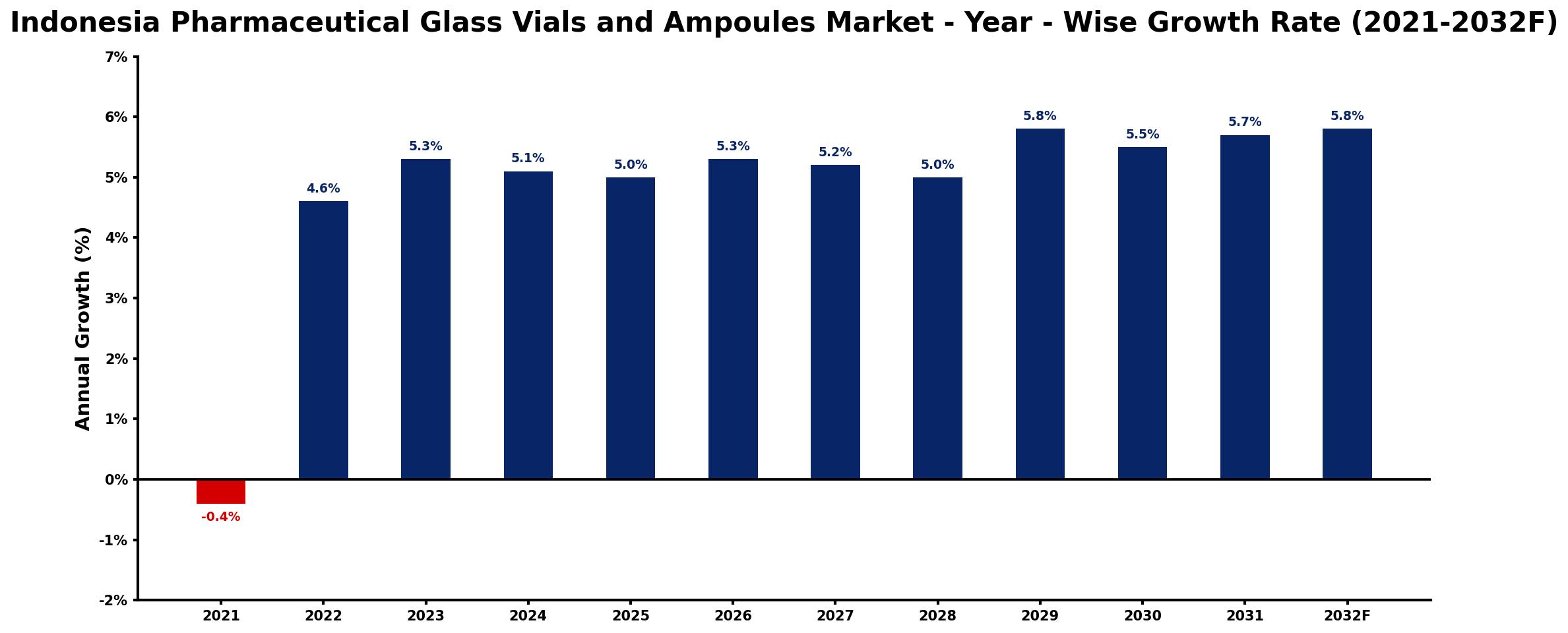
The table below presents the year‑wise growth rates along with the key drivers influencing the market
| Year | Growth Rate | Major Drivers |
| 2021 | -0.4% | Lower production capacity utilization |
| 2022 | 4.6% | Rising healthcare investment levels |
| 2023 | 5.3% | Increased demand for packaging solutions |
| 2024 | 5.1% | Expansion of domestic manufacturing facilities |
| 2025 | 5.0% | growing emerging market penetration |
| 2026 | 5.3% | Technological advancements in production |
| 2027 | 5.2% | Heightened focus on sustainable practices |
| 2028 | 5.0% | Emerging markets driving demand growth |
| 2029 | 5.8% | Increased research and development activities |
| 2030 | 5.5% | Growing trend towards personalized medicine |
| 2031 | 5.7% | Strengthened regulatory frameworks enhancing trust |
| 2032 | 5.8% | Rising consumer health awareness initiatives |
Note: Market size estimations and growth projections presented in this report are based on 6Wresearch's proprietary forecasting methodology, utilizing the latest available industry data, government publications, and primary research inputs.
Indonesia Pharmaceutical Glass Vials and Ampoules Market Synopsis
In Indonesia, the pharmaceutical glass vials and ampoules market is witnessing a significant upturn, driven by the growing healthcare infrastructure and a burgeoning demand for effective drug delivery systems. The trend towards personalized medicine necessitates more sophisticated packaging solutions, further propelling market growth.
Moreover, the ongoing pandemic has highlighted the importance of contamination-free packaging. With stringent regulatory standards now in place, manufacturers are focusing on producing high-quality glass products to meet these requirements, ensuring the safety and efficacy of pharmaceutical products.
Indonesia Pharmaceutical Glass Vials and Ampoules Market Key Takeaways
- The market is poised for substantial growth, driven by increasing healthcare demands and advancements in the pharmaceutical sector.
- Regulatory pressures are elevating the quality standards for glass vials and ampoules, emphasizing their role in maintaining drug integrity.
- The rise of biologics and personalized medicine is creating new demands for specialized packaging solutions.
- Recent supply chain disruptions have led to fluctuations in availability, but recovery is anticipated as production stabilizes.
- Major players are adapting to the changing landscape by innovating in manufacturing processes and quality assurance.
Evaluation of Restraints in Indonesia Pharmaceutical Glass Vials and Ampoules Market
Despite the optimistic growth trajectory, several restraints hinder the market's full potential. Chief among these is the ongoing challenge of ensuring product integrity and sterility during manufacturing and distribution. Additionally, the reliance on consistent supply chains can be problematic, as any disruption may affect the availability of high-quality glass vials and ampoules. Furthermore, the need for compliance with strict regulatory standards can place significant pressures on manufacturers, potentially limiting their operational flexibility and increasing production costs.
Indonesia Pharmaceutical Glass Vials and Ampoules Market Trends
A notable trend within the Indonesia Pharmaceutical Glass Vials and Ampoules Market is the increasing shift towards sustainable practices. Manufacturers are exploring eco-friendly glass options and lightweight designs, reducing environmental impact while maintaining product efficacy. Additionally, the integration of smart packaging technologies is on the rise, where vials and ampoules are equipped with sensors to track temperature and humidity, thereby enhancing product safety during transport. This reflects a broader industry trend toward innovation and adaptability in response to changing consumer and regulatory demands.
Indonesia Pharmaceutical Glass Vials and Ampoules Market Opportunities
The market is ripe with opportunities for growth and investment, particularly in research and development of specialized packaging solutions tailored for biologics and personalized medicine. As the Indonesian healthcare sector expands, there is a growing demand for sophisticated packaging that not only secures medications but also extends their shelf life. Furthermore, collaborations between pharmaceutical companies and packaging manufacturers could lead to innovations that enhance both product functionality and consumer safety, paving the way for strategic investments in this segment.
Government Initiatives in the Indonesia Pharmaceutical Glass Vials and Ampoules Market
The Indonesian government has been proactive in promoting its healthcare sector, including initiatives aimed at strengthening pharmaceutical manufacturing capabilities. Public spending in healthcare infrastructure is on the rise, with incentives for local production of medical supplies, including pharmaceutical packaging. Regulatory bodies are also focusing on enhancing compliance measures to ensure that products meet international quality standards, thus creating a more favorable environment for the growth of the pharmaceutical glass vials and ampoules market.
Future Insights of the Indonesia Pharmaceutical Glass Vials and Ampoules Market
Looking ahead to 2026-2032, the Indonesia Pharmaceutical Glass Vials and Ampoules Market is expected to continue its upward momentum. As the healthcare landscape evolves and more companies enter the market, the demand for reliable and high-quality packaging will only intensify. Innovations in glass manufacturing technology, coupled with an increasing focus on sustainable practices, will further shape market dynamics. With regulatory frameworks becoming more robust, adherence to quality standards will remain a crucial factor in fostering consumer trust and ensuring market stability.
Indonesia Pharmaceutical Glass Vials and Ampoules Market Latest Developments (2025 - 2026)
In recent months, the industry has witnessed notable shifts towards enhanced quality control measures and innovative packaging solutions. Manufacturers are increasingly adopting advanced technologies to improve production efficiency and reduce costs. This is complemented by a growing emphasis on sustainability, as companies explore alternatives to traditional glass to minimize environmental impact. Overall, these developments indicate a robust commitment to addressing both market demands and regulatory expectations.
Indonesia Pharmaceutical Glass Vials and Ampoules Market - Key Attractiveness of the Report
- 10 Years of Market Numbers
- Historical Data Starting from 2022 to 2025
- Base Year: 2025
- Forecast Data until 2032
- Key Performance Indicators Impacting the Market
- Major Upcoming Developments and Projects
Key Highlights of the Report:
- Indonesia Pharmaceutical Glass Vials and Ampoules Market Outlook
- Market Size of Indonesia Pharmaceutical Glass Vials and Ampoules Market, 2025
- Forecast of Indonesia Pharmaceutical Glass Vials and Ampoules Market, 2032
- Historical Data and Forecast of Indonesia Pharmaceutical Glass Vials and Ampoules Revenues & Volume for the Period 2022-2032F
- Indonesia Pharmaceutical Glass Vials and Ampoules Market Trend Evolution
- Indonesia Pharmaceutical Glass Vials and Ampoules Market Drivers and Challenges
- Indonesia Pharmaceutical Glass Vials and Ampoules Price Trends
- Indonesia Pharmaceutical Glass Vials and Ampoules Porter's Five Forces
- Indonesia Pharmaceutical Glass Vials and Ampoules Industry Life Cycle
- Historical Data and Forecast of Indonesia Pharmaceutical Glass Vials and Ampoules Market Revenues & Volume By Type for the Period 2022-2032F
- Historical Data and Forecast of Indonesia Pharmaceutical Glass Vials and Ampoules Market Revenues & Volume By 2ml for the Period 2022-2032F
- Historical Data and Forecast of Indonesia Pharmaceutical Glass Vials and Ampoules Market Revenues & Volume By 3ml to 5ml for the Period 2022-2032F
- Historical Data and Forecast of Indonesia Pharmaceutical Glass Vials and Ampoules Market Revenues & Volume By 6ml to 8ml for the Period 2022-2032F
- Historical Data and Forecast of Indonesia Pharmaceutical Glass Vials and Ampoules Market Revenues & Volume By 8ml or more for the Period 2022-2032F
- Historical Data and Forecast of Indonesia Pharmaceutical Glass Vials and Ampoules Market Revenues & Volume By Application for the Period 2022-2032F
- Historical Data and Forecast of Indonesia Pharmaceutical Glass Vials and Ampoules Market Revenues & Volume By Pharmaceutical for the Period 2022-2032F
- Historical Data and Forecast of Indonesia Pharmaceutical Glass Vials and Ampoules Market Revenues & Volume By Chemical Reagent for the Period 2022-2032F
- Indonesia Pharmaceutical Glass Vials and Ampoules Import Export Trade Statistics
- Market Opportunity Assessment By Type
- Market Opportunity Assessment By Application
- Indonesia Pharmaceutical Glass Vials and Ampoules Top Companies Market Share
- Indonesia Pharmaceutical Glass Vials and Ampoules Competitive Benchmarking By Technical and Operational Parameters
- Indonesia Pharmaceutical Glass Vials and Ampoules Company Profiles
- Indonesia Pharmaceutical Glass Vials and Ampoules Key Strategic Recommendations






































