Indonesia Photosensitive Semiconductor Device Market Size, Share & Growth Rate
The Indonesia Photosensitive Semiconductor Device Market was estimated at USD 741 Million in 2025 and is projected to reach USD 1116 Million by 2032, growing at a CAGR of 6.0% from 2026 to 2032. This positive trajectory is primarily fueled by a surge in smart city initiatives across the archipelago, which has prompted both governmental and private sector investments in advanced technologies. The widespread adoption of IoT across various sectors further catalyzes the demand for photosensitive semiconductor devices, particularly in consumer electronics.
Indonesia Photosensitive Semiconductor Device Market Year-wise Growth Rate and Key Drivers
This graph highlights how the Indonesia Photosensitive Semiconductor Device Market has steadily grown over the years, supported by major growth factors.
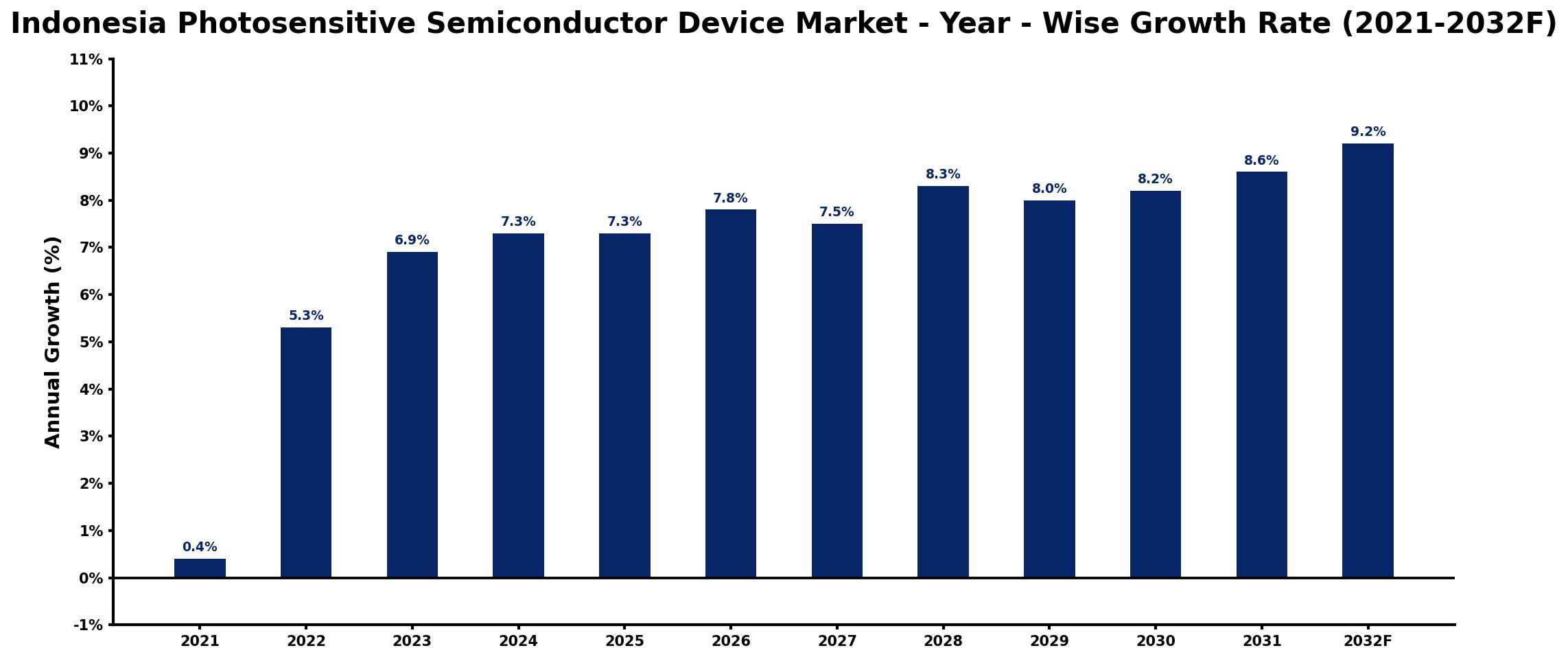
The table below presents the year‑wise growth rates along with the key drivers influencing the market
| Year | Growth Rate | Major Drivers |
| 2021 | 0.4% | Rising renewable energy investments |
| 2022 | 5.3% | Advancements in smart technology |
| 2023 | 6.9% | Increased demand for automation |
| 2024 | 7.3% | Growth in electric vehicle market |
| 2025 | 7.3% | Expansion of telecommunications infrastructure |
| 2026 | 7.8% | Surge in consumer electronics applications |
| 2027 | 7.5% | Emergence of new industrial applications |
| 2028 | 8.3% | Higher adoption of IoT solutions |
| 2029 | 8.0% | Boost in energy efficiency initiatives |
| 2030 | 8.2% | growing automotive sector requirements |
| 2031 | 8.6% | Increased focus on sustainability efforts |
| 2032 | 9.2% | growing downstream application demand |
Note: Market size estimations and growth projections presented in this report are based on 6Wresearch's proprietary forecasting methodology, utilizing the latest available industry data, government publications, and primary research inputs.
Indonesia Photosensitive Semiconductor Device Market Synopsis
In Indonesia, the photosensitive semiconductor device market is gaining momentum as technological advancements reshape the electronics landscape. The increasing integration of these devices in smartphones, cameras, and other electronic gadgets reflects a robust demand driven by consumer preferences for enhanced functionality and performance.
Moreover, the potential of emerging applications in autonomous vehicles and smart infrastructure is creating a fertile ground for further innovation. Companies are striving to develop advanced optoelectronic solutions that meet the evolving needs of these dynamic sectors, ensuring that the market remains competitive.
Indonesia Photosensitive Semiconductor Device Market Key Takeaways
- The market is projected to grow significantly, reaching USD 1116 Million by 2032.
- Smart city developments and IoT implementation are key drivers of growth.
- Consumer electronics, particularly smartphones, remain a crucial application area.
- Emerging trends include autonomous vehicles and advancements in sensor technology.
- Challenges related to technological advancements and quality assurance persist.
Evaluation of Restraints in Indonesia Photosensitive Semiconductor Device Market
The Indonesia Photosensitive Semiconductor Device market faces several notable constraints. A primary concern is the rapid pace of technological change across various industries, demanding continuous innovation to keep pace with consumer expectations for performance and efficiency. Furthermore, ensuring quality and reliability amidst manufacturing variations is critical for maintaining market trust. Compounding these challenges, intellectual property issues and complex international trade regulations can hinder market growth and deter new investments.
Indonesia Photosensitive Semiconductor Device Market Trends
Current trends in the Indonesia Photosensitive Semiconductor Device market are heavily influenced by advancements in technology and shifts in consumer behavior. The rise of smart devices and the Internet of Things is propelling the demand for sophisticated semiconductor solutions, while innovations in AI and machine learning create new applications. Additionally, the increasing interest in autonomous vehicles is reshaping the landscape, as manufacturers look to integrate photosensitive devices for enhanced functionality and safety.
Indonesia Photosensitive Semiconductor Device Market Opportunities
The opportunities in the Indonesian photosensitive semiconductor device market are plentiful. With ongoing smart city initiatives, investment in infrastructure technology is expected to grow, paving the way for increased adoption of advanced sensors and devices. Furthermore, the burgeoning smartphone market and rising demand for consumer electronics present significant avenues for growth. As the automotive sector increasingly explores autonomous functionalities, firms can capitalize on this trend by developing specialized photosensitive solutions tailored to automotive needs.
Government Initiatives in the Indonesia Photosensitive Semiconductor Device Market
The Indonesian government is actively promoting the development of advanced technology sectors, including semiconductor manufacturing and IoT applications. Initiatives aimed at fostering innovation, enhancing R&D capabilities, and providing funding for technology startups are being prioritized. Additionally, efforts to improve regional connectivity and digital infrastructure create a supportive environment for market growth, demonstrating a commitment to becoming a regional technology hub.
Future Insights of the Indonesia Photosensitive Semiconductor Device Market
Looking ahead to 2026-2032, the Indonesia Photosensitive Semiconductor Device market is set to flourish. As investments in smart city projects accelerate, the integration of photosensitive devices in everyday applications will become increasingly prevalent. Innovations in manufacturing processes and materials will likely yield devices that are more efficient and cost-effective. Furthermore, collaboration between public and private sectors will drive significant advancements, setting the stage for a more connected and technologically advanced Indonesia.
Indonesia Photosensitive Semiconductor Device Market Latest Developments (2025 - 2026)
Recent developments in the Indonesia Photosensitive Semiconductor Device market reflect a trend towards increased collaboration among stakeholders. Key industry players are focusing on enhancing R&D efforts to improve product offerings and meet evolving consumer demands. Additionally, various technology expos and industry conferences are being held, showcasing innovations and facilitating networking among key players. The government continues to engage with industry leaders to promote policies that support technological growth.
Indonesia Photosensitive Semiconductor Device Market - Key Attractiveness of the Report
- 10 Years of Market Numbers
- Historical Data Starting from 2022 to 2025
- Base Year: 2025
- Forecast Data until 2032
- Key Performance Indicators Impacting the Market
- Major Upcoming Developments and Projects
Key Highlights of the Report:
- Indonesia Photosensitive Semiconductor Device Market Outlook
- Market Size of Indonesia Photosensitive Semiconductor Device Market, 2025
- Forecast of Indonesia Photosensitive Semiconductor Device Market, 2032
- Historical Data and Forecast of Indonesia Photosensitive Semiconductor Device Revenues & Volume for the Period 2022-2032F
- Indonesia Photosensitive Semiconductor Device Market Trend Evolution
- Indonesia Photosensitive Semiconductor Device Market Drivers and Challenges
- Indonesia Photosensitive Semiconductor Device Price Trends
- Indonesia Photosensitive Semiconductor Device Porter's Five Forces
- Indonesia Photosensitive Semiconductor Device Industry Life Cycle
- Historical Data and Forecast of Indonesia Photosensitive Semiconductor Device Market Revenues & Volume By Device for the Period 2022-2032F
- Historical Data and Forecast of Indonesia Photosensitive Semiconductor Device Market Revenues & Volume By Photocell for the Period 2022-2032F
- Historical Data and Forecast of Indonesia Photosensitive Semiconductor Device Market Revenues & Volume By Photodiode for the Period 2022-2032F
- Historical Data and Forecast of Indonesia Photosensitive Semiconductor Device Market Revenues & Volume By Phototransistor for the Period 2022-2032F
- Historical Data and Forecast of Indonesia Photosensitive Semiconductor Device Market Revenues & Volume By Photoresistor for the Period 2022-2032F
- Historical Data and Forecast of Indonesia Photosensitive Semiconductor Device Market Revenues & Volume By Photo IC for the Period 2022-2032F
- Historical Data and Forecast of Indonesia Photosensitive Semiconductor Device Market Revenues & Volume By End User for the Period 2022-2032F
- Historical Data and Forecast of Indonesia Photosensitive Semiconductor Device Market Revenues & Volume By Automotive and Transportation for the Period 2022-2032F
- Historical Data and Forecast of Indonesia Photosensitive Semiconductor Device Market Revenues & Volume By Consumer Electronics for the Period 2022-2032F
- Historical Data and Forecast of Indonesia Photosensitive Semiconductor Device Market Revenues & Volume By Aerospace and Defence for the Period 2022-2032F
- Historical Data and Forecast of Indonesia Photosensitive Semiconductor Device Market Revenues & Volume By Healthcare for the Period 2022-2032F
- Historical Data and Forecast of Indonesia Photosensitive Semiconductor Device Market Revenues & Volume By Industrial for the Period 2022-2032F
- Historical Data and Forecast of Indonesia Photosensitive Semiconductor Device Market Revenues & Volume By Security and Survelliance for the Period 2022-2032F
- Indonesia Photosensitive Semiconductor Device Import Export Trade Statistics
- Market Opportunity Assessment By Device
- Market Opportunity Assessment By End User
- Indonesia Photosensitive Semiconductor Device Top Companies Market Share
- Indonesia Photosensitive Semiconductor Device Competitive Benchmarking By Technical and Operational Parameters
- Indonesia Photosensitive Semiconductor Device Company Profiles
- Indonesia Photosensitive Semiconductor Device Key Strategic Recommendations






































