Indonesia Physiotherapy Equipment Market Summary
The indonesia physiotherapy equipment market was estimated at USD 272 Million in 2025 and is projected to reach USD 359 Million by 2032, growing at a CAGR of 5.0% from 2026 to 2032.
Indonesia Physiotherapy Equipment Market Year-wise Growth Rate and Key Drivers
This graph highlights how the Indonesia Physiotherapy Equipment Market has steadily grown over the past five years, supported by major growth factors.
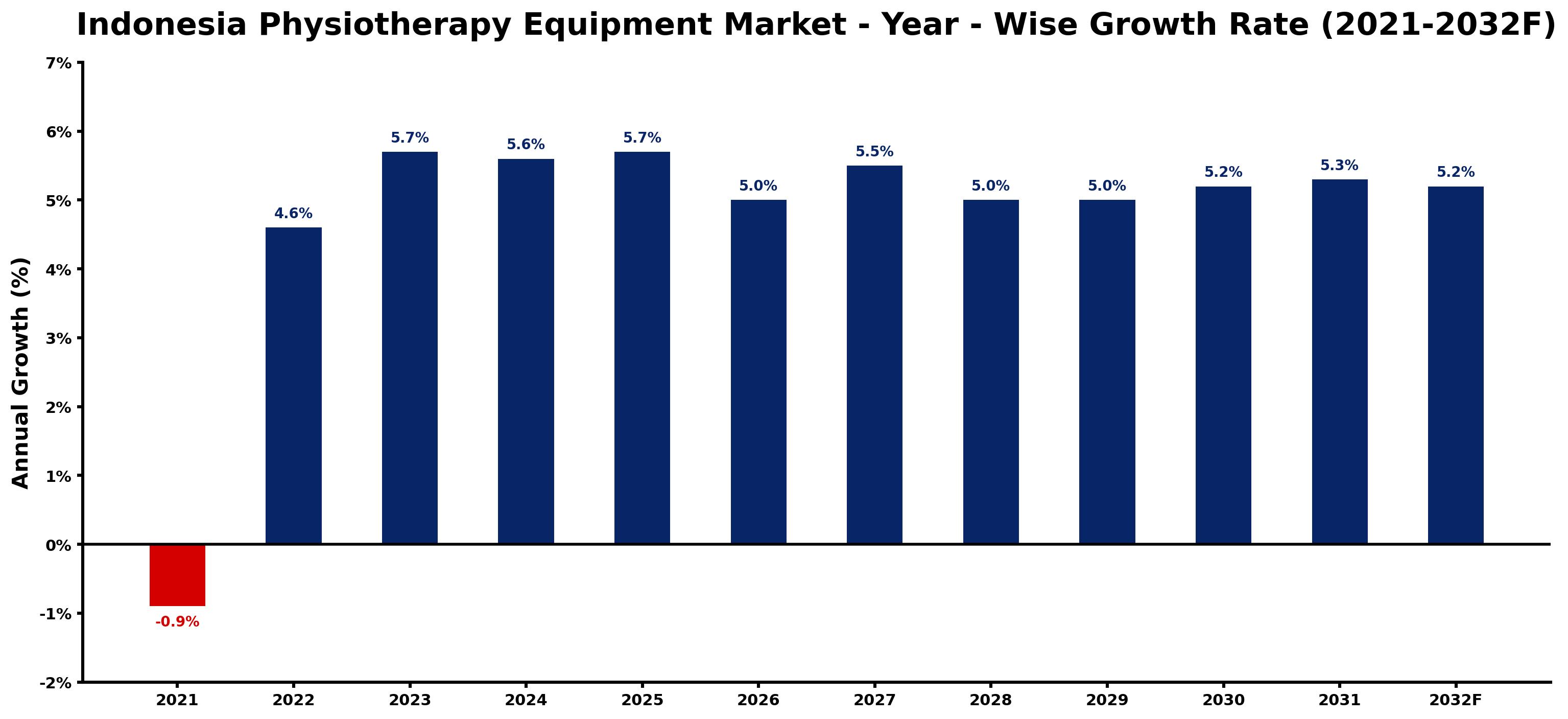
The table below presents the year wise growth rates along with the key drivers influencing the market
| Year | Growth Rate | Major Drivers |
| 2021 | -0.9% | The resurgence of COVID19 restrictions limited access to rehabilitation services, significantly reducing equipment demand. |
| 2022 | 4.6% | Telehealth integration in rehabilitation services enhances accessibility to physiotherapy treatments. |
| 2023 | 5.7% | Aging population contributes significantly to the rising need for physiotherapy interventions. |
| 2024 | 5.6% | Awareness campaigns promote physiotherapy benefits, influencing consumer purchasing behaviors positively. |
| 2025 | 5.7% | Collaboration between hospitals and private clinics leads to better equipment utilization rates. |
| 2026 | 5.0% | Technological innovations create advanced physiotherapy tools, attracting more practitioners and patients. |
| 2027 | 5.5% | Fitness trends shift focus towards injury prevention, boosting sales of physiotherapy equipment. |
| 2028 | 5.0% | Local manufacturing capabilities improve, reducing costs and increasing market competitiveness. |
| 2029 | 5.0% | Insurance coverage for physiotherapy expands, making treatment more affordable for patients. |
| 2030 | 5.2% | Corporate wellness programs increasingly include physiotherapy services, broadening market reach. |
| 2031 | 5.3% | Research partnerships emerge, leading to evidence-based practices in physiotherapy applications. |
| 2032 | 5.2% | Government healthcare policies evolve, emphasizing rehabilitation and physiotherapy in public health. |
Note - Market size estimations and growth projections presented in this report are based on 6Wresearch's advanced forecasting approach, validated with industry datasets as of June 2026.
Indonesia Physiotherapy Equipment Market Synopsis
The Indonesia Physiotherapy Equipment Market is projected to reach 5.0% and witness significant growth during the forecast period (2026-2032). The market is primarily driven by a rising prevalence of chronic diseases, increasing awareness about the benefits of physical therapy, and a growing geriatric population. Technological advancements in physiotherapy equipment also play a crucial role in this expansion, enhancing treatment efficacy and patient outcomes. Moreover, supportive government initiatives aimed at improving healthcare infrastructure contribute to a favorable market environment.
Indonesia Physiotherapy Equipment Market Growth Drivers
Several factors are propelling the growth of the Indonesia physiotherapy equipment market. The increasing incidence of chronic conditions such as arthritis, diabetes, and cardiovascular diseases necessitates effective rehabilitation solutions, which physiotherapy equipment provides. Additionally, heightened public awareness around physical health and therapeutic benefits is leading to a surge in physiotherapy service uptake.
- Chronic diseases are becoming more common, driving the need for physiotherapy equipment designed for rehabilitation.
- There is a marked increase in public awareness regarding the importance of physical therapy, resulting in a greater demand for related equipment.
- The geriatric population in Indonesia is on the rise, creating a larger demographic requiring physiotherapy services and equipment.
- Technological innovations are producing advanced equipment, improving efficiency and effectiveness in treatment.
- Government support for healthcare initiatives fosters an environment conducive to market growth.
Indonesia Physiotherapy Equipment Market Trends and Opportunities
The Indonesia physiotherapy equipment market is poised to benefit from several emerging trends and opportunities. There is a noticeable shift towards home-based physiotherapy due to the increasing population's demand for convenience and personalized care. This has led to a rise in portable physiotherapy equipment that can be utilized in home settings. Furthermore, the incorporation of smart technology into physiotherapy devices is enhancing patient engagement and compliance.
- The trend towards digital health solutions is driving the development of equipment that integrates with mobile applications for better patient monitoring.
- Home health care is gaining popularity, leading to increased demand for portable and user-friendly physiotherapy devices.
- Smart physiotherapy equipment that offers real-time data and analytics is emerging, enhancing treatment personalization.
- Collaboration between healthcare providers and technology firms is fostering innovation within the physiotherapy equipment sector.
- Renewed focus on preventive healthcare is stimulating investment in physiotherapy equipment designed for early intervention.
Indonesia Physiotherapy Equipment Market Challenges and Restraints
Despite the growth prospects, the Indonesia physiotherapy equipment market faces several challenges. High costs associated with advanced physiotherapy devices may limit accessibility, especially in rural areas. Additionally, a shortage of skilled physiotherapists can hinder the efficient use of available equipment, affecting overall service quality. Furthermore, fluctuating economic conditions can impact healthcare spending, potentially slowing down market growth.
- High cost of advanced physiotherapy equipment limits access for smaller clinics and facilities.
- Insufficient training and a lack of skilled physiotherapists can restrain effective utilization of the equipment.
- Economic fluctuations can lead to uncertainties in public and private healthcare spending.
- Market fragmentation with numerous players can create challenges in establishing brand recognition.
- Regulatory hurdles can delay the introduction of innovative devices into the market.
Indonesia Physiotherapy Equipment Market Government Investment and Initiatives
The Indonesian government has undertaken several initiatives aimed at enhancing healthcare infrastructure, which includes the development of physiotherapy services. Public investment in health and wellness programs has led to increased funding for rehabilitation centers and hospitals. This includes initiatives aimed at improving the training of healthcare professionals and expanding access to rehabilitation services, ensuring that physiotherapy becomes a standardized part of patient care across the country.
- Government investment in healthcare infrastructures, such as rehabilitation centers, is expected to drive demand for physiotherapy equipment.
- Public health campaigns promoting physical therapy are increasing awareness and driving service usage.
- Efforts to improve the training of physiotherapists through government programs enhance service quality and equipment usage.
- Incentives for healthcare providers to adopt advanced physiotherapy solutions can stimulate market growth.
- Collaborative initiatives between public and private sectors can lead to innovations in healthcare solutions.
Indonesia Physiotherapy Equipment Market Latest Developments (May 2025 - June 2026)
In the period from May 2025 to June 2026, the Indonesia physiotherapy equipment market has experienced various notable developments, indicating a dynamic industry landscape. There has been an increase in partnerships between local manufacturers and international technology firms, aimed at enhancing the capability and range of physiotherapy products available in Indonesia. Furthermore, advancements in telehealth technologies have contributed to the expansion of remote physiotherapy services, prompting investment in technologically advanced equipment capable of supporting these services.
- Collaborations between local and international firms have led to innovative product offerings tailored to the Indonesian market.
- Telehealth integration in physiotherapy services is on the rise, necessitating advanced rehabilitation equipment.
- The market witnessed a surge in demand for portable physiotherapy devices as home care becomes increasingly favored.
- There has been a notable increase in the training and certification of physiotherapists, enhancing service delivery.
- Supplier diversification is occurring as new players enter the market, promoting competition and innovation.
Indonesia Physiotherapy Equipment Market - Key Attractiveness of the Report
- 10 Years of Market Numbers
- Historical Data Starting from 2022 to 2025
- Base Year: 2025
- Forecast Data until 2032
- Key Performance Indicators Impacting the Market
- Major Upcoming Developments and Projects
Key Highlights of the Report:
- Indonesia Physiotherapy Equipment Market Outlook
- Market Size of Indonesia Physiotherapy Equipment Market, 2025
- Forecast of Indonesia Physiotherapy Equipment Market, 2032F
- Historical Data and Forecast of Indonesia Physiotherapy Equipment Revenues & Volume for the Period 2022-2032F
- Indonesia Physiotherapy Equipment Market Trend Evolution
- Indonesia Physiotherapy Equipment Market Drivers and Challenges
- Indonesia Physiotherapy Equipment Price Trends
- Indonesia Physiotherapy Equipment Porter's Five Forces
- Indonesia Physiotherapy Equipment Industry Life Cycle
- Historical Data and Forecast of Indonesia Physiotherapy Equipment Market Revenues & Volume By Product Types for the Period 2022-2032F
- Historical Data and Forecast of Indonesia Physiotherapy Equipment Market Revenues & Volume By Equipment for the Period 2022-2032F
- Historical Data and Forecast of Indonesia Physiotherapy Equipment Market Revenues & Volume By Accessories for the Period 2022-2032F
- Historical Data and Forecast of Indonesia Physiotherapy Equipment Market Revenues & Volume By Application? for the Period 2022-2032F
- Historical Data and Forecast of Indonesia Physiotherapy Equipment Market Revenues & Volume By Musculoskeletal Applications for the Period 2022-2032F
- Historical Data and Forecast of Indonesia Physiotherapy Equipment Market Revenues & Volume By Neurological Applications for the Period 2022-2032F
- Historical Data and Forecast of Indonesia Physiotherapy Equipment Market Revenues & Volume By Cardiovascular & Pulmonary Applications for the Period 2022-2032F
- Historical Data and Forecast of Indonesia Physiotherapy Equipment Market Revenues & Volume By Pediatric Applications for the Period 2022-2032F
- Historical Data and Forecast of Indonesia Physiotherapy Equipment Market Revenues & Volume By Gynecological Applications for the Period 2022-2032F
- Historical Data and Forecast of Indonesia Physiotherapy Equipment Market Revenues & Volume By Other? for the Period 2022-2032F
- Historical Data and Forecast of Indonesia Physiotherapy Equipment Market Revenues & Volume By End-user for the Period 2022-2032F
- Historical Data and Forecast of Indonesia Physiotherapy Equipment Market Revenues & Volume By Physiotherapy & Rehabilitation Centers for the Period 2022-2032F
- Historical Data and Forecast of Indonesia Physiotherapy Equipment Market Revenues & Volume By Hospitals for the Period 2022-2032F
- Historical Data and Forecast of Indonesia Physiotherapy Equipment Market Revenues & Volume By Home Care Settings for the Period 2022-2032F
- Historical Data and Forecast of Indonesia Physiotherapy Equipment Market Revenues & Volume By Physician Offices for the Period 2022-2032F
- Historical Data and Forecast of Indonesia Physiotherapy Equipment Market Revenues & Volume By Others for the Period 2022-2032F
- Indonesia Physiotherapy Equipment Import Export Trade Statistics
- Market Opportunity Assessment By Product Types
- Market Opportunity Assessment By Application?
- Market Opportunity Assessment By End-user
- Indonesia Physiotherapy Equipment Top Companies Market Share
- Indonesia Physiotherapy Equipment Competitive Benchmarking By Technical and Operational Parameters
- Indonesia Physiotherapy Equipment Company Profiles
- Indonesia Physiotherapy Equipment Key Strategic Recommendations






































