Indonesia Platform as a Service (PaaS) Market Size & Growth Rate (2026-2032)
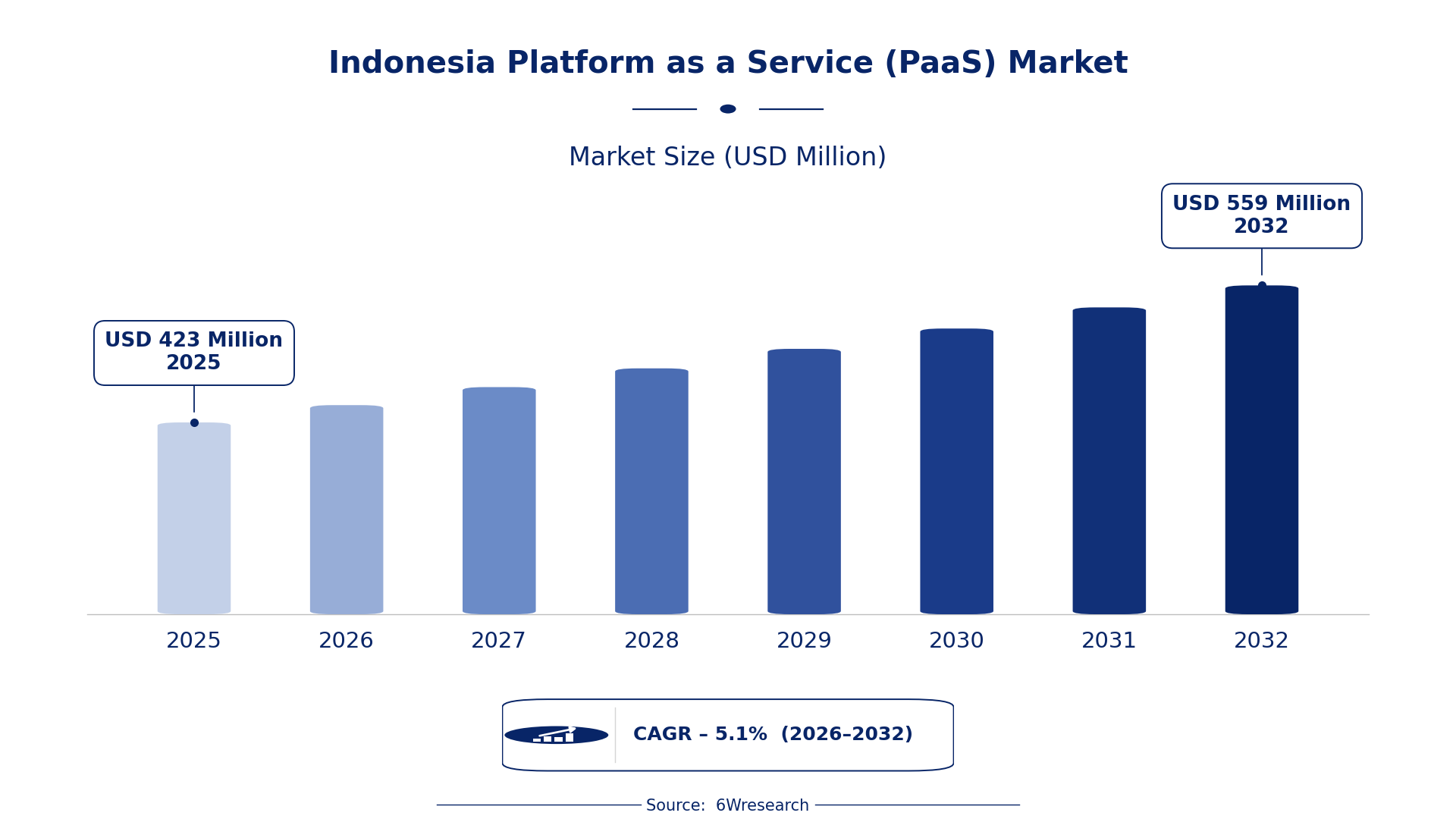
The Indonesia Platform as a Service (PaaS) Market was estimated at USD 423 Million in 2025 and is projected to reach USD 559 Million by 2032, growing at a CAGR of 5.1% from 2026 to 2032.
Indonesia Platform as a Service (PaaS) Market Synopsis
The driving force behind the Indonesia Platform as a Service (PaaS) market is the urgent need for organizations to expedite application development while minimizing infrastructure complexity. Businesses across various sectors are rapidly adopting PaaS solutions to streamline their digital transformation efforts.
This market is witnessing accelerated growth as companies shift towards cloud-native technologies, especially post-pandemic. The necessity for flexibility and speed in application deployment is paramount, leading to a growing reliance on PaaS offerings.
Indonesia Platform as a Service (PaaS) Market Year-wise Growth Rate and Key Drivers
This graph illustrates the annual growth rates of the Indonesia Platform as a Service (PaaS) Market from 2021 to 2032, highlighting a steady upward trajectory and projected expansion over the forecast period.
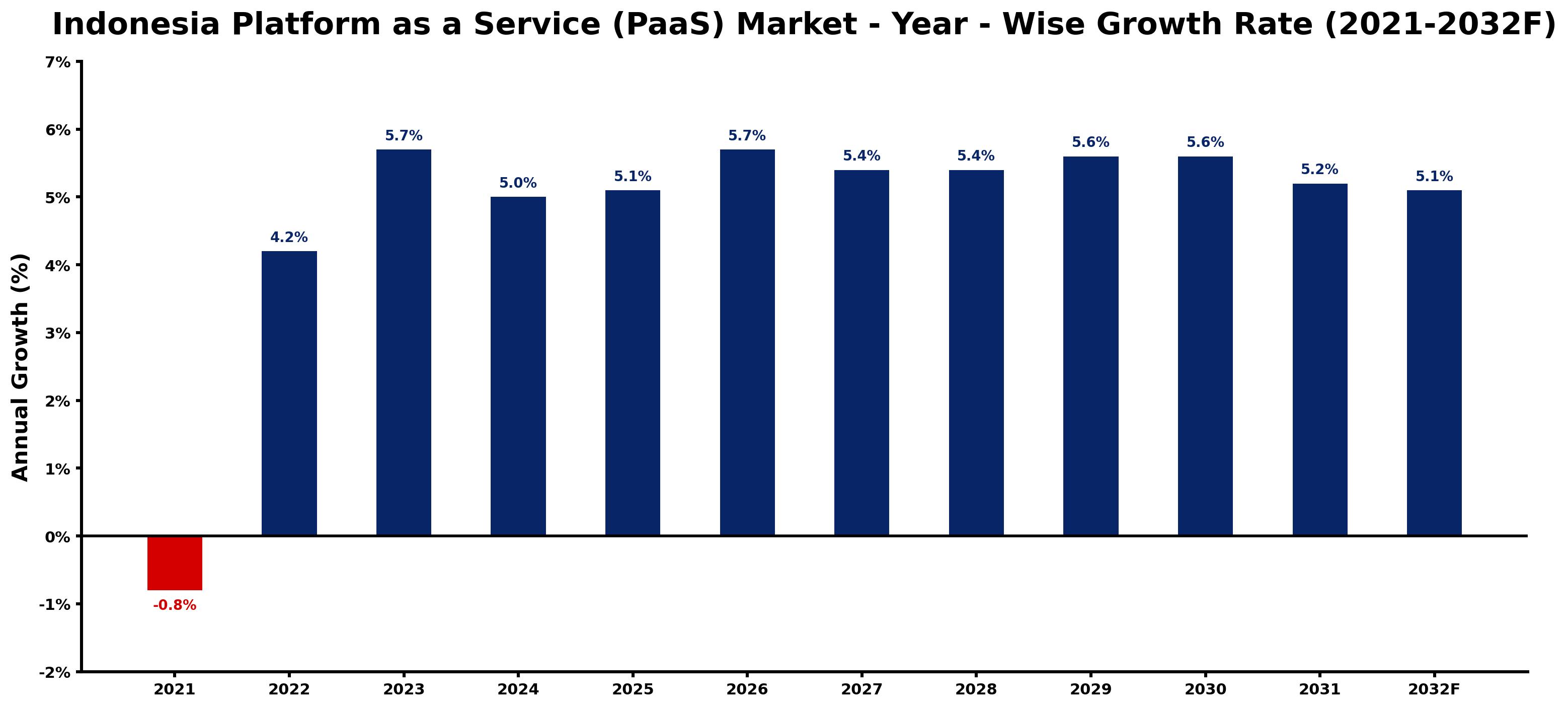
The table below presents the year‑wise growth rates along with the key drivers influencing the market
| Year | Growth Rate | Major Drivers |
| 2021 | -0.8% | Government cloud policy delayed PaaS adoption across sectors. |
| 2022 | 4.2% | Government's 2020-2024 Digital Economy Roadmap implementation. |
| 2023 | 5.7% | Increased adoption of cloud services by Indonesian startups. |
| 2024 | 5.0% | Emergence of local tech hubs fostering innovation and growth. |
| 2025 | 5.1% | Rise in mobile internet penetration boosting platform accessibility. |
| 2026 | 5.7% | Investment in fintech solutions driving platform development. |
| 2027 | 5.4% | Adoption of remote work trends promoting PaaS utilization. |
| 2028 | 5.4% | Growing e-commerce sector accelerating cloud computing demands. |
| 2029 | 5.6% | Regulatory support for data sovereignty enhancing local hosting. |
| 2030 | 5.6% | Partnerships with global tech firms expanding service offerings. |
| 2031 | 5.2% | Increasing focus on cybersecurity driving PaaS investments. |
| 2032 | 5.1% | Growing number of API integrations fostering platform ecosystems. |
Note: Market size estimations and growth projections presented in this report are based on 6Wresearch's proprietary forecasting methodology, utilizing the latest available industry data, government publications, and primary research inputs.
Indonesia Platform as a Service (PaaS) Market Key Takeaways
Below are some of the specific key takeaways from the market, including:
- Organizations are increasingly seeking PaaS solutions to reduce time-to-market for their applications.
- The pandemic has intensified the demand for cloud-based development environments.
- Vendor lock-in remains a critical challenge, hindering some companies from fully embracing PaaS.
- Investment in cloud-native technologies is expected to surge as firms prioritize digital transformation.
- Key players are enhancing their platforms to offer greater portability and flexibility to users.
Evaluation of Restraints in Indonesia Platform as a Service (PaaS) Market
The Indonesian PaaS market faces notable challenges that could impede its growth trajectory. Vendor lock-in is a significant concern, as businesses may struggle to migrate applications away from certain providers due to proprietary technologies. This limitation creates hesitancy among organizations when choosing a PaaS solution, as the long-term implications of dependency on a single vendor can be daunting. on top of that, the need for interoperability between different PaaS offerings remains a barrier, as users often find it challenging to integrate solutions from multiple providers.
Indonesia Platform as a Service (PaaS) Market Trends
Several trends are shaping the Indonesia PaaS market. First, there is an increasing focus on low-code and no-code development platforms, which allow non-technical users to create applications without extensive coding knowledge. This shift is democratizing application development and enabling faster prototyping.
Another trend is the rise of hybrid cloud solutions, where businesses combine on-premises infrastructure with cloud services. This approach provides the flexibility needed to manage workloads effectively and offers a more tailored solution for specific business needs.
Indonesia Platform as a Service (PaaS) Market Opportunities
The market presents numerous growth opportunities. As organizations strive for digital transformation, the demand for PaaS solutions that enhance efficiency and reduce costs is likely to escalate. on top of that, sectors such as e-commerce, fintech, and healthcare are particularly ripe for PaaS adoption due to their need for rapid application development and deployment.
Investments in advanced analytics and machine learning capabilities within PaaS offerings will also attract businesses looking to leverage data for informed decision-making. The potential for partnerships and collaborations between tech companies and local enterprises will further enhance the market's growth prospects.
Government Initiatives in the Indonesia Platform as a Service (PaaS) Market
The Indonesian government is actively promoting the digital economy, influencing the PaaS market through various initiatives. With a focus on enhancing digital infrastructure and supporting local startups, public policy is crucial for fostering an environment conducive to PaaS growth. The government's commitment to improving connectivity and reducing barriers for cloud adoption is shaping the trajectory of this market.
- A national digital infrastructure upgrade programme was recently completed, enhancing internet connectivity and access to cloud services across urban and rural areas.
- Currently ongoing is a public-private partnership initiative aimed at creating a comprehensive regulatory framework to support the adoption of cloud technologies.
- A planned initiative expected to launch in 2026 seeks to provide grants and resources for local startups developing cloud-based solutions.
- The government is also reviewing policies to address vendor lock-in challenges, with proposed regulations to increase portability across platforms.
- Upcoming initiatives include workshops and training programs aimed at upskilling the workforce in cloud technologies and PaaS applications.
Future Insights of the Indonesia Platform as a Service (PaaS) Market
Looking ahead, the Indonesia PaaS market is likely to continue its upward trajectory. By 2032, as more businesses embrace digital transformation, the demand for scalable and flexible cloud solutions will intensify. The focus will shift towards enhancing user experience and providing tools that facilitate rapid application development.
With ongoing government support and a burgeoning tech ecosystem, opportunities for innovation and growth in PaaS offerings will expand. Companies that can effectively address the challenges of vendor lock-in and interoperability will be well-positioned to lead in this competitive market.
Indonesia Platform as a Service (PaaS) Market Latest Developments
In the last year, the Indonesia PaaS market has seen a flurry of activity as organizations ramp up their digital capabilities. Companies are investing in enhancing their platforms and forming strategic partnerships to address market demands. The focus has shifted towards improving application deployment processes and user accessibility.
- A major technology vendor launched a new PaaS offering in early 2025, emphasizing integration capabilities with existing enterprise systems.
- An initiative that began in mid-2025 and remains underway aims to develop a suite of tools specifically designed for small and medium-sized enterprises.
- A service upgrade was completed in Q1 2025, introducing advanced analytics features within existing PaaS platforms.
- Plans for a collaborative project with local universities to foster innovation in cloud technologies are expected to commence by mid-2026.
- In early 2025, a leading regional operator announced a partnership with a global cloud provider to enhance its PaaS offerings.
Indonesia Platform as a Service (PaaS) Market - Key Attractiveness of the Report
- 10 Years of Market Numbers
- Historical Data Starting from 2022 to 2025
- Base Year: 2025
- Forecast Data until 2032
- Key Performance Indicators Impacting the Market
- Major Upcoming Developments and Projects
Key Highlights of the Report:
- Indonesia Platform as a Service (PaaS) Market Outlook
- Market Size of Indonesia Platform as a Service (PaaS) Market, 2025
- Forecast of Indonesia Platform as a Service (PaaS) Market, 2032
- Historical Data and Forecast of Indonesia Platform as a Service (PaaS) Revenues & Volume for the Period 2022-2032F
- Indonesia Platform as a Service (PaaS) Market Trend Evolution
- Indonesia Platform as a Service (PaaS) Market Drivers and Challenges
- Indonesia Platform as a Service (PaaS) Price Trends
- Indonesia Platform as a Service (PaaS) Porter's Five Forces
- Indonesia Platform as a Service (PaaS) Industry Life Cycle
- Historical Data and Forecast of Indonesia Platform as a Service (PaaS) Market Revenues & Volume By Type for the Period 2022-2032F
- Historical Data and Forecast of Indonesia Platform as a Service (PaaS) Market Revenues & Volume By Application PaaS (aPaaS) for the Period 2022-2032F
- Historical Data and Forecast of Indonesia Platform as a Service (PaaS) Market Revenues & Volume By Integration PaaS (iPaaS) for the Period 2022-2032F
- Historical Data and Forecast of Indonesia Platform as a Service (PaaS) Market Revenues & Volume By Database PaaS (dbPaaS) for the Period 2022-2032F
- Historical Data and Forecast of Indonesia Platform as a Service (PaaS) Market Revenues & Volume By Others for the Period 2022-2032F
- Historical Data and Forecast of Indonesia Platform as a Service (PaaS) Market Revenues & Volume By Deployment for the Period 2022-2032F
- Historical Data and Forecast of Indonesia Platform as a Service (PaaS) Market Revenues & Volume By Public for the Period 2022-2032F
- Historical Data and Forecast of Indonesia Platform as a Service (PaaS) Market Revenues & Volume By Private for the Period 2022-2032F
- Historical Data and Forecast of Indonesia Platform as a Service (PaaS) Market Revenues & Volume By Market Type for the Period 2022-2032F
- Historical Data and Forecast of Indonesia Platform as a Service (PaaS) Market Revenues & Volume By APaaS for the Period 2022-2032F
- Historical Data and Forecast of Indonesia Platform as a Service (PaaS) Market Revenues & Volume By IPaaS for the Period 2022-2032F
- Historical Data and Forecast of Indonesia Platform as a Service (PaaS) Market Revenues & Volume By DBPaaS for the Period 2022-2032F
- Historical Data and Forecast of Indonesia Platform as a Service (PaaS) Market Revenues & Volume By Organization Size for the Period 2022-2032F
- Historical Data and Forecast of Indonesia Platform as a Service (PaaS) Market Revenues & Volume By Large Enterprises for the Period 2022-2032F
- Historical Data and Forecast of Indonesia Platform as a Service (PaaS) Market Revenues & Volume By SMEs for the Period 2022-2032F
- Historical Data and Forecast of Indonesia Platform as a Service (PaaS) Market Revenues & Volume By Vertical for the Period 2022-2032F
- Historical Data and Forecast of Indonesia Platform as a Service (PaaS) Market Revenues & Volume By BFSI for the Period 2022-2032F
- Historical Data and Forecast of Indonesia Platform as a Service (PaaS) Market Revenues & Volume By Consumer goods and retail for the Period 2022-2032F
- Historical Data and Forecast of Indonesia Platform as a Service (PaaS) Market Revenues & Volume By Telecommunication for the Period 2022-2032F
- Historical Data and Forecast of Indonesia Platform as a Service (PaaS) Market Revenues & Volume By IT and ITeS for the Period 2022-2032F
- Historical Data and Forecast of Indonesia Platform as a Service (PaaS) Market Revenues & Volume By Manufacturing for the Period 2022-2032F
- Historical Data and Forecast of Indonesia Platform as a Service (PaaS) Market Revenues & Volume By Healthcare and life sciences for the Period 2022-2032F
- Historical Data and Forecast of Indonesia Platform as a Service (PaaS) Market Revenues & Volume By Energy and utility for the Period 2022-2032F
- Historical Data and Forecast of Indonesia Platform as a Service (PaaS) Market Revenues & Volume By Others for the Period 2022-2032F
- Indonesia Platform as a Service (PaaS) Import Export Trade Statistics
- Market Opportunity Assessment By Type
- Market Opportunity Assessment By Deployment
- Market Opportunity Assessment By Market Type
- Market Opportunity Assessment By Organization Size
- Market Opportunity Assessment By Vertical
- Indonesia Platform as a Service (PaaS) Top Companies Market Share
- Indonesia Platform as a Service (PaaS) Competitive Benchmarking By Technical and Operational Parameters
- Indonesia Platform as a Service (PaaS) Company Profiles
- Indonesia Platform as a Service (PaaS) Key Strategic Recommendations






































