Indonesia Pneumatic Tools Market Size, Share & Growth Rate
The Indonesia Pneumatic Tools Market was estimated at USD 218 Million in 2025 and is projected to reach USD 289 Million by 2032, growing at a CAGR of 4.1% from 2026 to 2032. This growth trajectory is significantly driven by the rising demand for efficient and reliable tools across vital sectors such as automotive, manufacturing, and construction. The ongoing industrialization efforts and the increased focus on safety standards in these industries further augment the market's expansion.
Indonesia Pneumatic Tools Market Year-wise Growth Rate and Key Drivers
This graph highlights how the Indonesia Pneumatic Tools Market has steadily grown over the years, supported by major growth factors.
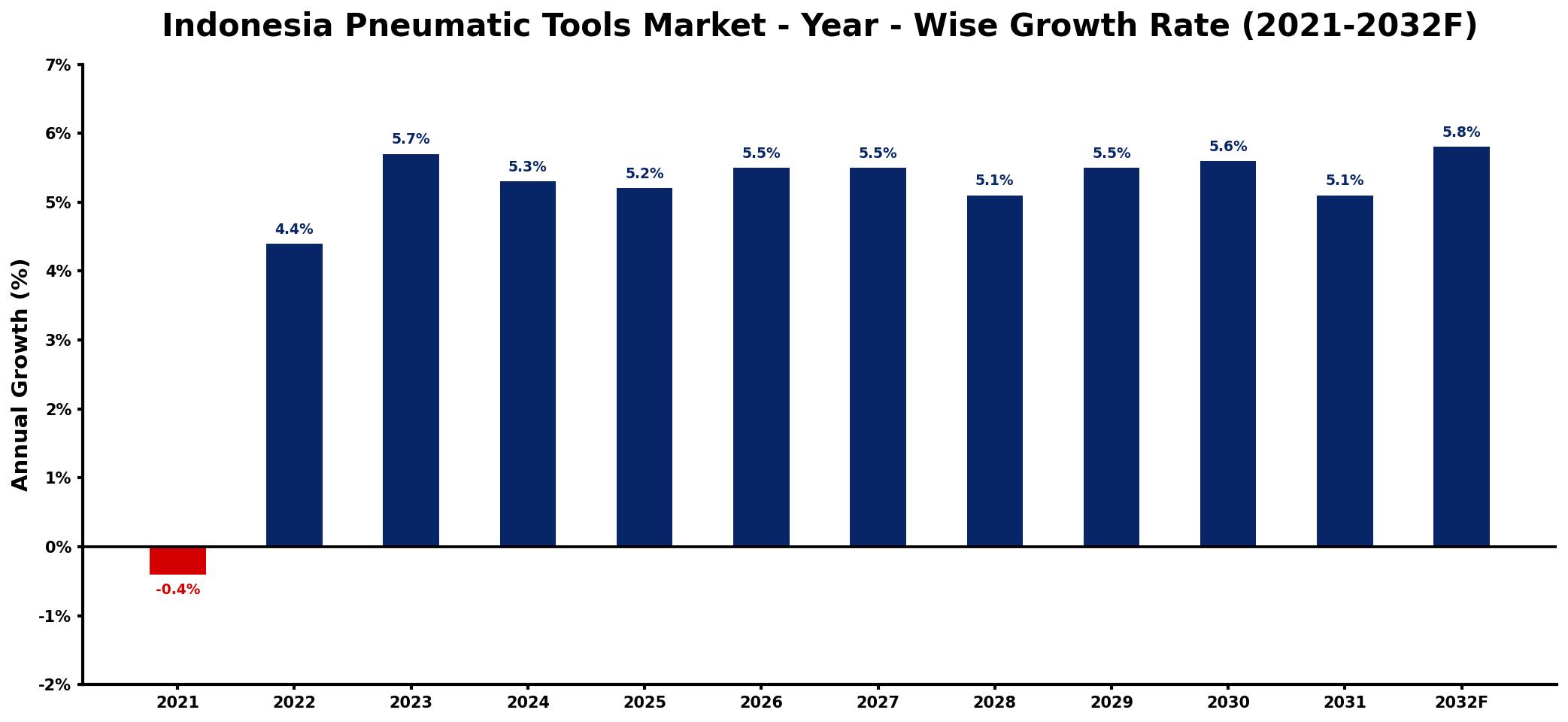
The table below presents the year‑wise growth rates along with the key drivers influencing the market
| Year | Growth Rate | Major Drivers |
| 2021 | -0.4% | decreased industrial manufacturing activities |
| 2022 | 4.4% | increased construction sector investments |
| 2023 | 5.7% | growing automotive industry demand |
| 2024 | 5.3% | expansion in manufacturing capabilities |
| 2025 | 5.2% | rising demand from agriculture sector |
| 2026 | 5.5% | enhanced logistics and transportation needs |
| 2027 | 5.5% | growth in renewable energy projects |
| 2028 | 5.1% | increased focus on automation solutions |
| 2029 | 5.5% | surge in DIY home improvement |
| 2030 | 5.6% | development of infrastructure projects |
| 2031 | 5.1% | expansion of maintenance services |
| 2032 | 5.8% | increased adoption of robotics technology |
Note: Market size estimations and growth projections presented in this report are based on 6Wresearch's proprietary forecasting methodology, utilizing the latest available industry data, government publications, and primary research inputs.
Indonesia Pneumatic Tools Market Synopsis
The pneumatic tools market in Indonesia is gaining momentum, largely due to the diverse applications these tools find across multiple industries. From automotive assembly lines to food processing units, their efficiency and reliability make them indispensable. As businesses prioritize productivity and modernization, the adoption of pneumatic tools is set to intensify.
Furthermore, as the construction and manufacturing sectors continue to flourish, the need for advanced tools to streamline operations is becoming increasingly evident. Small and medium enterprises are particularly drawn to pneumatic tools for their cost-effectiveness and low maintenance requirements, making them an attractive choice for expanding operations.
Indonesia Pneumatic Tools Market Key Takeaways
- The market is experiencing robust growth driven by industrial expansion and modernization.
- Pneumatic tools are favored for their durability, cost-effectiveness, and low risk factors compared to other tool types.
- Construction and automotive sectors are primary consumers, fueling demand for efficient tools.
- Domestic demand is on the rise, spurred by increased production needs from private end users.
- Infrastructure projects in Indonesia are expected to significantly boost the market's growth trajectory.
Evaluation of Restraints in Indonesia Pneumatic Tools Market
Despite the promising growth prospects, the Indonesia pneumatic tools market faces certain restraints that could hinder its expansion. One notable challenge is the initial investment required for pneumatic systems, which include compressors and other necessary accessories. The high upfront costs can deter small and medium-sized enterprises from fully adopting these tools. Additionally, regular maintenance is essential to ensure optimal performance, leading to potential ongoing costs. The market's reliance on compressed air availability and pricing can also pose significant challenges, affecting the operational efficiency of pneumatic tools across various applications.
Indonesia Pneumatic Tools Market Trends
Several trends are shaping the Indonesian pneumatic tools market. The increasing emphasis on safety in industrial operations is driving the adoption of pneumatic tools, as they tend to have lower risk factors compared to electric or hydraulic alternatives. Moreover, advancements in technology are enhancing the efficiency and capabilities of pneumatic tools, making them more attractive to end-users. There is also a growing trend toward automation in manufacturing, with pneumatic tools playing a crucial role in facilitating seamless operations.
Indonesia Pneumatic Tools Market Opportunities
The future of the Indonesia pneumatic tools market is rich with opportunities for growth and investment. The ongoing infrastructure development and construction projects present a significant avenue for market expansion. Additionally, the increasing number of automotive production facilities and manufacturing plants is set to drive demand for pneumatic tools. By focusing on innovation and enhancing product offerings, companies can position themselves to capture a larger share of this burgeoning market.
Government Initiatives in the Indonesia Pneumatic Tools Market
The Indonesian government has been actively investing in infrastructure development and industrial modernization, which plays a crucial role in fostering the pneumatic tools market. Various public spending initiatives aimed at improving manufacturing capabilities and enhancing safety standards across industries are encouraging the adoption of pneumatic tools. Programs that support the growth of small and medium enterprises also contribute positively, allowing these businesses to leverage pneumatic solutions for operational efficiency.
Future Insights of the Indonesia Pneumatic Tools Market
Looking ahead to 2026-2032, the Indonesia pneumatic tools market is poised for significant growth, driven by the continued expansion of key industries and the integration of advanced technologies. With increasing investments in infrastructure and manufacturing, the demand for pneumatic tools is expected to rise substantially. As businesses strive for operational efficiency and enhanced productivity, pneumatic solutions will increasingly be viewed as essential assets in achieving these goals.
Indonesia Pneumatic Tools Market Latest Developments (2025 - 2026)
Recent developments in the Indonesia pneumatic tools market indicate a shift towards more sustainable and technologically advanced solutions. Manufacturers are increasingly focusing on innovations that enhance efficiency and reduce energy consumption. Industry events and trade shows have highlighted emerging technologies in pneumatic tools, facilitating knowledge sharing and fostering collaboration among stakeholders. This proactive approach positions the market for continued growth and adaptation in an ever-evolving industrial landscape.
Indonesia Pneumatic Tools Market - Key Attractiveness of the Report
- 10 Years of Market Numbers
- Historical Data Starting from 2022 to 2025
- Base Year: 2025
- Forecast Data until 2032
- Key Performance Indicators Impacting the Market
- Major Upcoming Developments and Projects
Key Highlights of the Report:
- Indonesia Pneumatic Tools Market Outlook
- Market Size of Indonesia Pneumatic Tools Market, 2025
- Forecast of Indonesia Pneumatic Tools Market, 2032
- Historical Data and Forecast of Indonesia Pneumatic Tools Revenues & Volume for the Period 2022-2032F
- Indonesia Pneumatic Tools Market Trend Evolution
- Indonesia Pneumatic Tools Market Drivers and Challenges
- Indonesia Pneumatic Tools Price Trends
- Indonesia Pneumatic Tools Porter's Five Forces
- Indonesia Pneumatic Tools Industry Life Cycle
- Historical Data and Forecast of Indonesia Pneumatic Tools Market Revenues & Volume By Types for the Period 2022-2032F
- Historical Data and Forecast of Indonesia Pneumatic Tools Market Revenues & Volume By Pneumatic Wrenches for the Period 2022-2032F
- Historical Data and Forecast of Indonesia Pneumatic Tools Market Revenues & Volume By Pneumatic Sanders for the Period 2022-2032F
- Historical Data and Forecast of Indonesia Pneumatic Tools Market Revenues & Volume By Pneumatic Hammers for the Period 2022-2032F
- Historical Data and Forecast of Indonesia Pneumatic Tools Market Revenues & Volume By Pneumatic Drills for the Period 2022-2032F
- Historical Data and Forecast of Indonesia Pneumatic Tools Market Revenues & Volume By Pneumatic Polishers for the Period 2022-2032F
- Historical Data and Forecast of Indonesia Pneumatic Tools Market Revenues & Volume By Pneumatic Grinders for the Period 2022-2032F
- Historical Data and Forecast of Indonesia Pneumatic Tools Market Revenues & Volume By Other Pneumatic Tools for the Period 2022-2032F
- Historical Data and Forecast of Indonesia Pneumatic Tools Market Revenues & Volume By Application for the Period 2022-2032F
- Historical Data and Forecast of Indonesia Pneumatic Tools Market Revenues & Volume By Industrial for the Period 2022-2032F
- Historical Data and Forecast of Indonesia Pneumatic Tools Market Revenues & Volume By Residential or Household for the Period 2022-2032F
- Historical Data and Forecast of Indonesia Pneumatic Tools Market Revenues & Volume By Others for the Period 2022-2032F
- Historical Data and Forecast of Indonesia Pneumatic Tools Market Revenues & Volume By End-use for the Period 2022-2032F
- Historical Data and Forecast of Indonesia Pneumatic Tools Market Revenues & Volume By Automobile for the Period 2022-2032F
- Historical Data and Forecast of Indonesia Pneumatic Tools Market Revenues & Volume By Textile for the Period 2022-2032F
- Historical Data and Forecast of Indonesia Pneumatic Tools Market Revenues & Volume By Defense for the Period 2022-2032F
- Historical Data and Forecast of Indonesia Pneumatic Tools Market Revenues & Volume By Mining for the Period 2022-2032F
- Historical Data and Forecast of Indonesia Pneumatic Tools Market Revenues & Volume By Chemicals for the Period 2022-2032F
- Historical Data and Forecast of Indonesia Pneumatic Tools Market Revenues & Volume By Manufacturing for the Period 2022-2032F
- Historical Data and Forecast of Indonesia Pneumatic Tools Market Revenues & Volume By Mining for the Period 2022-2032F
- Indonesia Pneumatic Tools Import Export Trade Statistics
- Market Opportunity Assessment By Types
- Market Opportunity Assessment By Application
- Market Opportunity Assessment By End-use
- Indonesia Pneumatic Tools Top Companies Market Share
- Indonesia Pneumatic Tools Competitive Benchmarking By Technical and Operational Parameters
- Indonesia Pneumatic Tools Company Profiles
- Indonesia Pneumatic Tools Key Strategic Recommendations






































