Indonesia Pneumatic Valves Market Summary
The indonesia pneumatic valves market was estimated at USD 339 Million in 2025 and is projected to reach USD 450 Million by 2032, growing at a CAGR of 5.4% from 2026 to 2032.
Indonesia Pneumatic Valves Market Year-wise Growth Rate and Key Drivers
This graph highlights how the Indonesia Pneumatic Valves Market has steadily grown over the past five years, supported by major growth factors.
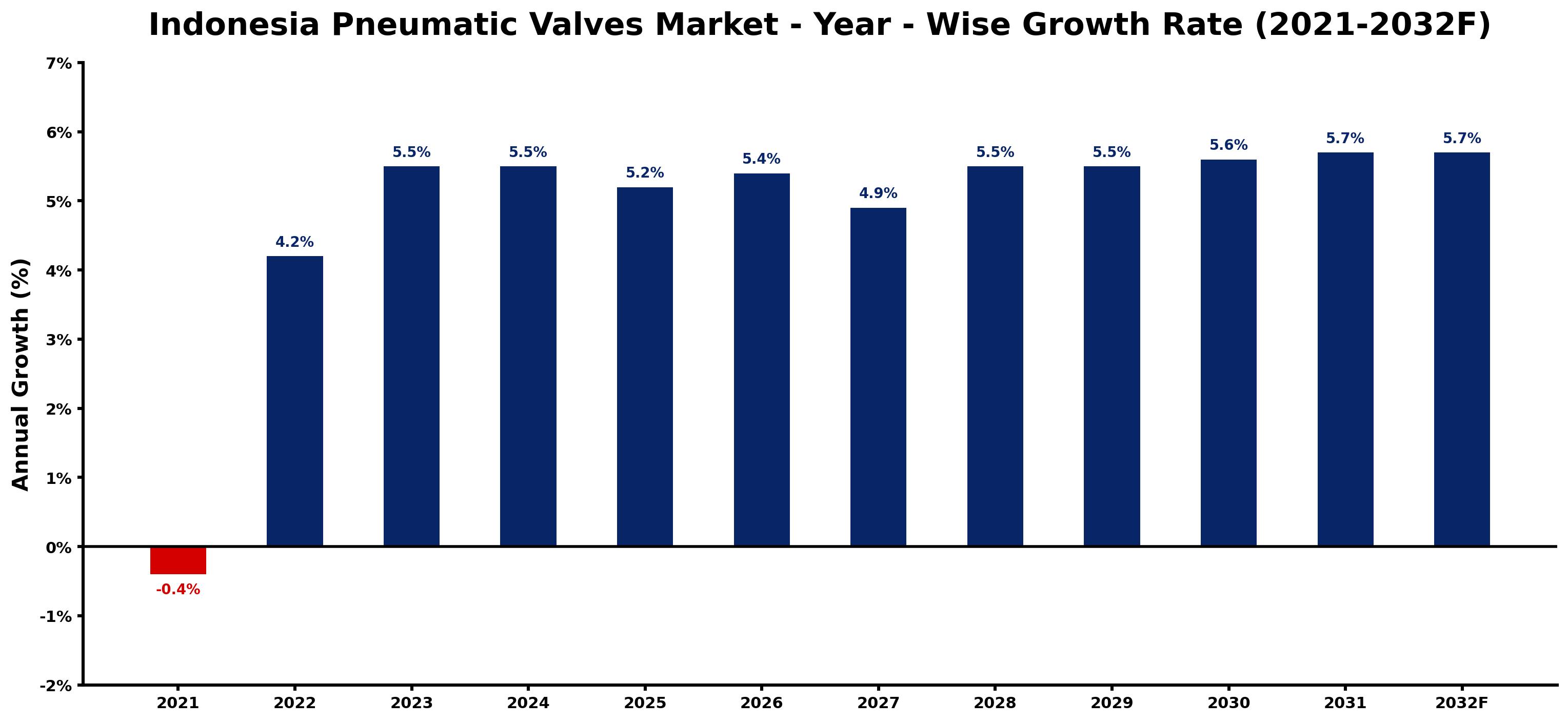
The table below presents the year wise growth rates along with the key drivers influencing the market
| Year | Growth Rate | Major Drivers |
| 2021 | -0.4% | Supply chain interruptions caused by the pandemic hindered production capabilities and delayed project completions. |
| 2022 | 4.2% | Manufacturers look to enhance efficiency, sparking interest in advanced valve technologies. |
| 2023 | 5.5% | Infrastructure development initiatives catalyze the need for reliable pneumatic solutions nationwide. |
| 2024 | 5.5% | Rising automation in manufacturing sectors drives the market for precision valves. |
| 2025 | 5.2% | Local industries increasingly prioritize cost-effective pneumatic systems for competitive advantage. |
| 2026 | 5.4% | Investment in renewable energy projects requires adaptable pneumatic valve technologies. |
| 2027 | 4.9% | Growth in automotive and aerospace sectors fuels demand for high-performance valves. |
| 2028 | 5.5% | Expansion of smart manufacturing necessitates integrated pneumatic solutions for efficiency. |
| 2029 | 5.5% | Emerging start-ups introduce innovative pneumatic systems, revitalizing market competition. |
| 2030 | 5.6% | Environmental sustainability efforts elevate interest in eco-friendly pneumatic valve options. |
| 2031 | 5.7% | Supply chain improvements streamline logistics, enhancing market accessibility for pneumatic systems. |
| 2032 | 5.7% | Global trade agreements open new markets, significantly expanding opportunities for Indonesian manufacturers. |
Note - Market size estimations and growth projections presented in this report are based on 6Wresearch's advanced forecasting approach, validated with industry datasets as of June 2026.
Indonesia Pneumatic Valves Market Synopsis
The Indonesia Pneumatic Valves Market is projected to reach 5.4% and witness significant growth during the forecast period (2026-2032). The market is poised for a compound annual growth rate (CAGR) of 6.6%, driven by an increasing demand for automation across various sectors, including food and beverage, automotive, oil and gas, and pharmaceuticals. The acceleration of industrialization in Indonesia has further bolstered the demand for pneumatic valves, underscored by an expanding population and enhanced infrastructure initiatives supported by the government. Additionally, advancements in technology have opened new avenues for applications of pneumatic valves, contributing to their increasing relevance in the market.
Indonesia Pneumatic Valves Market Growth Drivers
The drive towards automation is a key factor propelling the growth of the Indonesia pneumatic valves market. More industries are recognizing the efficiencies gained through automation, which not only reduces operational costs but also ensures consistency in product quality. This paradigm shift contributes to increased investments in automated solutions, such as pneumatic valves, as businesses seek to enhance production processes while maintaining stringent quality standards.
In particular, the following factors are contributing to the market's robust growth:
- Rising industrial activities across Indonesia are creating a higher demand for reliable pneumatic solutions, enabling more efficient manufacturing processes.
- The expansion of the automotive sector, driven by growing domestic consumption and a demand for higher production rates, requires advanced pneumatic systems, further pushing the market forward.
- Increased investments in infrastructure projects provide a conducive environment for the growth of pneumatic valves, essential in the operation of various systems.
- The ongoing emphasis on energy efficiency among industries has made pneumatic valves an attractive option, as they support reduced energy consumption in systems.
- Technological innovations are enhancing the capabilities and functionalities of pneumatic valves, making them suitable for diverse applications and thus broadening their market appeal.
Indonesia Pneumatic Valves Market Challenges and Restraints
Despite the optimistic outlook for the Indonesia pneumatic valves market, several challenges persist. Chief among these is the volatility in raw material prices, which can significantly impact manufacturing costs and, consequently, the pricing of pneumatic valves in the market. Fluctuations in material costs can arise from various ecological and supply chain factors, placing pressure on profit margins for manufacturers. Other notable challenges include:
- Stringent regulatory requirements that necessitate compliance can complicate operations for manufacturers, impacting product development timelines.
- The fast-paced technological advancements may require continuous investments in research and development, which can be a financial strain for smaller players.
- Changing consumer preferences towards more eco-friendly solutions necessitate adaptation in product offerings, which could pose a threat to traditional valve manufacturers.
- Economic fluctuations and uncertainties can affect industrial investment decisions, leading to unpredictable demand for pneumatic valves.
- Competition from alternative valve technologies may limit market share for pneumatic valves in specific applications, forcing manufacturers to innovate continuously.
Indonesia Pneumatic Valves Market Government Investment and Initiatives
The Indonesian government is actively fostering an environment conducive to industrial growth through various policies and initiatives. Investment in infrastructure development is a cornerstone of government strategy, with public spending directed towards enhancing logistical and operational capabilities throughout the nation. The commitment to improving industrial facilities has led to an increase in demand for pneumatic valves, integral to automated systems.
Moreover, the government's push for sustainable industrial practices is steering companies towards advanced automation solutions. These initiatives encompass tax incentives for industries adopting innovative technologies, thus indirectly supporting the pneumatic valves market. The overall regulatory framework is being oriented towards encouraging investments in technology and infrastructure, which will ultimately strengthen the position of pneumatic valves within the industrial landscape.
Indonesia Pneumatic Valves Market Latest Developments (May 2025 - June 2026)
In the evolving landscape of the Indonesia pneumatic valves market, several key developments have emerged. The focus on automation and smart manufacturing has led to increased collaborations among technology firms to enhance product offerings, particularly in sectors like food processing and pharmaceuticals, where precision is critical. Innovations aiming at improving valve responsiveness and energy efficiency have gained traction, aligning with the global trend towards sustainability.
Additionally, significant government projects targeting industrial modernization have seen a surge, creating demand for advanced pneumatic systems. Industry stakeholders are increasingly engaging in partnerships to navigate the fluctuating costs of raw materials, ensuring supply chain resilience. This period also reflects a growing awareness among manufacturers regarding the importance of digital transformation, leading to investments in smart valve technologies that promise enhanced performance and reliability.
Indonesia Pneumatic Valves Market - Key Attractiveness of the Report
- 10 Years of Market Numbers
- Historical Data Starting from 2022 to 2025
- Base Year: 2025
- Forecast Data until 2032
- Key Performance Indicators Impacting the Market
- Major Upcoming Developments and Projects
Key Highlights of the Report:
- Indonesia Pneumatic Valves Market Outlook
- Market Size of Indonesia Pneumatic Valves Market, 2025
- Forecast of Indonesia Pneumatic Valves Market, 2032F
- Historical Data and Forecast of Indonesia Pneumatic Valves Revenues & Volume for the Period 2022-2032F
- Indonesia Pneumatic Valves Market Trend Evolution
- Indonesia Pneumatic Valves Market Drivers and Challenges
- Indonesia Pneumatic Valves Price Trends
- Indonesia Pneumatic Valves Porter's Five Forces
- Indonesia Pneumatic Valves Industry Life Cycle
- Historical Data and Forecast of Indonesia Pneumatic Valves Market Revenues & Volume By Product Type for the Period 2022-2032F
- Historical Data and Forecast of Indonesia Pneumatic Valves Market Revenues & Volume By Sliding shaft for the Period 2022-2032F
- Historical Data and Forecast of Indonesia Pneumatic Valves Market Revenues & Volume By Rotating shaft for the Period 2022-2032F
- Historical Data and Forecast of Indonesia Pneumatic Valves Market Revenues & Volume By End-Users for the Period 2022-2032F
- Historical Data and Forecast of Indonesia Pneumatic Valves Market Revenues & Volume By Chemicals and petrochemicals for the Period 2022-2032F
- Historical Data and Forecast of Indonesia Pneumatic Valves Market Revenues & Volume By Power generation and management for the Period 2022-2032F
- Historical Data and Forecast of Indonesia Pneumatic Valves Market Revenues & Volume By Mining for the Period 2022-2032F
- Historical Data and Forecast of Indonesia Pneumatic Valves Market Revenues & Volume By Water and wastewater management? for the Period 2022-2032F
- Indonesia Pneumatic Valves Import Export Trade Statistics
- Market Opportunity Assessment By Product Type
- Market Opportunity Assessment By End-Users
- Indonesia Pneumatic Valves Top Companies Market Share
- Indonesia Pneumatic Valves Competitive Benchmarking By Technical and Operational Parameters
- Indonesia Pneumatic Valves Company Profiles
- Indonesia Pneumatic Valves Key Strategic Recommendations






































