Indonesia Point Of Sale Terminals Market Size, Share & Growth Rate
The Indonesia Point Of Sale Terminals Market was estimated at USD 191 Million in 2025 and is projected to reach USD 252 Million by 2032, growing at a CAGR of 4.0% from 2026 to 2032. This growth trajectory is underpinned by the rising consumer preference for cashless transactions and a growing number of card users, spurred on by an increase in mobile payment adoption. Furthermore, government incentives aimed at encouraging small-scale businesses to adopt POS systems are also playing a pivotal role in the market's expansion.
Indonesia Point Of Sale Terminals Market Year-wise Growth Rate and Key Drivers
This graph highlights how the Indonesia Point Of Sale Terminals Market has steadily grown over the years, supported by major growth factors.
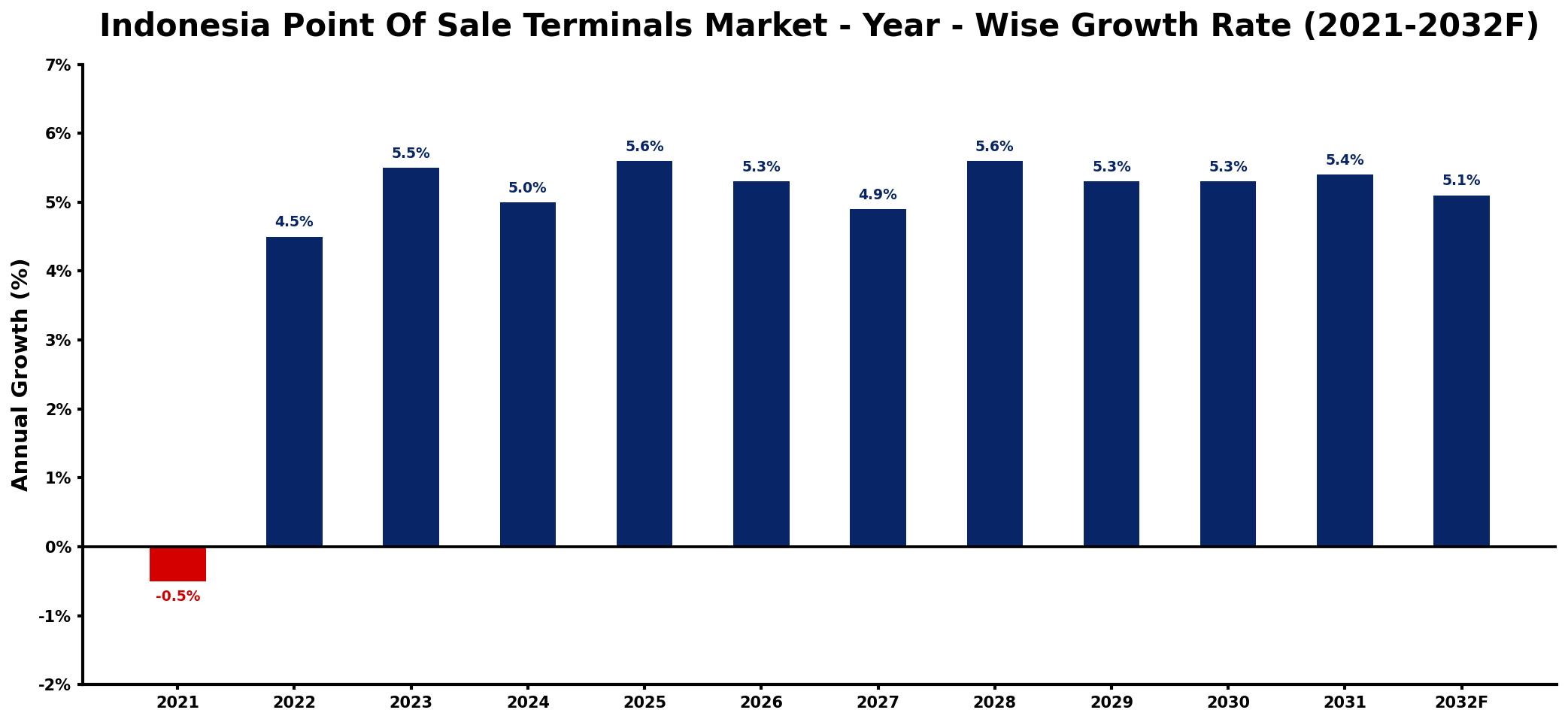
The table below presents the year‑wise growth rates along with the key drivers influencing the market
| Year | Growth Rate | Major Drivers |
| 2021 | -0.5% | Consumer spending shows significant decline |
| 2022 | 4.5% | Increased digital payment adoption trends |
| 2023 | 5.5% | Rising investments in technology infrastructure |
| 2024 | 5.0% | Expansion of e-commerce platforms rapidly |
| 2025 | 5.6% | Growing demand for contactless transactions |
| 2026 | 5.3% | Surge in mobile payment applications |
| 2027 | 4.9% | strengthening international trade flows |
| 2028 | 5.6% | expanding industrial usage applications |
| 2029 | 5.3% | stronger distribution network expansion |
| 2030 | 5.3% | Widespread integration of loyalty programs |
| 2031 | 5.4% | Growing interest in fintech innovations |
| 2032 | 5.1% | rising end-use demand growth |
Note: Market size estimations and growth projections presented in this report are based on 6Wresearch's proprietary forecasting methodology, utilizing the latest available industry data, government publications, and primary research inputs.
Indonesia Point Of Sale Terminals Market Synopsis
In recent years, Indonesia has witnessed a significant shift towards digital payment solutions, transforming the way consumers interact with businesses. The growth of the e-commerce sector and the increasing demand for streamlined payment processes are solidifying the importance of point of sale terminals in the retail landscape.
As more consumers embrace cashless transactions, the POS terminals market is adapting, with enhanced features such as mobile compatibility and advanced security measures becoming standard. The Indonesian government's initiatives to bolster financial inclusion further amplify the demand for POS systems among small and medium-sized enterprises.
Indonesia Point Of Sale Terminals Market Key Takeaways
- The market is experiencing consistent growth due to increased consumer inclination towards cashless transactions.
- Government policies promoting digital payments are catalyzing market expansion, especially among small businesses.
- Technological advancements in POS systems are enhancing security and user convenience.
- Growing e-commerce and retail sectors are critical drivers for the adoption of POS terminals.
- Ongoing consumer awareness campaigns about data security are influencing market dynamics positively.
Evaluation of Restraints in Indonesia Point Of Sale Terminals Market
Despite its robust growth, the Indonesia point of sale terminals market faces certain restraints that could impede progress. The rapid evolution of digital payment platforms poses a challenge for traditional POS solutions, compelling manufacturers to innovate continuously. Additionally, concerns regarding data security and the potential for cyber threats necessitate ongoing investments in cybersecurity measures. This constant pressure to adapt may limit the capacity of some smaller businesses to keep pace with advancements, which could restrict their ability to fully leverage POS technology.
Indonesia Point Of Sale Terminals Market Trends
Several trends are emerging in the Indonesia point of sale terminals market that promise to shape future demand. The integration of contactless payment technologies is becoming more prevalent as consumers seek quicker and more efficient transaction methods. Additionally, the rise of mobile point of sale (mPOS) solutions caters to businesses operating in diverse environments, enabling greater flexibility and convenience. Enhanced data analytics capabilities within POS systems are also allowing merchants to understand consumer behavior better and tailor their offerings accordingly.
Indonesia Point Of Sale Terminals Market Opportunities
The growth and expansion of the Indonesia point of sale terminals market reveal numerous opportunities for investment and development. As the number of small to medium enterprises increases, so does the potential customer base for POS solutions. Furthermore, the ongoing digital transformation across various sectors signals the demand for advanced POS systems that can seamlessly integrate with e-commerce platforms. Innovators focused on creating user-friendly, secure, and flexible payment solutions stand to gain significant market traction as businesses pursue digitalization.
Government Initiatives in the Indonesia Point Of Sale Terminals Market
The Indonesian government has been proactive in supporting the adoption of point of sale terminals through various initiatives. Programs that provide financial incentives such as cashback offers to merchants who install POS systems are designed to encourage small businesses to transition away from cash transactions. Additionally, public spending aimed at enhancing digital infrastructure across urban and rural areas is essential for promoting widespread access to modern payment solutions.
Future Insights of the Indonesia Point Of Sale Terminals Market
Looking ahead to the period from 2026 to 2032, the Indonesia point of sale terminals market is set to evolve significantly. With the ongoing digital transformation within the economy, the demand for technologically advanced POS systems is expected to grow. Investments in mobile and contactless payment technologies will likely continue, driven by consumer preferences and the government's push towards a cashless economy. As security remains a top concern, innovations focused on safeguarding transactions will also be paramount, positioning the market for sustained growth in the years to come.
Indonesia Point Of Sale Terminals Market Latest Developments (2025 - 2026)
Recent developments in the Indonesia point of sale terminals market indicate a growing emphasis on mobile solutions and integrated payment platforms. Retailers are increasingly adopting advanced POS technologies that offer multi-functionality, such as inventory management and customer engagement tools. These advancements are being driven by both consumer demand and competitive pressures within the retail sector. Additionally, partnerships between technology firms and payment processors are emerging, aimed at enhancing system interoperability and user experience.
Indonesia Point Of Sale Terminals Market - Key Attractiveness of the Report
- 10 Years of Market Numbers
- Historical Data Starting from 2022 to 2025
- Base Year: 2025
- Forecast Data until 2032
- Key Performance Indicators Impacting the Market
- Major Upcoming Developments and Projects
Key Highlights of the Report:
- Indonesia Point Of Sale Terminals Market Outlook
- Market Size of Indonesia Point Of Sale Terminals Market, 2025
- Forecast of Indonesia Point Of Sale Terminals Market, 2032
- Historical Data and Forecast of Indonesia Point Of Sale Terminals Revenues & Volume for the Period 2022-2032F
- Indonesia Point Of Sale Terminals Market Trend Evolution
- Indonesia Point Of Sale Terminals Market Drivers and Challenges
- Indonesia Point Of Sale Terminals Price Trends
- Indonesia Point Of Sale Terminals Porter's Five Forces
- Indonesia Point Of Sale Terminals Industry Life Cycle
- Historical Data and Forecast of Indonesia Point Of Sale Terminals Market Revenues & Volume By Product for the Period 2022-2032F
- Historical Data and Forecast of Indonesia Point Of Sale Terminals Market Revenues & Volume By Fixed for the Period 2022-2032F
- Historical Data and Forecast of Indonesia Point Of Sale Terminals Market Revenues & Volume By Mobile for the Period 2022-2032F
- Historical Data and Forecast of Indonesia Point Of Sale Terminals Market Revenues & Volume By Component for the Period 2022-2032F
- Historical Data and Forecast of Indonesia Point Of Sale Terminals Market Revenues & Volume By Hardware for the Period 2022-2032F
- Historical Data and Forecast of Indonesia Point Of Sale Terminals Market Revenues & Volume By Software for the Period 2022-2032F
- Historical Data and Forecast of Indonesia Point Of Sale Terminals Market Revenues & Volume By Services for the Period 2022-2032F
- Historical Data and Forecast of Indonesia Point Of Sale Terminals Market Revenues & Volume By Deployment for the Period 2022-2032F
- Historical Data and Forecast of Indonesia Point Of Sale Terminals Market Revenues & Volume By Cloud for the Period 2022-2032F
- Historical Data and Forecast of Indonesia Point Of Sale Terminals Market Revenues & Volume By On-premise for the Period 2022-2032F
- Historical Data and Forecast of Indonesia Point Of Sale Terminals Market Revenues & Volume By End Use for the Period 2022-2032F
- Historical Data and Forecast of Indonesia Point Of Sale Terminals Market Revenues & Volume By Restaurants for the Period 2022-2032F
- Historical Data and Forecast of Indonesia Point Of Sale Terminals Market Revenues & Volume By Retail for the Period 2022-2032F
- Historical Data and Forecast of Indonesia Point Of Sale Terminals Market Revenues & Volume By Hospitality for the Period 2022-2032F
- Historical Data and Forecast of Indonesia Point Of Sale Terminals Market Revenues & Volume By Healthcare for the Period 2022-2032F
- Historical Data and Forecast of Indonesia Point Of Sale Terminals Market Revenues & Volume By Warehouse for the Period 2022-2032F
- Historical Data and Forecast of Indonesia Point Of Sale Terminals Market Revenues & Volume By Entertainment for the Period 2022-2032F
- Historical Data and Forecast of Indonesia Point Of Sale Terminals Market Revenues & Volume By Others for the Period 2022-2032F
- Indonesia Point Of Sale Terminals Import Export Trade Statistics
- Market Opportunity Assessment By Product
- Market Opportunity Assessment By Component
- Market Opportunity Assessment By Deployment
- Market Opportunity Assessment By End Use
- Indonesia Point Of Sale Terminals Top Companies Market Share
- Indonesia Point Of Sale Terminals Competitive Benchmarking By Technical and Operational Parameters
- Indonesia Point Of Sale Terminals Company Profiles
- Indonesia Point Of Sale Terminals Key Strategic Recommendations






































