Indonesia Policy Management in Telecom Market Size & Growth Rate (2026-2032)
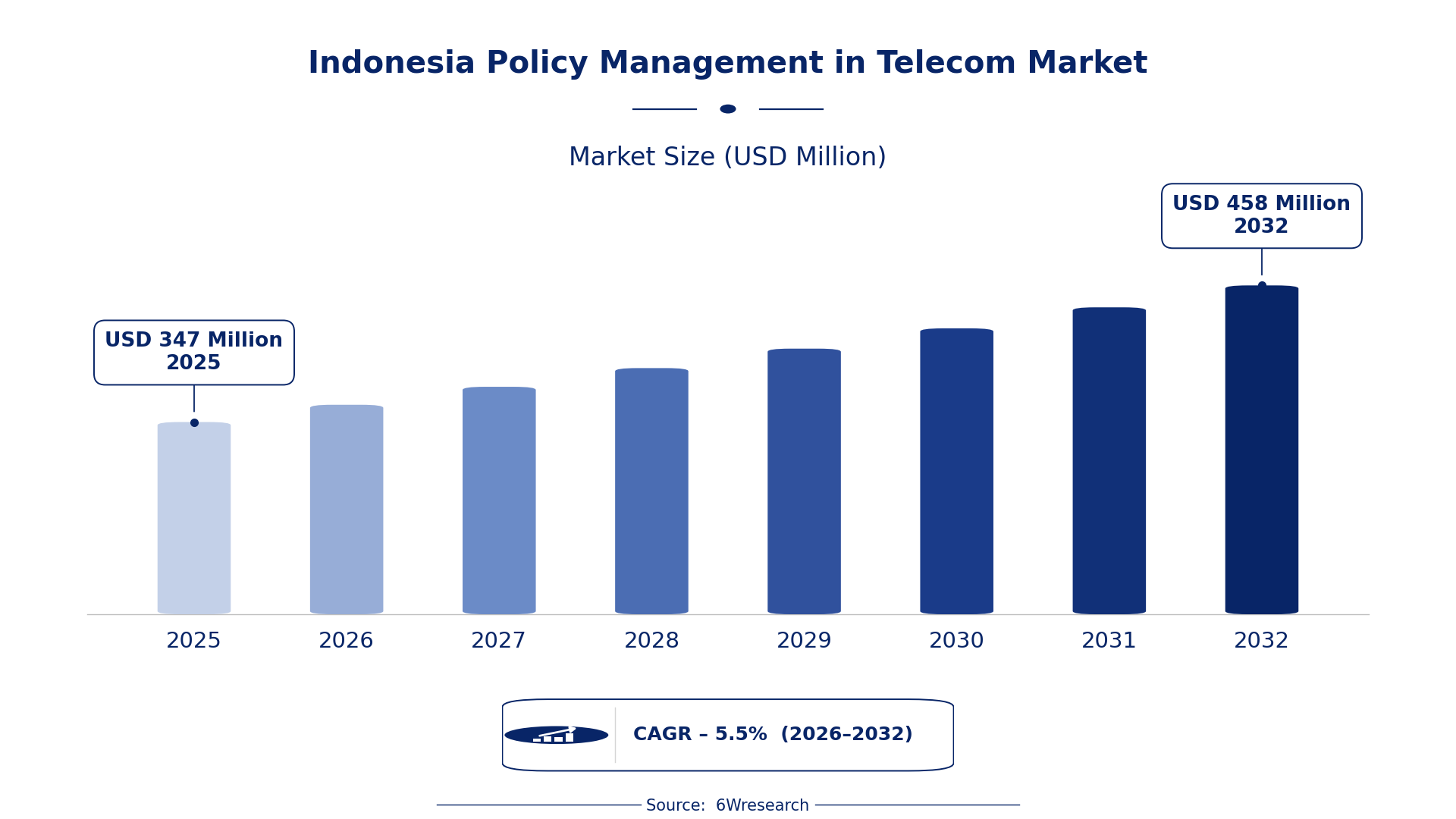
The Indonesia Policy Management in Telecom Market was estimated at USD 347 Million in 2025 and is projected to reach USD 458 Million by 2032, growing at a CAGR of 5.5% from 2026 to 2032.
Indonesia Policy Management in Telecom Market Synopsis
The rapid expansion of telecommunication services in Indonesia has escalated the demand for effective policy management. As telecom providers face increased network complexity, the implementation of tailored policy solutions has become essential for maintaining quality of service and compliance with local regulations.
Amidst this backdrop, the industry is adapting to changing consumer behaviors and technological advancements. The adoption of 5G and IoT further emphasizes the need for robust policy frameworks that ensure security and efficiency in network operations, paving the way for sustainable growth.
Indonesia Policy Management in Telecom Market Year-wise Growth Rate and Key Drivers
This graph illustrates the annual growth rates of the Indonesia Policy Management in Telecom Market from 2021 to 2032, highlighting a steady upward trajectory and projected expansion over the forecast period.
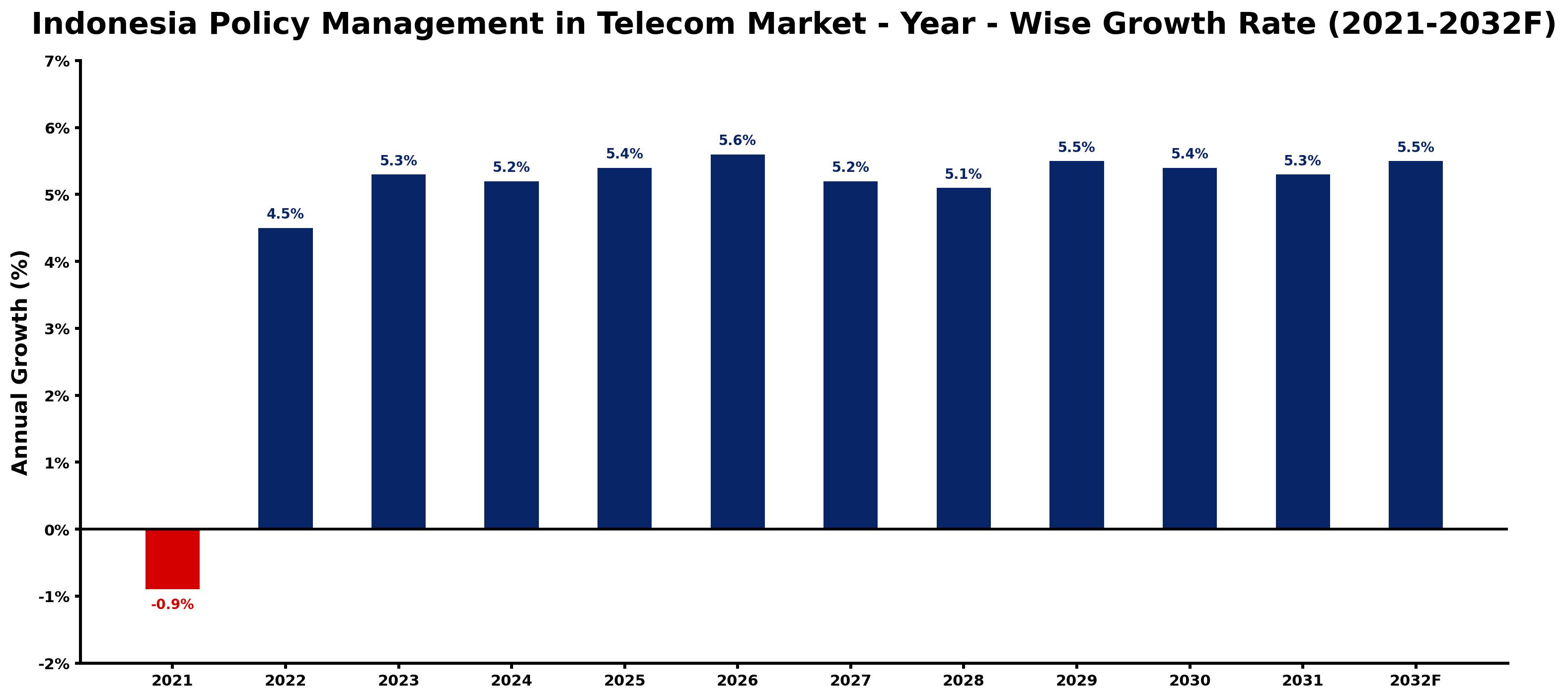
The table below presents the year‑wise growth rates along with the key drivers influencing the market
| Year | Growth Rate | Major Drivers |
| 2021 | -0.9% | Government's rigid bandwidth allocation policies hindered innovation. |
| 2022 | 4.5% | Launch of the 5G spectrum by Kominfo. |
| 2023 | 5.3% | Increased mobile subscriber penetration in urban areas. |
| 2024 | 5.2% | Telecom regulatory reforms encouraging competition among operators. |
| 2025 | 5.4% | Government initiatives for digital economy transformation. |
| 2026 | 5.6% | Adoption of e-wallet services driving mobile data use. |
| 2027 | 5.2% | Growth of local startups in digital communication tools. |
| 2028 | 5.1% | Partnerships between telecoms and e-commerce platforms expanding access. |
| 2029 | 5.5% | Investment in fiber optic infrastructure by state-owned enterprises. |
| 2030 | 5.4% | National strategy for renewable energy promoting telecom power efficiency. |
| 2031 | 5.3% | Regulatory incentives for bandwidth expansion initiatives. |
| 2032 | 5.5% | Increase in mobile payment systems enhancing telecom service adoption. |
Note: Market size estimations and growth projections presented in this report are based on 6Wresearch's proprietary forecasting methodology, utilizing the latest available industry data, government publications, and primary research inputs.
Indonesia Policy Management in Telecom Market Key Takeaways
Below are some of the specific key takeaways from the market, including:
- The market is driven by a need for effective policy enforcement and compliance with evolving regulations.
- Customization versus standardization presents a unique challenge for telecom providers.
- The impact of COVID-19 has accelerated the need for real-time policy management solutions.
- Key players are focusing on innovative solutions to enhance network security and service quality.
- Government initiatives are shaping regulatory frameworks critical to the market's future.
Evaluation of Restraints in Indonesia Policy Management in Telecom Market
The policy management sector in Indonesia grapples with the tension between customization and standardization. Service providers aim to create unique policies tailored to diverse customer needs while adhering to overarching regulatory frameworks. This balancing act can lead to inefficiencies and difficulties in policy enforcement. Additionally, the rapid pace of technological advancement means that current policies must be frequently revisited and updated, stretching the resources of operators striving to remain compliant and competitive.
Indonesia Policy Management in Telecom Market Trends
One prominent trend is the shift towards automation in policy management processes. Telecom operators are increasingly deploying AI-driven solutions to optimize policy enforcement, ensuring quicker responses to changing network conditions and customer demands. Alongside this, a growing focus on data privacy and security compliance is shaping policy frameworks, as providers respond to heightened consumer awareness and regulatory scrutiny.
Furthermore, the rise of 5G technology is necessitating more granular policy controls to manage network traffic effectively. This trend illustrates the need for telecom companies to invest in advanced policy management systems capable of handling complex, high-speed networks while ensuring seamless service delivery.
Indonesia Policy Management in Telecom Market Opportunities
The growth of the IoT market presents significant opportunities for policy management solutions. As more devices connect to networks, effective policy frameworks will be essential for managing the associated traffic and ensuring quality of service. Additionally, public-private partnerships focusing on infrastructure development are likely to stimulate innovation in policy management technologies.
Furthermore, a focus on sustainability is creating openings for new policies that promote energy-efficient network practices, offering telecom companies a chance to differentiate themselves in a competitive environment.
Government Initiatives in the Indonesia Policy Management in Telecom Market
The Indonesian government has taken a proactive stance in shaping the policy management framework for telecommunications. Regulatory bodies are emphasizing compliance and transparency, recognizing the critical role of effective governance in fostering a competitive telecom environment. This focus is essential for supporting the ongoing growth and modernization of the sector.
- A recently completed initiative involved the introduction of a regulatory framework mandating stricter billing transparency for telecom operators to enhance consumer trust.
- Currently, the government is conducting an extensive review of existing telecom regulations to align them with global best practices and local market needs.
- A planned public-private initiative is expected to be launched in 2026 to improve digital infrastructure access across rural areas, broadening the reach of telecom services.
- An ongoing programme focusing on the development of a national cybersecurity policy aims to bolster network security across all telecom operators.
- The government is also rolling out a digital literacy campaign designed to educate consumers about their rights and responsibilities in the telecom sector.
Future Insights of the Indonesia Policy Management in Telecom Market
Looking ahead to 2026-2032, the Indonesia Policy Management in Telecom market is expected to witness substantial growth driven by technological advancements and regulatory reforms. The adoption of emerging technologies, such as artificial intelligence and machine learning, will likely enhance policy management systems, allowing telecom providers to respond more dynamically to market changes.
Additionally, as consumer expectations shift towards increased transparency and quality of service, policy frameworks will need to evolve accordingly. The interplay between regulation, technology, and consumer demand will play a critical role in shaping the industry's future.
Indonesia Policy Management in Telecom Market Latest Developments
Recent activity in the Indonesia Policy Management in Telecom market reflects a concerted effort by telecom operators to enhance service quality and compliance. Over the past year, the industry has seen a surge in partnerships aimed at developing advanced policy management solutions that leverage AI technology to automate enforcement and ensure compliance.
- A leading telecom operator announced a pilot programme in early 2025 for a new AI-driven policy management platform aimed at enhancing customer experience and network performance.
- An initiative that began in Q1 2025 focuses on upgrading existing policy management systems across multiple service providers to accommodate increased traffic from the roll-out of 5G networks.
- A collaboration between major industry players is currently underway to establish a standardized policy management protocol to improve interoperability between networks, anticipated to conclude in late 2026.
- A rollout of enhanced consumer protection policies is expected to begin in mid-2025, aimed at promoting transparency in billing and service quality.
Indonesia Policy Management in Telecom Market - Key Attractiveness of the Report
- 10 Years of Market Numbers
- Historical Data Starting from 2022 to 2025
- Base Year: 2025
- Forecast Data until 2032
- Key Performance Indicators Impacting the Market
- Major Upcoming Developments and Projects
Key Highlights of the Report:
- Indonesia Policy Management in Telecom Market Outlook
- Market Size of Indonesia Policy Management in Telecom Market, 2025
- Forecast of Indonesia Policy Management in Telecom Market, 2032
- Historical Data and Forecast of Indonesia Policy Management in Telecom Revenues & Volume for the Period 2022-2032F
- Indonesia Policy Management in Telecom Market Trend Evolution
- Indonesia Policy Management in Telecom Market Drivers and Challenges
- Indonesia Policy Management in Telecom Price Trends
- Indonesia Policy Management in Telecom Porter's Five Forces
- Indonesia Policy Management in Telecom Industry Life Cycle
- Historical Data and Forecast of Indonesia Policy Management in Telecom Market Revenues & Volume By Network for the Period 2022-2032F
- Historical Data and Forecast of Indonesia Policy Management in Telecom Market Revenues & Volume By Fixed for the Period 2022-2032F
- Historical Data and Forecast of Indonesia Policy Management in Telecom Market Revenues & Volume By Wireless for the Period 2022-2032F
- Historical Data and Forecast of Indonesia Policy Management in Telecom Market Revenues & Volume By Component for the Period 2022-2032F
- Historical Data and Forecast of Indonesia Policy Management in Telecom Market Revenues & Volume By Solutions for the Period 2022-2032F
- Historical Data and Forecast of Indonesia Policy Management in Telecom Market Revenues & Volume By Services for the Period 2022-2032F
- Historical Data and Forecast of Indonesia Policy Management in Telecom Market Revenues & Volume By Deployment for the Period 2022-2032F
- Historical Data and Forecast of Indonesia Policy Management in Telecom Market Revenues & Volume By Cloud for the Period 2022-2032F
- Historical Data and Forecast of Indonesia Policy Management in Telecom Market Revenues & Volume By On-Premises for the Period 2022-2032F
- Indonesia Policy Management in Telecom Import Export Trade Statistics
- Market Opportunity Assessment By Network
- Market Opportunity Assessment By Component
- Market Opportunity Assessment By Deployment
- Indonesia Policy Management in Telecom Top Companies Market Share
- Indonesia Policy Management in Telecom Competitive Benchmarking By Technical and Operational Parameters
- Indonesia Policy Management in Telecom Company Profiles
- Indonesia Policy Management in Telecom Key Strategic Recommendations






































