Indonesia Pressure Sensor Market Size Growth Rate
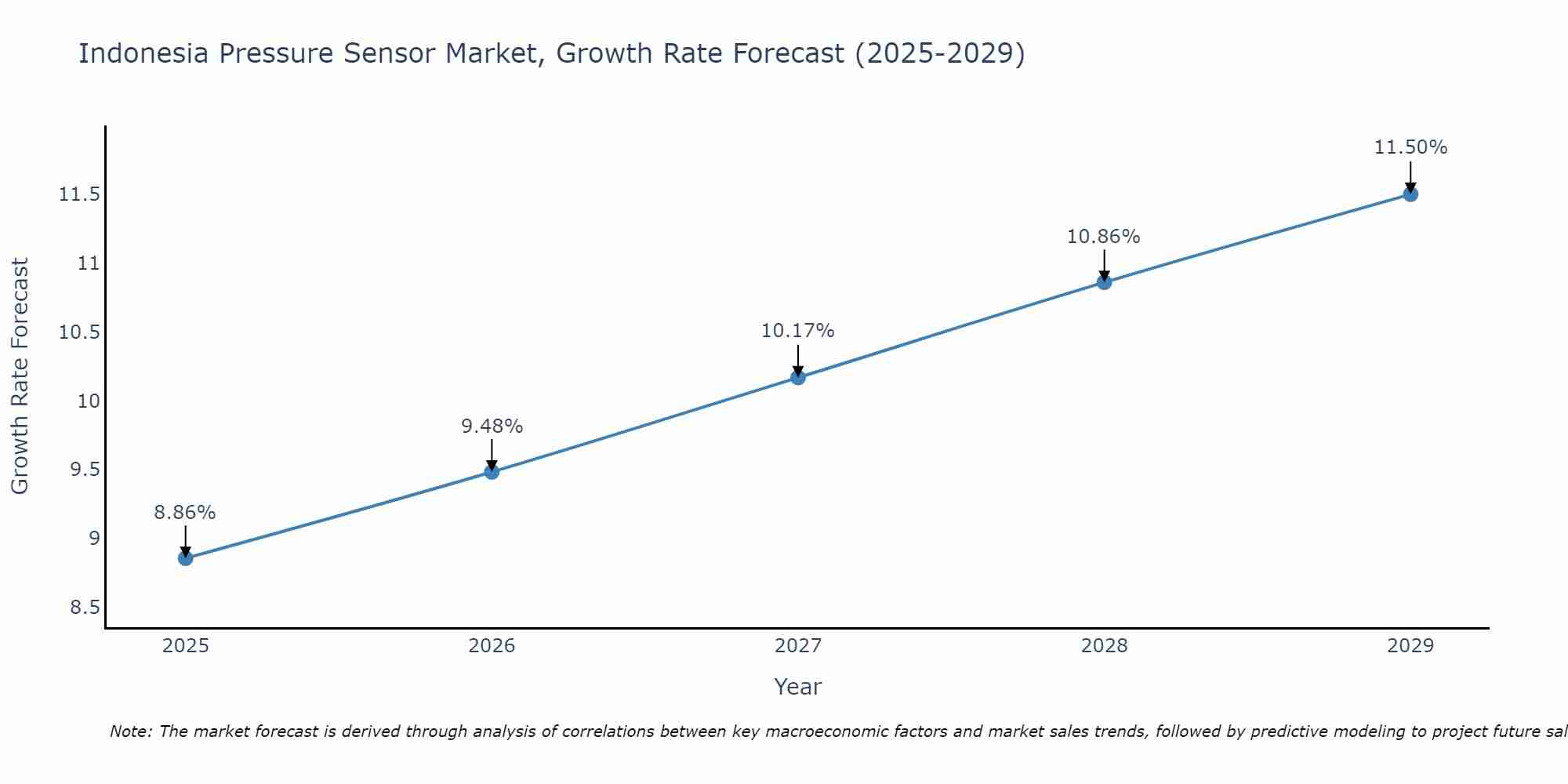
The Indonesia Pressure Sensor Market is poised for steady growth rate improvements from 2025 to 2029. From 8.86% in 2025, the growth rate steadily ascends to 11.50% in 2029.
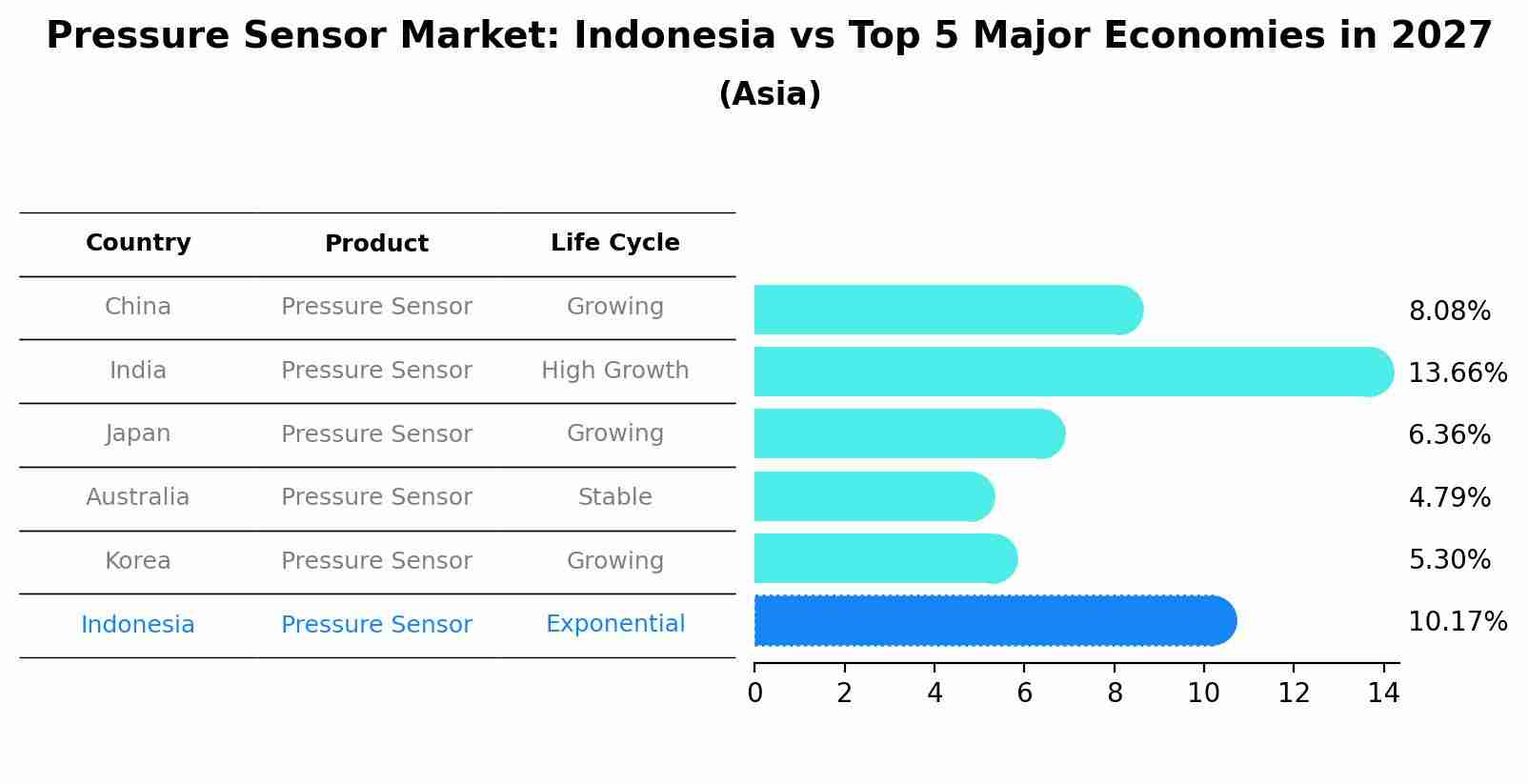
Pressure Sensor Market: Indonesia vs Top 5 Major Economies in 2027 (Asia)
The Pressure Sensor market in Indonesia is projected to grow at a high growth rate of 10.17% by 2027, highlighting the country's increasing focus on advanced technologies within the Asia region, where China holds the dominant position, followed closely by India, Japan, Australia and South Korea, shaping overall regional demand.
Indonesia Pressure Sensor Market Synopsis
Pressure sensors are essential components in various industries, including automotive, aerospace, and industrial automation. The Indonesia pressure sensor market is poised for growth due to the increasing adoption of automation and sensor technologies in manufacturing and automotive sectors. Additionally, the demand for pressure sensors in environmental monitoring and healthcare applications is expected to contribute to market expansion.
Drivers of the Market
The pressure sensor market in Indonesia is experiencing substantial growth driven by several factors. Industrial automation is a key driver, as pressure sensors are integral components in various automated processes, ensuring precision and safety. Additionally, the automotive industry relies on pressure sensors for applications like tire pressure monitoring and engine control systems. The increasing emphasis on environmental monitoring and safety regulations in industries such as oil and gas and pharmaceuticals has further boosted the demand for pressure sensors. Advancements in microelectromechanical systems (MEMS) technology have led to smaller and more cost-effective pressure sensors, expanding their applications across sectors.
Challenges of the Market
Challenges in the pressure sensor market include the need for high accuracy and reliability, especially in industries like aerospace and automotive. Ensuring compatibility with various fluids and gases and addressing issues related to signal interference are ongoing concerns.
COVID-19 Impact on the Market
The pressure sensor market in Indonesia witnessed a substantial disruption due to the pandemic. With lockdowns, travel restrictions, and disruptions in supply chains, the manufacturing industry, which is a major user of pressure sensors, faced significant challenges. This led to a decline in demand for pressure sensors in various applications, including automotive, industrial, and healthcare. However, as economic activities gradually resumed and industries adapted to new safety norms, the market began to recover. The demand for pressure sensors is expected to rebound in the post-pandemic period as industries prioritize automation and data-driven decision-making.
Key Players in the Market
The Indonesia pressure sensor market is witnessing substantial growth due to increased industrialization and the adoption of advanced technologies across various sectors. Key players in this market include local companies like PT XYZ Sensors and international giants such as Honeywell and Siemens. These players are focusing on developing innovative pressure sensing solutions for applications ranging from automotive to healthcare.
Key Highlights of the Report:
- Indonesia Pressure Sensor Market Outlook
- Market Size of Indonesia Pressure Sensor Market, 2024
- Forecast of Indonesia Pressure Sensor Market, 2031
- Historical Data and Forecast of Indonesia Pressure Sensor Revenues & Volume for the Period 2021-2031
- Indonesia Pressure Sensor Market Trend Evolution
- Indonesia Pressure Sensor Market Drivers and Challenges
- Indonesia Pressure Sensor Price Trends
- Indonesia Pressure Sensor Porter's Five Forces
- Indonesia Pressure Sensor Industry Life Cycle
- Historical Data and Forecast of Indonesia Pressure Sensor Market Revenues & Volume By Application for the Period 2021-2031
- Historical Data and Forecast of Indonesia Pressure Sensor Market Revenues & Volume By Automotive for the Period 2021-2031
- Historical Data and Forecast of Indonesia Pressure Sensor Market Revenues & Volume By Medical for the Period 2021-2031
- Historical Data and Forecast of Indonesia Pressure Sensor Market Revenues & Volume By Consumer Electronics for the Period 2021-2031
- Historical Data and Forecast of Indonesia Pressure Sensor Market Revenues & Volume By Industrial for the Period 2021-2031
- Historical Data and Forecast of Indonesia Pressure Sensor Market Revenues & Volume By Aerospace and Defense for the Period 2021-2031
- Historical Data and Forecast of Indonesia Pressure Sensor Market Revenues & Volume By Food and Beverage for the Period 2021-2031
- Historical Data and Forecast of Indonesia Pressure Sensor Market Revenues & Volume By HVAC for the Period 2021-2031
- Indonesia Pressure Sensor Import Export Trade Statistics
- Market Opportunity Assessment By Application
- Indonesia Pressure Sensor Top Companies Market Share
- Indonesia Pressure Sensor Competitive Benchmarking By Technical and Operational Parameters
- Indonesia Pressure Sensor Company Profiles
- Indonesia Pressure Sensor Key Strategic Recommendations






































