Indonesia Process Automation And Instrumentation Market Size, Share & Growth Rate
The Indonesia Process Automation And Instrumentation Market was estimated at USD 1427 Million in 2025 and is projected to reach USD 2029 Million by 2032, growing at a CAGR of 5.2% from 2026 to 2032. This growth trajectory is significantly driven by the escalating need for enhanced operational efficiency in industries, particularly oil & gas and manufacturing, which are increasingly adopting sophisticated automation technologies. Additionally, the rise of IoT and Industry 4.0 concepts is compelling companies to invest in cutting-edge instrumentation solutions that streamline processes and bolster productivity.
Indonesia Process Automation And Instrumentation Market Year-wise Growth Rate and Key Drivers
This graph highlights how the Indonesia Process Automation And Instrumentation Market has steadily grown over the years, supported by major growth factors.
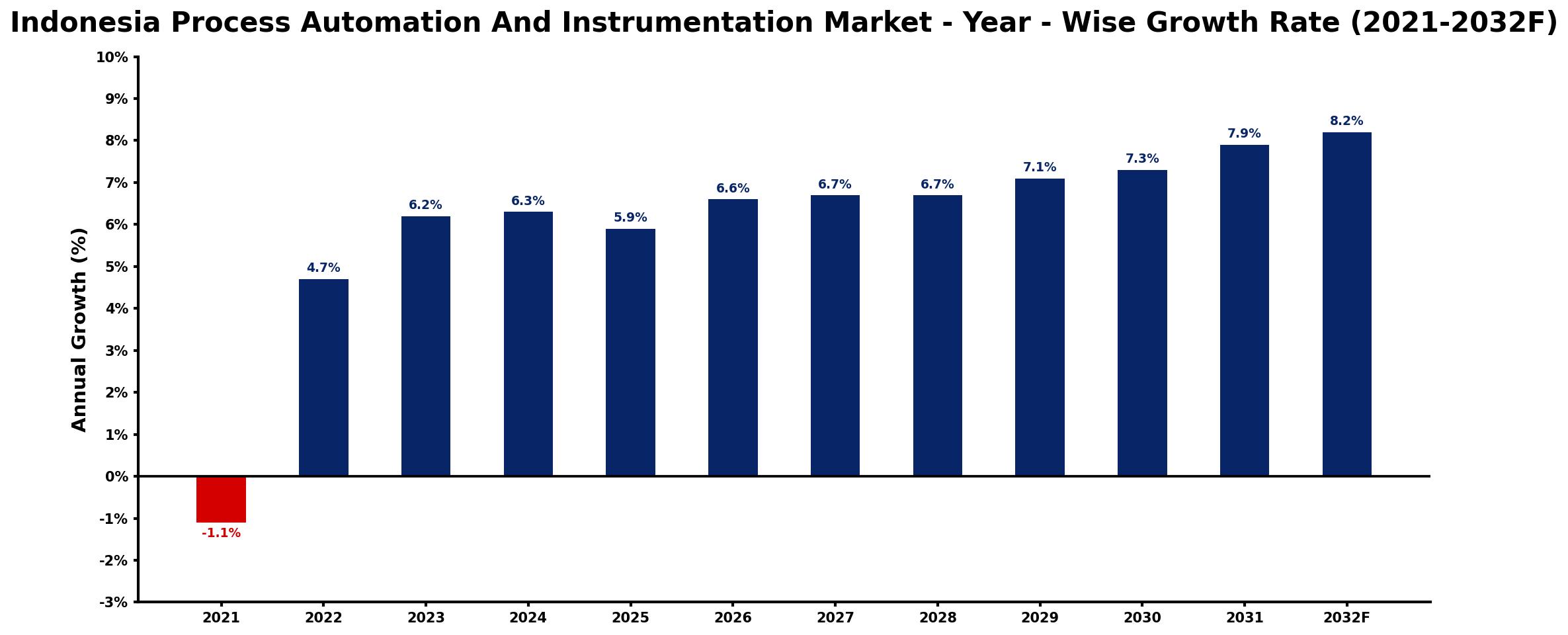
The table below presents the year‑wise growth rates along with the key drivers influencing the market
| Year | Growth Rate | Major Drivers |
| 2021 | -1.1% | decrease in industrial spending |
| 2022 | 4.7% | growing demand from manufacturing sector |
| 2023 | 6.2% | expansion of renewable energy projects |
| 2024 | 6.3% | increased investments in infrastructure |
| 2025 | 5.9% | rise in smart city initiatives |
| 2026 | 6.6% | enhanced focus on digital transformation |
| 2027 | 6.7% | growth of data analytics applications |
| 2028 | 6.7% | surge in environmental regulations compliance |
| 2029 | 7.1% | increased adoption of IoT technologies |
| 2030 | 7.3% | expanding industrial usage applications |
| 2031 | 7.9% | growth in industrial safety standards |
| 2032 | 8.2% | increased capital investment inflows |
Note: Market size estimations and growth projections presented in this report are based on 6Wresearch's proprietary forecasting methodology, utilizing the latest available industry data, government publications, and primary research inputs.
Indonesia Process Automation And Instrumentation Market Synopsis
In Indonesia, the adoption of process automation is accelerating as companies seek to elevate their operational capabilities. Key sectors, including petrochemicals and power generation, are especially focused on integrating advanced process control systems that enable precise monitoring and control over their operations.
The growing emphasis on compliance with environmental regulations is driving the demand for innovative instrumentation devices. Businesses are not only aiming for cost reductions but also striving to enhance their sustainability practices through automation, which is reshaping the landscape of the market in Indonesia.
Indonesia Process Automation And Instrumentation Market Key Takeaways
- The market is experiencing a significant increase in investments driven by the need for operational efficiency.
- Industries are increasingly integrating IoT and Industry 4.0 practices to enhance data-driven decision-making.
- Demand for process instrumentation is particularly pronounced in sectors such as oil & gas, chemicals, and pharmaceuticals.
- The post-COVID rebound is expected to catalyze a stronger focus on automation solutions and technologies.
- Concerns around cybersecurity are emerging as critical issues amidst rapid technological adoption.
Evaluation of Restraints in Indonesia Process Automation And Instrumentation Market
Despite the promising growth of the Indonesia Process Automation And Instrumentation Market, several restraints impact its potential. The rapid integration of advanced technologies, such as IoT and AI, raises significant concerns regarding the security of automation systems against cyber threats. Companies are tasked with ensuring the resilience of their infrastructure while facing pressures to adopt cost-effective solutions. Additionally, a shortage of skilled workforce in certain areas can hinder the implementation of advanced systems, posing a notable challenge in realizing the full benefits of automation and instrumentation.
Indonesia Process Automation And Instrumentation Market Trends
Several key trends are shaping the Indonesia Process Automation And Instrumentation Market. The increasing emphasis on smart manufacturing is leading to a surge in demand for intelligent instrumentation that supports real-time data collection and analysis. Furthermore, companies are prioritizing sustainability initiatives, which is leading to an uptick in investments in automation solutions that minimize waste and energy consumption. Collaborative robots (cobots) are also gaining traction, enhancing human-robot interaction on production lines, thereby increasing productivity and safety.
Indonesia Process Automation And Instrumentation Market Opportunities
The future landscape of the Indonesia Process Automation And Instrumentation Market presents ample opportunities for growth and investment. Companies are increasingly looking for innovative automation solutions that not only drive efficiency but also align with sustainable practices. The rapid digital transformation across industries opens the door for new entrants offering specialized automation services. Moreover, as the government pushes for modernization in traditional sectors, there is potential for significant public-private partnerships aimed at infrastructure upgrades and technology integration.
Government Initiatives in the Indonesia Process Automation And Instrumentation Market
The Indonesian government is keen on promoting industrial innovation through various initiatives that aim to enhance automation and instrumentation capabilities. Policies focusing on Industry 4.0 encourage investments in smart technologies and automation solutions across sectors. Furthermore, the government is allocating funds towards digital infrastructure development, which is vital for supporting the transition to advanced manufacturing practices and ensuring compliance with environmental regulations. These initiatives are set to create a more conducive environment for the growth of the process automation market.
Future Insights of the Indonesia Process Automation And Instrumentation Market
Looking ahead to 2026-2032, the Indonesia Process Automation And Instrumentation Market is expected to continue its upward trajectory. As industries increasingly embrace digital transformation, the demand for sophisticated automation solutions will further escalate. The convergence of advanced technologies like AI, machine learning, and the IoT will reshape traditional industrial processes, leading to smarter, more efficient operational environments. Additionally, the focus on sustainability and compliance will drive further innovations in instrumentation technologies, securing the markets growth path.
Indonesia Process Automation And Instrumentation Market Latest Developments (2025 - 2026)
Recent developments in the Indonesia Process Automation And Instrumentation Market have showcased a noteworthy shift towards smarter automation solutions. Companies are increasingly adopting cloud-based platforms for better data management and operational efficiency. There has also been a significant rise in partnerships and collaborations aimed at developing advanced technologies that enhance process control. Furthermore, the growing focus on cybersecurity measures is prompting firms to integrate more robust security protocols into their automation systems to safeguard against emerging threats.
Indonesia Process Automation And Instrumentation Market - Key Attractiveness of the Report
- 10 Years of Market Numbers
- Historical Data Starting from 2022 to 2025
- Base Year: 2025
- Forecast Data until 2032
- Key Performance Indicators Impacting the Market
- Major Upcoming Developments and Projects
Key Highlights of the Report:
- Indonesia Process Automation And Instrumentation Market Outlook
- Market Size of Indonesia Process Automation And Instrumentation Market, 2025
- Forecast of Indonesia Process Automation And Instrumentation Market, 2032
- Historical Data and Forecast of Indonesia Process Automation And Instrumentation Revenues & Volume for the Period 2022-2032F
- Indonesia Process Automation And Instrumentation Market Trend Evolution
- Indonesia Process Automation And Instrumentation Market Drivers and Challenges
- Indonesia Process Automation And Instrumentation Price Trends
- Indonesia Process Automation And Instrumentation Porter's Five Forces
- Indonesia Process Automation And Instrumentation Industry Life Cycle
- Historical Data and Forecast of Indonesia Process Automation And Instrumentation Market Revenues & Volume By Instrument for the Period 2022-2032F
- Historical Data and Forecast of Indonesia Process Automation And Instrumentation Market Revenues & Volume By Field Instruments for the Period 2022-2032F
- Historical Data and Forecast of Indonesia Process Automation And Instrumentation Market Revenues & Volume By Control Valve for the Period 2022-2032F
- Historical Data and Forecast of Indonesia Process Automation And Instrumentation Market Revenues & Volume By Analytical Instruments for the Period 2022-2032F
- Historical Data and Forecast of Indonesia Process Automation And Instrumentation Market Revenues & Volume By Solution for the Period 2022-2032F
- Historical Data and Forecast of Indonesia Process Automation And Instrumentation Market Revenues & Volume By Advanced Process Control (APC) for the Period 2022-2032F
- Historical Data and Forecast of Indonesia Process Automation And Instrumentation Market Revenues & Volume By Distributed Control System (DCS) for the Period 2022-2032F
- Historical Data and Forecast of Indonesia Process Automation And Instrumentation Market Revenues & Volume By Human Machine Interaction (HMI) for the Period 2022-2032F
- Historical Data and Forecast of Indonesia Process Automation And Instrumentation Market Revenues & Volume By Manufacturing Execution System (MES) for the Period 2022-2032F
- Historical Data and Forecast of Indonesia Process Automation And Instrumentation Market Revenues & Volume By Programmable Logic Controller (PLC) for the Period 2022-2032F
- Historical Data and Forecast of Indonesia Process Automation And Instrumentation Market Revenues & Volume By Safety Automation for the Period 2022-2032F
- Historical Data and Forecast of Indonesia Process Automation And Instrumentation Market Revenues & Volume By Supervisory Control and Data Acquisition (SCADA) for the Period 2022-2032F
- Historical Data and Forecast of Indonesia Process Automation And Instrumentation Market Revenues & Volume By End-user Industry for the Period 2022-2032F
- Historical Data and Forecast of Indonesia Process Automation And Instrumentation Market Revenues & Volume By Oil and Gas for the Period 2022-2032F
- Historical Data and Forecast of Indonesia Process Automation And Instrumentation Market Revenues & Volume By Food and Beverage for the Period 2022-2032F
- Historical Data and Forecast of Indonesia Process Automation And Instrumentation Market Revenues & Volume By Pharmaceutical and Biopharma for the Period 2022-2032F
- Historical Data and Forecast of Indonesia Process Automation And Instrumentation Market Revenues & Volume By Chemical and Petrochemical for the Period 2022-2032F
- Historical Data and Forecast of Indonesia Process Automation And Instrumentation Market Revenues & Volume By Other End-user Industries for the Period 2022-2032F
- Indonesia Process Automation And Instrumentation Import Export Trade Statistics
- Market Opportunity Assessment By Instrument
- Market Opportunity Assessment By Solution
- Market Opportunity Assessment By End-user Industry
- Indonesia Process Automation And Instrumentation Top Companies Market Share
- Indonesia Process Automation And Instrumentation Competitive Benchmarking By Technical and Operational Parameters
- Indonesia Process Automation And Instrumentation Company Profiles
- Indonesia Process Automation And Instrumentation Key Strategic Recommendations






































