Indonesia Professional Lighting Market Summary
The indonesia professional lighting market was estimated at USD 333 Million in 2025 and is projected to reach USD 440 Million by 2032, growing at a CAGR of 5.0% from 2026 to 2032.
Indonesia Professional Lighting Market Year-wise Growth Rate and Key Drivers
This graph highlights how the Indonesia Professional Lighting Market has steadily grown over the past five years, supported by major growth factors.
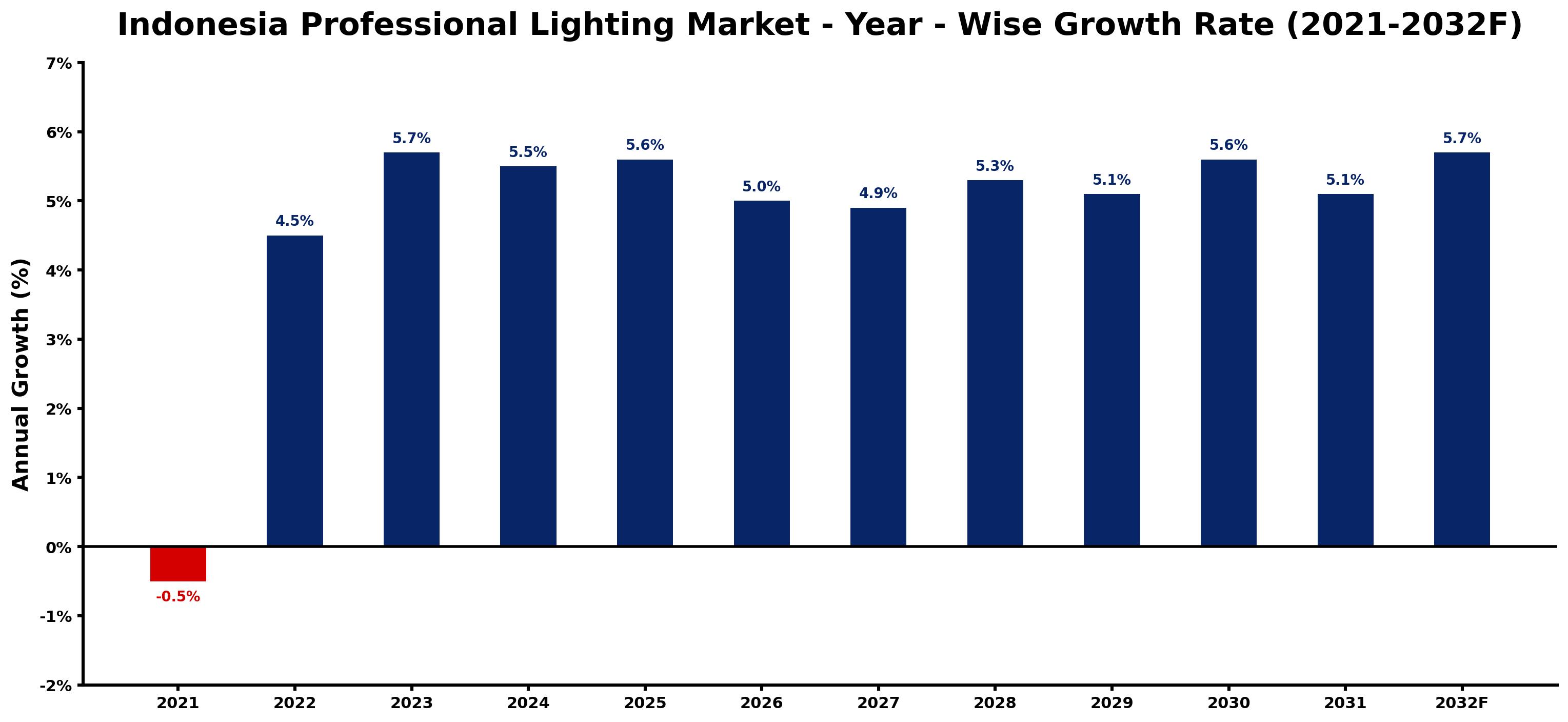
The table below presents the year wise growth rates along with the key drivers influencing the market
| Year | Growth Rate | Major Drivers |
| 2021 | -0.5% | Supply chain disruptions caused by the pandemic hindered project completions, leading to reduced investment in professional lighting. |
| 2022 | 4.5% | Construction projects in urban centers stimulated a need for advanced lighting systems. |
| 2023 | 5.7% | Increased focus on environmentally friendly practices influenced lighting choices among businesses. |
| 2024 | 5.5% | Technological improvements in LED lighting systems improved performance and reduced costs. |
| 2025 | 5.6% | Corporate sustainability goals encouraged investments in smart lighting technologies. |
| 2026 | 5.0% | Indonesia's hospitality sector experienced a boom, demanding unique lighting experiences. |
| 2027 | 4.9% | Growing urbanization trends necessitated smart lighting for safety and navigation. |
| 2028 | 5.3% | Rising competition among manufacturers fostered innovation in product offerings and designs. |
| 2029 | 5.1% | Architectural advancements in public spaces required modern lighting solutions to enhance aesthetics. |
| 2030 | 5.6% | Smart city projects catalyzed the integration of lighting with IoT and automation. |
| 2031 | 5.1% | Increased disposable incomes led to higher spending on premium lighting fixtures. |
| 2032 | 5.7% | Enhanced focus on wellness and ambiance transformed consumer preferences in lighting design. |
Note - Market size estimations and growth projections presented in this report are based on 6Wresearch's advanced forecasting approach, validated with industry datasets as of June 2026.
Indonesia Professional Lighting Market Synopsis
The Indonesia Professional Lighting Market is projected to reach 5.0% and witness significant growth during the forecast period (2026-2032). This growth is anticipated at a compound annual growth rate (CAGR) of 8.8%, primarily driven by the increasing demand for energy-efficient and cost-effective lighting solutions. The rising awareness among consumers about the benefits of LED technology is amplifying this trend, while supportive government initiatives such as tax exemptions on LED products are expected to further stimulate investments in the sector over the coming years.
Indonesia Professional Lighting Market Growth Drivers
Several factors are contributing to the positive trajectory of the Indonesia Professional Lighting Market:
- The increasing demand for energy-efficient lighting solutions is a significant driver of market growth. As concern over energy conservation intensifies, businesses and consumers are increasingly opting for advanced lighting solutions that minimize electricity consumption.
- LED technology's superior efficiency compared to traditional light sources, such as fluorescent lamps and incandescent bulbs, has made it a popular choice among manufacturers and suppliers, paving the way for increased market competitiveness.
- Additionally, the low installation and maintenance costs associated with professional LED lights make them an attractive option for end users in Indonesia looking for economical yet high-quality lighting solutions.
- Furthermore, the international standards set by organizations such as the International Electrotechnical Commission (IEC) ensure that consumers feel confident in the reliability and performance of professional lighting products, encouraging market growth.
- Finally, the shift toward smart lighting systems is gaining traction, as these solutions offer enhanced control, flexibility, and energy savings, appealing to both commercial and residential sectors.
Indonesia Professional Lighting Market Challenges and Restraints
Despite the promising growth, the Indonesia Professional Lighting Market faces several challenges that could impede progress:
- A notable challenge is the lack of awareness among consumers regarding the advantages of professional lighting products. Many potential buyers remain uninformed about the different types and benefits of modern lighting solutions, hindering their purchasing decisions.
- The high import duty structure for lighting products also presents a barrier. Imported goods typically incur higher taxes than locally manufactured items, making them less appealing to cost-sensitive consumers.
- The lingering impacts of the COVID-19 pandemic have resulted in sluggish economic activity, which may affect consumer spending in the professional lighting sector.
- Additionally, manufacturers must continually adapt to rapid technological advancements, which can require significant investment in research and development to remain competitive.
- Lastly, fluctuations in raw material prices and supply chain disruptions may create volatility in production costs, potentially leading to increased prices for end users.
Indonesia Professional Lighting Market Government Investment and Initiatives
The Indonesian government has introduced several initiatives aimed at bolstering the professional lighting market, reflecting a commitment to sustainable development:
- Government policies encouraging the adoption of energy-efficient technologies are pivotal. This includes tax exemptions on LED products to incentivize businesses and consumers to transition from traditional lighting solutions.
- Investment in infrastructure developments is prioritized, with plans to integrate advanced lighting solutions into public spaces, enhancing energy efficiency and reducing operational costs.
- Public awareness campaigns focusing on the benefits of LED lighting are being launched to educate consumers about their advantages, including longevity and energy savings.
- Partnerships with private sectors are also encouraged, helping to facilitate research and development in the professional lighting industry and ensure the deployment of innovative technologies.
- Finally, the government's commitment to sustainability aligns with international agreements on climate change, further incentivizing investments into energy-efficient lighting systems.
Indonesia Professional Lighting Market Latest Developments (May 2025 - June 2026)
In the period between May 2025 and June 2026, several notable developments have been observed in the Indonesia Professional Lighting Market:
- The market has seen an uptick in the introduction of smart lighting solutions, which provide enhanced functionalities such as remote control and energy monitoring capabilities, catering to the evolving demands of modern consumers.
- There has been an increased focus on sustainability, with manufacturers increasingly prioritizing eco-friendly materials in their product lines, reflecting a growing consumer preference for environmentally conscious solutions.
- Industry participation in exhibitions and trade fairs has intensified, allowing companies to showcase innovations and foster partnerships, ultimately enhancing market visibility.
- Technological advancements in LED efficiency have been a major highlight, with products now offering improved luminosity and longer lifespans, thereby increasing their appeal.
- Finally, discussions around regulatory policies aimed at reducing import duties on lighting equipment have emerged, indicating potential for improved accessibility of international products in the Indonesian market.
Indonesia Professional Lighting Market - Key Attractiveness of the Report
- 10 Years of Market Numbers
- Historical Data Starting from 2022 to 2025
- Base Year: 2025
- Forecast Data until 2032
- Key Performance Indicators Impacting the Market
- Major Upcoming Developments and Projects
Key Highlights of the Report:
- Indonesia Professional Lighting Market Outlook
- Market Size of Indonesia Professional Lighting Market, 2025
- Forecast of Indonesia Professional Lighting Market, 2032
- Historical Data and Forecast of Indonesia Professional Lighting Revenues & Volume for the Period 2022-2032
- Indonesia Professional Lighting Market Trend Evolution
- Indonesia Professional Lighting Market Drivers and Challenges
- Indonesia Professional Lighting Price Trends
- Indonesia Professional Lighting Porter's Five Forces
- Indonesia Professional Lighting Industry Life Cycle
- Historical Data and Forecast of Indonesia Professional Lighting Market Revenues & Volume By Light Source for the Period 2022-2032
- Historical Data and Forecast of Indonesia Professional Lighting Market Revenues & Volume By LEDs for the Period 2022-2032
- Historical Data and Forecast of Indonesia Professional Lighting Market Revenues & Volume By Others (halogen lamps, xenon bulbs, incandescent lamps) for the Period 2022-2032
- Historical Data and Forecast of Indonesia Professional Lighting Market Revenues & Volume By Applications for the Period 2022-2032
- Historical Data and Forecast of Indonesia Professional Lighting Market Revenues & Volume By Entertainment for the Period 2022-2032
- Historical Data and Forecast of Indonesia Professional Lighting Market Revenues & Volume By Stage lighting for the Period 2022-2032
- Historical Data and Forecast of Indonesia Professional Lighting Market Revenues & Volume By Medical for the Period 2022-2032
- Historical Data and Forecast of Indonesia Professional Lighting Market Revenues & Volume By UV Lamps for the Period 2022-2032
- Historical Data and Forecast of Indonesia Professional Lighting Market Revenues & Volume By Others for the Period 2022-2032
- Indonesia Professional Lighting Import Export Trade Statistics
- Market Opportunity Assessment By Light Source
- Market Opportunity Assessment By Applications
- Indonesia Professional Lighting Top Companies Market Share
- Indonesia Professional Lighting Competitive Benchmarking By Technical and Operational Parameters
- Indonesia Professional Lighting Company Profiles
- Indonesia Professional Lighting Key Strategic Recommendations






































