Indonesia Radio Remote Control Equipment Market Size, Share & Growth Rate
The Indonesia Radio Remote Control Equipment Market was estimated at USD 331 Million in 2025 and is projected to reach USD 438 Million by 2032, growing at a CAGR of 4.1% from 2026 to 2032. This growth trajectory is significantly driven by the increasing adoption of automation across various sectors such as automotive and healthcare, where the demand for efficient remote-controlled machinery is becoming essential. Additionally, the rising focus on workplace safety and operational efficiency is pushing industries to integrate advanced remote control solutions, particularly in manufacturing environments.
Indonesia Radio Remote Control Equipment Market Year-wise Growth Rate and Key Drivers
This graph highlights how the Indonesia Radio Remote Control Equipment Market has steadily grown over the years, supported by major growth factors.
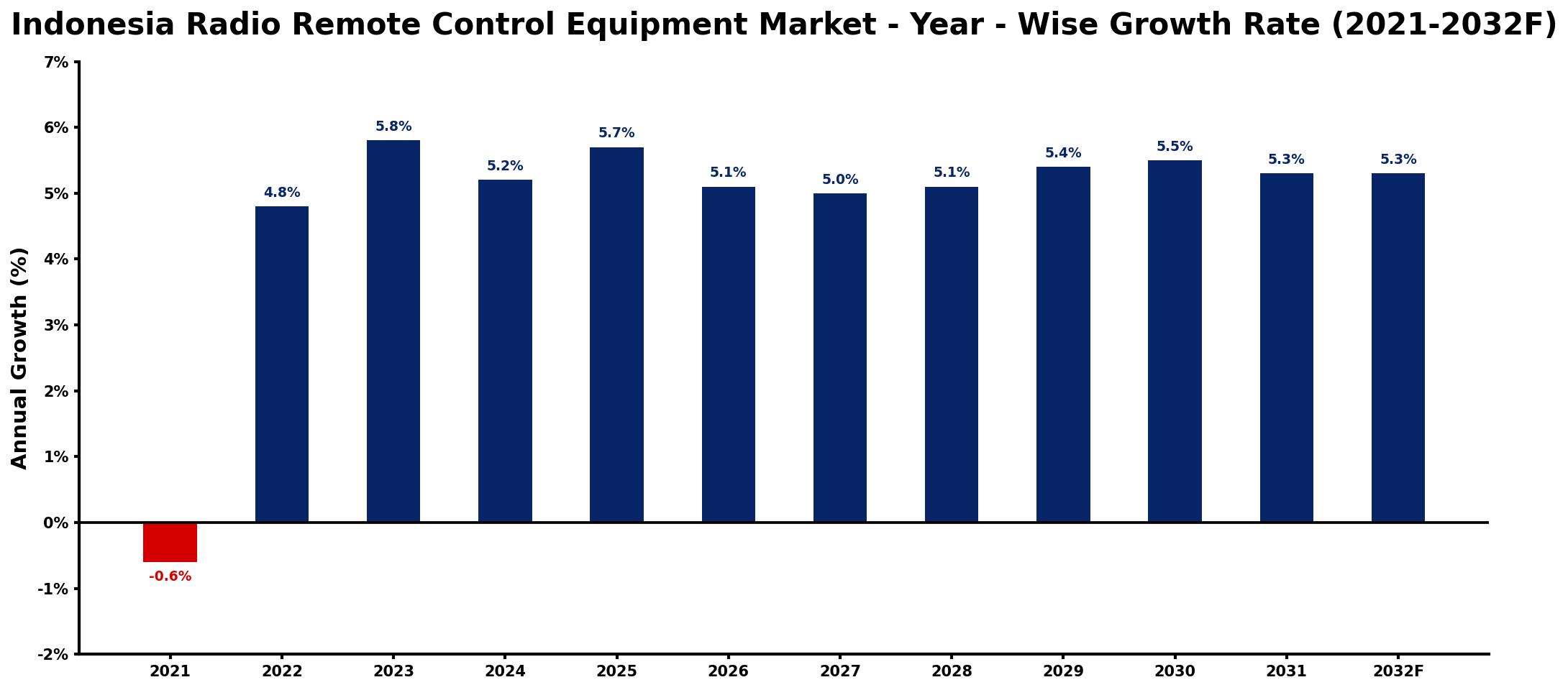
The table below presents the year‑wise growth rates along with the key drivers influencing the market
| Year | Growth Rate | Major Drivers |
| 2021 | -0.6% | decreased consumer demand for technology |
| 2022 | 4.8% | rising adoption of smart technologies |
| 2023 | 5.8% | increased investment in automation |
| 2024 | 5.2% | growth in home entertainment systems |
| 2025 | 5.7% | expansion of IoT applications |
| 2026 | 5.1% | emergence of new market entrants |
| 2027 | 5.0% | increased focus on energy efficiency |
| 2028 | 5.1% | growing trend of wireless connectivity |
| 2029 | 5.4% | enhanced consumer interest in convenience |
| 2030 | 5.5% | development of advanced user interfaces |
| 2031 | 5.3% | surge in online shopping platforms |
| 2032 | 5.3% | continuing evolution of smart homes |
Note: Market size estimations and growth projections presented in this report are based on 6Wresearch's proprietary forecasting methodology, utilizing the latest available industry data, government publications, and primary research inputs.
Indonesia Radio Remote Control Equipment Market Synopsis
One of the strongest forces shaping the Indonesia Radio Remote Control Equipment Market is the escalating demand for industrial automation. As manufacturers in Indonesia strive for higher efficiency and productivity, remote control equipment is becoming pivotal in streamlining operations, minimizing human error, and enhancing safety protocols. Furthermore, the growing prevalence of robotics in sectors like aerospace and defense amplifies the market's appeal, fostering a robust environment for innovations.
The healthcare industry is also a significant catalyst for growth within this market. With the rising incidence of diseases such as cancer, the increasing integration of radio remote control equipment in medical applications emphasizes the need for precise and safe handling of equipment. This trend is further supported by heightened awareness regarding the importance of early diagnosis and treatment, particularly in urban areas, boosting the demand for advanced medical technologies.
Indonesia Radio Remote Control Equipment Market Key Takeaways
- Continuous advancements in automation technologies are significantly influencing the demand for remote control equipment across various sectors.
- The growing emphasis on workplace safety is driving industries to adopt innovative solutions to mitigate risks.
- Urbanization and increased awareness of health issues are propelling the growth of remote control applications in the healthcare sector.
- Regulatory frameworks are evolving to accommodate innovations in radio communication devices, impacting market dynamics.
- The rebound of the manufacturing sector post-COVID-19 is expected to invigorate market growth in the coming years.
Evaluation of Restraints in Indonesia Radio Remote Control Equipment Market
Despite the promising growth outlook, several real restraints may hinder the market's progress. Interference issues in radio frequency bands remain a concern for users, potentially impacting the reliability of remote control equipment. Moreover, navigating the complex landscape of regulatory compliance for communication devices can be challenging, which may deter smaller players from entering the market. Furthermore, the pressing need for robust and secure remote control solutions poses a challenge, as manufacturers must invest in the research and development of technologies that ensure data integrity and operational security.
Indonesia Radio Remote Control Equipment Market Trends
Current trends indicate a shift towards integrating smart technologies and IoT capabilities into radio remote control equipment. These innovations are enhancing the functionality and usability of remote controls, allowing for more sophisticated applications across various sectors. Additionally, as industries become more aware of environmental impacts, there is a growing inclination towards developing energy-efficient solutions, which is influencing product design and manufacturing processes.
Indonesia Radio Remote Control Equipment Market Opportunities
There are genuine growth opportunities in enhancing remote control applications within the healthcare sector, particularly in telemedicine and robotic surgery. The automotive industry's increasing shift towards automation and electric vehicles also presents a substantial opportunity for remote control technologies. Investments in research and development for innovative solutions tailored to specific industry needs can provide a competitive edge and stimulate market expansion.
Government Initiatives in the Indonesia Radio Remote Control Equipment Market
The Indonesian government has been actively promoting initiatives aimed at enhancing industrial automation and technological advancement. Various public spending programs focus on supporting research and development in communication technologies, which is beneficial for the radio remote control equipment market. Additionally, incentives for adopting modern technologies in manufacturing processes are encouraging businesses to invest in advanced remote control solutions, bolstering overall market growth.
Future Insights of the Indonesia Radio Remote Control Equipment Market
Looking ahead to 2026-2032, the Indonesia Radio Remote Control Equipment Market is poised for significant growth. The convergence of various industries towards automation, combined with ongoing technological advancements, is likely to stimulate demand further. As challenges such as regulatory compliance are addressed, and with the anticipated recovery of the manufacturing sector, the market is expected to flourish. Companies that leverage innovative technologies while ensuring compliance and security will be well-positioned to capture the emerging opportunities.
Indonesia Radio Remote Control Equipment Market Latest Developments (2025 - 2026)
In the past year, the Indonesia Radio Remote Control Equipment Market has seen a notable shift towards integrating AI and IoT capabilities into remote control systems, enhancing operational efficiency across sectors. Additionally, there has been an uptick in strategic partnerships between technology providers and industrial players, aimed at fostering innovation and improving product offerings. Regulatory bodies are also advancing their frameworks to better accommodate the rapid evolution of communication technologies, signaling a positive outlook for future market developments.
Indonesia Radio Remote Control Equipment Market - Key Attractiveness of the Report
- 10 Years of Market Numbers
- Historical Data Starting from 2022 to 2025
- Base Year: 2025
- Forecast Data until 2032
- Key Performance Indicators Impacting the Market
- Major Upcoming Developments and Projects
Key Highlights of the Report:
- Indonesia Radio Remote Control Equipment Market Outlook
- Market Size of Indonesia Radio Remote Control Equipment Market, 2025
- Forecast of Indonesia Radio Remote Control Equipment Market, 2032
- Historical Data and Forecast of Indonesia Radio Remote Control Equipment Revenues & Volume for the Period 2022-2032F
- Indonesia Radio Remote Control Equipment Market Trend Evolution
- Indonesia Radio Remote Control Equipment Market Drivers and Challenges
- Indonesia Radio Remote Control Equipment Price Trends
- Indonesia Radio Remote Control Equipment Porter's Five Forces
- Indonesia Radio Remote Control Equipment Industry Life Cycle
- Historical Data and Forecast of Indonesia Radio Remote Control Equipment Market Revenues & Volume By Type for the Period 2022-2032F
- Historical Data and Forecast of Indonesia Radio Remote Control Equipment Market Revenues & Volume By Pushbutton for the Period 2022-2032F
- Historical Data and Forecast of Indonesia Radio Remote Control Equipment Market Revenues & Volume By Joystick for the Period 2022-2032F
- Historical Data and Forecast of Indonesia Radio Remote Control Equipment Market Revenues & Volume By Application for the Period 2022-2032F
- Historical Data and Forecast of Indonesia Radio Remote Control Equipment Market Revenues & Volume By Industry & Logistics for the Period 2022-2032F
- Historical Data and Forecast of Indonesia Radio Remote Control Equipment Market Revenues & Volume By Construction Crane for the Period 2022-2032F
- Historical Data and Forecast of Indonesia Radio Remote Control Equipment Market Revenues & Volume By Mobile Hydraulics for the Period 2022-2032F
- Historical Data and Forecast of Indonesia Radio Remote Control Equipment Market Revenues & Volume By Forestry for the Period 2022-2032F
- Historical Data and Forecast of Indonesia Radio Remote Control Equipment Market Revenues & Volume By Mining for the Period 2022-2032F
- Historical Data and Forecast of Indonesia Radio Remote Control Equipment Market Revenues & Volume By Others for the Period 2022-2032F
- Indonesia Radio Remote Control Equipment Import Export Trade Statistics
- Market Opportunity Assessment By Type
- Market Opportunity Assessment By Application
- Indonesia Radio Remote Control Equipment Top Companies Market Share
- Indonesia Radio Remote Control Equipment Competitive Benchmarking By Technical and Operational Parameters
- Indonesia Radio Remote Control Equipment Company Profiles
- Indonesia Radio Remote Control Equipment Key Strategic Recommendations






































