Indonesia Radioactive Waste Management Market Size, Share & Growth Rate
The Indonesia Radioactive Waste Management Market was estimated at USD 263 Million in 2025 and is projected to reach USD 349 Million by 2032, growing at a CAGR of 4.1% from 2026 to 2032. This growth trajectory reflects the country's increasing reliance on nuclear technology for energy production and research. As nuclear energy gains traction as a viable alternative to fossil fuels, the urgency for efficient radioactive waste management escalates, prompting investment in both advanced technologies and regulatory frameworks.
Indonesia Radioactive Waste Management Market Year-wise Growth Rate and Key Drivers
This graph highlights how the Indonesia Radioactive Waste Management Market has steadily grown over the years, supported by major growth factors.
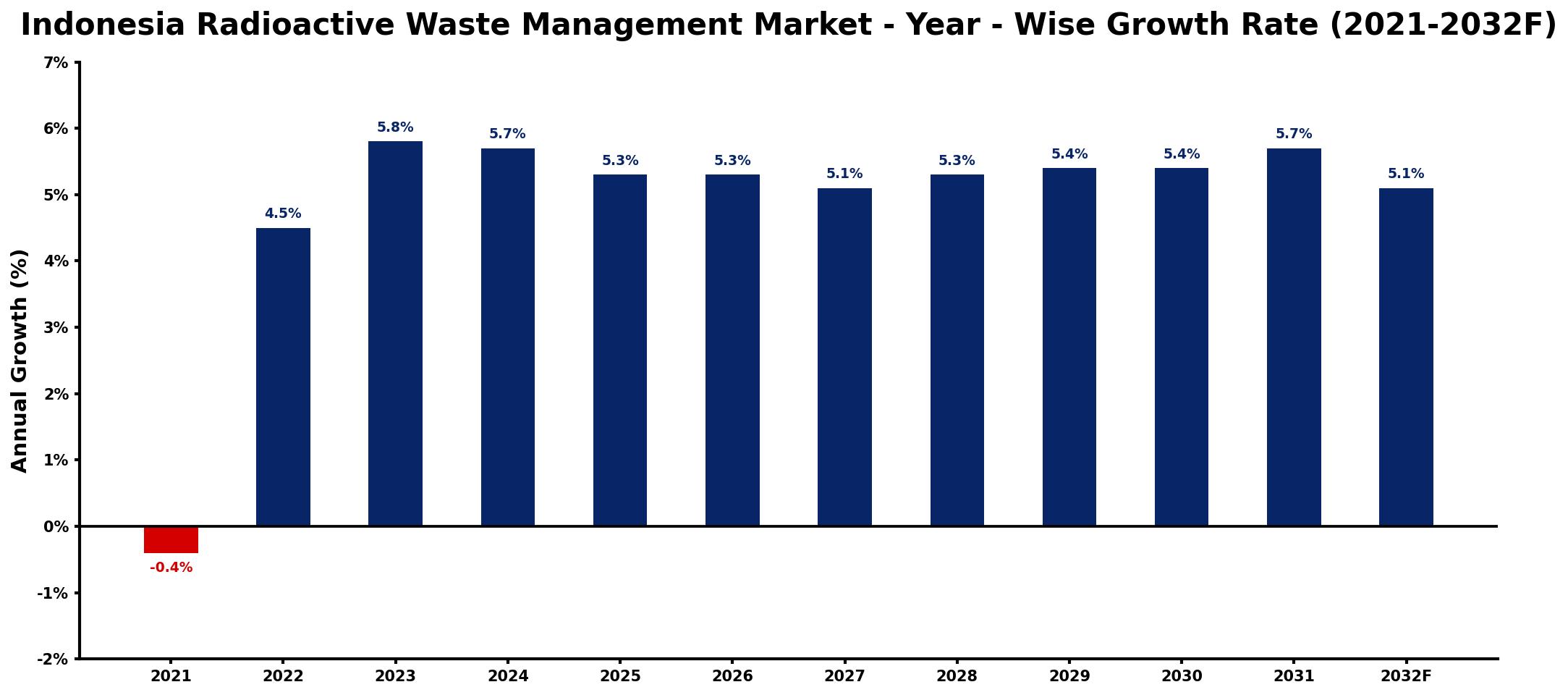
The table below presents the year‑wise growth rates along with the key drivers influencing the market
| Year | Growth Rate | Major Drivers |
| 2021 | -0.4% | decrease in regulatory investments |
| 2022 | 4.5% | rising public health awareness |
| 2023 | 5.8% | increased industrial compliance standards |
| 2024 | 5.7% | growing energy sector investments |
| 2025 | 5.3% | expansion of environmental policies |
| 2026 | 5.3% | enhanced technology adoption rates |
| 2027 | 5.1% | improved raw material availability |
| 2028 | 5.3% | growing international cooperation efforts |
| 2029 | 5.4% | rising demand for sustainable solutions |
| 2030 | 5.4% | strengthened community engagement initiatives |
| 2031 | 5.7% | increased funding for research projects |
| 2032 | 5.1% | growing emphasis on safety protocols |
Note: Market size estimations and growth projections presented in this report are based on 6Wresearch's proprietary forecasting methodology, utilizing the latest available industry data, government publications, and primary research inputs.
Indonesia Radioactive Waste Management Market Synopsis
Recently, Indonesia has made strides in enhancing its nuclear capabilities, which has catalyzed a burgeoning interest in radioactive waste management. This market is now on a trajectory toward significant development, driven by both governmental initiatives and private sector investment in safety and compliance measures.
Looking ahead, the market is expected to mature as public awareness about nuclear safety grows alongside the country's efforts to establish a robust regulatory environment. However, the need to address public concerns about environmental impacts and safety will remain pivotal as Indonesia navigates its nuclear future.
Indonesia Radioactive Waste Management Market Key Takeaways
- The market is poised for steady growth, influenced by regulatory frameworks and the increasing use of nuclear technology.
- Investment in waste management technologies is crucial for safe disposal and public safety compliance.
- Public perception and environmental concerns pose ongoing challenges for market players.
- Governmental support is essential for developing infrastructure and establishing effective disposal solutions.
- COVID-19 has impacted project timelines, highlighting the need for adaptive strategies in waste management.
Evaluation of Restraints in Indonesia Radioactive Waste Management Market
Despite the promising growth outlook, the Indonesia Radioactive Waste Management market faces significant constraints. One of the foremost challenges is the establishment of safe disposal facilities that meet both domestic and international standards. Long-term storage solutions for various types of radioactive waste are not yet fully developed, which raises concerns about environmental safety and public health. Additionally, the complexities of regulatory compliance can hinder market entry and expansion, especially as public opinion remains sensitive to issues surrounding nuclear waste management. These factors necessitate a careful balancing act among stakeholders to ensure both safety and market viability.
Indonesia Radioactive Waste Management Market Trends
The landscape of the Indonesia Radioactive Waste Management market is being shaped by several notable trends. Increasing investments in cutting-edge waste treatment technologies, such as advanced thermal treatment and immobilization methods, are gaining traction. Additionally, partnerships between governmental agencies and private enterprises are becoming more common, facilitating knowledge transfer and resource sharing. A growing emphasis on sustainability is also prompting stakeholders to explore eco-friendly disposal methods, reflecting a broader global trend toward environmental stewardship in nuclear waste management.
Indonesia Radioactive Waste Management Market Opportunities
Emerging opportunities abound in the Indonesia Radioactive Waste Management market. The expansion of nuclear facilities presents a significant demand for comprehensive waste management solutions, creating a fertile ground for innovation and investment. Furthermore, the increasing focus on international collaborations and adherence to global standards offers avenues for technological advancements. Companies that can navigate regulatory landscapes and align with public safety concerns may find substantial prospects in providing tailored waste management services and infrastructure solutions.
Government Initiatives in the Indonesia Radioactive Waste Management Market
The Indonesian government is actively enhancing its commitment to radioactive waste management through various initiatives. The National Nuclear Energy Agency (BATAN) is at the forefront, spearheading policies aimed at ensuring safe disposal practices and regulatory compliance. Investments in public infrastructure are being prioritized, along with educational programs aimed at increasing public awareness and trust in nuclear safety. These measures reflect a robust framework designed to bolster the market while adhering to international standards and best practices.
Future Insights of the Indonesia Radioactive Waste Management Market
Looking to the future, the Indonesia Radioactive Waste Management market is poised for evolution between 2026 and 2032. As the country continues to embrace nuclear energy, the emphasis on developing comprehensive waste management solutions will intensify. Enhanced regulatory frameworks and increased public engagement are anticipated to reshape market dynamics. The intersection of innovation in waste treatment technologies and strong governmental support will be crucial in driving the sector forward, positioning Indonesia as a model for responsible nuclear waste management in the region.
Indonesia Radioactive Waste Management Market Latest Developments (2025 - 2026)
In the recent past, the Indonesia Radioactive Waste Management market has seen various developments that indicate a shift towards more comprehensive safety practices. Initiatives to upgrade disposal facilities and enhance training for personnel involved in waste management have gained momentum. Additionally, partnerships between local and international entities are emerging, reflecting a growing interest in shared expertise and resource allocation for more effective waste handling solutions. As these developments unfold, they signal a commitment to improving both safety and environmental standards in the sector.
Indonesia Radioactive Waste Management Market - Key Attractiveness of the Report
- 10 Years of Market Numbers
- Historical Data Starting from 2022 to 2025
- Base Year: 2025
- Forecast Data until 2032
- Key Performance Indicators Impacting the Market
- Major Upcoming Developments and Projects
Key Highlights of the Report:
- Indonesia Radioactive Waste Management Market Outlook
- Market Size of Indonesia Radioactive Waste Management Market, 2025
- Forecast of Indonesia Radioactive Waste Management Market, 2032
- Historical Data and Forecast of Indonesia Radioactive Waste Management Revenues & Volume for the Period 2022-2032F
- Indonesia Radioactive Waste Management Market Trend Evolution
- Indonesia Radioactive Waste Management Market Drivers and Challenges
- Indonesia Radioactive Waste Management Price Trends
- Indonesia Radioactive Waste Management Porter's Five Forces
- Indonesia Radioactive Waste Management Industry Life Cycle
- Historical Data and Forecast of Indonesia Radioactive Waste Management Market Revenues & Volume By Type for the Period 2022-2032F
- Historical Data and Forecast of Indonesia Radioactive Waste Management Market Revenues & Volume By Exempt Waste and Very Low-Level Waste(VLLW) for the Period 2022-2032F
- Historical Data and Forecast of Indonesia Radioactive Waste Management Market Revenues & Volume By Low-Level Waste(LLW) for the Period 2022-2032F
- Historical Data and Forecast of Indonesia Radioactive Waste Management Market Revenues & Volume By Intermediate-Level Waste(ILW) for the Period 2022-2032F
- Historical Data and Forecast of Indonesia Radioactive Waste Management Market Revenues & Volume By High-Level Waste(HLW) for the Period 2022-2032F
- Historical Data and Forecast of Indonesia Radioactive Waste Management Market Revenues & Volume By Application for the Period 2022-2032F
- Historical Data and Forecast of Indonesia Radioactive Waste Management Market Revenues & Volume By Industrial for the Period 2022-2032F
- Historical Data and Forecast of Indonesia Radioactive Waste Management Market Revenues & Volume By Utility for the Period 2022-2032F
- Indonesia Radioactive Waste Management Import Export Trade Statistics
- Market Opportunity Assessment By Type
- Market Opportunity Assessment By Application
- Indonesia Radioactive Waste Management Top Companies Market Share
- Indonesia Radioactive Waste Management Competitive Benchmarking By Technical and Operational Parameters
- Indonesia Radioactive Waste Management Company Profiles
- Indonesia Radioactive Waste Management Key Strategic Recommendations






































