Indonesia Radiotherapy Market Size, Share & Growth Rate
The Indonesia Radiotherapy Market was estimated at USD 355 Million in 2025 and is projected to reach USD 469 Million by 2032, growing at a CAGR of 4.1% from 2026 to 2032. This growth trajectory is significantly driven by the increasing incidence of cancer and the rising number of healthcare facilities offering advanced radiotherapy services. Furthermore, continuous advancements in radiotherapy technology and a government-led emphasis on cancer awareness and treatment are reinforcing the market's expansion.
Indonesia Radiotherapy Market Year-wise Growth Rate and Key Drivers
This graph highlights how the Indonesia Radiotherapy Market has steadily grown over the years, supported by major growth factors.
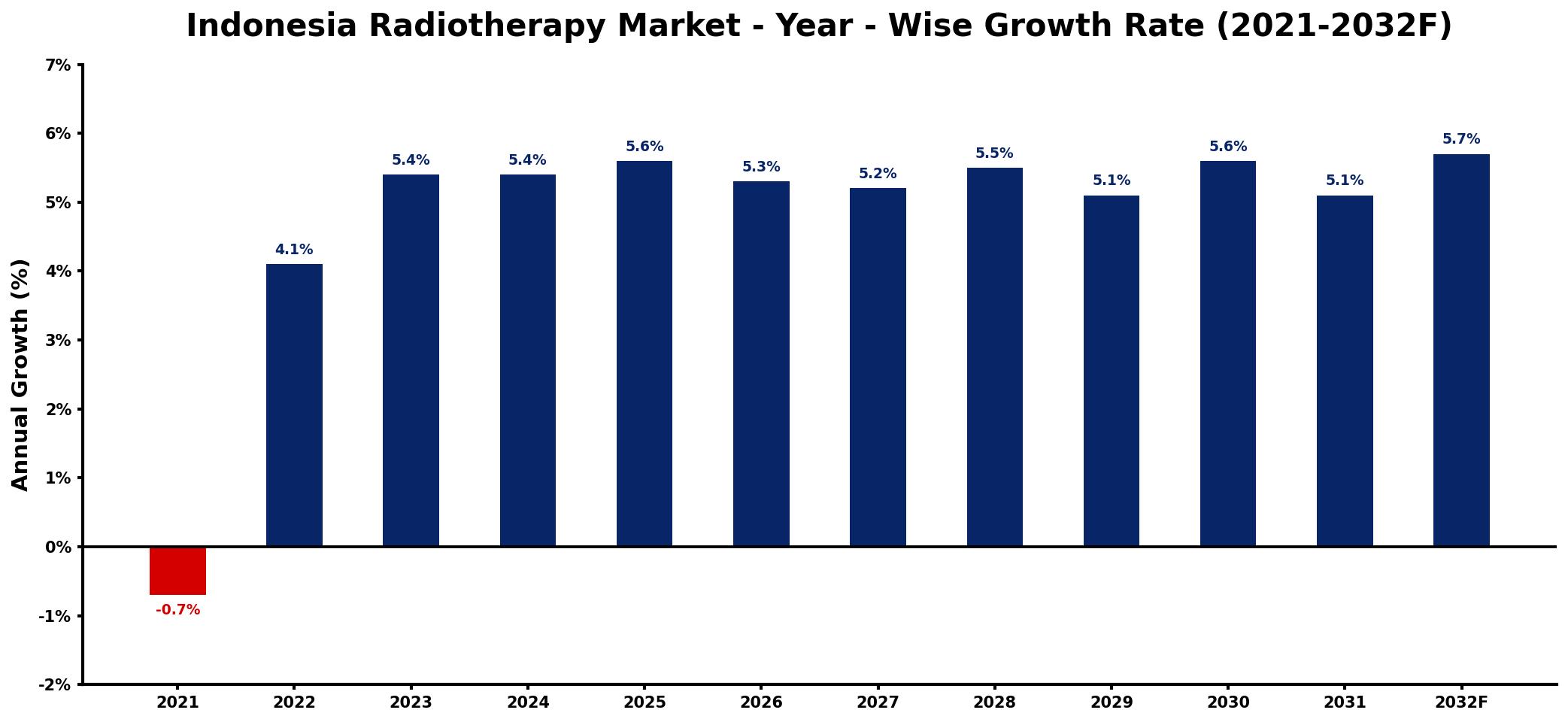
The table below presents the year‑wise growth rates along with the key drivers influencing the market
| Year | Growth Rate | Major Drivers |
| 2021 | -0.7% | decrease in healthcare investments |
| 2022 | 4.1% | rise in cancer treatment awareness |
| 2023 | 5.4% | expansion of healthcare infrastructure |
| 2024 | 5.4% | increased government health funding |
| 2025 | 5.6% | growing population aging demographics |
| 2026 | 5.3% | advancements in medical technology |
| 2027 | 5.2% | surge in patient treatment options |
| 2028 | 5.5% | enhanced healthcare service accessibility |
| 2029 | 5.1% | growth in private healthcare facilities |
| 2030 | 5.6% | rising demand for innovative therapies |
| 2031 | 5.1% | strengthened partnerships in healthcare |
| 2032 | 5.7% | improved patient education initiatives |
Note: Market size estimations and growth projections presented in this report are based on 6Wresearch's proprietary forecasting methodology, utilizing the latest available industry data, government publications, and primary research inputs.
Indonesia Radiotherapy Market Synopsis
The radiotherapy market in Indonesia has witnessed notable growth, spurred by a surge in cancer cases and the subsequent demand for effective treatment options. As hospitals enhance their capabilities and the government promotes cancer awareness campaigns, the market is positioned for further acceleration in the coming years.
In contrast to the recent momentum, the future of the Indonesia radiotherapy market looks promising, characterized by the introduction of modern equipment and innovative treatment methodologies. This evolution is expected to meet the healthcare needs of an increasingly aware and demanding patient population.
Indonesia Radiotherapy Market Key Takeaways
- The market is anticipated to grow substantially due to rising cancer rates and increasing healthcare investments.
- Government initiatives aimed at enhancing cancer treatment facilities are set to drive market advancements.
- Technological innovations in radiotherapy equipment are enhancing treatment effectiveness and patient outcomes.
- Ongoing educational efforts are aimed at improving awareness regarding early cancer detection among the populace.
- The recovery from the COVID-19 pandemic is expected to lead to a renewed focus on cancer treatment services.
Evaluation of Restraints in Indonesia Radiotherapy Market
Despite the market's promising outlook, several factors may hinder its progress. Access to cutting-edge radiotherapy equipment remains limited in certain regions, impacting treatment accessibility for many patients. Moreover, the ongoing need for specialized training for medical professionals in the use of advanced technology poses a challenge. Enhancing patient awareness about available treatment options is crucial, as is ensuring adherence to radiation safety standards. These restraints can impede the overall growth trajectory unless addressed promptly.
Indonesia Radiotherapy Market Trends
Current trends in the Indonesia radiotherapy market include a shift towards personalized treatment approaches and the integration of AI technologies to optimize radiotherapy protocols. Additionally, there is a growing emphasis on non-invasive techniques and innovative delivery systems to enhance patient comfort and reduce recovery times. As healthcare infrastructure develops, there is also a noticeable push towards collaborative care models that combine radiotherapy with other treatment modalities.
Indonesia Radiotherapy Market Opportunities
The potential for growth in the Indonesia radiotherapy market lies in several key areas. Investment in public-private partnerships can facilitate improved access to advanced radiotherapy technologies, particularly in underserved regions. Expansion of training programs for healthcare professionals will not only address equipment usage but also enhance treatment quality. Furthermore, increased governmental funding and support for cancer research initiatives can catalyze innovation and lead to the development of more effective therapeutic options.
Government Initiatives in the Indonesia Radiotherapy Market
The Indonesian government is actively implementing policies aimed at improving cancer treatment services nationwide. Initiatives include the launch of awareness campaigns focused on early cancer detection and treatment options. Additionally, public funding for advanced medical technologies is being prioritized to bolster healthcare infrastructure, allowing hospitals to upgrade their radiotherapy capabilities. These efforts are critical in cultivating a healthier society and ensuring that effective cancer treatments are accessible to all.
Future Insights of the Indonesia Radiotherapy Market
Looking ahead to the period from 2026 to 2032, the Indonesia radiotherapy market is expected to experience steady growth fueled by continual advancements in treatment technologies and expanding healthcare facilities. Rising public awareness and government support are likely to enhance patient access to necessary services. As the population ages and cancer prevalence increases, the market's demand for innovative radiotherapy solutions will continue to grow, ensuring a robust environment for investment and development.
Indonesia Radiotherapy Market Latest Developments (2025 - 2026)
Recent developments in the Indonesia radiotherapy market indicate a strong trend towards modernization and enhancement of treatment facilities. Several hospitals are reported to be upgrading their equipment with the latest radiotherapy technologies, aiming to improve patient outcomes. Additionally, there has been a rise in collaborative initiatives between healthcare institutions and government bodies focused on training programs and awareness campaigns designed to educate the public on cancer prevention and treatment.
Indonesia Radiotherapy Market - Key Attractiveness of the Report
- 10 Years of Market Numbers
- Historical Data Starting from 2022 to 2025
- Base Year: 2025
- Forecast Data until 2032
- Key Performance Indicators Impacting the Market
- Major Upcoming Developments and Projects
Key Highlights of the Report:
- Indonesia Radiotherapy Market Outlook
- Market Size of Indonesia Radiotherapy Market, 2025
- Forecast of Indonesia Radiotherapy Market, 2032
- Historical Data and Forecast of Indonesia Radiotherapy Revenues & Volume for the Period 2022-2032F
- Indonesia Radiotherapy Market Trend Evolution
- Indonesia Radiotherapy Market Drivers and Challenges
- Indonesia Radiotherapy Price Trends
- Indonesia Radiotherapy Porter's Five Forces
- Indonesia Radiotherapy Industry Life Cycle
- Historical Data and Forecast of Indonesia Radiotherapy Market Revenues & Volume By Product for the Period 2022-2032F
- Historical Data and Forecast of Indonesia Radiotherapy Market Revenues & Volume By External Beam Radiotherapy for the Period 2022-2032F
- Historical Data and Forecast of Indonesia Radiotherapy Market Revenues & Volume By Electron-emitting High-energy Linear Accelerators for the Period 2022-2032F
- Historical Data and Forecast of Indonesia Radiotherapy Market Revenues & Volume By Conventional Linear Accelerators for the Period 2022-2032F
- Historical Data and Forecast of Indonesia Radiotherapy Market Revenues & Volume By Stereotactic Advanced Electron/Cobalt-60 Linear Accelerators for the Period 2022-2032F
- Historical Data and Forecast of Indonesia Radiotherapy Market Revenues & Volume By Conventional Cobalt-60 Teletherapy Units for the Period 2022-2032F
- Historical Data and Forecast of Indonesia Radiotherapy Market Revenues & Volume By Particle Therapy Systems for the Period 2022-2032F
- Historical Data and Forecast of Indonesia Radiotherapy Market Revenues & Volume By Internal Beam Radiotherapy/Brachytherapy for the Period 2022-2032F
- Historical Data and Forecast of Indonesia External Beam Radiotherapy Radiotherapy Market Revenues & Volume By Systemic Radiotherapy for the Period 2022-2032F
- Historical Data and Forecast of Indonesia Radiotherapy Market Revenues & Volume By Application for the Period 2022-2032F
- Historical Data and Forecast of Indonesia Radiotherapy Market Revenues & Volume By External Beam Radiotherapy for the Period 2022-2032F
- Historical Data and Forecast of Indonesia Radiotherapy Market Revenues & Volume By Internal Beam Radiotherapy/Brachytherapy for the Period 2022-2032F
- Historical Data and Forecast of Indonesia Radiotherapy Market Revenues & Volume By Procedure for the Period 2022-2032F
- Historical Data and Forecast of Indonesia Radiotherapy Market Revenues & Volume By External Beam Radiotherapy for the Period 2022-2032F
- Historical Data and Forecast of Indonesia Radiotherapy Market Revenues & Volume By Internal Beam Radiotherapy/Brachytherapy for the Period 2022-2032F
- Historical Data and Forecast of Indonesia Radiotherapy Market Revenues & Volume By Systemic Radiotherapy for the Period 2022-2032F
- Historical Data and Forecast of Indonesia Radiotherapy Market Revenues & Volume By Intravenous Radiotherapy for the Period 2022-2032F
- Historical Data and Forecast of Indonesia Radiotherapy Market Revenues & Volume By Oral Radiotherapy for the Period 2022-2032F
- Historical Data and Forecast of Indonesia Radiotherapy Market Revenues & Volume By Instillation Radiotherapy for the Period 2022-2032F
- Historical Data and Forecast of Indonesia Radiotherapy Market Revenues & Volume By End User for the Period 2022-2032F
- Historical Data and Forecast of Indonesia Radiotherapy Market Revenues & Volume By Hospitals for the Period 2022-2032F
- Historical Data and Forecast of Indonesia Radiotherapy Market Revenues & Volume By Independent Radiotherapy Centers for the Period 2022-2032F
- Indonesia Radiotherapy Import Export Trade Statistics
- Market Opportunity Assessment By Product
- Market Opportunity Assessment By Application
- Market Opportunity Assessment By Procedure
- Market Opportunity Assessment By End User
- Indonesia Radiotherapy Top Companies Market Share
- Indonesia Radiotherapy Competitive Benchmarking By Technical and Operational Parameters
- Indonesia Radiotherapy Company Profiles
- Indonesia Radiotherapy Key Strategic Recommendations






































