Indonesia Revolvers Market Size, Share & Growth Rate
The Indonesia Revolvers Market was estimated at USD 1463 Million in 2025 and is projected to reach USD 2215 Million by 2032, growing at a CAGR of 6.1% from 2026 to 2032. This growth trajectory is largely driven by the increasing demand for revolvers among law enforcement and licensed security personnel, as well as a burgeoning interest in personal safety and home protection among civilians. However, the market's expansion is tempered by stringent gun regulations that limit civilian ownership and the broader implications of public safety considerations.
Indonesia Revolvers Market Year-wise Growth Rate and Key Drivers
This graph highlights how the Indonesia Revolvers Market has steadily grown over the years, supported by major growth factors.
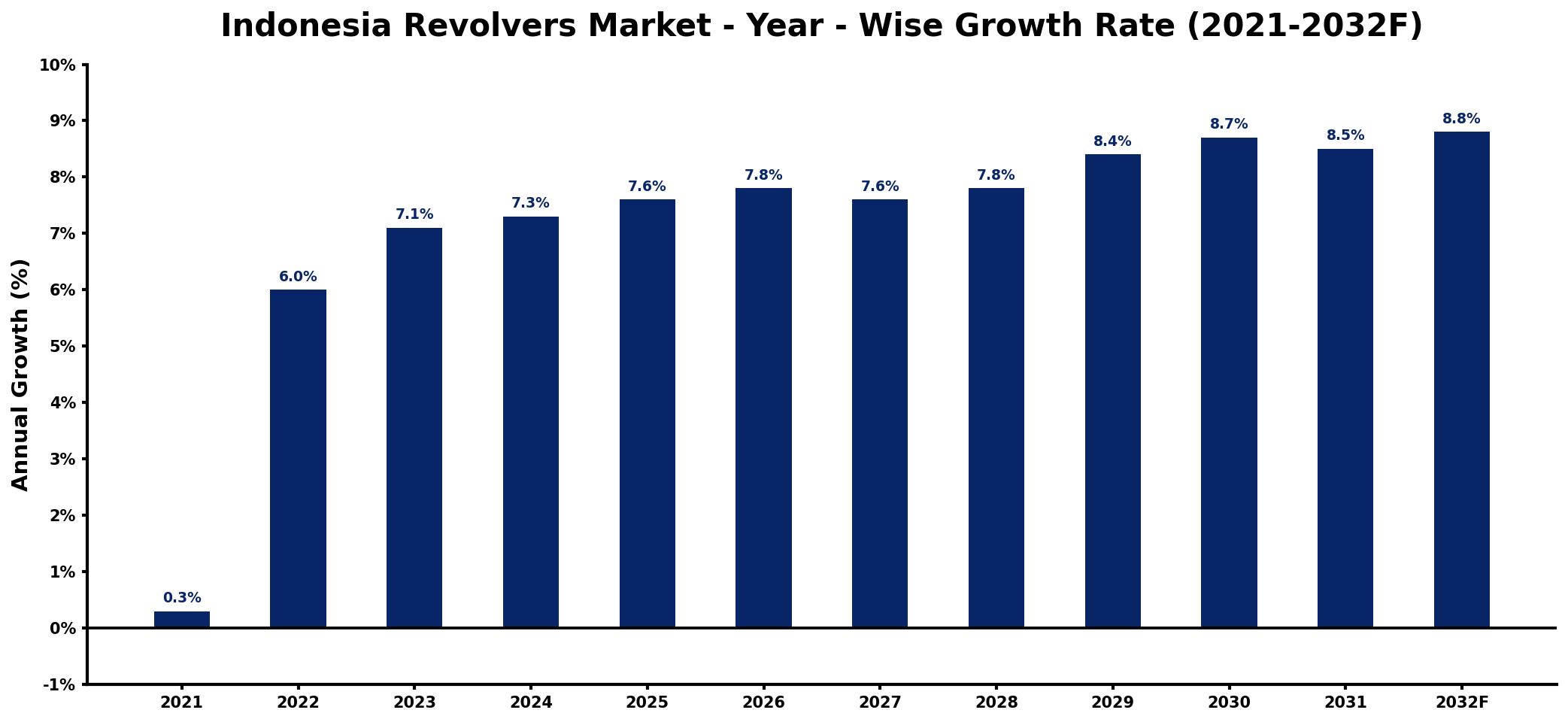
The table below presents the year‑wise growth rates along with the key drivers influencing the market
| Year | Growth Rate | Major Drivers |
| 2021 | 0.3% | Rising interest in personal safety |
| 2022 | 6.0% | Increased investment in security technology |
| 2023 | 7.1% | Growing demand for self-defense tools |
| 2024 | 7.3% | Expansion of retail distribution channels |
| 2025 | 7.6% | Surge in firearms training programs |
| 2026 | 7.8% | Enhanced marketing strategies implemented |
| 2027 | 7.6% | Increase in recreational shooting activities |
| 2028 | 7.8% | Broader acceptance of gun ownership |
| 2029 | 8.4% | Advancements in manufacturing processes |
| 2030 | 8.7% | Growing urban population influences demand |
| 2031 | 8.5% | Strengthened community safety initiatives |
| 2032 | 8.8% | Rising awareness of personal protection |
Note: Market size estimations and growth projections presented in this report are based on 6Wresearch's proprietary forecasting methodology, utilizing the latest available industry data, government publications, and primary research inputs.
Indonesia Revolvers Market Synopsis
The unique landscape of the Indonesia Revolvers Market is characterized by its focused clientele, primarily law enforcement agencies and security personnel. The reliability and simplicity of revolvers make them a preferred choice for various security applications. However, the stringent regulatory environment significantly restricts civilian access to firearms, which impacts overall market dynamics.
Moreover, while the interest in revolvers for self-defense is growing, the complex licensing process serves as a barrier to entry for many potential consumers. This dichotomy of supply and demand creates a nuanced market landscape that requires careful navigation by stakeholders looking to capitalize on growth opportunities.
Indonesia Revolvers Market Key Takeaways
- Growth driven by rising demand from law enforcement and security agencies.
- Increasing interest in personal safety fuels civilian market potential.
- Stringent government regulations limit civilian ownership, affecting market dynamics.
- Revolvers are preferred for their reliability and ease of use in security applications.
- The overall market remains steady despite challenges presented by regulatory frameworks.
Evaluation of Restraints in Indonesia Revolvers Market
The primary restraints in the Indonesia Revolvers Market arise from the stringent gun laws that govern firearm ownership and use. These regulations necessitate extensive licensing processes, which can deter potential buyers from pursuing revolvers for personal safety. Furthermore, public sentiment around gun ownership and its implications for safety can contribute to a lack of widespread acceptance among the general populace. As a result, while the market exhibits growth potential, the prevailing regulatory framework continues to impose limitations that stakeholders must navigate carefully.
Indonesia Revolvers Market Trends
Emerging trends in the Indonesia Revolvers Market reflect a growing public awareness of personal safety and security needs. The increasing prevalence of urban crime has spurred interest in self-defense solutions, positioning revolvers as a viable option for individuals seeking protection. Additionally, advancements in firearm technology are making revolvers more appealing, as manufacturers focus on improving safety features and ease of use. These trends indicate a potential shift in public perception, which could alter the dynamics of market demand in the years to come.
Indonesia Revolvers Market Opportunities
Significant growth opportunities lie within the training and educational sectors, where there is a pressing need for programs that promote responsible firearm ownership and safety. This not only assists in compliance with regulations but also fosters a culture of safety and responsibility among potential users. Additionally, partnerships with law enforcement agencies to provide specialized training and support can enhance market penetration. As the demand for personal security solutions rises, innovative marketing strategies that focus on the benefits of revolvers can also drive market growth.
Government Initiatives in the Indonesia Revolvers Market
The Indonesian government has instituted several initiatives aimed at regulating firearm ownership and ensuring public safety. These initiatives include strict licensing requirements for firearm possession and usage, alongside educational programs focused on safe firearm handling. Moreover, there are ongoing discussions regarding potential reforms to streamline the licensing process while maintaining a focus on safety. Such government actions not only shape the market dynamics but also reflect the broader societal attitudes towards firearm regulation in Indonesia.
Future Insights of the Indonesia Revolvers Market
Looking forward to the years 2026-2032, the Indonesia Revolvers Market is expected to gradually adapt to evolving consumer attitudes towards personal security. With an increase in urban crime and a rising emphasis on self-defense, the market is poised for steady growth. However, the progression will largely depend on how the regulatory landscape evolves in response to public sentiment and safety concerns. Stakeholders who can effectively align their offerings with these changing dynamics will be well-positioned for success.
Indonesia Revolvers Market Latest Developments (2025 - 2026)
Recent developments within the Indonesia Revolvers Market indicate a cautious yet optimistic approach from stakeholders. Industry players are focusing on enhancing their compliance with existing regulations while exploring innovative product designs that appeal to both law enforcement and civilian markets. Additionally, there have been increased collaborations between security agencies and firearm training organizations to promote responsible ownership. This trend reflects a broader commitment to ensuring that safety remains a top priority, even as market demands evolve.
Indonesia Revolvers Market - Key Attractiveness of the Report
- 10 Years of Market Numbers
- Historical Data Starting from 2022 to 2025
- Base Year: 2025
- Forecast Data until 2032
- Key Performance Indicators Impacting the Market
- Major Upcoming Developments and Projects
Key Highlights of the Report:
- Indonesia Revolvers Market Outlook
- Market Size of Indonesia Revolvers Market, 2025
- Forecast of Indonesia Revolvers Market, 2032
- Historical Data and Forecast of Indonesia Revolvers Revenues & Volume for the Period 2022-2032F
- Indonesia Revolvers Market Trend Evolution
- Indonesia Revolvers Market Drivers and Challenges
- Indonesia Revolvers Price Trends
- Indonesia Revolvers Porter's Five Forces
- Indonesia Revolvers Industry Life Cycle
- Historical Data and Forecast of Indonesia Revolvers Market Revenues & Volume By Product Type for the Period 2022-2032F
- Historical Data and Forecast of Indonesia Revolvers Market Revenues & Volume By Semi Automatic Revolvers for the Period 2022-2032F
- Historical Data and Forecast of Indonesia Revolvers Market Revenues & Volume By Single and Double Action Revolvers for the Period 2022-2032F
- Historical Data and Forecast of Indonesia Revolvers Market Revenues & Volume By Applications for the Period 2022-2032F
- Historical Data and Forecast of Indonesia Revolvers Market Revenues & Volume By Civil for the Period 2022-2032F
- Historical Data and Forecast of Indonesia Revolvers Market Revenues & Volume By Military for the Period 2022-2032F
- Indonesia Revolvers Import Export Trade Statistics
- Market Opportunity Assessment By Product Type
- Market Opportunity Assessment By Applications
- Indonesia Revolvers Top Companies Market Share
- Indonesia Revolvers Competitive Benchmarking By Technical and Operational Parameters
- Indonesia Revolvers Company Profiles
- Indonesia Revolvers Key Strategic Recommendations






































