Indonesia Rocking Chairs Market Size, Share & Growth Rate
The Indonesia Rocking Chairs Market was estimated at USD 1481 Million in 2025 and is projected to reach USD 2269 Million by 2032, growing at a CAGR of 6.3% from 2026 to 2032. This robust growth trajectory is fueled by rising disposable incomes and a burgeoning middle class eager to invest in home furnishings that enhance comfort and aesthetic appeal. Furthermore, the ongoing trend toward home-centric lifestyles, catalyzed by the COVID-19 pandemic, has amplified the demand for stylish yet functional furniture, including rocking chairs.
Indonesia Rocking Chairs Market Year-wise Growth Rate and Key Drivers
This graph highlights how the Indonesia Rocking Chairs Market has steadily grown over the years, supported by major growth factors.
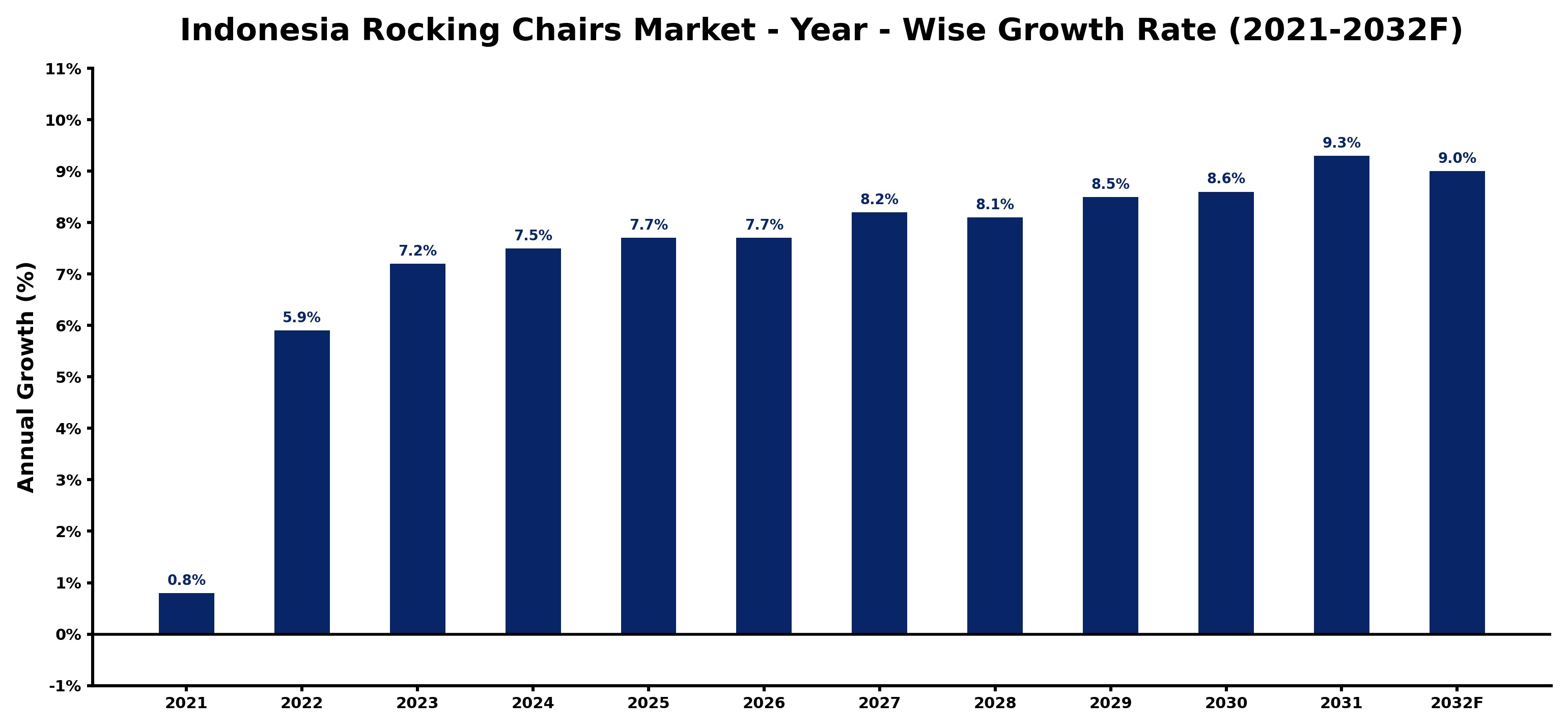
The table below presents the year‑wise growth rates along with the key drivers influencing the market
| Year | Growth Rate | Major Drivers |
| 2021 | 0.8% | Domestic furniture demand boosts rocking chair production capabilities |
| 2022 | 5.9% | Furniture manufacturing investments boost domestic rocking chair production capacity |
| 2023 | 7.2% | Regional furniture manufacturing adapts smart technology for productivity gains |
| 2024 | 7.5% | Higher demand for eco friendly materials drives rocking chair production expansion |
| 2025 | 7.7% | Modernized furniture production lines boost rocking chair output efficiency |
| 2026 | 7.7% | Local furniture manufacturers expand operations to meet rising export demand |
| 2027 | 8.2% | Local furniture manufacturers invest in advanced wood treatment technologies |
| 2028 | 8.1% | Technological upgrades in local workshops boost rocking chair production efficiency |
| 2029 | 8.5% | Production expansion of wooden components boosts rocking chair output |
| 2030 | 8.6% | Domestic furniture manufacturing investments boost rocking chair production capacity |
| 2031 | 9.3% | Investment in woodworking machinery boosted rocking chair production efficiency |
| 2032 | 9.0% | Domestic wood furniture manufacturing boosts rocking chair component sourcing |
Note - Market size estimations and growth projections presented in this report are based on 6Wresearch’s advanced forecasting approach, validated with industry datasets as of June 2026.
Indonesia Rocking Chairs Market Synopsis
A significant force currently shaping the Indonesia Rocking Chairs Market is the increased consumer focus on home comfort and design. As households adapt to more time spent indoors, the demand for furniture that provides both relaxation and style has surged, leading to a notable uptick in rocking chair sales.
Additionally, the shift towards eco-conscious living is influencing purchasing decisions, with consumers increasingly favoring products made from sustainable materials. This trend is prompting manufacturers to explore the use of organic materials like teak wood, further propelling market growth.
Indonesia Rocking Chairs Market Key Takeaways
- The market is projected to reach USD 2269 Million by 2032, driven by urbanization and changing consumer preferences.
- Increasing demand for eco-friendly products is reshaping production practices in the rocking chair sector.
- Young consumers are significantly influencing the market, prioritizing comfort and style in their furniture choices.
- Government incentives for local manufacturing are creating a more favorable environment for domestic producers.
- Innovation in design and functionality, such as integrated massaging features, is enhancing product appeal.
Evaluation of Restraints in Indonesia Rocking Chairs Market
Despite the growth potential, several restraints hinder the Indonesia Rocking Chairs Market. The influx of cheaper imported options poses a challenge to local manufacturers who struggle to compete on price. Furthermore, traditional furniture craftsmanship, deeply rooted in rural communities, continues to dominate preferences for many consumers, limiting the market's expansion potential. Regulatory constraints and tax incentives favoring foreign companies also contribute to a competitive landscape that can be difficult for domestic brands to navigate.
Indonesia Rocking Chairs Market Trends
Current trends in the Indonesia Rocking Chairs Market emphasize personalization and multifunctionality. Consumers are increasingly drawn to chairs that not only provide comfort but also serve multiple purposes, such as convertible furniture that can adapt to different needs. Additionally, there's a growing appreciation for artisanal designs, reflecting a broader trend toward unique, handcrafted products that tell a story.
Indonesia Rocking Chairs Market Opportunities
The market presents several opportunities for growth, particularly in urban areas where space is limited. Compact and innovative rocking chair designs that maximize comfort without sacrificing style are poised to capture consumer interest. Moreover, the rise of e-commerce is facilitating wider market access, allowing brands to reach customers in less accessible regions, thereby expanding their consumer base.
Government Initiatives in the Indonesia Rocking Chairs Market
The Indonesian government is actively supporting the furniture industry through various initiatives aimed at fostering local production. Policies encouraging the use of local materials and craftsmanship aim to enhance the competitiveness of domestic manufacturers. Additionally, incentives for businesses that prioritize sustainability align with global trends, promoting environmentally-friendly practices within the sector.
Future Insights of the Indonesia Rocking Chairs Market
Looking ahead to 2026-2032, the Indonesia Rocking Chairs Market is expected to continue its upward trajectory. Factors such as increasing urbanization, coupled with a persistent desire for stylish home furnishings, will sustain demand. Moreover, as consumers become more discerning about design and functionality, manufacturers that innovate and emphasize quality are likely to thrive in this evolving landscape.
Indonesia Rocking Chairs Market Latest Developments (May 2025 - June 2026)
Recent developments in the Indonesia Rocking Chairs Market indicate a growing focus on online retail strategies, as manufacturers enhance their digital presence to engage consumers. Several brands are launching new collections that reflect contemporary design trends while maintaining traditional craftsmanship. This shift not only meets consumer demand for unique pieces but also adapts to the evolving shopping behaviors driven by the pandemic.
Indonesia Rocking Chairs Market - Key Attractiveness of the Report
- 10 Years of Market Numbers
- Historical Data Starting from 2022 to 2025
- Base Year: 2025
- Forecast Data until 2032
- Key Performance Indicators Impacting the Market
- Major Upcoming Developments and Projects
Key Highlights of the Report:
- Indonesia Rocking Chairs Market Outlook
- Market Size of Indonesia Rocking Chairs Market, 2025
- Forecast of Indonesia Rocking Chairs Market, 2032
- Historical Data and Forecast of Indonesia Rocking Chairs Revenues & Volume for the Period 2022-2032F
- Indonesia Rocking Chairs Market Trend Evolution
- Indonesia Rocking Chairs Market Drivers and Challenges
- Indonesia Rocking Chairs Price Trends
- Indonesia Rocking Chairs Porter's Five Forces
- Indonesia Rocking Chairs Industry Life Cycle
- Historical Data and Forecast of Indonesia Rocking Chairs Market Revenues & Volume By Types for the Period 2022-2032F
- Historical Data and Forecast of Indonesia Rocking Chairs Market Revenues & Volume By Metal for the Period 2022-2032F
- Historical Data and Forecast of Indonesia Rocking Chairs Market Revenues & Volume By Fabric for the Period 2022-2032F
- Historical Data and Forecast of Indonesia Rocking Chairs Market Revenues & Volume By Leather for the Period 2022-2032F
- Historical Data and Forecast of Indonesia Rocking Chairs Market Revenues & Volume By Plastic for the Period 2022-2032F
- Historical Data and Forecast of Indonesia Rocking Chairs Market Revenues & Volume By Others for the Period 2022-2032F
- Historical Data and Forecast of Indonesia Rocking Chairs Market Revenues & Volume By Application for the Period 2022-2032F
- Historical Data and Forecast of Indonesia Rocking Chairs Market Revenues & Volume By Department Stores for the Period 2022-2032F
- Historical Data and Forecast of Indonesia Rocking Chairs Market Revenues & Volume By Grocery Stores and Supermarkets for the Period 2022-2032F
- Historical Data and Forecast of Indonesia Rocking Chairs Market Revenues & Volume By Warehouse Retailers for the Period 2022-2032F
- Historical Data and Forecast of Indonesia Rocking Chairs Market Revenues & Volume By Convenience Retailer for the Period 2022-2032F
- Historical Data and Forecast of Indonesia Rocking Chairs Market Revenues & Volume By Discount Retailer for the Period 2022-2032F
- Historical Data and Forecast of Indonesia Rocking Chairs Market Revenues & Volume By Others for the Period 2022-2032F
- Indonesia Rocking Chairs Import Export Trade Statistics
- Market Opportunity Assessment By Types
- Market Opportunity Assessment By Application
- Indonesia Rocking Chairs Top Companies Market Share
- Indonesia Rocking Chairs Competitive Benchmarking By Technical and Operational Parameters
- Indonesia Rocking Chairs Company Profiles
- Indonesia Rocking Chairs Key Strategic Recommendations






































