Indonesia Slag Cement Market Size, Share & Growth Rate
The Indonesia Slag Cement Market was estimated at USD 173 Million in 2025 and is projected to reach USD 229 Million by 2032, growing at a CAGR of 4.1% from 2026 to 2032. This growth trajectory is driven largely by an increasing emphasis on sustainable construction practices within the country, as well as supportive government regulations aimed at reducing carbon emissions. As construction projects expand, the appeal of slag cements durability and environmental benefits is propelling its adoption across various infrastructure developments.
Indonesia Slag Cement Market Year-wise Growth Rate and Key Drivers
This graph highlights how the Indonesia Slag Cement Market has steadily grown over the years, supported by major growth factors.
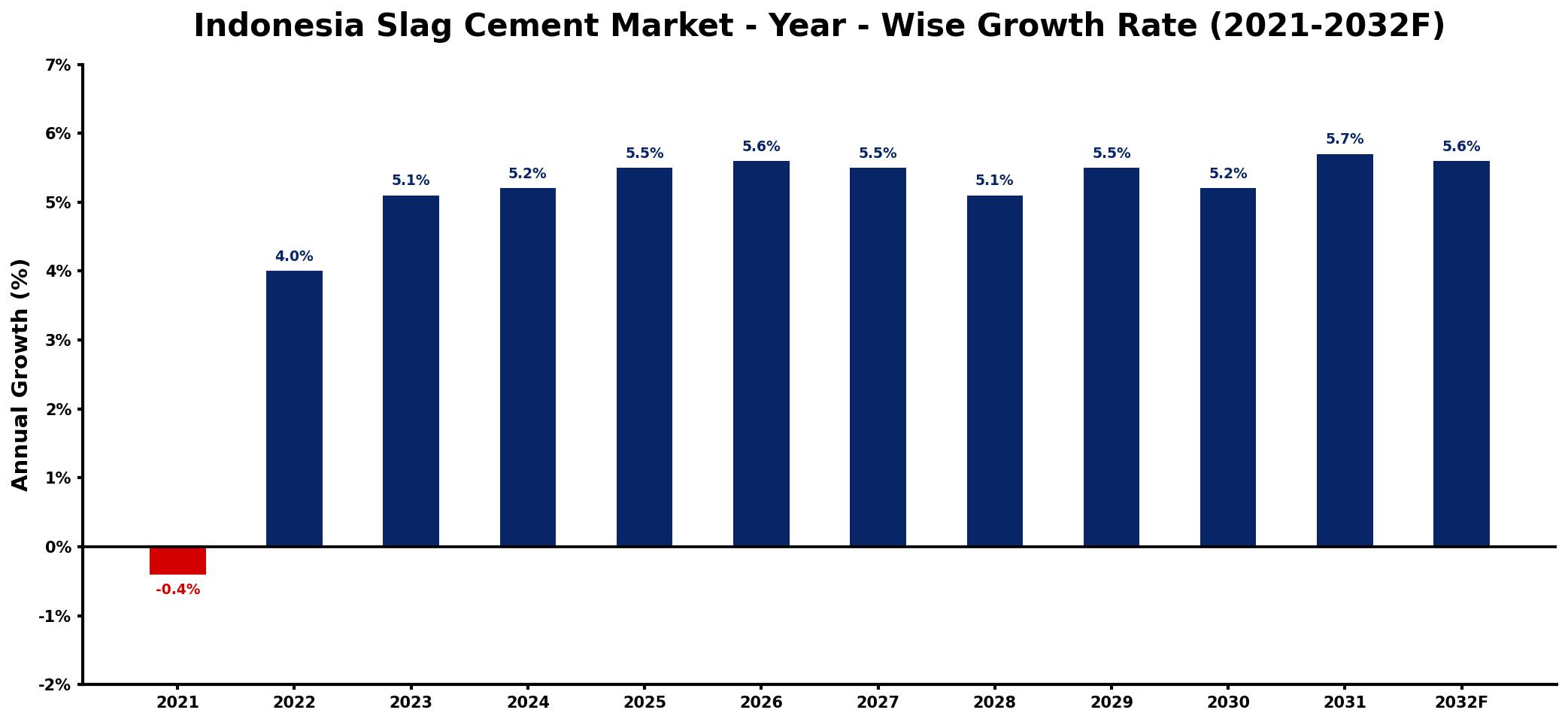
The table below presents the year‑wise growth rates along with the key drivers influencing the market
| Year | Growth Rate | Major Drivers |
| 2021 | -0.4% | construction projects slowed down significantly |
| 2022 | 4.0% | increased infrastructure investments nationwide |
| 2023 | 5.1% | growing demand for sustainable materials |
| 2024 | 5.2% | expansion of residential construction activities |
| 2025 | 5.5% | rising urbanization driving consumption |
| 2026 | 5.6% | government initiatives promoting green building |
| 2027 | 5.5% | increased exports to neighboring countries |
| 2028 | 5.1% | increased capital investment inflows |
| 2029 | 5.5% | growing popularity of eco-friendly alternatives |
| 2030 | 5.2% | increased public-private partnerships emerging |
| 2031 | 5.7% | stronger regulations supporting environmental standards |
| 2032 | 5.6% | rising infrastructure development spending |
Note: Market size estimations and growth projections presented in this report are based on 6Wresearch's proprietary forecasting methodology, utilizing the latest available industry data, government publications, and primary research inputs.
Indonesia Slag Cement Market Synopsis
The Indonesia Slag Cement Market is on a transformative path, fueled by the construction sector's growing preference for eco-friendly materials. As stakeholders strive for greener alternatives, slag cement emerges as a compelling option due to its lower carbon footprint and enhanced durability compared to traditional cement. This evolution reflects a broader shift in societal values toward sustainability, prompting increased demand.
Moreover, Indonesia's strategic focus on infrastructure development presents a lucrative arena for slag cement utilization. The material's proven performance in key construction applications positions it as a vital component for modern projects, aligning with both environmental goals and economic growth. This synergy indicates a promising outlook for the market, underpinned by an evolving landscape in building materials.
Indonesia Slag Cement Market Key Takeaways
- Increasing awareness of eco-friendly construction materials propels demand for slag cement.
- Government initiatives emphasize sustainable building practices, enhancing market growth.
- Infrastructure projects leverage slag cement's strength and durability, making it a preferred choice.
- Consumer perceptions and education on slag cement remain crucial for market expansion.
- Technological advancements in processing and applications further improve market dynamics.
Evaluation of Restraints in Indonesia Slag Cement Market
The Indonesia Slag Cement Market faces notable restraints primarily related to consumer perceptions and market education. Despite its sustainable attributes and superior performance, many construction professionals and consumers remain tethered to traditional Portland cement due to lingering misconceptions regarding slag cement's quality. This gap in understanding can hinder broader adoption and market growth. Additionally, ensuring a consistent supply of high-quality slag as a raw material poses another challenge, particularly amid rising demand.
Moreover, compliance with evolving regulatory standards is imperative for market participants. Adhering to quality norms and sustainability guidelines can create both operational hurdles and additional costs, potentially impacting pricing strategies and market competitiveness. These factors necessitate a concerted effort from stakeholders to educate the market and improve the supply chain for slag cement.
Indonesia Slag Cement Market Trends
Several current trends are shaping the Indonesia Slag Cement Market. The push for green building certifications, alongside increasing investments in sustainable infrastructure, has heightened interest in slag cement as a viable alternative. Additionally, technological advancements in production processes are enhancing the performance characteristics of slag cement, allowing it to compete more effectively with conventional cement products. Innovations in formulation and application methods are also helping to address the concerns related to cement quality.
Furthermore, collaborative initiatives between government entities and industry players are encouraging the adoption of slag cement, showcasing its benefits in real-world applications. The emphasis on recycling industrial byproducts not only supports sustainability but also enhances the overall efficiency of material usage in construction, further driving demand for slag cement.
Indonesia Slag Cement Market Opportunities
The Indonesia Slag Cement Market presents several promising growth and investment opportunities. As urbanization accelerates, the rising need for infrastructure—such as roads, bridges, and commercial buildings—creates a robust demand for durable construction materials. The ongoing governmental push for green initiatives and sustainable construction practices makes slag cement an attractive option for contractors seeking to meet environmental standards.
Moreover, partnerships between cement manufacturers and the construction industry can stimulate innovation in application techniques, thus expanding the markets scope. The increasing focus on the circular economy, whereby waste materials are utilized effectively, further enhances the potential for slag cement to play a vital role in Indonesia's future construction landscape.
Government Initiatives in the Indonesia Slag Cement Market
The Indonesian government is actively promoting sustainable building practices, recognizing the critical role of environmentally-friendly materials in achieving national sustainability goals. Policies encouraging the use of alternative materials like slag cement are being implemented to support this shift. Incentives for infrastructure projects that prioritize sustainability are driving demand for slag cement, as the government seeks to lower carbon emissions associated with the construction sector. Enhanced regulations focused on reducing the environmental impact of cement production further underscore the importance of adopting slag cement across various construction projects.
Future Insights of the Indonesia Slag Cement Market
Looking ahead to 2026-2032, the Indonesia Slag Cement Market is set to experience a substantial transformation. With increasing governmental support for sustainable materials and a shift in consumer preferences toward eco-friendly options, the market is poised for significant growth. Enhanced education regarding the benefits of slag cement will likely improve public perception, fostering wider acceptance and use.
Technological advancements in slag cement production, alongside improvements in processing and application methods, will further bolster market expansion. As infrastructure projects continue to proliferate, the integration of slag cement into building practices is anticipated to become a standard, ensuring both durability and sustainability in Indonesias construction sector.
Indonesia Slag Cement Market Latest Developments (2025 - 2026)
In recent months, the Indonesia Slag Cement Market has seen a notable shift towards increased collaboration between industry stakeholders and government agencies to promote sustainable construction practices. Various initiatives have emerged aimed at enhancing the supply chain for slag cement, including improved logistics for sourcing and distributing high-quality slag as a raw material. Additionally, advancements in production technology have been reported, focusing on improving the efficiency and sustainability of slag cement manufacturing processes.
Indonesia Slag Cement Market - Key Attractiveness of the Report
- 10 Years of Market Numbers
- Historical Data Starting from 2022 to 2025
- Base Year: 2025
- Forecast Data until 2032
- Key Performance Indicators Impacting the Market
- Major Upcoming Developments and Projects
Key Highlights of the Report:
- Indonesia Slag Cement Market Outlook
- Market Size of Indonesia Slag Cement Market, 2025
- Forecast of Indonesia Slag Cement Market, 2032
- Historical Data and Forecast of Indonesia Slag Cement Revenues & Volume for the Period 2022-2032F
- Indonesia Slag Cement Market Trend Evolution
- Indonesia Slag Cement Market Drivers and Challenges
- Indonesia Slag Cement Price Trends
- Indonesia Slag Cement Porter's Five Forces
- Indonesia Slag Cement Industry Life Cycle
- Historical Data and Forecast of Indonesia Slag Cement Market Revenues & Volume By Product for the Period 2022-2032F
- Historical Data and Forecast of Indonesia Slag Cement Market Revenues & Volume By Low Heat Cement for the Period 2022-2032F
- Historical Data and Forecast of Indonesia Slag Cement Market Revenues & Volume By Sulphates resisting cement for the Period 2022-2032F
- Historical Data and Forecast of Indonesia Slag Cement Market Revenues & Volume By Blast Furnace Slag Cement for the Period 2022-2032F
- Historical Data and Forecast of Indonesia Slag Cement Market Revenues & Volume By High Alumina Cement for the Period 2022-2032F
- Historical Data and Forecast of Indonesia Slag Cement Market Revenues & Volume By White Cement for the Period 2022-2032F
- Historical Data and Forecast of Indonesia Slag Cement Market Revenues & Volume By Coloured cement for the Period 2022-2032F
- Historical Data and Forecast of Indonesia Slag Cement Market Revenues & Volume By Pozzolanic Cement for the Period 2022-2032F
- Historical Data and Forecast of Indonesia Slag Cement Market Revenues & Volume By Applications for the Period 2022-2032F
- Historical Data and Forecast of Indonesia Slag Cement Market Revenues & Volume By Residential Buildings for the Period 2022-2032F
- Historical Data and Forecast of Indonesia Slag Cement Market Revenues & Volume By Industrial Buildings for the Period 2022-2032F
- Historical Data and Forecast of Indonesia Slag Cement Market Revenues & Volume By Commercial Buildings for the Period 2022-2032F
- Indonesia Slag Cement Import Export Trade Statistics
- Market Opportunity Assessment By Product
- Market Opportunity Assessment By Applications
- Indonesia Slag Cement Top Companies Market Share
- Indonesia Slag Cement Competitive Benchmarking By Technical and Operational Parameters
- Indonesia Slag Cement Company Profiles
- Indonesia Slag Cement Key Strategic Recommendations






































