Indonesia Smart Highway Market Size & Growth Rate (2026-2032)
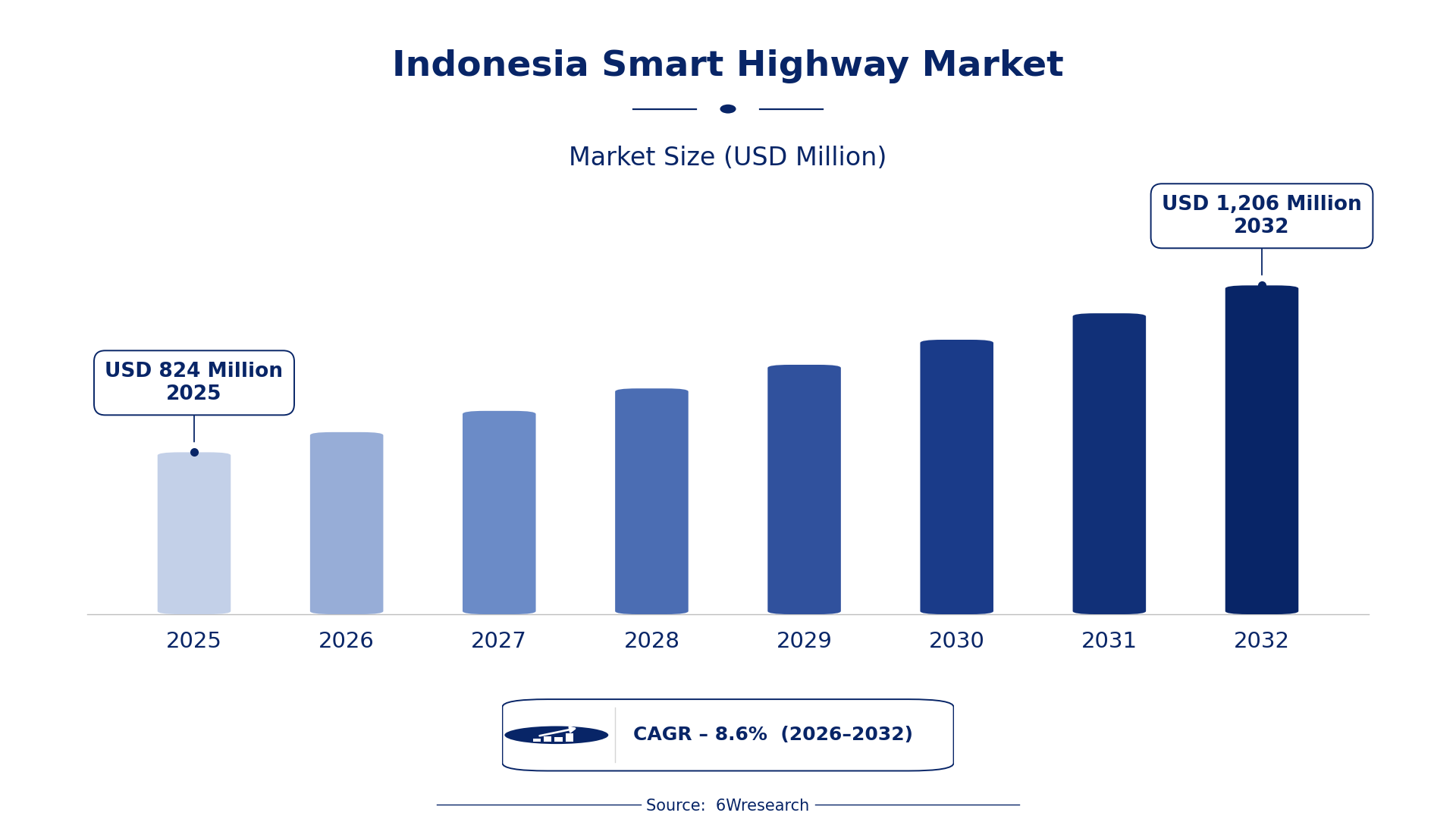
The Indonesia Smart Highway Market was estimated at USD 824 Million in 2025 and is projected to reach USD 1206 Million by 2032, growing at a CAGR of 8.6% from 2026 to 2032.
Indonesia Smart Highway Market Synopsis
The Indonesian government’s drive to enhance transportation infrastructure is the primary force shaping the smart highway market. Focused investments aim to reduce traffic congestion while improving overall road safety and efficiency.
Smart highway technologies are gaining traction, including intelligent traffic management systems and advanced toll collection methods. These innovations are not just technical upgrades; they represent a significant shift towards a modern transportation framework capable of meeting the demands of urbanization.
Indonesia Smart Highway Market Year-wise Growth Rate and Key Drivers
This graph illustrates the annual growth rates of the Indonesia Smart Highway Market from 2021 to 2032, highlighting a steady upward trajectory and projected expansion over the forecast period.
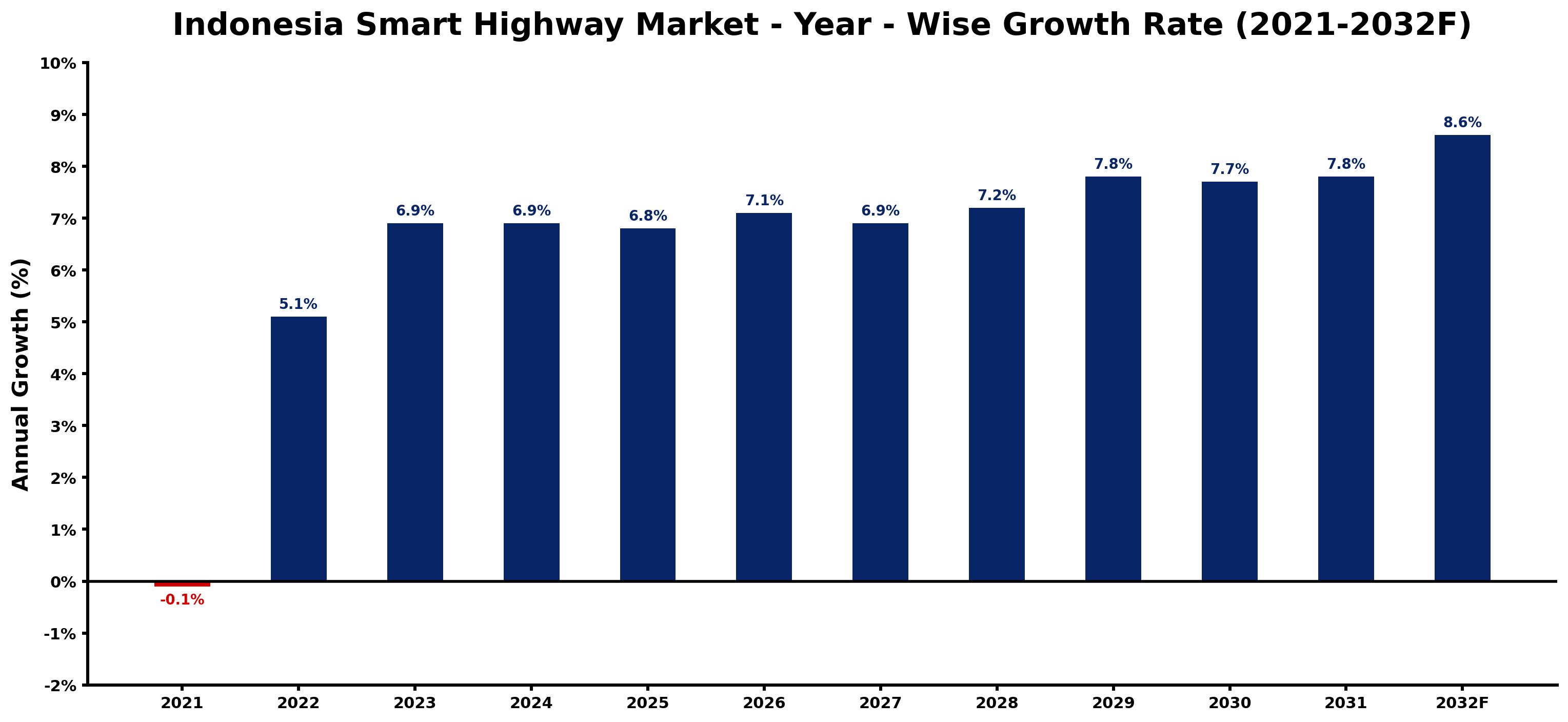
The table below presents the year‑wise growth rates along with the key drivers influencing the market
| Year | Growth Rate | Major Drivers |
| 2021 | -0.1% | Government delays on major infrastructure projects impacted investments. |
| 2022 | 5.1% | Government's smart transportation policy initiative launched |
| 2023 | 6.9% | Increased urban mobility demand in Greater Jakarta area |
| 2024 | 6.9% | Infrastructure investment from Asian Development Bank funding |
| 2025 | 6.8% | Partnerships with local tech firms for smart solutions |
| 2026 | 7.1% | Rise in IoT implementation in urban road networks |
| 2027 | 6.9% | Focus on reducing traffic congestion by local authorities |
| 2028 | 7.2% | Easier access to electric vehicle charging stations |
| 2029 | 7.8% | Growing public-private partnerships for highway innovations |
| 2030 | 7.7% | Adoption of AI-driven traffic management systems |
| 2031 | 7.8% | Steady rise in electric vehicle ownership and usage |
| 2032 | 8.6% | Implementation of sustainability mandates by transport ministry |
Note: Market size estimations and growth projections presented in this report are based on 6Wresearch's proprietary forecasting methodology, utilizing the latest available industry data, government publications, and primary research inputs.
Indonesia Smart Highway Market Key Takeaways
Below are some of the specific key takeaways from the market, including:
- The market is set to experience a steady growth trajectory driven by government initiatives and private sector involvement.
- Technological advancements in traffic management are expected to play a crucial role in alleviating congestion.
- Investment in smart infrastructure is being prioritized in response to COVID-19 recovery efforts.
- Collaboration between public agencies and private firms will be essential for successful project implementation.
- Funding challenges remain a concern, necessitating innovative financing solutions for large-scale projects.
Evaluation of Restraints in Indonesia Smart Highway Market
Despite the promising growth prospects, the smart highway market faces several constraints. Infrastructure development is often hampered by bureaucratic delays and a lack of cohesive planning across regions. Additionally, the integration of advanced technologies can be complex, requiring significant investment in training and systems compatibility. Funding for expansive highway projects is also a critical issue, as both public and private entities grapple with budget constraints in the wake of the pandemic.
Indonesia Smart Highway Market Trends
A notable trend is the increasing adoption of intelligent transportation systems (ITS), which utilize real-time data analytics to optimize traffic flow. Another trend is the shift towards eco-friendly technologies, including electric vehicle (EV) charging stations integrated into highway systems. on top of that, the rise in urbanization is driving demand for better public transportation linkages, with smart highways serving as critical connectors.
Indonesia Smart Highway Market Opportunities
Opportunities for growth are abundant in smart highway innovations. The push for sustainable transport solutions opens doors for investments in green technologies and renewable energy sources. Additionally, the government’s economic recovery plans present a unique chance for public-private partnerships to enhance infrastructure. As urban areas expand, the need for smarter traffic solutions creates a ripe environment for innovative startups and tech firms.
Government Initiatives in the Indonesia Smart Highway Market
Government policy is a decisive factor in shaping the Indonesia Smart Highway Market. With a clear focus on improving transportation infrastructure, the government is prioritizing smart highway projects. These initiatives reflect a commitment to enhancing safety, efficiency, and connectivity across the nation.
- A recently completed project involved the installation of intelligent traffic management systems in major urban areas, aimed at reducing congestion and improving safety.
- Currently ongoing is a national digital infrastructure upgrade programme that includes smart highway enhancements, aiming to integrate advanced technologies into existing frameworks.
- A planned public-private initiative is expected to launch in 2026, focusing on expanding EV charging infrastructure along key highway routes.
- The Ministry of Public Works and Housing is developing regulatory frameworks to facilitate smoother implementation of smart highway technologies.
- An upcoming initiative aims to incorporate smart toll collection systems into the national expressway network by 2028.
Future Insights of the Indonesia Smart Highway Market
Looking ahead to 2026-2032, the Indonesia Smart Highway Market is poised for transformative growth. The intersection of technological advancement and urbanization will drive demand for smarter, more efficient transportation solutions. As the government continues to invest in infrastructure, the integration of IoT and AI technologies will redefine traffic management, promising safer and more reliable travel for all users.
Indonesia Smart Highway Market Latest Developments
Recent activity in the Indonesia Smart Highway Market indicates a strong push towards modernization and efficiency. Investments in technology and infrastructure are gaining momentum as stakeholders recognize the importance of smart solutions.
- A major technology vendor launched an advanced toll collection system in early 2025, significantly reducing vehicle wait times at toll booths.
- A government initiative focusing on traffic data analytics began in mid-2025 and remains underway, aimed at improving real-time traffic management.
- A partnership between local construction firms and tech companies is set to roll out in late 2025, focused on smart road safety systems.
- In early 2026, a comprehensive training program for highway operators will be implemented to enhance the management of smart technologies.
- A planned smart highway pilot project in a suburban area is expected to commence by mid-2026, showcasing cutting-edge traffic management solutions.
Indonesia Smart Highway Market - Key Attractiveness of the Report
- 10 Years of Market Numbers
- Historical Data Starting from 2022 to 2025
- Base Year: 2025
- Forecast Data until 2032
- Key Performance Indicators Impacting the Market
- Major Upcoming Developments and Projects
Key Highlights of the Report:
- Indonesia Smart Highway Market Outlook
- Market Size of Indonesia Smart Highway Market, 2025
- Forecast of Indonesia Smart Highway Market, 2032
- Historical Data and Forecast of Indonesia Smart Highway Revenues & Volume for the Period 2022-2032F
- Indonesia Smart Highway Market Trend Evolution
- Indonesia Smart Highway Market Drivers and Challenges
- Indonesia Smart Highway Price Trends
- Indonesia Smart Highway Porter's Five Forces
- Indonesia Smart Highway Industry Life Cycle
- Historical Data and Forecast of Indonesia Smart Highway Market Revenues & Volume By Technology for the Period 2022-2032F
- Historical Data and Forecast of Indonesia Smart Highway Market Revenues & Volume By Intelligent Transportation Management System for the Period 2022-2032F
- Historical Data and Forecast of Indonesia Smart Highway Market Revenues & Volume By Intelligent Traffic Management System for the Period 2022-2032F
- Historical Data and Forecast of Indonesia Smart Highway Market Revenues & Volume By Communication System for the Period 2022-2032F
- Historical Data and Forecast of Indonesia Smart Highway Market Revenues & Volume By Monitoring System for the Period 2022-2032F
- Historical Data and Forecast of Indonesia Smart Highway Market Revenues & Volume By Displays for the Period 2022-2032F
- Historical Data and Forecast of Indonesia Smart Highway Market Revenues & Volume By Variable Message Signs for the Period 2022-2032F
- Historical Data and Forecast of Indonesia Smart Highway Market Revenues & Volume By Digital Signage for the Period 2022-2032F
- Historical Data and Forecast of Indonesia Smart Highway Market Revenues & Volume By Others for the Period 2022-2032F
- Historical Data and Forecast of Indonesia Smart Highway Market Revenues & Volume By Service for the Period 2022-2032F
- Historical Data and Forecast of Indonesia Smart Highway Market Revenues & Volume By Consultancy Service for the Period 2022-2032F
- Historical Data and Forecast of Indonesia Smart Highway Market Revenues & Volume By Maintenance and Operation Service for the Period 2022-2032F
- Historical Data and Forecast of Indonesia Smart Highway Market Revenues & Volume By Managed Service for the Period 2022-2032F
- Historical Data and Forecast of Indonesia Smart Highway Market Revenues & Volume By Deployments for the Period 2022-2032F
- Historical Data and Forecast of Indonesia Smart Highway Market Revenues & Volume By On-premise for the Period 2022-2032F
- Historical Data and Forecast of Indonesia Smart Highway Market Revenues & Volume By On-cloud for the Period 2022-2032F
- Indonesia Smart Highway Import Export Trade Statistics
- Market Opportunity Assessment By Technology
- Market Opportunity Assessment By Displays
- Market Opportunity Assessment By Service
- Market Opportunity Assessment By Deployments
- Indonesia Smart Highway Top Companies Market Share
- Indonesia Smart Highway Competitive Benchmarking By Technical and Operational Parameters
- Indonesia Smart Highway Company Profiles
- Indonesia Smart Highway Key Strategic Recommendations






































