Indonesia Smart Locks Market Size, Share & Growth Rate
The Indonesia Smart Locks Market was estimated at USD 1198 Million in 2025 and is projected to reach USD 1759 Million by 2032, growing at a CAGR of 5.6% from 2026 to 2032. This upward trajectory is largely driven by the increasing demand for sophisticated security solutions as urbanization accelerates and disposable incomes rise. As more consumers become aware of the benefits of smart locks, their appeal grows, aligning with broader technological advancements in home automation.
Indonesia Smart Locks Market Year-wise Growth Rate and Key Drivers
This graph highlights how the Indonesia Smart Locks Market has steadily grown over the years, supported by major growth factors.
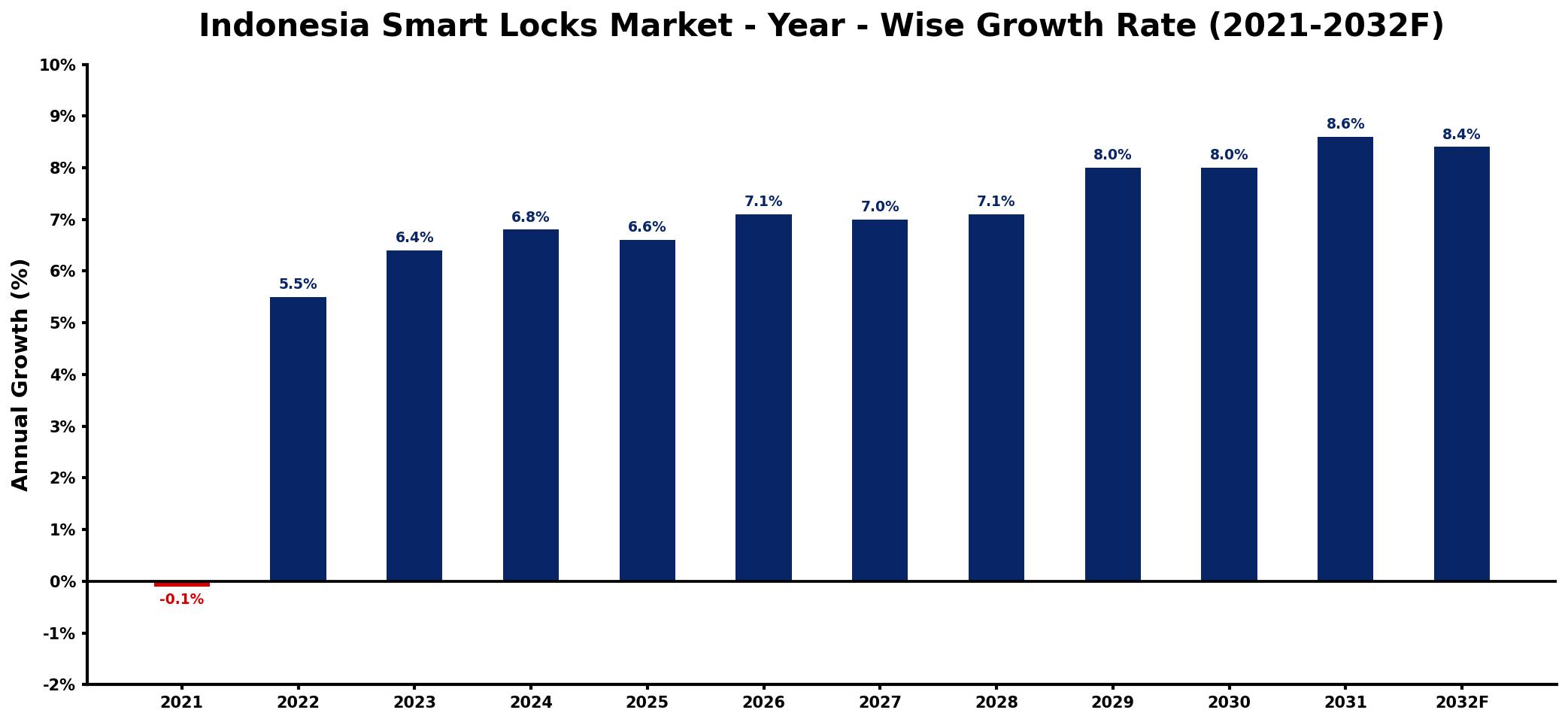
The table below presents the year‑wise growth rates along with the key drivers influencing the market
| Year | Growth Rate | Major Drivers |
| 2021 | -0.1% | decrease in consumer spending habits |
| 2022 | 5.5% | rise in home security awareness |
| 2023 | 6.4% | increased urbanization and modernization |
| 2024 | 6.8% | growth in tech adoption rates |
| 2025 | 6.6% | expansion of e-commerce platforms |
| 2026 | 7.1% | enhanced focus on energy efficiency |
| 2027 | 7.0% | surge in property renovations |
| 2028 | 7.1% | increased domestic production output |
| 2029 | 8.0% | growing interest in remote access |
| 2030 | 8.0% | increased investment in IoT technology |
| 2031 | 8.6% | emphasis on user-friendly interfaces |
| 2032 | 8.4% | growing demand for customization options |
Note: Market size estimations and growth projections presented in this report are based on 6Wresearch's proprietary forecasting methodology, utilizing the latest available industry data, government publications, and primary research inputs.
Indonesia Smart Locks Market Synopsis
The most significant force currently shaping the Indonesia Smart Locks market is the growing trend toward urbanization, leading to heightened security needs in both residential and commercial sectors. As urban living spaces become more populated, the demand for efficient and reliable access control systems has intensified.
Furthermore, heightened awareness of the advantages of advanced security features, such as remote access and keyless entry, is pushing consumers to adopt smart locks. This shift reflects a broader movement toward integrating technology into daily life, making smart locks an increasingly attractive investment.
Indonesia Smart Locks Market Key Takeaways
- Significant growth projected with an estimated market size of USD 1759 Million by 2032.
- Urbanization is a key factor driving demand for sophisticated security solutions in Indonesia.
- COVID-19 has accelerated the shift towards contactless entry solutions, further boosting market growth.
- Increased awareness and demand for home automation are propelling smart lock adoption rates.
- Challenges related to affordability and security remain barriers to wider adoption among consumers.
Evaluation of Restraints in Indonesia Smart Locks Market
Despite the promising growth, the Indonesia Smart Locks market faces several restraints that could impede its expansion. Chief among these is the affordability issue; many consumers may find smart locks to be a significant investment, limiting their accessibility to budget-conscious individuals. Security concerns also loom large, as potential vulnerabilities in smart lock technology could deter consumers wary of hacking or system failures. Additionally, compatibility with existing door hardware and infrastructure presents practical challenges that could slow adoption rates across various demographics.
Indonesia Smart Locks Market Trends
Several current trends are influencing the Indonesia Smart Locks market. Firstly, there is a marked shift towards smart home integration, with consumers seeking products that seamlessly connect with their existing systems. This trend is driving manufacturers to innovate and develop more sophisticated locking mechanisms that offer enhanced features. Additionally, the increasing importance placed on sustainability and energy efficiency in consumer choices is shaping the design and functionality of smart locks.
Indonesia Smart Locks Market Opportunities
The Indonesia Smart Locks market presents genuine growth and investment opportunities, particularly in the realm of smart home technology integration. As more households adopt smart home ecosystems, the demand for compatible and innovative locking solutions is set to rise. Moreover, targeted marketing strategies aimed at educating consumers about the benefits of smart locks could further boost adoption rates. The ongoing trend of urban development also paves the way for new construction projects, providing a fertile ground for smart lock installations.
Government Initiatives in the Indonesia Smart Locks Market
The Indonesian government is increasingly recognizing the importance of enhancing urban security and has implemented initiatives aimed at promoting advanced security technologies. Public spending directed towards urban infrastructure projects may include provisions for smart locking solutions, reflecting a commitment to fostering modern, secure living environments. Additionally, government policies may encourage local manufacturers and investors to develop and distribute smart lock technologies, thus supporting the industrys growth.
Future Insights of the Indonesia Smart Locks Market
Looking ahead to 2026-2032, the Indonesia Smart Locks market is poised for significant transformation. Increased urbanization will likely drive demand for enhanced security solutions, prompting further innovation in smart lock technologies. As consumers continue to prioritize safety and convenience, we anticipate a surge in demand for features like biometric access and cloud connectivity. Additionally, the collaboration between technology providers and security firms will accelerate the development of integrated smart home security systems, offering consumers greater flexibility and peace of mind.
Indonesia Smart Locks Market Latest Developments (2025 - 2026)
Recent industry developments indicate a growing momentum in the Indonesia Smart Locks market, with several firms unveiling new products designed to meet the specific needs of urban consumers. As the market adapts to changing consumer demands, innovations such as voice-activated controls and enhanced mobile applications are becoming more common. The trend toward touchless technology is also being embraced, reflecting the ongoing impact of the COVID-19 pandemic on consumer preferences and behaviors.
Indonesia Smart Locks Market - Key Attractiveness of the Report
- 10 Years of Market Numbers
- Historical Data Starting from 2022 to 2025
- Base Year: 2025
- Forecast Data until 2032
- Key Performance Indicators Impacting the Market
- Major Upcoming Developments and Projects
Key Highlights of the Report:
- Indonesia Smart Locks Market Outlook
- Market Size of Indonesia Smart Locks Market, 2025
- Forecast of Indonesia Smart Locks Market, 2032
- Historical Data and Forecast of Indonesia Smart Locks Revenues & Volume for the Period 2022-2032F
- Indonesia Smart Locks Market Trend Evolution
- Indonesia Smart Locks Market Drivers and Challenges
- Indonesia Smart Locks Price Trends
- Indonesia Smart Locks Porter's Five Forces
- Indonesia Smart Locks Industry Life Cycle
- Historical Data and Forecast of Indonesia Smart Locks Market Revenues & Volume By Product for the Period 2022-2032F
- Historical Data and Forecast of Indonesia Smart Locks Market Revenues & Volume By Deadbolts for the Period 2022-2032F
- Historical Data and Forecast of Indonesia Smart Locks Market Revenues & Volume By Lever Handles for the Period 2022-2032F
- Historical Data and Forecast of Indonesia Smart Locks Market Revenues & Volume By Padlocks for the Period 2022-2032F
- Historical Data and Forecast of Indonesia Smart Locks Market Revenues & Volume By Others for the Period 2022-2032F
- Historical Data and Forecast of Indonesia Smart Locks Market Revenues & Volume By Technology for the Period 2022-2032F
- Historical Data and Forecast of Indonesia Smart Locks Market Revenues & Volume By Bluetooth for the Period 2022-2032F
- Historical Data and Forecast of Indonesia Smart Locks Market Revenues & Volume By Wi-Fi for the Period 2022-2032F
- Historical Data and Forecast of Indonesia Smart Locks Market Revenues & Volume By End User for the Period 2022-2032F
- Historical Data and Forecast of Indonesia Smart Locks Market Revenues & Volume By Residential for the Period 2022-2032F
- Historical Data and Forecast of Indonesia Smart Locks Market Revenues & Volume By Commercial for the Period 2022-2032F
- Indonesia Smart Locks Import Export Trade Statistics
- Market Opportunity Assessment By Product
- Market Opportunity Assessment By Technology
- Market Opportunity Assessment By End User
- Indonesia Smart Locks Top Companies Market Share
- Indonesia Smart Locks Competitive Benchmarking By Technical and Operational Parameters
- Indonesia Smart Locks Company Profiles
- Indonesia Smart Locks Key Strategic Recommendations






































