Indonesia Smart Waste Management Market Size & Growth Rate (2026-2032)
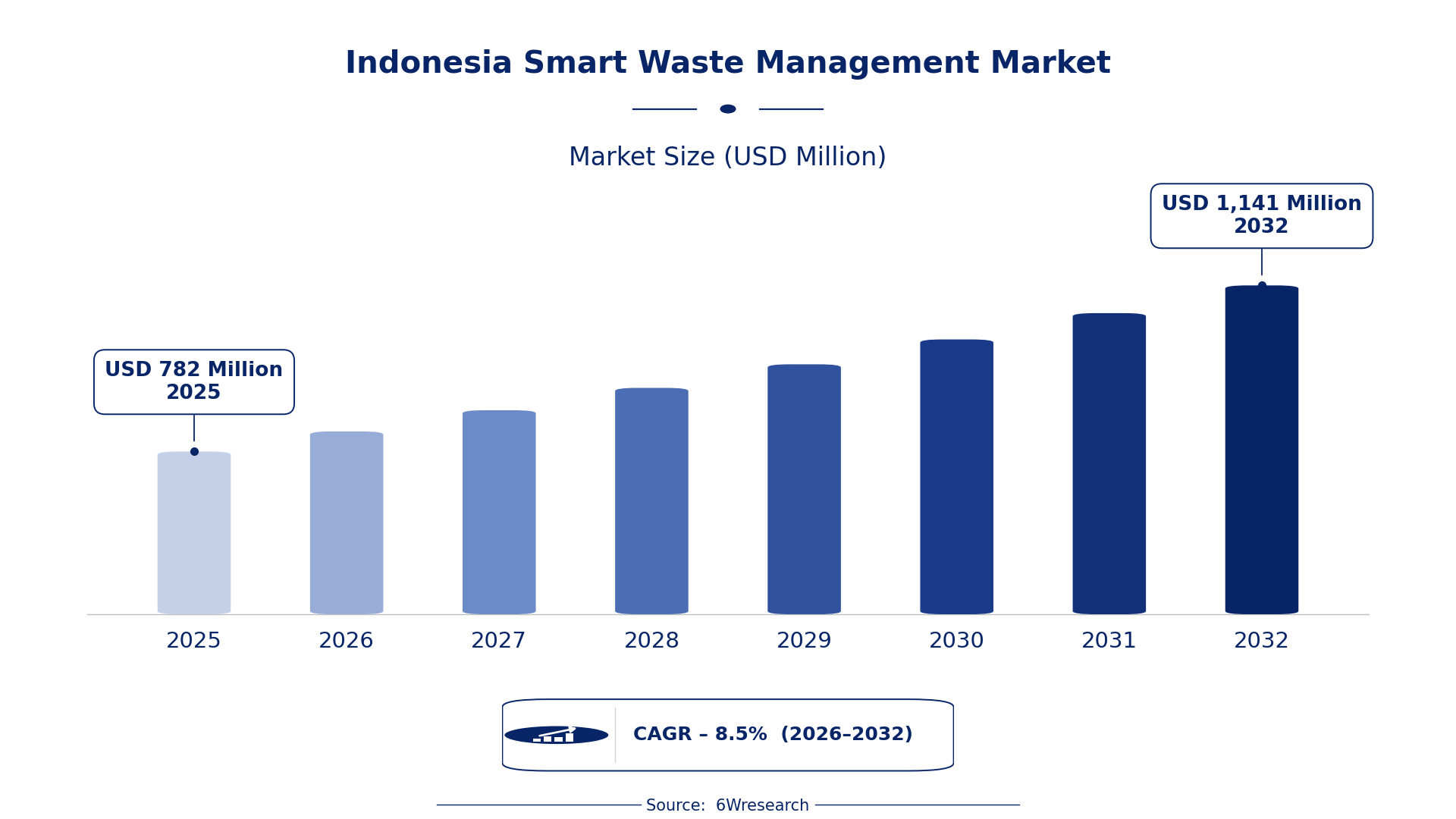
The Indonesia Smart Waste Management Market was estimated at USD 782 Million in 2025 and is projected to reach USD 1141 Million by 2032, growing at a CAGR of 8.5% from 2026 to 2032.
Indonesia Smart Waste Management Market Synopsis
Indonesia is facing a critical waste management crisis, with urban areas struggling to cope with increasing waste generation. The demand for smart waste management solutions has surged as cities seek to implement technologies that enhance efficiency in collection and recycling processes.
With the integration of IoT technology, municipalities are adopting smart bins equipped with sensors that monitor waste levels in real-time. This innovation not only streamlines waste collection routes but also significantly reduces operational costs and environmental impact, making sustainability a priority for local governments.
Indonesia Smart Waste Management Market Year-wise Growth Rate and Key Drivers
This graph illustrates the annual growth rates of the Indonesia Smart Waste Management Market from 2021 to 2032, highlighting a steady upward trajectory and projected expansion over the forecast period.
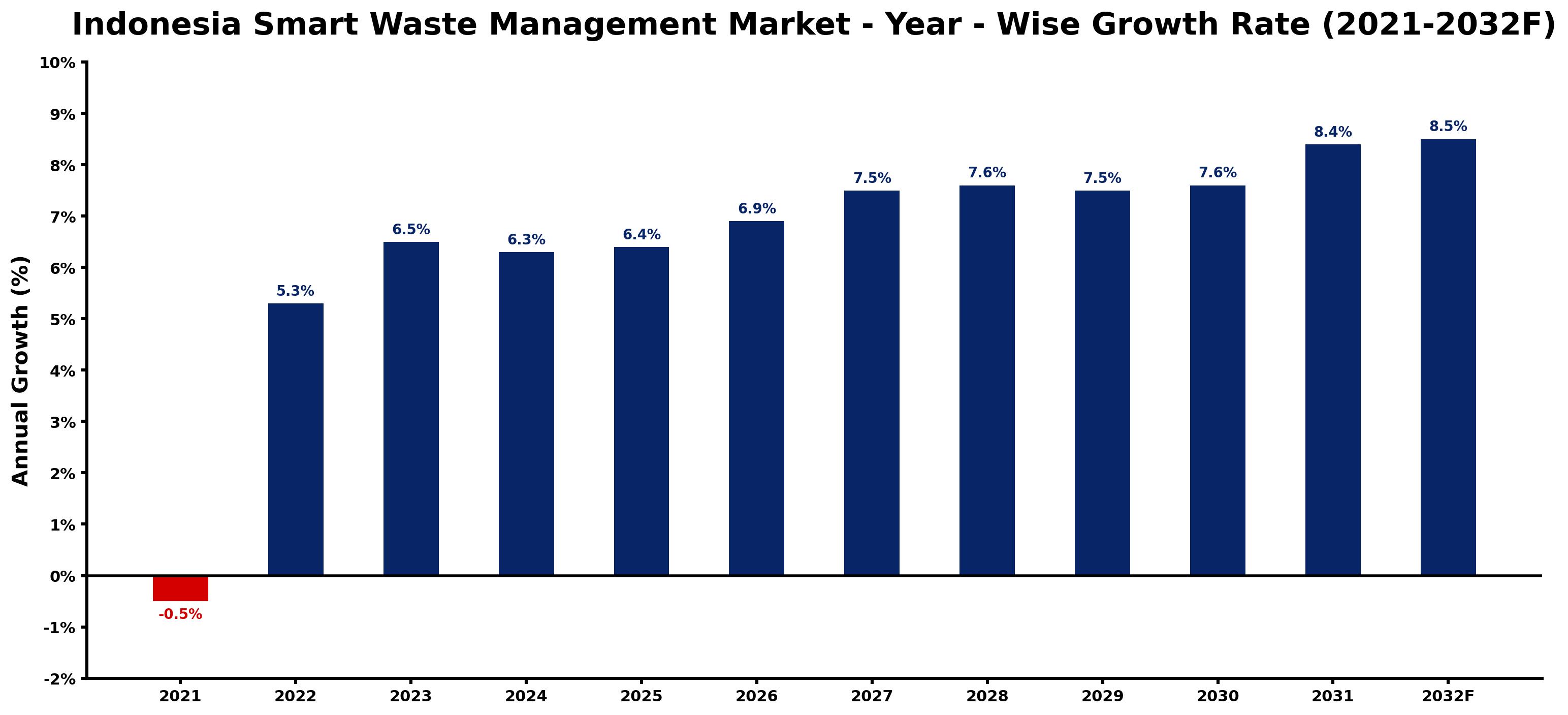
The table below presents the year‑wise growth rates along with the key drivers influencing the market
| Year | Growth Rate | Major Drivers |
| 2021 | -0.5% | Jakarta's strict waste disposal regulations hindered adoption |
| 2022 | 5.3% | Government's waste-to-energy policy boosts sector investments. |
| 2023 | 6.5% | Increased environmental awareness drives smart solution adoption. |
| 2024 | 6.3% | Rise in urban population accelerates waste management needs. |
| 2025 | 6.4% | Investment in IoT technology improves waste collection efficiency. |
| 2026 | 6.9% | Regulatory framework incentivizes recycling and waste reduction. |
| 2027 | 7.5% | Local startups innovate in smart waste sorting technologies. |
| 2028 | 7.6% | Partnerships with universities advance research in waste solutions. |
| 2029 | 7.5% | New local government initiatives focus on sustainability education. |
| 2030 | 7.6% | Increased foreign investment expands smart waste technology market. |
| 2031 | 8.4% | Public-private partnerships enhance waste management service delivery. |
| 2032 | 8.5% | National plastic waste reduction targets drive smart solutions. |
Note: Market size estimations and growth projections presented in this report are based on 6Wresearch's proprietary forecasting methodology, utilizing the latest available industry data, government publications, and primary research inputs.
Indonesia Smart Waste Management Market Key Takeaways
Below are some of the specific key takeaways from the market, including:
- Growing environmental concerns are accelerating the demand for smart waste management solutions across Indonesia.
- Government policies aimed at reducing waste and promoting recycling are driving technological adoption.
- IoT-based waste management systems are enhancing collection efficiency and operational performance.
- Public awareness campaigns are crucial for improving waste segregation and recycling practices.
- Investments in smart waste infrastructure are essential to address challenges in remote areas.
Evaluation of Restraints in Indonesia Smart Waste Management Market
The Indonesia Smart Waste Management Market faces significant restraints that hinder its growth potential. One major issue is the lack of adequate waste collection and disposal infrastructure, particularly in rural and remote regions. This inadequacy complicates the implementation of smart technologies, as they require reliable infrastructure to function effectively. on top of that, inconsistent waste segregation practices among the public hinder the effectiveness of recycling efforts. Variability in regulatory enforcement across different regions adds another layer of complexity, making it difficult for municipalities to implement standardized solutions that could improve overall waste management.
Indonesia Smart Waste Management Market Trends
One prominent trend in Indonesia's smart waste management market is the increasing adoption of data analytics to drive decision-making. Municipalities are leveraging data collected from smart bins to optimize collection schedules, leading to reduced operational costs and improved service efficiency. There's also a growing interest in public-private partnerships aimed at expanding smart waste management initiatives, which can enhance resource allocation and infrastructure development. Additionally, the rise of environmentally conscious consumers is pushing businesses to adopt sustainable practices, further driving demand for smart waste solutions.
Indonesia Smart Waste Management Market Opportunities
The market presents ample opportunities for investment, particularly in technology development and infrastructure enhancement. Companies specializing in IoT and data analytics have a prime chance to collaborate with local governments to create customized solutions tailored to urban and rural waste challenges. on top of that, educational initiatives focused on public awareness can foster a culture of sustainability, encouraging more effective waste management practices. With government backing and an increasing focus on sustainable urban development, the potential for growth is substantial.
Government Initiatives in the Indonesia Smart Waste Management Market
The Indonesian government is actively shaping the smart waste management market through various initiatives aimed at promoting sustainable practices. Policies designed to enhance waste reduction and recycling efforts are gaining traction, reflecting a commitment to environmental stewardship. These efforts not only address immediate waste management issues but also encourage broader community involvement in sustainability efforts.
- A national waste management policy introduced in 2025 aims to standardize waste collection practices and promote recycling initiatives across urban centers.
- Current initiatives include pilot projects for smart waste collection systems in major cities, utilizing IoT technology to improve efficiency.
- Upcoming plans for 2027 involve the launch of a public awareness campaign targeting waste segregation practices in schools and communities.
- A regulatory framework encouraging private sector investment in waste management technologies is currently being drafted to streamline approvals for smart solutions.
- Recent partnerships with environmental NGOs aim to enhance community engagement in sustainable waste practices.
Future Insights of the Indonesia Smart Waste Management Market
Looking ahead to 2026-2032, the Indonesia Smart Waste Management Market is expected to witness transformative advancements driven by technology and regulatory support. As more cities adopt smart waste solutions, the efficiency of waste collection and recycling processes will improve significantly. Continuous investments in infrastructure and community education will enhance public participation in sustainability efforts. The market will likely evolve to include more comprehensive data analytics capabilities, allowing municipalities to make informed decisions that align with environmental goals.
Indonesia Smart Waste Management Market Latest Developments
In the past year, the Indonesian smart waste management sector has seen a surge in innovative projects and collaborations aimed at improving waste management practices. With a focus on integrating technology into waste collection, these developments underscore a growing commitment to sustainability and operational efficiency.
- A leading technology vendor launched a pilot program in early 2025 to deploy smart bins equipped with sensors in Jakarta, improving collection efficiency.
- A recent collaboration between local municipalities and tech firms initiated in mid-2025 aims to enhance data analytics capabilities for optimizing waste collection routes.
- Ongoing workshops are being conducted by NGOs to educate citizens on the importance of waste segregation, a program that began in late 2025.
- A planned rollout of smart waste management systems across major Indonesian cities is expected to commence in the second half of 2026.
- In early 2025, a public-private partnership was formed to develop a comprehensive waste-to-energy facility in Surabaya.
Indonesia Smart Waste Management Market - Key Attractiveness of the Report
- 10 Years of Market Numbers
- Historical Data Starting from 2022 to 2025
- Base Year: 2025
- Forecast Data until 2032
- Key Performance Indicators Impacting the Market
- Major Upcoming Developments and Projects
Key Highlights of the Report:
- Indonesia Smart Waste Management Market Outlook
- Market Size of Indonesia Smart Waste Management Market, 2025
- Forecast of Indonesia Smart Waste Management Market, 2032
- Historical Data and Forecast of Indonesia Smart Waste Management Revenues & Volume for the Period 2022-2032F
- Indonesia Smart Waste Management Market Trend Evolution
- Indonesia Smart Waste Management Market Drivers and Challenges
- Indonesia Smart Waste Management Price Trends
- Indonesia Smart Waste Management Porter's Five Forces
- Indonesia Smart Waste Management Industry Life Cycle
- Historical Data and Forecast of Indonesia Smart Waste Management Market Revenues & Volume By Solution for the Period 2022-2032F
- Historical Data and Forecast of Indonesia Smart Waste Management Market Revenues & Volume By Optimization Solutions for the Period 2022-2032F
- Historical Data and Forecast of Indonesia Smart Waste Management Market Revenues & Volume By Analytics and Reporting Solutions for the Period 2022-2032F
- Historical Data and Forecast of Indonesia Smart Waste Management Market Revenues & Volume By Asset Management for the Period 2022-2032F
- Historical Data and Forecast of Indonesia Smart Waste Management Market Revenues & Volume By Network Management for the Period 2022-2032F
- Historical Data and Forecast of Indonesia Smart Waste Management Market Revenues & Volume By Others for the Period 2022-2032F
- Historical Data and Forecast of Indonesia Smart Waste Management Market Revenues & Volume By Service for the Period 2022-2032F
- Historical Data and Forecast of Indonesia Smart Waste Management Market Revenues & Volume By Professional Services for the Period 2022-2032F
- Historical Data and Forecast of Indonesia Smart Waste Management Market Revenues & Volume By Managed Services for the Period 2022-2032F
- Historical Data and Forecast of Indonesia Smart Waste Management Market Revenues & Volume By Application for the Period 2022-2032F
- Historical Data and Forecast of Indonesia Smart Waste Management Market Revenues & Volume By Food & Retail for the Period 2022-2032F
- Historical Data and Forecast of Indonesia Smart Waste Management Market Revenues & Volume By Construction for the Period 2022-2032F
- Historical Data and Forecast of Indonesia Smart Waste Management Market Revenues & Volume By Manufacturing & Industrial for the Period 2022-2032F
- Historical Data and Forecast of Indonesia Smart Waste Management Market Revenues & Volume By HealthCare for the Period 2022-2032F
- Historical Data and Forecast of Indonesia Smart Waste Management Market Revenues & Volume By Municipalities for the Period 2022-2032F
- Historical Data and Forecast of Indonesia Smart Waste Management Market Revenues & Volume By Colleges & Universities for the Period 2022-2032F
- Indonesia Smart Waste Management Import Export Trade Statistics
- Market Opportunity Assessment By Solution
- Market Opportunity Assessment By Service
- Market Opportunity Assessment By Application
- Indonesia Smart Waste Management Top Companies Market Share
- Indonesia Smart Waste Management Competitive Benchmarking By Technical and Operational Parameters
- Indonesia Smart Waste Management Company Profiles
- Indonesia Smart Waste Management Key Strategic Recommendations






































