Indonesia Soap Market: Import Trend Analysis
In the Indonesia soap market, the import trend experienced a decline from 2023 to 2024, with a growth rate of -7.57%. However, the compound annual growth rate (CAGR) for imports over the period from 2020 to 2024 stood at 5.41%. This decrease in import momentum could be attributed to shifting consumer preferences or changes in trade policies impacting market stability.
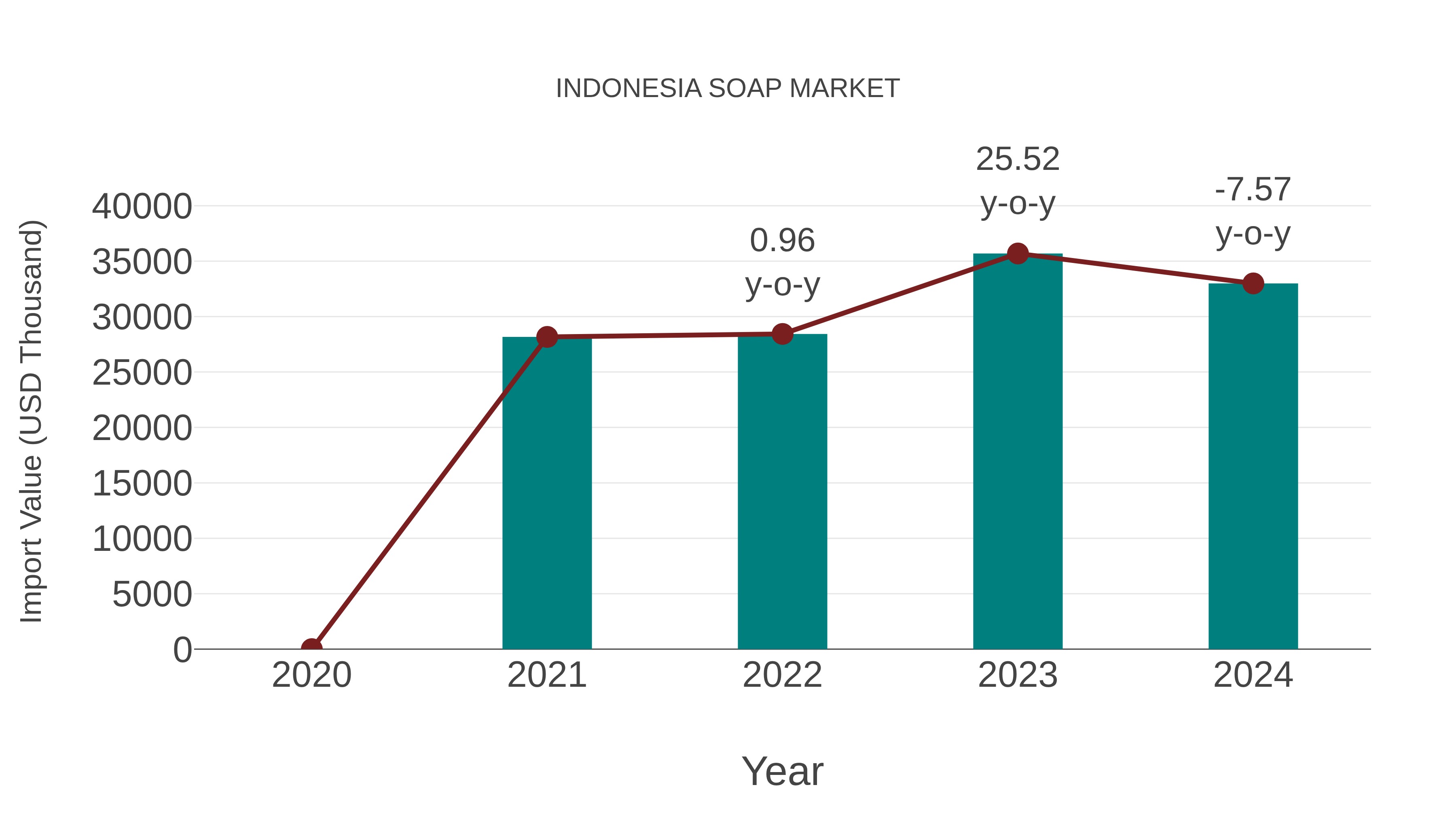
Indonesia Soap Market Growth Rate
According to 6Wresearch internal database and industry insights, the Indonesia Soap Market is projected to grow at a compound annual growth rate (CAGR) of 6.3% during the forecast period from 2026 to 2032.
Topics Covered in the Indonesia Soap Market Report
The Indonesia Soap Market report thoroughly covers the market by type, application, and distribution channel, providing an unbiased and detailed analysis of ongoing market trends, opportunities, challenges, and market drivers, helping stakeholders align their strategies with current and future market dynamics.
Indonesia Soap Market Highlights
| Report Name | Indonesia Soap Market |
| Forecast period | 2026–2032 |
| CAGR | 6.3% |
| Growing Sector | Soap |
Indonesia Soap Market Synopsis
Indonesia Soap Market is experiencing steady growth due to the rising consumer awareness about hygiene and personal care. With the increasing demand for soap products, especially liquid soap, as well as innovations in soap formulations catering to different skin types, the market is expanding. Furthermore, the rise of online retail and eco-friendly product offerings is adding to the growth of the market. The preference for luxury soaps and skin care-enhancing products is expected to propel the market forward, driven by changing consumer preferences and an expanding middle class.
Evaluation of Growth Drivers in the Indonesia Soap Market
Below mentioned are some prominent drivers and their impact on the market dynamics:
| Drivers | Primary Segments Affected | Why It Matters (evidence) |
| Increasing Hygiene Awareness | Bar Soap, Liquid Soap | Consumers are becoming more health-conscious, leading to increased usage of soap for personal hygiene. |
| Rising Demand for Skin Care Products | Liquid Soap, Bar Soap | To attract consumers seeking cleanliness and skin benefits, soap manufacturers are focusing on skin-care-oriented products. |
| E-Commerce Growth | All Product Segments | Soap products, particularly premium and luxury variants, have become more accessible due to the growth of online retail. |
| Eco-Friendly Packaging | Liquid Soap, Bar Soap | A growing number of people would argue that there would be massive gains attached to targeting biodegradable and eco- friendly soap packaging. |
| Affluent Consumer Growth | Luxury Soap | The increasing middle-class income and preference for luxury soap products are contributing to market expansion. |
Indonesia Soap Market Size is projected to grow at a CAGR of 6.3% from 2026 to 2032. The market is growing as consumers prefer hygiene products, demand for skincare soap products has increased, and businesses use sustainable packaging solutions. As consumers become more aware of health and skin care needs, the demand for bar and liquid soaps has risen. The market is growing as soap companies introduce new ingredients and packaging solutions, with customers increasingly preferring natural and organic products. The market trends and consumer preferences are being shaped by skincare products which have become essential to people.
Evaluation of Restraints in the Indonesia Soap Market
Below mentioned are some major restraints and their influence on the market dynamics:
| Restraints | Primary Segments Affected | What This Means (evidence) |
| Price Sensitivity | Mass Market, Bar Soap | The higher cost of premium soaps can limit accessibility for price-sensitive consumers. |
| Competition from Alternatives | Liquid Soap, Bar Soap | The growing popularity of body washes and alternative cleaning products could slow down the growth of the soap market. |
| Regulatory and Safety Standards | All Product Segments | Strict regulations regarding ingredient safety and soap production processes could impact market entry and product innovation. |
| Consumer Preferences | Bar Soap, Liquid Soap | The mainstream body wash business can lead to a reduce in demand and use of bar soap and other simple forms of soap. |
| Raw Material Supply | All Product Segments | Price volatility and supply chain disturbances in terms of materials, such as oils and fats, might have some bearing on the production costs associated with soap. |
Indonesia Soap Market Challenges
Indonesia Soap Industry faces challenges like price sensitivity, where premium soaps may be inaccessible to many. The rising preference for body washes and other alternatives may limit soap demand. The strict regulatory requirements for ingredient safety and product standards create barriers that prevent new brands from entering the market. Furthermore, the factors mentioned above compel market participants to develop innovative soap products which provide affordable yet secure and effective solutions that meet consumer demands while they handle regulatory requirements and face market competition.
Indonesia Soap Market Trends
Here are some major trends changing the Indonesia Soap Market Growth dynamics:
- Increasing Demand for Skin Care Soaps: The demand for skin care soaps is growing as people prefer soaps which provide cleaning benefits and skin enhancement properties. The market demand exists for products which contain both moisturizing elements and natural plant-based extracts.
- Rise in Eco-Friendly Products: Soaps with eco-friendly, biodegradable, and plastic-free packaging are becoming increasingly popular as consumers shift towards environmentally conscious purchases.
- Expansion of Luxury Soaps: The demand for luxury soap products has increased as more people can afford high-end products which use premium ingredients and exclusive scents.
Investment Opportunities in the Indonesia Soap Industry
The Indonesia Soap Market presents several investment opportunities, including:
- Innovation in Soap Formulas: The research development funds of companies should be used to develop specialized soap products which provide moisturizing and anti-aging and organic formulas for different skin needs.
- Sustainability Initiatives: Companies should invest in sustainable packaging materials and environmentally responsible ingredient extraction methods to meet the needs of customers who prioritize environmental protection.
- Expansion into E-Commerce: Companies should use their financial resources to develop online sales methods which will enable them to access a wider customer base and sell their high-end soap products through digital channels.
Top 5 Leading Players in the Indonesia Soap Market
Below is the list of prominent companies leading the Indonesia Soap Market Share:
1. PT Unilever Indonesia Tbk
| Company Name | PT Unilever Indonesia Tbk |
| Established Year | 1933 |
| Headquarters | Tangerang, Banten |
| Official Website | Click Here |
Unilever remains the dominant leader in the Indonesian soap market, holding a significant share of the bath and shower segment. Its flagship brands, Lifebuoy and Lux, are household staples nationwide.
2. PT Wings Surya (Wings Group)
| Company Name | PT Wings Surya (Wings Group) |
| Established Year | 1948 |
| Headquarters | Surabaya, East Java |
| Official Website | - |
Originally founded as a laundry soap manufacturer, Wings Group has grown into one of Indonesia's largest domestic consumer goods companies. Its personal care brand, Nuvo, is a primary competitor to international labels, offering high-quality antibacterial soaps at competitive price points.
3. PT Kao Indonesia
| Company Name | PT Kao Indonesia |
| Established Year | 1985 |
| Headquarters | Jakarta, Indonesia |
| Official Website | Click Here |
A joint venture between Kao Corporation Japan and local partners, PT Kao Indonesia is a major player in the premium and health-beauty segments.
4. PT Paragon Technology and Innovation
| Company Name | PT Paragon Technology and Innovation |
| Established Year | 1985 |
| Headquarters | Jakarta, Indonesia |
| Official Website | Click Here |
Paragon is the leading local player in the Halal-certified personal care market. While famous for its Wardah cosmetics line, the company has successfully expanded into the soap and body wash market with brands like Biodef. Paragon’s growth is driven by its focus on local consumer preferences, high-frequency innovation, and a strong appeal to the country’s large Muslim demographic.
5. PT Lion Wings
| Company Name | PT Lion Wings |
| Established Year | 1981 |
| Headquarters | Jakarta, Indonesia |
| Official Website | Click Here |
A strategic partnership between Lion Corporation Japan and the Wings Group, PT Lion Wings specializes in various personal care and home care categories.
Government Regulations Introduced in the Indonesia Soap Market
According to Indonesian government data, the Indonesian government, through the National Agency of Drug and Food Control (BPOM), enforces regulations which protect soap products from safety and quality violations. The agency monitors the compliance of ingredients used in soap, which allows them to confirm that all components are safe for consumer use. The Ministry of Health has established production guidelines to help manufacturers produce soap products that meet hygiene requirements. Government initiatives include regulations which require soap manufacturers to use natural ingredients, which will protect consumer safety while maintaining product quality.
Future Insights of the Indonesia Soap Market
The future of Indonesia Soap Market outlook shows a positive trend as people are becoming more aware of hygiene and there is growing demand for skin-care-enhancing soap products and eco-friendly packaging solutions. The online retail market will grow as more consumers can afford luxury soaps. The market will continue to grow as people will spend more money on health products and their incomes will increase which will drive demand for premium skin-care products that meet the needs of wealthy health-conscious customers.
Market Segmentation Analysis
The report offers a comprehensive study of the following market segments and their leading categories:
By Type- Bar Soap to Dominate the Market
According to Ritika Kalra, Senior Research Analyst, 6Wresearch, Bar Soap will dominate the market due to its traditional use, wide availability, and affordability. Bar soap remains a preferred choice in households across Indonesia.
By Application- Household to Dominate the Market
Household is poised to dominate the market since soap is generally used for personal hygiene and skin care, among individual consumers.
By Distribution Channel - Traditional Trade to Dominate the Market
The market will continue to be dominated by traditional trade as rural areas depend on local stores as their main source of soap products. Online Trade is experiencing fast growth since it enables customers to buy high-quality eco-friendly products.
Key attractiveness of the Report
- 10 Years Market Numbers.
- Historical Data Starting from 2022 to 2025.
- Base Year: 2025.
- Forecast Data until 2032.
- Key Performance Indicators Impacting the Market.
- Major Upcoming Developments and Projects.
Key Highlights of the Report:
- Indonesia Soap Market Outlook
- Market Size of Indonesia Soap Market, 2025
- Forecast of Indonesia Soap Market, 2032
- Historical Data and Forecast of Indonesia Soap Revenues & Volume for the Period 2022 - 2032F
- Indonesia Soap Market Trend Evolution
- Indonesia Soap Market Drivers and Challenges
- Indonesia Soap Price Trends
- Indonesia Soap Porter's Five Forces
- Indonesia Soap Industry Life Cycle
- Historical Data and Forecast of Indonesia Soap Market Revenues & Volume By Type for the Period 2022 - 2032F
- Historical Data and Forecast of Indonesia Soap Market Revenues & Volume By Bar Soap for the Period 2022 - 2032F
- Historical Data and Forecast of Indonesia Soap Market Revenues & Volume By Liquid Soap for the Period 2022 - 2032F
- Historical Data and Forecast of Indonesia Soap Market Revenues & Volume By Application for the Period 2022 - 2032F
- Historical Data and Forecast of Indonesia Soap Market Revenues & Volume By Household for the Period 2022 - 2032F
- Historical Data and Forecast of Indonesia Soap Market Revenues & Volume By Commercial for the Period 2022 - 2032F
- Historical Data and Forecast of Indonesia Soap Market Revenues & Volume By Other for the Period 2022 - 2032F
- Historical Data and Forecast of Indonesia Soap Market Revenues & Volume By Distribution Channel for the Period 2022 - 2032F
- Historical Data and Forecast of Indonesia Soap Market Revenues & Volume By Modern Trade for the Period 2022 - 2032F
- Historical Data and Forecast of Indonesia Soap Market Revenues & Volume By Traditional Trade for the Period 2022 - 2032F
- Historical Data and Forecast of Indonesia Soap Market Revenues & Volume By Online for the Period 2022 - 2032F
- Indonesia Soap Import Export Trade Statistics
- Market Opportunity Assessment By Type
- Market Opportunity Assessment By Application
- Market Opportunity Assessment By Distribution Channel
- Indonesia Soap Top Companies Market Share
- Indonesia Soap Competitive Benchmarking By Technical and Operational Parameters
- Indonesia Soap Company Profiles
- Indonesia Soap Key Strategic Recommendations
Markets Covered
The report offers a comprehensive study of the subsequent market segments
By Type
- Bar Soap
- Liquid Soap
By Application
- Household
- Commercial
- Others
By Distribution Channel
- Modern Trade
- Traditional Trade
- Online






































