Indonesia Sports Equipment Market Size, Share & Growth Rate
The Indonesia Sports Equipment Market was estimated at USD 437 Million in 2025 and is projected to reach USD 581 Million by 2032, growing at a CAGR of 4.2% from 2026 to 2032. This growth trajectory is fueled by an increasing sports culture and a nationwide shift toward fitness and outdoor activities. As more Indonesians embrace healthier lifestyles, the demand for sports gear across popular sports such as badminton, soccer, and basketball continues to rise.
Indonesia Sports Equipment Market Year-wise Growth Rate and Key Drivers
This graph highlights how the Indonesia Sports Equipment Market has steadily grown over the years, supported by major growth factors.
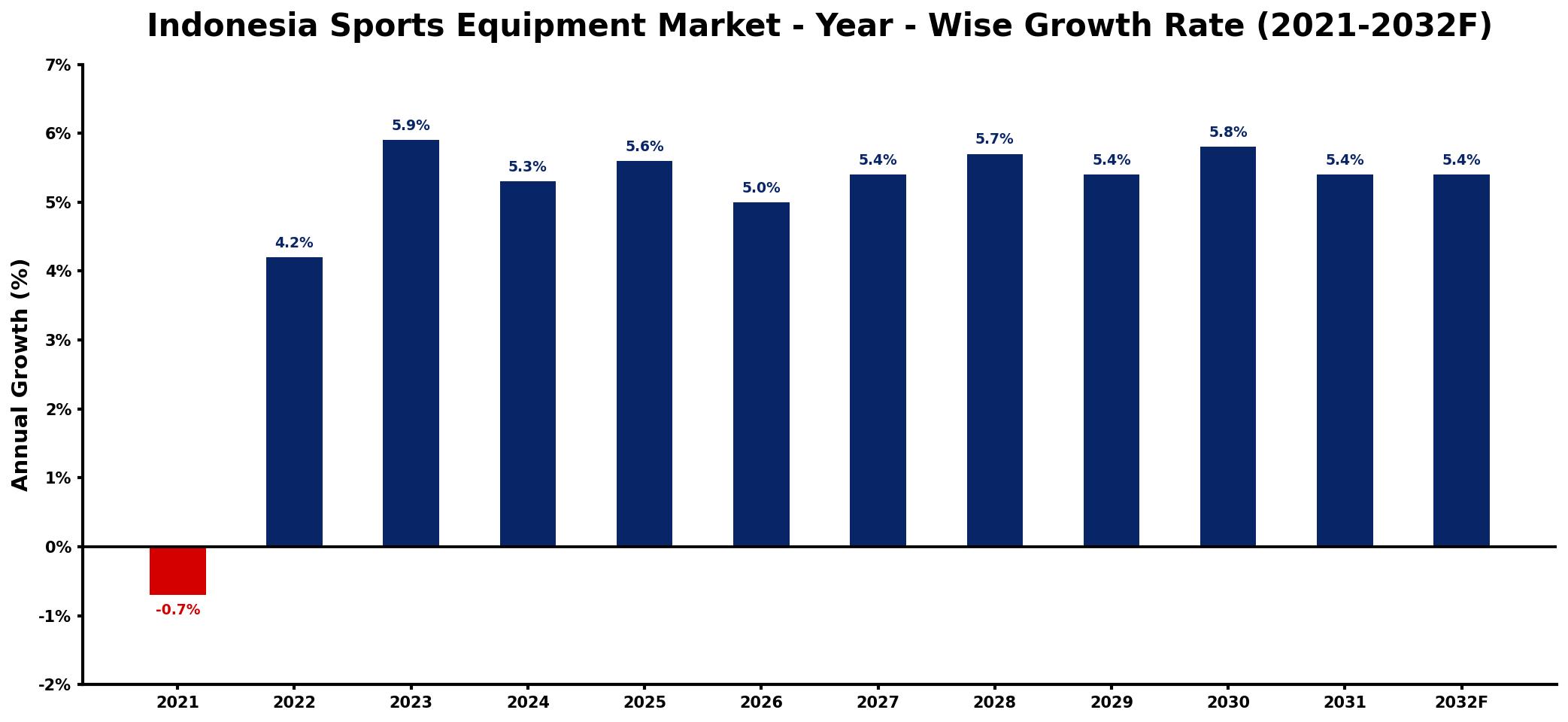
The table below presents the year‑wise growth rates along with the key drivers influencing the market
| Year | Growth Rate | Major Drivers |
| 2021 | -0.7% | decreased consumer spending on leisure |
| 2022 | 4.2% | rise in health consciousness nationwide |
| 2023 | 5.9% | increased participation in recreational activities |
| 2024 | 5.3% | growing investment in fitness facilities |
| 2025 | 5.6% | expansion of e-commerce platforms |
| 2026 | 5.0% | surge in youth engagement programs |
| 2027 | 5.4% | growing popularity of outdoor events |
| 2028 | 5.7% | enhanced marketing strategies adopted |
| 2029 | 5.4% | increased collaboration with influencers |
| 2030 | 5.8% | development of innovative training programs |
| 2031 | 5.4% | increased domestic production output |
| 2032 | 5.4% | enhanced product quality standards |
Note: Market size estimations and growth projections presented in this report are based on 6Wresearch's proprietary forecasting methodology, utilizing the latest available industry data, government publications, and primary research inputs.
Indonesia Sports Equipment Market Synopsis
The recent momentum in the Indonesian sports equipment market reflects a thriving enthusiasm for sports among the population, paired with a growing commitment to fitness. This is coupled with the escalating influence of health awareness campaigns, which encourage active participation in various sports and physical activities.
Looking ahead, the market is poised for sustained growth, as governmental initiatives and community programs increasingly support sports participation. E-commerce platforms are also emerging as key facilitators, making equipment more accessible to a broader audience and contributing to market vitality.
Indonesia Sports Equipment Market Key Takeaways
- Significant growth expected, with a projected market size of USD 581 Million by 2032.
- Popular sports driving demand include badminton, soccer, and basketball.
- Health awareness and fitness culture are pivotal in shaping consumer preferences.
- E-commerce is revolutionizing distribution, improving access to a variety of sports gear.
- Community and government initiatives are increasingly supporting sports participation nationwide.
Evaluation of Restraints in Indonesia Sports Equipment Market
Despite its growth potential, the Indonesia sports equipment market faces several challenges. A fragmented distribution network limits the efficient delivery of products, particularly in rural regions. Furthermore, maintaining quality control remains a concern for both local manufacturers and consumers who are increasingly wary of counterfeit products. The rising competition from established international brands also poses a challenge for local players aiming to carve out their market share in this evolving landscape.
Indonesia Sports Equipment Market Trends
Several trends are emerging within the Indonesian sports equipment market that are shaping its future. The incorporation of technology into sporting equipment, such as fitness trackers and smart sports gear, is becoming increasingly popular among the tech-savvy youth demographic. Moreover, sustainability is gaining traction, with consumers showing a preference for eco-friendly products. The rise of fitness influencers on social media platforms is also a driving force, propelling traditional and modern equipment into the spotlight.
Indonesia Sports Equipment Market Opportunities
The current landscape offers numerous growth and investment opportunities within the Indonesian sports equipment market. As urban areas continue to develop, theres potential for specialized sports facilities and training centers, further driving demand for quality equipment. Additionally, tapping into the growing interest in niche sports can provide companies with opportunities to differentiate their offerings. The rise of online retail platforms opens avenues for brands to engage with consumers directly, enhancing brand loyalty and accessibility.
Government Initiatives in the Indonesia Sports Equipment Market
The Indonesian government has been actively promoting sports and physical fitness through various initiatives, which significantly benefit the sports equipment market. Investments in public sports facilities and community sports programs are aimed at fostering increased participation in physical activities. Furthermore, collaborations with private sectors and sponsors help to organize sports events, enhancing visibility for both local and international sports brands. This proactive approach not only encourages a healthier lifestyle but also stimulates market growth.
Future Insights of the Indonesia Sports Equipment Market
From 2026 to 2032, the Indonesian sports equipment market is expected to continue its upward trajectory, driven by sustained interest in health and fitness. As e-commerce continues to expand, access to diverse sports equipment will improve, fostering greater participation in various sports. Moreover, the ongoing digitalization of consumer engagement, through social media and online platforms, will likely play a crucial role in shaping market dynamics, enabling brands to connect more effectively with their audience.
Indonesia Sports Equipment Market Latest Developments (2025 - 2026)
In recent months, the Indonesian sports equipment market has seen increased activity surrounding local initiatives to promote sports among youth. Numerous grassroots programs focusing on community engagement have been launched, aimed at cultivating interest in various sports. Simultaneously, e-commerce platforms have ramped up their offerings, introducing a wider range of products and enhancing customer experience through innovations in online shopping. These developments indicate a vibrant market landscape, ripe for further exploration and investment.
Indonesia Sports Equipment Market - Key Attractiveness of the Report
- 10 Years of Market Numbers
- Historical Data Starting from 2022 to 2025
- Base Year: 2025
- Forecast Data until 2032
- Key Performance Indicators Impacting the Market
- Major Upcoming Developments and Projects
Key Highlights of the Report:
- Indonesia Sports Equipment Market Outlook
- Market Size of Indonesia Sports Equipment Market, 2025
- Forecast of Indonesia Sports Equipment Market, 2032
- Historical Data and Forecast of Indonesia Sports Equipment Revenues & Volume for the Period 2022-2032F
- Indonesia Sports Equipment Market Trend Evolution
- Indonesia Sports Equipment Market Drivers and Challenges
- Indonesia Sports Equipment Price Trends
- Indonesia Sports Equipment Porter's Five Forces
- Indonesia Sports Equipment Industry Life Cycle
- Historical Data and Forecast of Indonesia Sports Equipment Market Revenues & Volume By Product for the Period 2022-2032F
- Historical Data and Forecast of Indonesia Sports Equipment Market Revenues & Volume By Ball over net games for the Period 2022-2032F
- Historical Data and Forecast of Indonesia Sports Equipment Market Revenues & Volume By Ball games for the Period 2022-2032F
- Historical Data and Forecast of Indonesia Sports Equipment Market Revenues & Volume By Fitness/Strength equipment for the Period 2022-2032F
- Historical Data and Forecast of Indonesia Sports Equipment Market Revenues & Volume By Athletic training equipment for the Period 2022-2032F
- Historical Data and Forecast of Indonesia Sports Equipment Market Revenues & Volume By Others for the Period 2022-2032F
- Historical Data and Forecast of Indonesia Sports Equipment Market Revenues & Volume By Distribution Channel for the Period 2022-2032F
- Historical Data and Forecast of Indonesia Sports Equipment Market Revenues & Volume By Online retail for the Period 2022-2032F
- Historical Data and Forecast of Indonesia Sports Equipment Market Revenues & Volume By Specialty & sports shops for the Period 2022-2032F
- Historical Data and Forecast of Indonesia Sports Equipment Market Revenues & Volume By Department & discount stores for the Period 2022-2032F
- Indonesia Sports Equipment Import Export Trade Statistics
- Market Opportunity Assessment By Product
- Market Opportunity Assessment By Distribution Channel
- Indonesia Sports Equipment Top Companies Market Share
- Indonesia Sports Equipment Competitive Benchmarking By Technical and Operational Parameters
- Indonesia Sports Equipment Company Profiles
- Indonesia Sports Equipment Key Strategic Recommendations






































