Indonesia Stone Crushing Equipment Market Size, Share & Growth Rate
The Indonesia Stone Crushing Equipment Market was estimated at USD 428 Million in 2025 and is projected to reach USD 567 Million by 2032, growing at a CAGR of 4.1% from 2026 to 2032. This growth trajectory is primarily driven by the continuous expansion of the construction and infrastructure sectors, propelled by urbanization and substantial government investments. As infrastructure projects gain momentum, the demand for efficient stone crushing machinery is expected to increase significantly, providing a robust foundation for market expansion.
Indonesia Stone Crushing Equipment Market Year-wise Growth Rate and Key Drivers
This graph highlights how the Indonesia Stone Crushing Equipment Market has steadily grown over the years, supported by major growth factors.
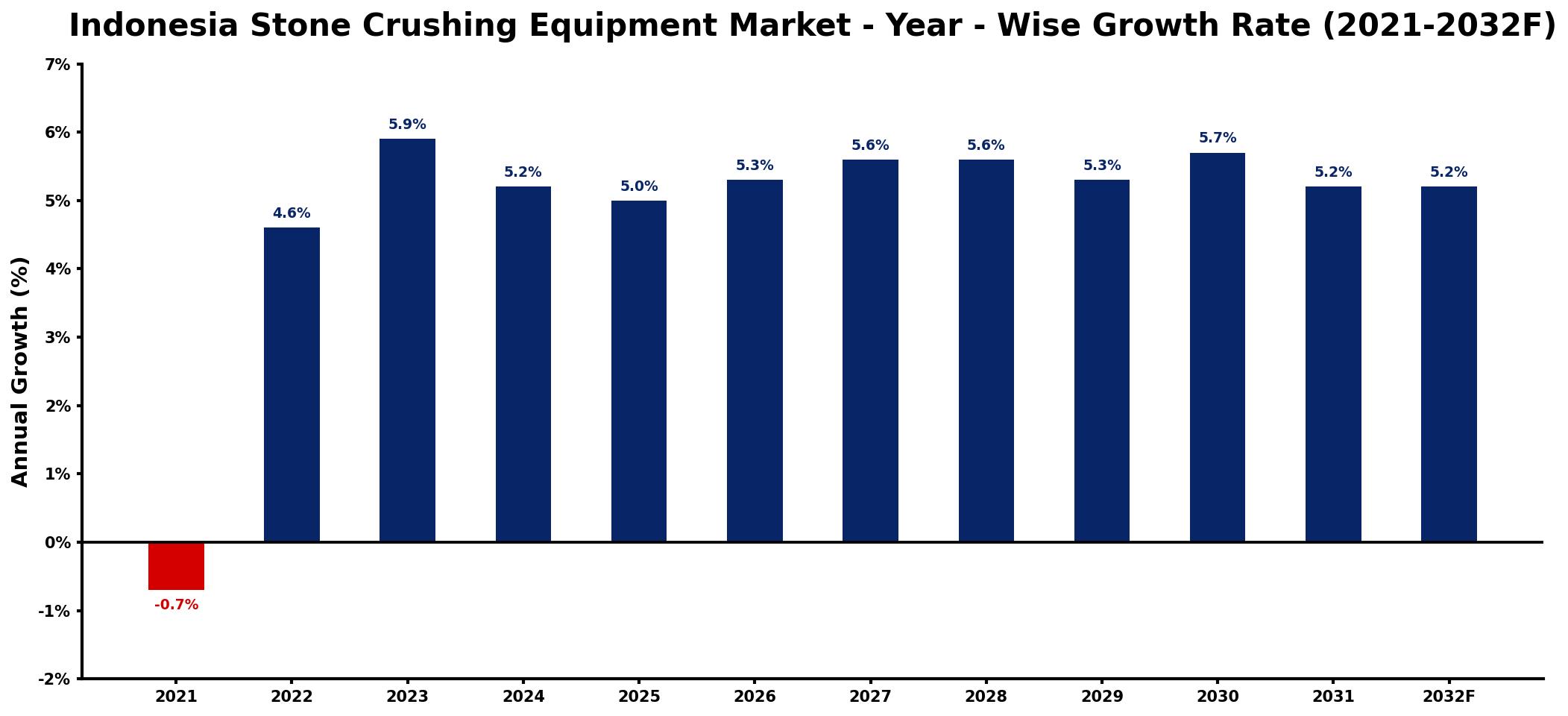
The table below presents the year‑wise growth rates along with the key drivers influencing the market
| Year | Growth Rate | Major Drivers |
| 2021 | -0.7% | decrease in infrastructure projects |
| 2022 | 4.6% | rise in construction activities |
| 2023 | 5.9% | increased mining sector investments |
| 2024 | 5.2% | expansion of urban development |
| 2025 | 5.0% | growing demand for aggregates |
| 2026 | 5.3% | boost in renewable energy projects |
| 2027 | 5.6% | enhanced government spending initiatives |
| 2028 | 5.6% | surge in residential construction |
| 2029 | 5.3% | increased foreign direct investments |
| 2030 | 5.7% | development of transportation networks |
| 2031 | 5.2% | growth in industrial applications |
| 2032 | 5.2% | rising need for infrastructure upgrades |
Note: Market size estimations and growth projections presented in this report are based on 6Wresearch's proprietary forecasting methodology, utilizing the latest available industry data, government publications, and primary research inputs.
Indonesia Stone Crushing Equipment Market Synopsis
The Indonesian market for stone crushing equipment is witnessing an uptick in demand, particularly due to ongoing infrastructure initiatives aimed at bolstering the economy. With a diverse range of applications such as road construction, building projects, and aggregate production, the need for high-quality crushed stone continues to escalate.
Moreover, leading manufacturers are increasingly diversifying their product portfolios, introducing innovative technologies that enhance the efficiency and reliability of stone crushing equipment. These advancements are crucial in meeting the rising expectations of the construction sector and improving operational performance.
Indonesia Stone Crushing Equipment Market Key Takeaways
- Robust growth is driven by infrastructure development and urbanization trends.
- Technological advancements are enhancing the efficiency of stone crushing machinery.
- Government initiatives play a significant role in stimulating market demand.
- The market is anticipated to rebound following the COVID-19 pandemic recovery.
- Key players are focused on expanding product offerings to meet evolving industry needs.
Evaluation of Restraints in Indonesia Stone Crushing Equipment Market
Despite the promising growth trajectory, the Indonesia Stone Crushing Equipment Market faces notable challenges. Regulatory hurdles for quarrying and mining operations pose significant limitations on production capabilities. Environmental concerns, including noise pollution and land reclamation issues, may hinder operational efficiencies. Additionally, fluctuations in the construction sector could impact demand for crushed stone materials, thereby affecting market dynamics and profitability.
Indonesia Stone Crushing Equipment Market Trends
The current landscape of the Indonesia Stone Crushing Equipment Market is being shaped by several key trends. The integration of automation technologies into stone crushing equipment is revolutionizing operational workflows, resulting in improved productivity and reduced labor costs. Furthermore, an increasing emphasis on sustainability has led manufacturers to develop eco-friendly equipment that minimizes environmental impact while maintaining performance standards.
Indonesia Stone Crushing Equipment Market Opportunities
Growth opportunities abound in the Indonesia Stone Crushing Equipment Market, particularly in the context of rising government infrastructure projects. Investment in public-private partnerships (PPPs) and increased funding for urban development initiatives create a favorable environment for stakeholders. Additionally, as demand for recycled construction materials grows, there is potential for stone crushing equipment manufacturers to innovate solutions that cater to this emerging market segment.
Government Initiatives in the Indonesia Stone Crushing Equipment Market
The Indonesian government has introduced various initiatives aimed at boosting infrastructure development and construction activities. This includes increased public spending on infrastructure projects, which creates a ripple effect in the stone crushing equipment sector. Programs focusing on improving transportation networks and urban infrastructure are expected to provide significant growth opportunities for the market while also ensuring compliance with environmental regulations.
Future Insights of the Indonesia Stone Crushing Equipment Market
Looking forward to the period from 2026 to 2032, the Indonesia Stone Crushing Equipment Market is poised for substantial growth. This anticipated rise is largely attributed to a renewed focus on infrastructure development, both from the public and private sectors. As construction projects recommence and expand, the demand for advanced stone crushing technologies will grow, facilitating increased production capacities and operational efficiencies for manufacturers and consumers alike.
Indonesia Stone Crushing Equipment Market Latest Developments (2025 - 2026)
In recent months, the Indonesia Stone Crushing Equipment Market has experienced strategic shifts aimed at enhancing operational efficiencies. Several companies are actively pursuing technological innovations to improve machine performance and reduce costs. Partnerships and collaborations within the industry are also on the rise as stakeholders look to leverage shared expertise and resources to capture emerging market opportunities.
Indonesia Stone Crushing Equipment Market - Key Attractiveness of the Report
- 10 Years of Market Numbers
- Historical Data Starting from 2022 to 2025
- Base Year: 2025
- Forecast Data until 2032
- Key Performance Indicators Impacting the Market
- Major Upcoming Developments and Projects
Key Highlights of the Report:
- Indonesia Stone Crushing Equipment Market Outlook
- Market Size of Indonesia Stone Crushing Equipment Market, 2025
- Forecast of Indonesia Stone Crushing Equipment Market, 2032
- Historical Data and Forecast of Indonesia Stone Crushing Equipment Revenues & Volume for the Period 2022-2032F
- Indonesia Stone Crushing Equipment Market Trend Evolution
- Indonesia Stone Crushing Equipment Market Drivers and Challenges
- Indonesia Stone Crushing Equipment Price Trends
- Indonesia Stone Crushing Equipment Porter's Five Forces
- Indonesia Stone Crushing Equipment Industry Life Cycle
- Historical Data and Forecast of Indonesia Stone Crushing Equipment Market Revenues & Volume By Type for the Period 2022-2032F
- Historical Data and Forecast of Indonesia Stone Crushing Equipment Market Revenues & Volume By Jaw Crusher for the Period 2022-2032F
- Historical Data and Forecast of Indonesia Stone Crushing Equipment Market Revenues & Volume By Cone Crusher for the Period 2022-2032F
- Historical Data and Forecast of Indonesia Stone Crushing Equipment Market Revenues & Volume By Impact Crusher for the Period 2022-2032F
- Historical Data and Forecast of Indonesia Stone Crushing Equipment Market Revenues & Volume By Others for the Period 2022-2032F
- Historical Data and Forecast of Indonesia Stone Crushing Equipment Market Revenues & Volume By End Users for the Period 2022-2032F
- Historical Data and Forecast of Indonesia Stone Crushing Equipment Market Revenues & Volume By Mining for the Period 2022-2032F
- Historical Data and Forecast of Indonesia Stone Crushing Equipment Market Revenues & Volume By Quarrying for the Period 2022-2032F
- Historical Data and Forecast of Indonesia Stone Crushing Equipment Market Revenues & Volume By Recycling for the Period 2022-2032F
- Historical Data and Forecast of Indonesia Stone Crushing Equipment Market Revenues & Volume By Construction & Infrastructure for the Period 2022-2032F
- Historical Data and Forecast of Indonesia Stone Crushing Equipment Market Revenues & Volume By Others for the Period 2022-2032F
- Indonesia Stone Crushing Equipment Import Export Trade Statistics
- Market Opportunity Assessment By Type
- Market Opportunity Assessment By End Users
- Indonesia Stone Crushing Equipment Top Companies Market Share
- Indonesia Stone Crushing Equipment Competitive Benchmarking By Technical and Operational Parameters
- Indonesia Stone Crushing Equipment Company Profiles
- Indonesia Stone Crushing Equipment Key Strategic Recommendations






































