Indonesia Telecom Cloud Billing Market Size & Growth Rate (2026-2032)
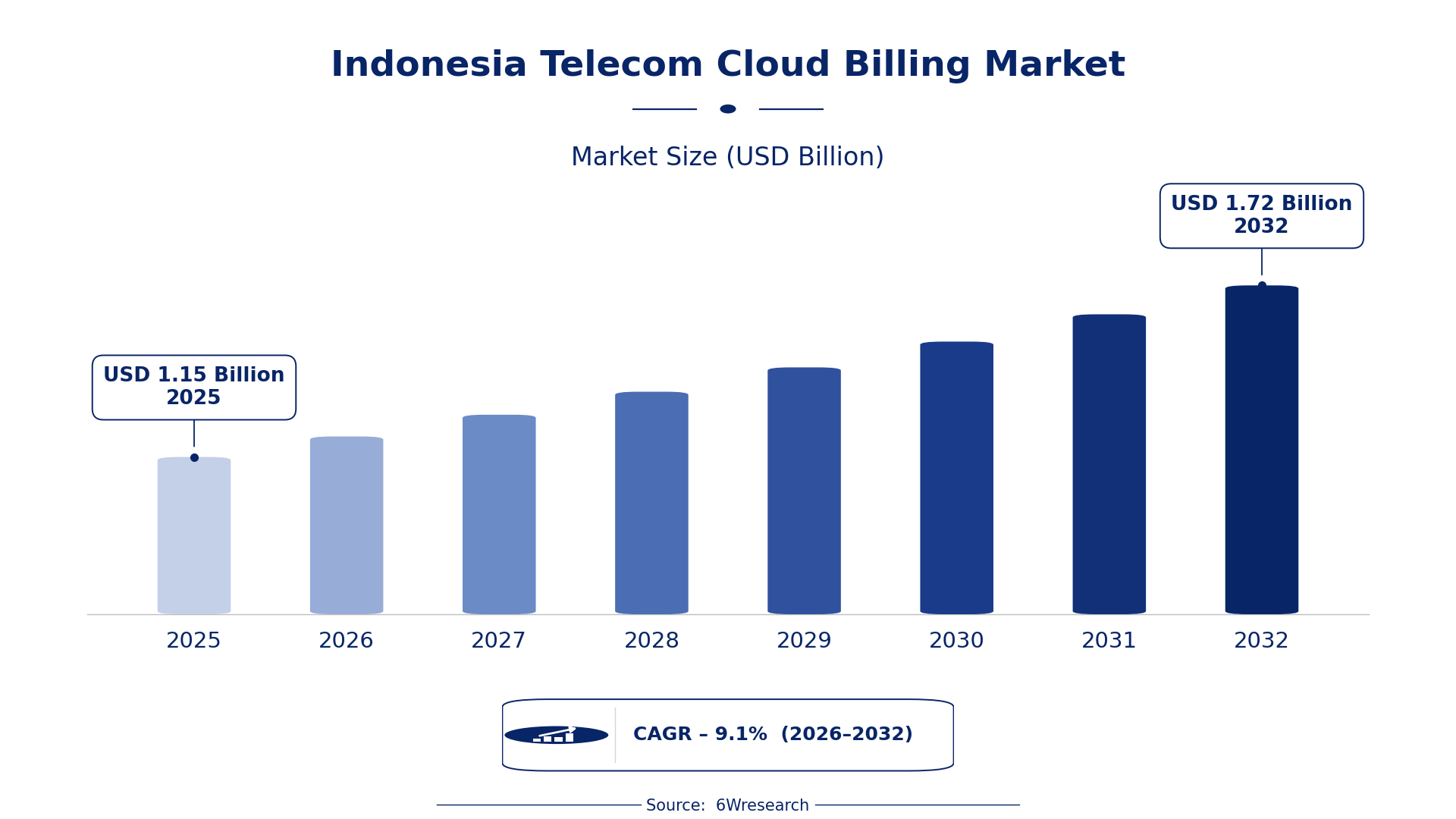
The Indonesia Telecom Cloud Billing Market was estimated at USD 1153 Million in 2025 and is projected to reach USD 1719 Million by 2032, growing at a CAGR of 9.1% from 2026 to 2032.
Indonesia Telecom Cloud Billing Market Synopsis
The Indonesian Telecom Cloud Billing Market has seen a surge in adoption as telecom operators increasingly shift towards cloud-based solutions for billing. This trend is catalyzed by the need for operational efficiency and the desire to enhance customer satisfaction in a competitive environment.
As we look ahead, the market is set to evolve further, driven by technological advancements and changing consumer expectations. The transition to cloud billing systems not only allows for greater scalability but also addresses the diverse needs of telecom operators striving to remain agile in a dynamic sector.
Indonesia Telecom Cloud Billing Market Year-wise Growth Rate and Key Drivers
This graph illustrates the annual growth rates of the Indonesia Telecom Cloud Billing Market from 2021 to 2032, highlighting a steady upward trajectory and projected expansion over the forecast period.
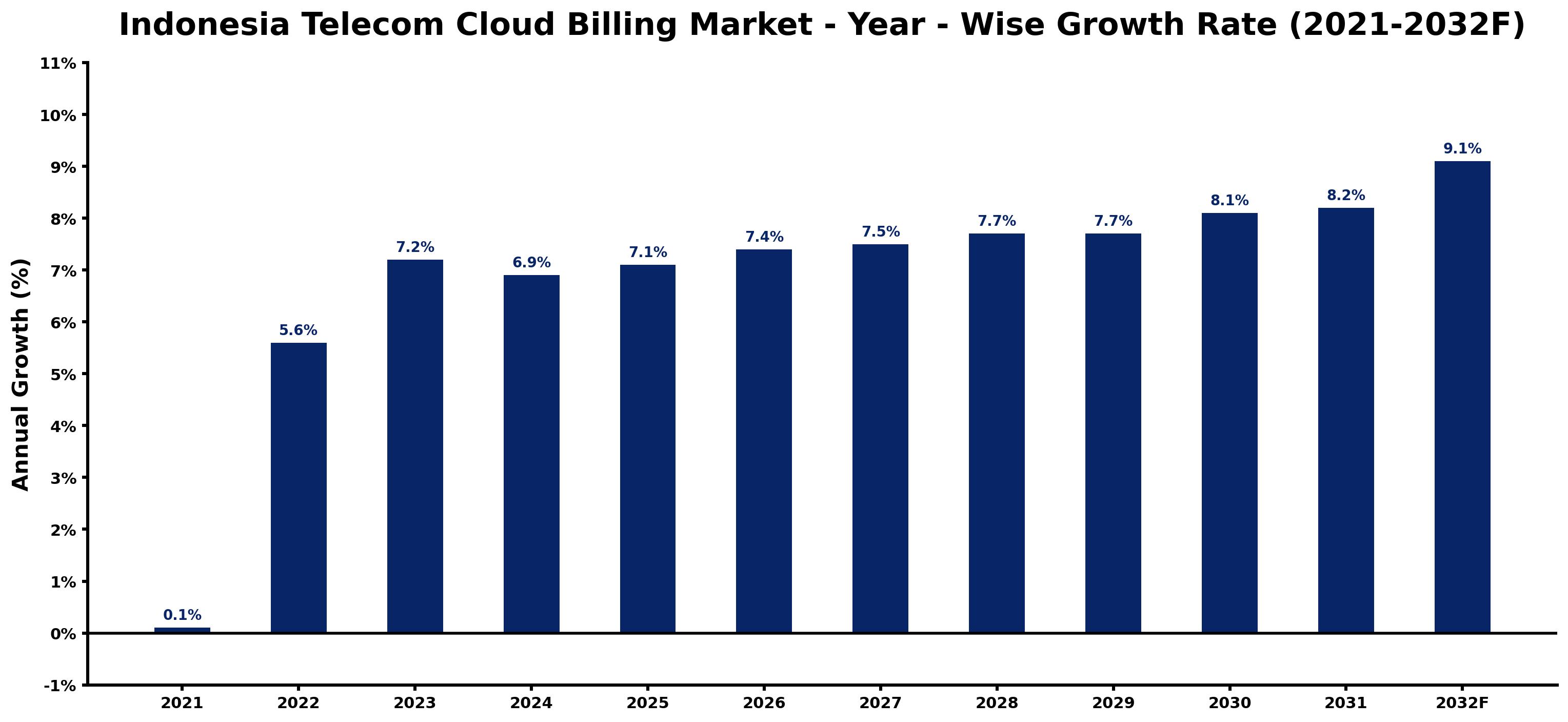
The table below presents the year‑wise growth rates along with the key drivers influencing the market
| Year | Growth Rate | Major Drivers |
| 2021 | 0.1% | Regulatory support for digital payment systems by OJK. |
| 2022 | 5.6% | Increased smartphone penetration fostering cloud billing adoption. |
| 2023 | 7.2% | Boost in telecom sector investments by Ministry of Communication. |
| 2024 | 6.9% | Growth of OTT platforms driving subscription billing services. |
| 2025 | 7.1% | Rising data usage leading to more complex billing needs. |
| 2026 | 7.4% | Government initiatives promoting digital infrastructure advancements. |
| 2027 | 7.5% | Emerging fintech partnerships enhancing billing solutions integration. |
| 2028 | 7.7% | Adoption of AI in billing systems improving customer experience. |
| 2029 | 7.7% | Regulatory push for transparent billing practices boosting trust. |
| 2030 | 8.1% | Increased competition among telecoms driving cloud service offerings. |
| 2031 | 8.2% | Shift towards bundling services spurring new billing models. |
| 2032 | 9.1% | Rise in consumer preferences for flexible payment options. |
Note: Market size estimations and growth projections presented in this report are based on 6Wresearch's proprietary forecasting methodology, utilizing the latest available industry data, government publications, and primary research inputs.
Indonesia Telecom Cloud Billing Market Key Takeaways
Below are some of the specific key takeaways from the market, including:
- The shift to cloud-based billing solutions is rapidly reshaping operational practices within the telecom sector.
- Cost-effectiveness and flexibility are primary drivers for telecom companies adopting cloud billing systems.
- Data security and compliance with local regulations remain pressing concerns for cloud billing providers.
- The COVID-19 pandemic accelerated the adoption of online billing systems across various sectors.
- Indonesia's regulatory environment is adapting to support the growth of cloud technologies in telecommunications.
Evaluation of Restraints in Indonesia Telecom Cloud Billing Market
Despite the promising growth trajectory, several restraints hinder the Indonesia Telecom Cloud Billing Market. Key challenges include stringent data protection laws that create barriers for cloud providers, necessitating robust security measures and compliance strategies. Furthermore, the varied billing requirements across different telecom operators complicate the development of flexible and scalable solutions, potentially limiting market access and competitiveness for some providers. As such, navigating these regulatory and operational challenges is critical for market participants aiming to thrive.
Indonesia Telecom Cloud Billing Market Trends
Current trends indicate a marked preference for integrated billing solutions that combine subscription and usage-based models. The increasing demand for real-time analytics is pushing providers to enhance their offerings, enabling telecom operators to personalize customer experiences and optimize revenue streams. Additionally, partnerships between telecom operators and cloud billing solution providers are on the rise, facilitating a more seamless transition to cloud technologies.
Indonesia Telecom Cloud Billing Market Opportunities
Genuine growth opportunities lie in the rise of IoT and 5G technologies, which are expected to further complicate billing processes and drive demand for innovative cloud-based solutions. Furthermore, as new players enter the telecom space, there is potential for tailored billing solutions that address specific market segments. Companies that can develop agile, compliant, and scalable cloud billing systems will be well-positioned to capture a significant share of the market in the coming years.
Government Initiatives in the Indonesia Telecom Cloud Billing Market
The Indonesian government is actively shaping the Telecom Cloud Billing Market through a series of initiatives aimed at fostering innovation and enhancing regulatory clarity. With a focus on modernizing the telecom infrastructure and ensuring data protection, these initiatives are critical for guiding market growth and securing consumer trust.
- A national digital infrastructure upgrade program launched in early 2025 aims to enhance connectivity and support cloud adoption across the telecom sector.
- Current efforts include the implementation of a regulatory framework introduced in 2025 that mandates billing transparency to protect consumer rights.
- Upcoming initiatives include a planned public-private partnership expected to advance telecom infrastructure access by 2028.
- A recent initiative focused on cybersecurity measures for cloud services, developed in response to growing data security concerns, is currently underway.
- The government's Digital Economy Roadmap outlines the objective of promoting cloud computing adoption, which includes supporting the telecom billing segment.
Future Insights of the Indonesia Telecom Cloud Billing Market
Looking ahead to 2026-2032, the Indonesia Telecom Cloud Billing Market is likely to experience accelerated growth fueled by continuous technological innovations and an increasingly competitive landscape. As telecom operators seek to enhance customer retention through personalized billing solutions, the demand for cloud billing will undoubtedly expand. Companies that invest in adaptability and customer-centric services will thrive, positioning themselves as leaders in this evolving market.
Indonesia Telecom Cloud Billing Market Latest Developments
Recent developments within the Indonesia Telecom Cloud Billing Market reflect a period of heightened activity and investment, as operators scramble to adapt to changing consumer behaviors and technological advancements. The shift towards cloud solutions is becoming more pronounced, with numerous companies accelerating their transformation efforts.
- A leading telecom operator commenced a cloud billing solution rollout in Q3 2025, aiming to enhance customer experience through improved billing processes.
- An initiative focused on integrating AI-driven analytics into billing systems began in early 2025 and is currently ongoing.
- A major technology vendor announced a partnership in mid-2025 with a regional operator to develop tailored cloud billing solutions, with completion expected in late 2025.
- New features for enhanced fraud detection in billing systems were successfully implemented by one of the telecom providers during Q2 2025.
- Upcoming plans for a new subscription-based model targeting SMEs are slated for introduction in early 2026, reflecting the market's evolving needs.
Indonesia Telecom Cloud Billing Market - Key Attractiveness of the Report
- 10 Years of Market Numbers
- Historical Data Starting from 2022 to 2025
- Base Year: 2025
- Forecast Data until 2032
- Key Performance Indicators Impacting the Market
- Major Upcoming Developments and Projects
Key Highlights of the Report:
- Indonesia Telecom Cloud Billing Market Outlook
- Market Size of Indonesia Telecom Cloud Billing Market, 2025
- Forecast of Indonesia Telecom Cloud Billing Market, 2032
- Historical Data and Forecast of Indonesia Telecom Cloud Billing Revenues & Volume for the Period 2022-2032F
- Indonesia Telecom Cloud Billing Market Trend Evolution
- Indonesia Telecom Cloud Billing Market Drivers and Challenges
- Indonesia Telecom Cloud Billing Price Trends
- Indonesia Telecom Cloud Billing Porter's Five Forces
- Indonesia Telecom Cloud Billing Industry Life Cycle
- Historical Data and Forecast of Indonesia Telecom Cloud Billing Market Revenues & Volume By Type of Billing for the Period 2022-2032F
- Historical Data and Forecast of Indonesia Telecom Cloud Billing Market Revenues & Volume By Convergent for the Period 2022-2032F
- Historical Data and Forecast of Indonesia Telecom Cloud Billing Market Revenues & Volume By Prepaid for the Period 2022-2032F
- Historical Data and Forecast of Indonesia Telecom Cloud Billing Market Revenues & Volume By Postpaid for the Period 2022-2032F
- Historical Data and Forecast of Indonesia Telecom Cloud Billing Market Revenues & Volume By Interconnect for the Period 2022-2032F
- Historical Data and Forecast of Indonesia Telecom Cloud Billing Market Revenues & Volume By Roaming for the Period 2022-2032F
- Historical Data and Forecast of Indonesia Telecom Cloud Billing Market Revenues & Volume By Others (Direct to Consumer (D2C) and Metered) for the Period 2022-2032F
- Historical Data and Forecast of Indonesia Telecom Cloud Billing Market Revenues & Volume By Cloud Platform for the Period 2022-2032F
- Historical Data and Forecast of Indonesia Telecom Cloud Billing Market Revenues & Volume By SaaS for the Period 2022-2032F
- Historical Data and Forecast of Indonesia Telecom Cloud Billing Market Revenues & Volume By Others (IaaS and PaaS) for the Period 2022-2032F
- Historical Data and Forecast of Indonesia Telecom Cloud Billing Market Revenues & Volume By End User for the Period 2022-2032F
- Historical Data and Forecast of Indonesia Telecom Cloud Billing Market Revenues & Volume By Individuals for the Period 2022-2032F
- Historical Data and Forecast of Indonesia Telecom Cloud Billing Market Revenues & Volume By Enterprises for the Period 2022-2032F
- Historical Data and Forecast of Indonesia Telecom Cloud Billing Market Revenues & Volume By Application for the Period 2022-2032F
- Historical Data and Forecast of Indonesia Telecom Cloud Billing Market Revenues & Volume By Revenue Management for the Period 2022-2032F
- Historical Data and Forecast of Indonesia Telecom Cloud Billing Market Revenues & Volume By Account Management for the Period 2022-2032F
- Historical Data and Forecast of Indonesia Telecom Cloud Billing Market Revenues & Volume By Customer Management for the Period 2022-2032F
- Historical Data and Forecast of Indonesia Telecom Cloud Billing Market Revenues & Volume By Rate of Charging Mode for the Period 2022-2032F
- Historical Data and Forecast of Indonesia Telecom Cloud Billing Market Revenues & Volume By Subscription-Based for the Period 2022-2032F
- Historical Data and Forecast of Indonesia Telecom Cloud Billing Market Revenues & Volume By Usage-Based for the Period 2022-2032F
- Historical Data and Forecast of Indonesia Telecom Cloud Billing Market Revenues & Volume By Service for the Period 2022-2032F
- Historical Data and Forecast of Indonesia Telecom Cloud Billing Market Revenues & Volume By Professional for the Period 2022-2032F
- Historical Data and Forecast of Indonesia Telecom Cloud Billing Market Revenues & Volume By Managed for the Period 2022-2032F
- Indonesia Telecom Cloud Billing Import Export Trade Statistics
- Market Opportunity Assessment By Type of Billing
- Market Opportunity Assessment By Cloud Platform
- Market Opportunity Assessment By End User
- Market Opportunity Assessment By Application
- Market Opportunity Assessment By Rate of Charging Mode
- Market Opportunity Assessment By Service
- Indonesia Telecom Cloud Billing Top Companies Market Share
- Indonesia Telecom Cloud Billing Competitive Benchmarking By Technical and Operational Parameters
- Indonesia Telecom Cloud Billing Company Profiles
- Indonesia Telecom Cloud Billing Key Strategic Recommendations






































