Indonesia Thermoformed Plastic Products Market Size, Share & Growth Rate
The Indonesia Thermoformed Plastic Products Market was estimated at USD 432 Million in 2025 and is projected to reach USD 572 Million by 2032, growing at a CAGR of 4.1% from 2026 to 2032. This steady growth trajectory is primarily driven by the increasing demand for diverse packaging solutions across various industries, particularly in food and beverage sectors. Additionally, as the automotive industry evolves, the need for lightweight materials is propelling the utilization of thermoformed plastics, thus bolstering market expansion.
Indonesia Thermoformed Plastic Products Market Year-wise Growth Rate and Key Drivers
This graph highlights how the Indonesia Thermoformed Plastic Products Market has steadily grown over the years, supported by major growth factors.
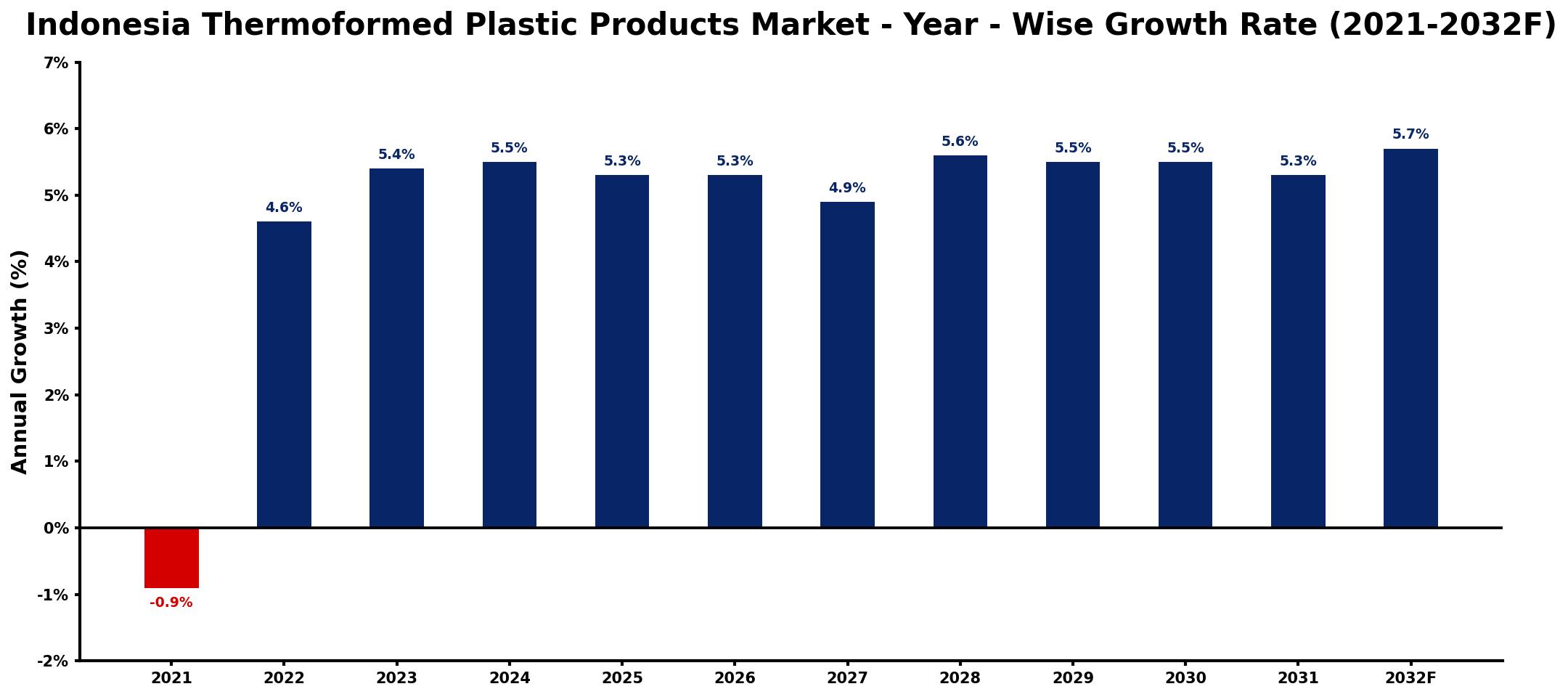
The table below presents the year‑wise growth rates along with the key drivers influencing the market
| Year | Growth Rate | Major Drivers |
| 2021 | -0.9% | decreased demand in manufacturing sector |
| 2022 | 4.6% | increased investment in packaging solutions |
| 2023 | 5.4% | growing interest in sustainable materials |
| 2024 | 5.5% | expansion of food service industry |
| 2025 | 5.3% | rising consumer preference for convenience |
| 2026 | 5.3% | enhanced recycling initiatives gaining traction |
| 2027 | 4.9% | growth in e-commerce logistics requirements |
| 2028 | 5.6% | broadening applications in healthcare sector |
| 2029 | 5.5% | increase in export opportunities emerging |
| 2030 | 5.5% | development of innovative design techniques |
| 2031 | 5.3% | strengthening regulations promoting sustainability |
| 2032 | 5.7% | enhanced product quality standards |
Note: Market size estimations and growth projections presented in this report are based on 6Wresearch's proprietary forecasting methodology, utilizing the latest available industry data, government publications, and primary research inputs.
Indonesia Thermoformed Plastic Products Market Synopsis
The Indonesian thermoformed plastic products market is uniquely positioned as manufacturers embrace innovative designs tailored to local consumer preferences. This adaptability is vital in an economy where packaged goods are becoming increasingly prevalent, meeting the rising demand for convenience and accessibility.
Moreover, the market is witnessing a shift toward sustainability, with manufacturers incorporating recycled materials in their offerings. This aligns with global environmental initiatives, ensuring that the market remains competitive and responsible in the eyes of increasingly eco-conscious consumers.
Indonesia Thermoformed Plastic Products Market Key Takeaways
- Significant growth driven by demand in food packaging, automotive, and construction sectors.
- Increasing adoption of recycled materials reflects a commitment to sustainability.
- The market is adapting to changing consumer preferences for convenient and customized packaging.
- Government incentives for eco-friendly practices are expected to further stimulate growth.
- Robust demand amid fluctuations in raw material costs poses a challenge to profitability.
Evaluation of Restraints in Indonesia Thermoformed Plastic Products Market
Despite the optimistic growth outlook, the Indonesia thermoformed plastic products market faces notable restraints that could hinder its potential. Environmental concerns surrounding plastic waste have intensified scrutiny on the manufacturing and usage of such products. Companies may need to invest significantly in innovative recycling technologies and sustainable practices to meet both regulatory requirements and consumer expectations. Additionally, the volatility of raw material prices can create budgeting uncertainties, affecting production costs and profit margins. Manufacturers must be strategic in sourcing to mitigate these impacts while remaining competitive in an evolving market landscape.
Indonesia Thermoformed Plastic Products Market Trends
The trend towards sustainability is not just a buzzword; it's shaping the future of the thermoformed plastic products market in Indonesia. Many manufacturers are shifting towards biodegradable and recyclable materials in response to rising environmental concerns. Furthermore, the increasing integration of technology in production processes is leading to improvements in efficiency and product quality. Advances in automation and smart manufacturing practices are enabling producers to offer highly customized solutions that cater to diverse market needs, enhancing customer satisfaction and loyalty.
Indonesia Thermoformed Plastic Products Market Opportunities
Opportunities abound in the Indonesia thermoformed plastic products market as industries seek innovative packaging solutions. The food and beverage sector, in particular, presents a substantial avenue for growth, given the rising consumption patterns and the demand for convenience packaging. Additionally, the automotive industry is increasingly turning to lightweight thermoformed plastics to improve vehicle efficiency and reduce emissions. With government backing for sustainable initiatives, companies investing in eco-friendly technologies stand to gain competitive advantages and tap into new consumer bases.
Government Initiatives in the Indonesia Thermoformed Plastic Products Market
The Indonesian government has been proactive in promoting sustainable practices within the manufacturing sector, including the thermoformed plastic products market. Initiatives aimed at reducing plastic waste and encouraging recycling through public awareness campaigns are gaining traction. Policies that incentivize the use of eco-friendly materials are fostering an environment conducive to innovation. As these programs unfold, they present opportunities for businesses to align with governmental objectives while enhancing their market presence.
Future Insights of the Indonesia Thermoformed Plastic Products Market
Looking ahead to 2026-2032, the Indonesia thermoformed plastic products market is poised for significant advancements, driven by a confluence of market demand and technological innovations. As consumers increasingly prioritize sustainability, companies that adapt and innovate will likely thrive. There is also potential for expansion in emerging industries, such as e-commerce, where tailored packaging solutions are essential. Ultimately, a combination of consumer trends, technological advancements, and supportive government policies will shape the market's evolution in the coming years.
Indonesia Thermoformed Plastic Products Market Latest Developments (2025 - 2026)
Recent developments in the Indonesia thermoformed plastic products market illustrate a dynamic shift towards sustainability and technological integration. Several manufacturers are investing in advanced production methods that reduce waste and enhance product lifecycle management. Additionally, collaborations with environmental organizations are becoming more common, as companies seek to strengthen their sustainability credentials. These trends indicate a market increasingly attuned to global environmental standards and consumer expectations.
Indonesia Thermoformed Plastic Products Market - Key Attractiveness of the Report
- 10 Years of Market Numbers
- Historical Data Starting from 2022 to 2025
- Base Year: 2025
- Forecast Data until 2032
- Key Performance Indicators Impacting the Market
- Major Upcoming Developments and Projects
Key Highlights of the Report:
- Indonesia Thermoformed Plastic Products Market Outlook
- Market Size of Indonesia Thermoformed Plastic Products Market, 2025
- Forecast of Indonesia Thermoformed Plastic Products Market, 2032
- Historical Data and Forecast of Indonesia Thermoformed Plastic Products Revenues & Volume for the Period 2022-2032F
- Indonesia Thermoformed Plastic Products Market Trend Evolution
- Indonesia Thermoformed Plastic Products Market Drivers and Challenges
- Indonesia Thermoformed Plastic Products Price Trends
- Indonesia Thermoformed Plastic Products Porter's Five Forces
- Indonesia Thermoformed Plastic Products Industry Life Cycle
- Historical Data and Forecast of Indonesia Thermoformed Plastic Products Market Revenues & Volume By Product for the Period 2022-2032F
- Historical Data and Forecast of Indonesia Thermoformed Plastic Products Market Revenues & Volume By Polymethyl Methacrylate (PMMA) for the Period 2022-2032F
- Historical Data and Forecast of Indonesia Thermoformed Plastic Products Market Revenues & Volume By Bio-degradable polymers for the Period 2022-2032F
- Historical Data and Forecast of Indonesia Thermoformed Plastic Products Market Revenues & Volume By Polyethylene (PE) for the Period 2022-2032F
- Historical Data and Forecast of Indonesia Thermoformed Plastic Products Market Revenues & Volume By Acrylonitrile Butadiene Styrene (ABS) for the Period 2022-2032F
- Historical Data and Forecast of Indonesia Thermoformed Plastic Products Market Revenues & Volume By Poly Vinyl Chloride (PVC) for the Period 2022-2032F
- Historical Data and Forecast of Indonesia Thermoformed Plastic Products Market Revenues & Volume By High Impact Polystyrene (HIPS) for the Period 2022-2032F
- Historical Data and Forecast of Indonesia Thermoformed Plastic Products Market Revenues & Volume By Polystyrene (PS) for the Period 2022-2032F
- Historical Data and Forecast of Indonesia Polymethyl Methacrylate (PMMA) Thermoformed Plastic Products Market Revenues & Volume By Polypropylene (PP) for the Period 2022-2032F
- Historical Data and Forecast of Indonesia Thermoformed Plastic Products Market Revenues & Volume By Process for the Period 2022-2032F
- Historical Data and Forecast of Indonesia Thermoformed Plastic Products Market Revenues & Volume By Plug Assist Forming for the Period 2022-2032F
- Historical Data and Forecast of Indonesia Thermoformed Plastic Products Market Revenues & Volume By Thick Gauge Thermoforming for the Period 2022-2032F
- Historical Data and Forecast of Indonesia Thermoformed Plastic Products Market Revenues & Volume By Thin Gauge Thermoforming for the Period 2022-2032F
- Historical Data and Forecast of Indonesia Thermoformed Plastic Products Market Revenues & Volume By Vacuum Snapback for the Period 2022-2032F
- Historical Data and Forecast of Indonesia Thermoformed Plastic Products Market Revenues & Volume By Application for the Period 2022-2032F
- Historical Data and Forecast of Indonesia Thermoformed Plastic Products Market Revenues & Volume By Healthcare & Medical for the Period 2022-2032F
- Historical Data and Forecast of Indonesia Thermoformed Plastic Products Market Revenues & Volume By Food Packaging for the Period 2022-2032F
- Historical Data and Forecast of Indonesia Thermoformed Plastic Products Market Revenues & Volume By Electrical & Electronics for the Period 2022-2032F
- Historical Data and Forecast of Indonesia Thermoformed Plastic Products Market Revenues & Volume By Automotive for the Period 2022-2032F
- Historical Data and Forecast of Indonesia Thermoformed Plastic Products Market Revenues & Volume By Construction for the Period 2022-2032F
- Historical Data and Forecast of Indonesia Thermoformed Plastic Products Market Revenues & Volume By Consumer Goods & Appliances for the Period 2022-2032F
- Indonesia Thermoformed Plastic Products Import Export Trade Statistics
- Market Opportunity Assessment By Product
- Market Opportunity Assessment By Process
- Market Opportunity Assessment By Application
- Indonesia Thermoformed Plastic Products Top Companies Market Share
- Indonesia Thermoformed Plastic Products Competitive Benchmarking By Technical and Operational Parameters
- Indonesia Thermoformed Plastic Products Company Profiles
- Indonesia Thermoformed Plastic Products Key Strategic Recommendations






































