Indonesia Thermostats Market Summary
The indonesia thermostats market was estimated at USD 182 Million in 2025 and is projected to reach USD 241 Million by 2032, growing at a CAGR of 5.2% from 2026 to 2032.
Indonesia Thermostats Market Year-wise Growth Rate and Key Drivers
This graph highlights how the Indonesia Thermostats Market has steadily grown over the years, supported by major growth factors.
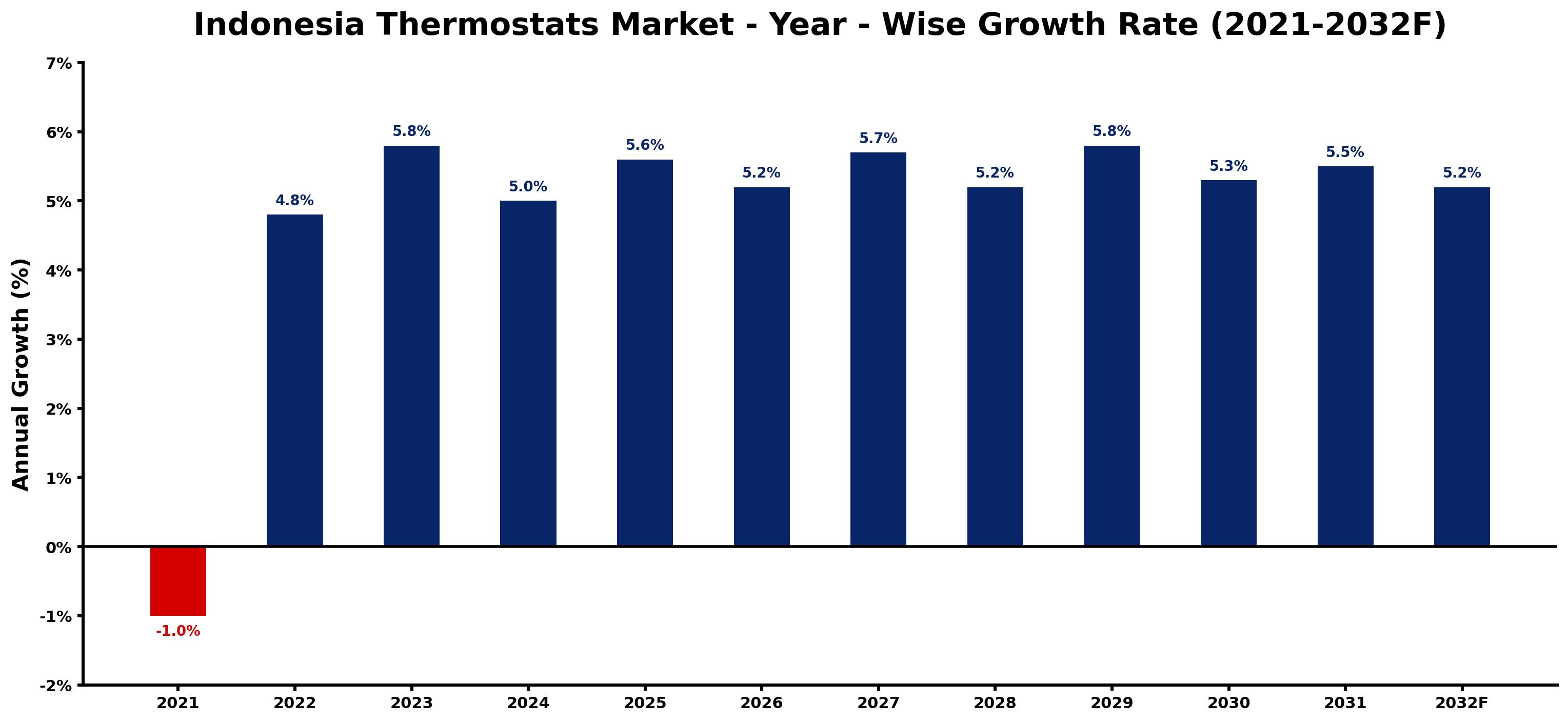
The table below presents the year wise growth rates along with the key drivers influencing the market
| Year | Growth Rate | Major Drivers |
| 2021 | -1.0% | Increased competition from smart home technologies diminished consumer interest in traditional thermostat options. |
| 2022 | 4.8% | Emerging middle-class households increasingly prioritize energy efficiency in home renovations. |
| 2023 | 5.8% | Urbanization trends lead to heightened interest in automated climate control solutions. |
| 2024 | 5.0% | Homebuilders emphasize installing smart thermostats in new residential developments. |
| 2025 | 5.6% | Increased awareness about energy conservation shapes consumer choices in climate systems. |
| 2026 | 5.2% | Manufacturers invest in localized production to cater to Indonesia's unique market needs. |
| 2027 | 5.7% | Growing competition among tech firms enhances product innovation and affordability. |
| 2028 | 5.2% | Partnerships between tech startups and real estate firms boost thermostat integration projects. |
| 2029 | 5.8% | Climate variability raises awareness of climate control technologies in urban planning. |
| 2030 | 5.3% | Insurance companies offer discounts for homes equipped with smart energy management systems. |
| 2031 | 5.5% | Digital transformation initiatives drive collaboration among thermostat manufacturers and IoT companies. |
| 2032 | 5.2% | Consumer education campaigns highlight long-term savings from investing in smart thermostats. |
Note - Market size estimations and growth projections presented in this report are based on 6Wresearch's advanced forecasting approach, validated with industry datasets as of June 2026.
Indonesia Thermostats Market Synopsis
The Indonesia Thermostats Market is projected to reach 5.2% and witness significant growth during the forecast period (2026-2032). The market is anticipated to expand at a CAGR of 4.26%, driven by the increasing adoption of smart home technologies, a rising demand for energy-efficient products, and expanding construction activities throughout the country. The growth trajectory is further supported by government initiatives aimed at enhancing energy efficiency and tax exemptions on HVAC system installations.
Indonesia Thermostats Market Growth Drivers
Several factors are propelling the Indonesia thermostats market, notably:
- The proliferation of smart home systems has significantly increased the demand for advanced thermostats, which offer precise temperature control and remote access capabilities. This integration contributes to enhanced comfort and energy savings for consumers.
- The growing trend towards energy efficiency is prompting homeowners and businesses to invest in more sophisticated heating and cooling solutions, including programmable and WiFi-enabled thermostats, which allow for greater control over energy consumption.
- Urbanization and rising disposable incomes have led to an increase in residential construction projects, spurring demand for temperature control solutions among newly built households seeking modern automation.
- Technological advancements in thermostat functionality and connectivity, such as integration with smart home ecosystems, are driving adoption rates among consumers enthusiastic about home automation.
- Government incentives aimed at promoting energy-efficient building standards are encouraging homeowners and businesses to upgrade their HVAC systems, thereby boosting the adoption of advanced thermostats.
Indonesia Thermostats Market Challenges and Restraints
Despite the promising outlook, the Indonesia thermostats market faces several challenges:
- High upfront costs associated with advanced thermostatic systems can deter potential buyers, particularly in lower-income segments where budget constraints are prevalent.
- The complexity of installation and integration with existing HVAC systems can lead to additional expenses, which may dissuade consumers from making the switch to modern thermostats.
- Maintenance costs for advanced thermostatic systems can be high, creating a barrier for potential users who may prefer traditional heating methods that require less ongoing investment.
- Limited awareness and understanding of the benefits of smart thermostats among certain consumer groups may hinder market penetration.
- Regulatory challenges and varying standards across regions can create confusion in the installation and operation of advanced thermostat systems, potentially affecting market growth.
Indonesia Thermostats Market Government Investment and Initiatives
The Indonesian government has been actively promoting energy efficiency through various policies and initiatives aimed at improving HVAC system performance and adoption. Key aspects include:
- Implementing tax exemptions for HVAC system installations encourages the adoption of energy-efficient technologies, including advanced thermostats, across both residential and commercial sectors.
- The establishment of stringent building regulations that mandate energy-efficient designs in new constructions has led to increased demand for thermostatic solutions that comply with these standards.
- Public awareness campaigns aimed at educating consumers about the benefits of energy-efficient products are fostering a more informed market and driving interest in smart thermostats.
- Incentives for manufacturers to produce locally sourced and energy-efficient products are supporting the growth of a sustainable market environment.
- Research and development investments in smart home technologies are positioning Indonesia as a competitive market for innovative thermostatic solutions in the Southeast Asian region.
Indonesia Thermostats Market Latest Developments (May 2025 - June 2026)
Recent developments in the Indonesia thermostats market indicate a growing focus on technological integration and energy efficiency. During this period, several key trends emerged:
- Enhanced features in newer thermostat models, including machine learning capabilities for predictive maintenance, are gaining traction, enabling users to optimize their energy consumption more effectively.
- The integration of thermostats with mobile apps has become a standard expectation among consumers, allowing for improved user experience and management of home heating and cooling remotely.
- Increased collaboration between technology firms and HVAC manufacturers is leading to innovative product offerings that cater to both energy efficiency and smart home functionalities.
- Market players are increasingly focusing on educational initiatives to raise awareness about the benefits of smart thermostats and energy-efficient solutions among Indonesian consumers.
- The Indonesian government has continued to support infrastructure development projects, facilitating the adoption of advanced HVAC technologies in alignment with national energy efficiency goals.
Indonesia Thermostats Market - Key Attractiveness of the Report
- 10 Years of Market Numbers
- Historical Data Starting from 2022 to 2025
- Base Year: 2025
- Forecast Data until 2032
- Key Performance Indicators Impacting the Market
- Major Upcoming Developments and Projects
Key Highlights of the Report:
- Indonesia Thermostats Market Outlook
- Market Size of Indonesia Thermostats Market, 2025
- Forecast of Indonesia Thermostats Market, 2032F
- Historical Data and Forecast of Indonesia Thermostats Revenues & Volume for the Period 2022-2032F
- Indonesia Thermostats Market Trend Evolution
- Indonesia Thermostats Market Drivers and Challenges
- Indonesia Thermostats Price Trends
- Indonesia Thermostats Porter's Five Forces
- Indonesia Thermostats Industry Life Cycle
- Historical Data and Forecast of Indonesia Thermostats Market Revenues & Volume By Products for the Period 2022-2032F
- Historical Data and Forecast of Indonesia Thermostats Market Revenues & Volume By Smart Thermostat for the Period 2022-2032F
- Historical Data and Forecast of Indonesia Thermostats Market Revenues & Volume By Mechanical Thermostat for the Period 2022-2032F
- Historical Data and Forecast of Indonesia Thermostats Market Revenues & Volume By Programmable Thermostat for the Period 2022-2032F
- Historical Data and Forecast of Indonesia Thermostats Market Revenues & Volume By Distribution Channel for the Period 2022-2032F
- Historical Data and Forecast of Indonesia Thermostats Market Revenues & Volume By Utility for the Period 2022-2032F
- Historical Data and Forecast of Indonesia Thermostats Market Revenues & Volume By Retail for the Period 2022-2032F
- Historical Data and Forecast of Indonesia Thermostats Market Revenues & Volume By Security for the Period 2022-2032F
- Historical Data and Forecast of Indonesia Thermostats Market Revenues & Volume By HVAC for the Period 2022-2032F
- Historical Data and Forecast of Indonesia Thermostats Market Revenues & Volume By Mode of Operations for the Period 2022-2032F
- Historical Data and Forecast of Indonesia Thermostats Market Revenues & Volume By Line Voltage for the Period 2022-2032F
- Historical Data and Forecast of Indonesia Thermostats Market Revenues & Volume By Low Voltage for the Period 2022-2032F
- Historical Data and Forecast of Indonesia Thermostats Market Revenues & Volume By Millivolt for the Period 2022-2032F
- Historical Data and Forecast of Indonesia Thermostats Market Revenues & Volume By Applications for the Period 2022-2032F
- Historical Data and Forecast of Indonesia Thermostats Market Revenues & Volume By Residential for the Period 2022-2032F
- Historical Data and Forecast of Indonesia Thermostats Market Revenues & Volume By Commercial for the Period 2022-2032F
- Indonesia Thermostats Import Export Trade Statistics
- Market Opportunity Assessment By Products
- Market Opportunity Assessment By Distribution Channel
- Market Opportunity Assessment By Mode of Operations
- Market Opportunity Assessment By Applications
- Indonesia Thermostats Top Companies Market Share
- Indonesia Thermostats Competitive Benchmarking By Technical and Operational Parameters
- Indonesia Thermostats Company Profiles
- Indonesia Thermostats Key Strategic Recommendations






































