Indonesia Ultrasonic Cleaning Equipment Market Size, Share & Growth Rate
The Indonesia Ultrasonic Cleaning Equipment Market was estimated at USD 341 Million in 2025 and is projected to reach USD 450 Million by 2032, growing at a CAGR of 4.0% from 2026 to 2032. This growth is driven by the increasing need for precision cleaning solutions across diverse sectors such as automotive, aerospace, and electronics. As industries become more automated and cost-focused, the demand for efficient cleaning methods that enhance product quality and operational efficiency continues to expand.
Indonesia Ultrasonic Cleaning Equipment Market Year-wise Growth Rate and Key Drivers
This graph highlights how the Indonesia Ultrasonic Cleaning Equipment Market has steadily grown over the years, supported by major growth factors.
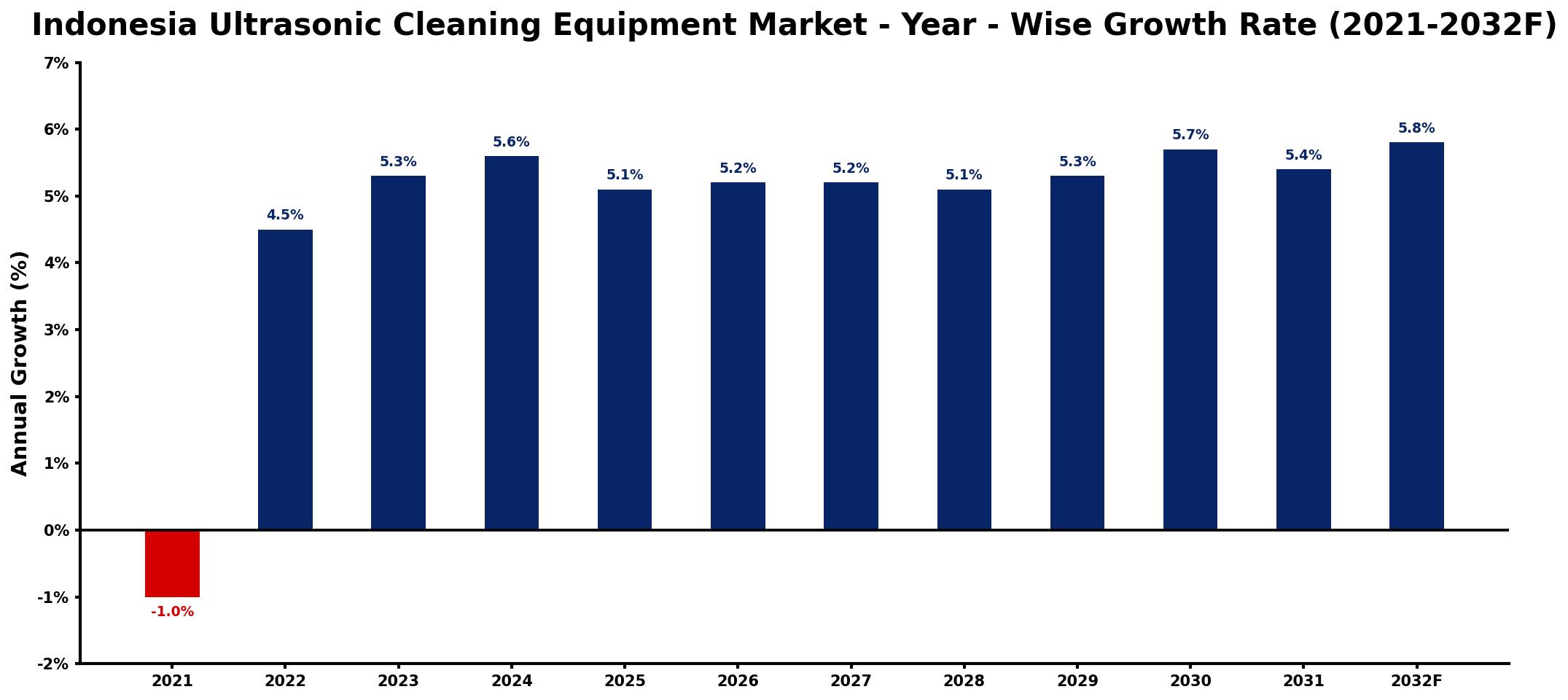
The table below presents the year‑wise growth rates along with the key drivers influencing the market
| Year | Growth Rate | Major Drivers |
| 2021 | -1.0% | decreased industrial manufacturing activities |
| 2022 | 4.5% | rising demand for automation solutions |
| 2023 | 5.3% | increased focus on precision processes |
| 2024 | 5.6% | expansion in healthcare sector investments |
| 2025 | 5.1% | growing adoption in automotive industry |
| 2026 | 5.2% | strengthening demand from electronics sector |
| 2027 | 5.2% | surge in research and development |
| 2028 | 5.1% | enhanced environmental regulations enforcement |
| 2029 | 5.3% | growth in aerospace industry applications |
| 2030 | 5.7% | rising awareness of sustainability practices |
| 2031 | 5.4% | increased investments in technology advancements |
| 2032 | 5.8% | expanding applications across various sectors |
Note: Market size estimations and growth projections presented in this report are based on 6Wresearch's proprietary forecasting methodology, utilizing the latest available industry data, government publications, and primary research inputs.
Indonesia Ultrasonic Cleaning Equipment Market Synopsis
In Indonesia, the ultrasonic cleaning equipment market is gaining traction due to its vital role in industries that require thorough and precise cleaning processes. Particularly, sectors such as automotive and healthcare are embracing these solutions to maintain high standards of cleanliness and hygiene. The increasing adoption of advanced cleaning technology is evident as manufacturers seek to optimize their operations while ensuring compliance with stringent quality standards.
Current trends reflect a rising awareness of the advantages of ultrasonic cleaning systems. With capabilities to effectively clean intricate components and sensitive devices, these systems are becoming indispensable in various applications. Furthermore, the market is experiencing a wave of innovation as companies invest in research and development to introduce new products tailored to meet evolving industry needs.
Indonesia Ultrasonic Cleaning Equipment Market Key Takeaways
- The market is positioned for significant growth, fueled by demand in automotive, electronics, and healthcare sectors.
- Automation and cost optimization are driving the adoption of ultrasonic cleaning solutions among manufacturers.
- Strong emphasis on hygiene and cleanliness standards, especially in healthcare, is bolstering market demand.
- Innovative product development and strategic collaborations are key factors shaping the competitive landscape.
- Overall, the market outlook is positive, indicating robust investment opportunities through 2032.
Evaluation of Restraints in Indonesia Ultrasonic Cleaning Equipment Market
Despite the promising growth trajectory, the Indonesian ultrasonic cleaning equipment market faces specific challenges. Chief among them are cost considerations; maintaining competitive pricing while ensuring high-quality standards can be a complex balancing act for manufacturers. Additionally, the varied requirements across different industries necessitate tailored solutions, which can complicate production processes. Moreover, fluctuations in raw material costs could potentially impact pricing strategies and profit margins.
Indonesia Ultrasonic Cleaning Equipment Market Trends
A notable trend is the increasing integration of advanced technologies such as IoT in ultrasonic cleaning equipment. This development allows for real-time monitoring and better efficiency. Additionally, there is a growing preference for eco-friendly cleaning solutions, leading manufacturers to innovate with sustainable materials and processes. As industries prioritize environmental responsibility, the demand for green cleaning technologies is expected to rise significantly.
Indonesia Ultrasonic Cleaning Equipment Market Opportunities
Investors and stakeholders are presented with a multitude of opportunities in the Indonesia ultrasonic cleaning equipment market. The rise of e-commerce and online retail channels offers avenues for expanding distribution networks, while the health and safety focus in the post-COVID-19 landscape is likely to sustain demand. Furthermore, emerging sectors such as renewable energy and technology manufacturing present untapped potential for the application of ultrasonic cleaning solutions.
Government Initiatives in the Indonesia Ultrasonic Cleaning Equipment Market
The Indonesian government is actively promoting initiatives aimed at enhancing industrial efficiency and competitiveness, which indirectly supports the ultrasonic cleaning equipment market. Programs emphasizing manufacturing modernization and automation are gaining traction, encouraging businesses to adopt advanced cleaning technologies. Additionally, public health initiatives focusing on sanitation and hygiene are pushing various sectors to invest in better cleaning practices, bolstering demand for ultrasonic cleaning solutions.
Future Insights of the Indonesia Ultrasonic Cleaning Equipment Market
Looking ahead to 2026-2032, the Indonesia ultrasonic cleaning equipment market is poised for robust expansion. The continuous push for operational efficiency and the rising standards of cleanliness across industries will drive further adoption. As technology evolves, the potential for new applications and improved functionalities will attract more investment. Overall, a proactive approach by manufacturers and an optimistic economic climate will be critical in realizing this growth potential.
Indonesia Ultrasonic Cleaning Equipment Market Latest Developments (2025 - 2026)
In the recent months, there has been a significant uptick in research and development efforts directed towards creating more efficient ultrasonic cleaning systems. This includes enhanced user interfaces and improved energy efficiency features. Moreover, collaborations among companies have led to the introduction of customized cleaning solutions tailored to specific industry needs, further enriching the market landscape. Companies are also focusing on marketing strategies that highlight the benefits of ultrasonic cleaning in maintaining stringent cleanliness standards.
Indonesia Ultrasonic Cleaning Equipment Market - Key Attractiveness of the Report
- 10 Years of Market Numbers
- Historical Data Starting from 2022 to 2025
- Base Year: 2025
- Forecast Data until 2032
- Key Performance Indicators Impacting the Market
- Major Upcoming Developments and Projects
Key Highlights of the Report:
- Indonesia Ultrasonic Cleaning Equipment Market Outlook
- Market Size of Indonesia Ultrasonic Cleaning Equipment Market, 2025
- Forecast of Indonesia Ultrasonic Cleaning Equipment Market, 2032
- Historical Data and Forecast of Indonesia Ultrasonic Cleaning Equipment Revenues & Volume for the Period 2022-2032F
- Indonesia Ultrasonic Cleaning Equipment Market Trend Evolution
- Indonesia Ultrasonic Cleaning Equipment Market Drivers and Challenges
- Indonesia Ultrasonic Cleaning Equipment Price Trends
- Indonesia Ultrasonic Cleaning Equipment Porter's Five Forces
- Indonesia Ultrasonic Cleaning Equipment Industry Life Cycle
- Historical Data and Forecast of Indonesia Ultrasonic Cleaning Equipment Market Revenues & Volume By Type for the Period 2022-2032F
- Historical Data and Forecast of Indonesia Ultrasonic Cleaning Equipment Market Revenues & Volume By Standalone for the Period 2022-2032F
- Historical Data and Forecast of Indonesia Ultrasonic Cleaning Equipment Market Revenues & Volume By Benchtop for the Period 2022-2032F
- Historical Data and Forecast of Indonesia Ultrasonic Cleaning Equipment Market Revenues & Volume By Multistage for the Period 2022-2032F
- Historical Data and Forecast of Indonesia Ultrasonic Cleaning Equipment Market Revenues & Volume By Application for the Period 2022-2032F
- Historical Data and Forecast of Indonesia Ultrasonic Cleaning Equipment Market Revenues & Volume By Automotive for the Period 2022-2032F
- Historical Data and Forecast of Indonesia Ultrasonic Cleaning Equipment Market Revenues & Volume By Healthcare for the Period 2022-2032F
- Historical Data and Forecast of Indonesia Ultrasonic Cleaning Equipment Market Revenues & Volume By Electrical & Electronics for the Period 2022-2032F
- Historical Data and Forecast of Indonesia Ultrasonic Cleaning Equipment Market Revenues & Volume By Aerospace & Defense for the Period 2022-2032F
- Historical Data and Forecast of Indonesia Ultrasonic Cleaning Equipment Market Revenues & Volume By Others for the Period 2022-2032F
- Indonesia Ultrasonic Cleaning Equipment Import Export Trade Statistics
- Market Opportunity Assessment By Type
- Market Opportunity Assessment By Application
- Indonesia Ultrasonic Cleaning Equipment Top Companies Market Share
- Indonesia Ultrasonic Cleaning Equipment Competitive Benchmarking By Technical and Operational Parameters
- Indonesia Ultrasonic Cleaning Equipment Company Profiles
- Indonesia Ultrasonic Cleaning Equipment Key Strategic Recommendations






































