Indonesia Unified Communications as a Service Market Size, Share & Growth Rate
The Indonesia Unified Communications as a Service Market was estimated at USD 334 Million in 2025 and is projected to reach USD 443 Million by 2032, growing at a CAGR of 4.1% from 2026 to 2032. This growth trajectory is largely driven by the ongoing transformation towards remote work, which has necessitated the adoption of sophisticated communication solutions. Furthermore, the increasing penetration of cloud technology is enabling businesses to deploy unified platforms that enhance collaboration and operational efficiency.
Indonesia Unified Communications as a Service Market Year-wise Growth Rate and Key Drivers
This graph highlights how the Indonesia Unified Communications as a Service Market has steadily grown over the years, supported by major growth factors.
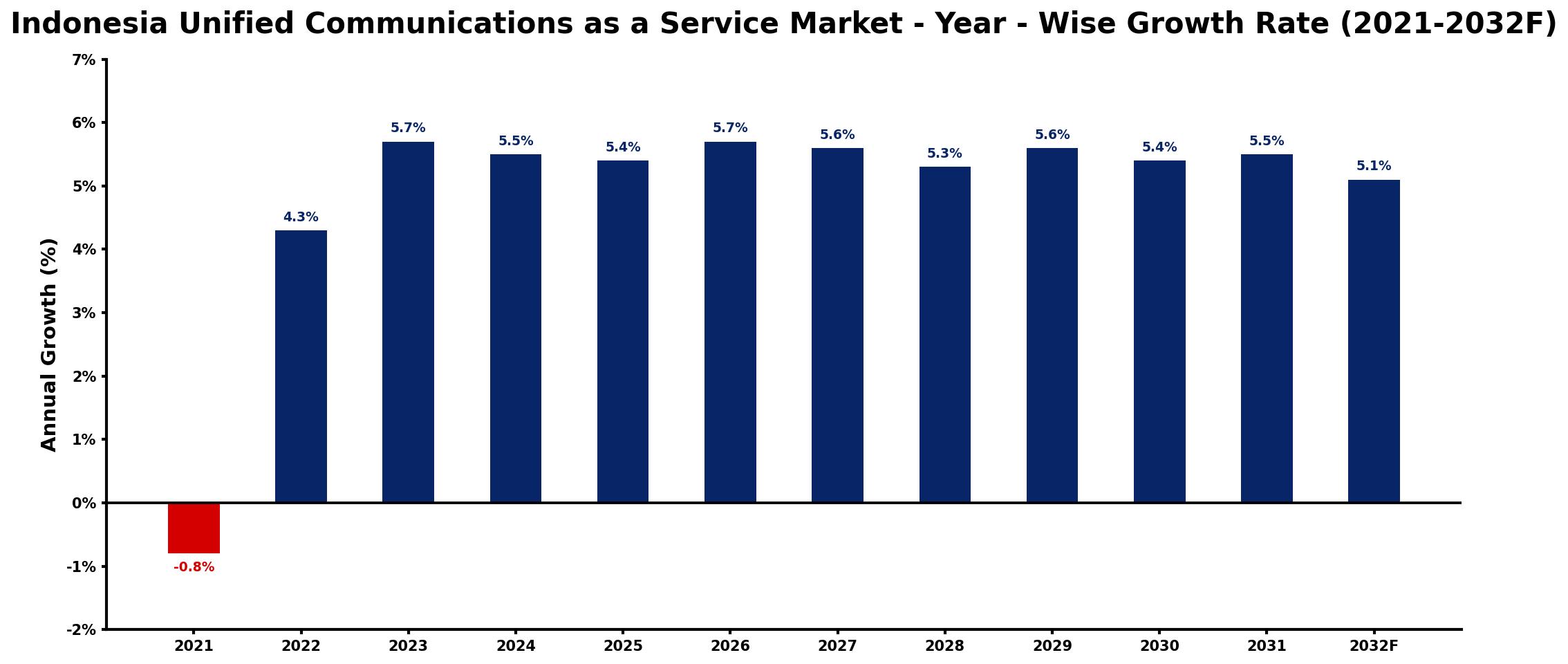
The table below presents the year‑wise growth rates along with the key drivers influencing the market
| Year | Growth Rate | Major Drivers |
| 2021 | -0.8% | decreased corporate technology investments |
| 2022 | 4.3% | growing remote work adoption rates |
| 2023 | 5.7% | increased digital transformation initiatives |
| 2024 | 5.5% | rising demand for collaboration tools |
| 2025 | 5.4% | expansion of cloud infrastructure capabilities |
| 2026 | 5.7% | enhanced focus on cybersecurity solutions |
| 2027 | 5.6% | growing popularity of hybrid workplaces |
| 2028 | 5.3% | increased investment in digital platforms |
| 2029 | 5.6% | increased pharmaceutical industry usage |
| 2030 | 5.4% | rising need for real-time connectivity |
| 2031 | 5.5% | growing reliance on AI technologies |
| 2032 | 5.1% | increased emphasis on user experience |
Note: Market size estimations and growth projections presented in this report are based on 6Wresearch's proprietary forecasting methodology, utilizing the latest available industry data, government publications, and primary research inputs.
Indonesia Unified Communications as a Service Market Synopsis
A fundamental force shaping the Indonesia Unified Communications as a Service Market is the heightened demand for seamless and flexible communication tools among businesses. As more organizations adopt hybrid work models, the need for integrated communication solutions that facilitate collaboration and connectivity becomes increasingly critical.
Moreover, the market is influenced by the rapid evolution of digital infrastructures, which allow companies to leverage advanced UCaaS offerings. This shift not only enhances employee productivity but also improves customer engagement, making it a key area of focus for enterprises looking to thrive in a competitive landscape.
Indonesia Unified Communications as a Service Market Key Takeaways
- The market is driven by the growing demand for remote work solutions and integrated communication tools.
- Cloud technology adoption is pivotal in shaping the UCaaS landscape in Indonesia.
- Key players include both global firms and local providers who cater to diverse business needs.
- Infrastructure challenges remain a significant barrier to widespread adoption of UCaaS.
- The COVID-19 pandemic catalyzed a rapid uptake of UCaaS services across various sectors.
Evaluation of Restraints in Indonesia Unified Communications as a Service Market
Despite the robust growth potential, the Indonesia Unified Communications as a Service Market faces notable restraints primarily linked to network infrastructure. Many businesses encounter connectivity issues that impede the quality of communication services, leading to a hesitant adoption of UCaaS solutions. Significant investment in high-quality, resilient infrastructure is essential for overcoming these barriers and facilitating seamless communication experiences. Additionally, there is a pressing need for technical skill development among the workforce to maximize the benefits of these advanced communication tools.
Indonesia Unified Communications as a Service Market Trends
Current trends within the Indonesia Unified Communications as a Service Market indicate a strong shift towards all-in-one communication platforms that combine voice, video, and messaging services. Businesses are increasingly seeking solutions that integrate with existing systems, enhancing user experience and operational efficiency. Furthermore, there is a rising interest in artificial intelligence and machine learning capabilities within UCaaS offerings, enabling more personalized communication and automated customer interactions. As these technologies evolve, they are expected to play a pivotal role in shaping future demand for UCaaS solutions.
Indonesia Unified Communications as a Service Market Opportunities
Opportunities for growth in the Indonesia Unified Communications as a Service Market lie in the expanding need for digital transformation across various industries. Organizations are looking to improve their communication capabilities not just for operational efficiency, but also for enhanced customer engagement. As companies increasingly recognize the importance of collaboration tools, there is a significant market for providers to deliver tailored solutions that address specific industry needs. Additionally, as businesses invest in upgrading their digital infrastructures, there is a ripe landscape for UCaaS solutions that offer scalability and flexibility.
Government Initiatives in the Indonesia Unified Communications as a Service Market
The Indonesian government has been proactive in supporting the development of digital infrastructure, which indirectly bolsters the UCaaS market. Initiatives aimed at improving internet connectivity and technology adoption are critical for businesses looking to implement advanced communication solutions. Furthermore, public programs promoting digital literacy and skills development are essential for ensuring that the workforce can effectively utilize these technologies, ultimately driving adoption and growth in the UCaaS sector.
Future Insights of the Indonesia Unified Communications as a Service Market
Looking ahead to 2026-2032, the Indonesia Unified Communications as a Service Market is expected to continue on its upward trajectory, fueled by ongoing advancements in cloud technology and a sustained emphasis on digital collaboration. As businesses increasingly adopt hybrid work models, the demand for reliable and flexible communication tools is anticipated to grow. Additionally, the integration of artificial intelligence in UCaaS solutions will likely enhance operational capabilities, leading to more efficient communication and collaboration practices across diverse sectors.
Indonesia Unified Communications as a Service Market Latest Developments (2025 - 2026)
Recent developments in the Indonesia Unified Communications as a Service Market indicate a trend towards partnerships between local and global providers to offer comprehensive and localized solutions. Additionally, emerging technologies such as enhanced security measures and mobile-first strategies are being prioritized to meet the evolving needs of businesses. The market is witnessing an increase in user-friendly interfaces and functionalities as vendors focus on improving customer experience and engagement.
Indonesia Unified Communications as a Service Market - Key Attractiveness of the Report
- 10 Years of Market Numbers
- Historical Data Starting from 2022 to 2025
- Base Year: 2025
- Forecast Data until 2032
- Key Performance Indicators Impacting the Market
- Major Upcoming Developments and Projects
Key Highlights of the Report:
- Indonesia Unified Communications as a Service Market Outlook
- Market Size of Indonesia Unified Communications as a Service Market, 2025
- Forecast of Indonesia Unified Communications as a Service Market, 2032
- Historical Data and Forecast of Indonesia Unified Communications as a Service Revenues & Volume for the Period 2022-2032F
- Indonesia Unified Communications as a Service Market Trend Evolution
- Indonesia Unified Communications as a Service Market Drivers and Challenges
- Indonesia Unified Communications as a Service Price Trends
- Indonesia Unified Communications as a Service Porter's Five Forces
- Indonesia Unified Communications as a Service Industry Life Cycle
- Historical Data and Forecast of Indonesia Unified Communications as a Service Market Revenues & Volume By Component for the Period 2022-2032F
- Historical Data and Forecast of Indonesia Unified Communications as a Service Market Revenues & Volume By Telephony for the Period 2022-2032F
- Historical Data and Forecast of Indonesia Unified Communications as a Service Market Revenues & Volume By Unified Messaging for the Period 2022-2032F
- Historical Data and Forecast of Indonesia Unified Communications as a Service Market Revenues & Volume By Conferencing for the Period 2022-2032F
- Historical Data and Forecast of Indonesia Unified Communications as a Service Market Revenues & Volume By Collaboration Platforms And Applications for the Period 2022-2032F
- Historical Data and Forecast of Indonesia Unified Communications as a Service Market Revenues & Volume By Organization Size for the Period 2022-2032F
- Historical Data and Forecast of Indonesia Unified Communications as a Service Market Revenues & Volume By SMEs for the Period 2022-2032F
- Historical Data and Forecast of Indonesia Unified Communications as a Service Market Revenues & Volume By Large Enterprises for the Period 2022-2032F
- Historical Data and Forecast of Indonesia Unified Communications as a Service Market Revenues & Volume By Vertical for the Period 2022-2032F
- Historical Data and Forecast of Indonesia Unified Communications as a Service Market Revenues & Volume By BFSI for the Period 2022-2032F
- Historical Data and Forecast of Indonesia Unified Communications as a Service Market Revenues & Volume By Telecom and IT for the Period 2022-2032F
- Historical Data and Forecast of Indonesia Unified Communications as a Service Market Revenues & Volume By Consumer Goods and Retail for the Period 2022-2032F
- Historical Data and Forecast of Indonesia Unified Communications as a Service Market Revenues & Volume By Healthcare for the Period 2022-2032F
- Historical Data and Forecast of Indonesia Unified Communications as a Service Market Revenues & Volume By Public Sector and Utilities for the Period 2022-2032F
- Historical Data and Forecast of Indonesia Unified Communications as a Service Market Revenues & Volume By Logistics and Transportation for the Period 2022-2032F
- Historical Data and Forecast of Indonesia Unified Communications as a Service Market Revenues & Volume By Travel and Hospitality for the Period 2022-2032F
- Historical Data and Forecast of Indonesia Unified Communications as a Service Market Revenues & Volume By Others (Education, Media and Entertainment, and Manufacturing) for the Period 2022-2032F
- Indonesia Unified Communications as a Service Import Export Trade Statistics
- Market Opportunity Assessment By Component
- Market Opportunity Assessment By Organization Size
- Market Opportunity Assessment By Vertical
- Indonesia Unified Communications as a Service Top Companies Market Share
- Indonesia Unified Communications as a Service Competitive Benchmarking By Technical and Operational Parameters
- Indonesia Unified Communications as a Service Company Profiles
- Indonesia Unified Communications as a Service Key Strategic Recommendations






































