Global Unified Communications as a Service Market Highlights
| Market Size (2025) | USD 27.8 Billion |
| Forecast Size (2032) | USD 67.9 Billion |
| CAGR | 12.70% |
| Base Year | 2025 |
| Forecast Period | 2026-2032 |
| Largest Region | North America |
| Fastest Growing Region | Asia-Pacific |
| Largest Segment | Telephony |
| Fastest Growing Segment | Collaboration Platforms |
| Leading Companies | Zoom, Microsoft, Cisco, RingCentral, 8x8 |
Global Unified Communications as a Service Market Size & Growth Rate (2026-2032)
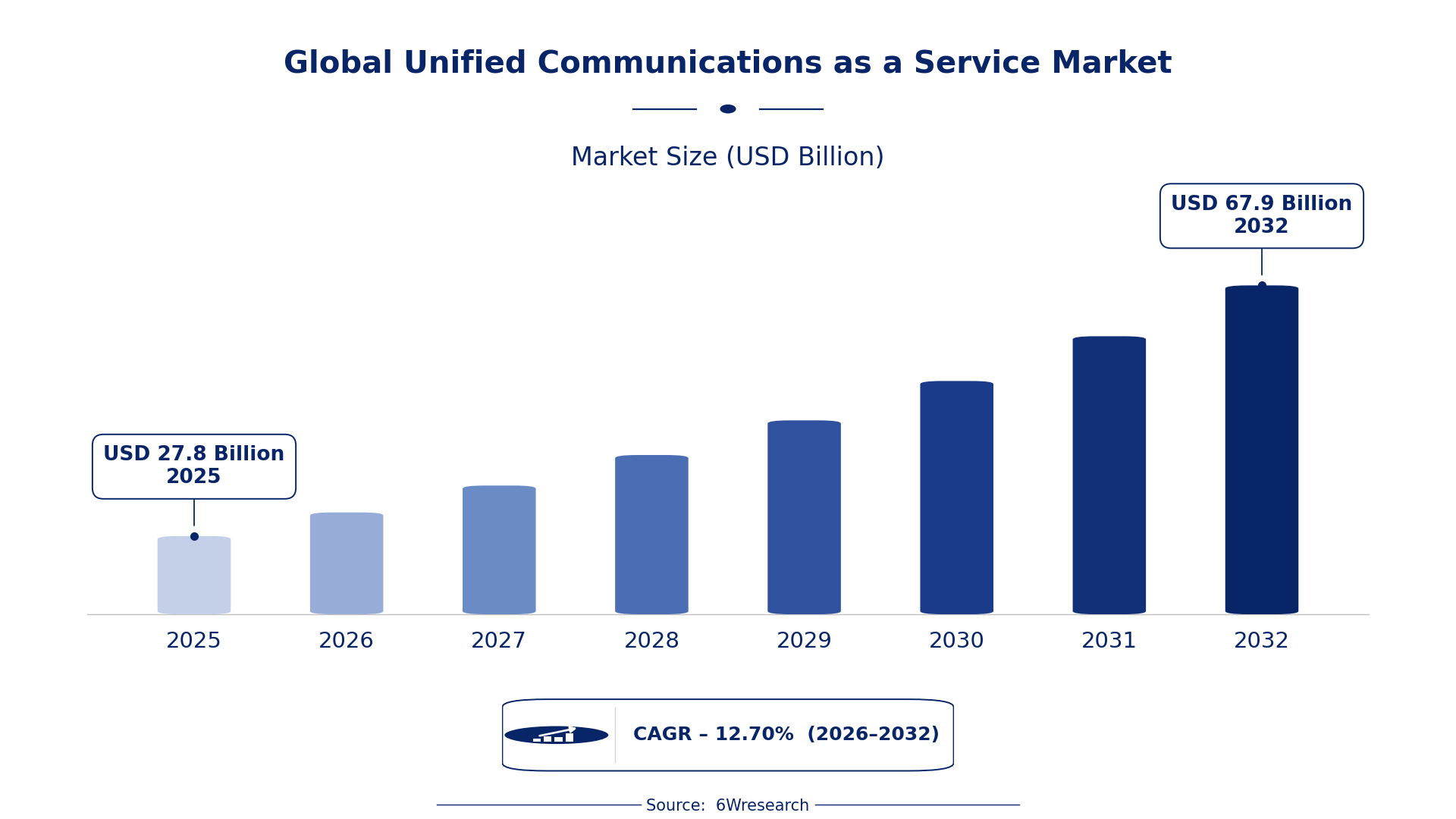
The Global Unified Communications as a Service Market was estimated at USD 27.8 Billion in 2025 and is projected to reach USD 67.9 Billion by 2032, growing at a CAGR of 12.70% from 2026 to 2032.
Global Unified Communications as a Service Market Synopsis
The Global Unified Communications as a Service (UCaaS) market is currently positioned at the forefront of transformational communication technologies. With an increasing emphasis on collaboration and integrated communication tools, businesses are gravitating towards cloud-based platforms that simplify processes and enhance team connectivity. This shift is especially pronounced in sectors such as remote work and digital collaboration, where traditional communication methods are being replaced by more agile and effective solutions.
A notable driver in the UCaaS market is the heightened focus on productivity improvements across organizations of all sizes. Enterprises are transitioning from on-premises solutions to cloud-based systems to leverage functionalities like voice, video conferencing, and messaging within a single framework. This trend is accentuated by the rise of mobile workforces and the increasing reliance on flexible communication infrastructures.
Global Unified Communications as a Service Market Year-wise Growth Rate and Key Drivers
This graph illustrates the annual growth rates of the Global Unified Communications as a Service Market from 2022 to 2032, highlighting a steady upward trajectory and projected expansion over the forecast period.
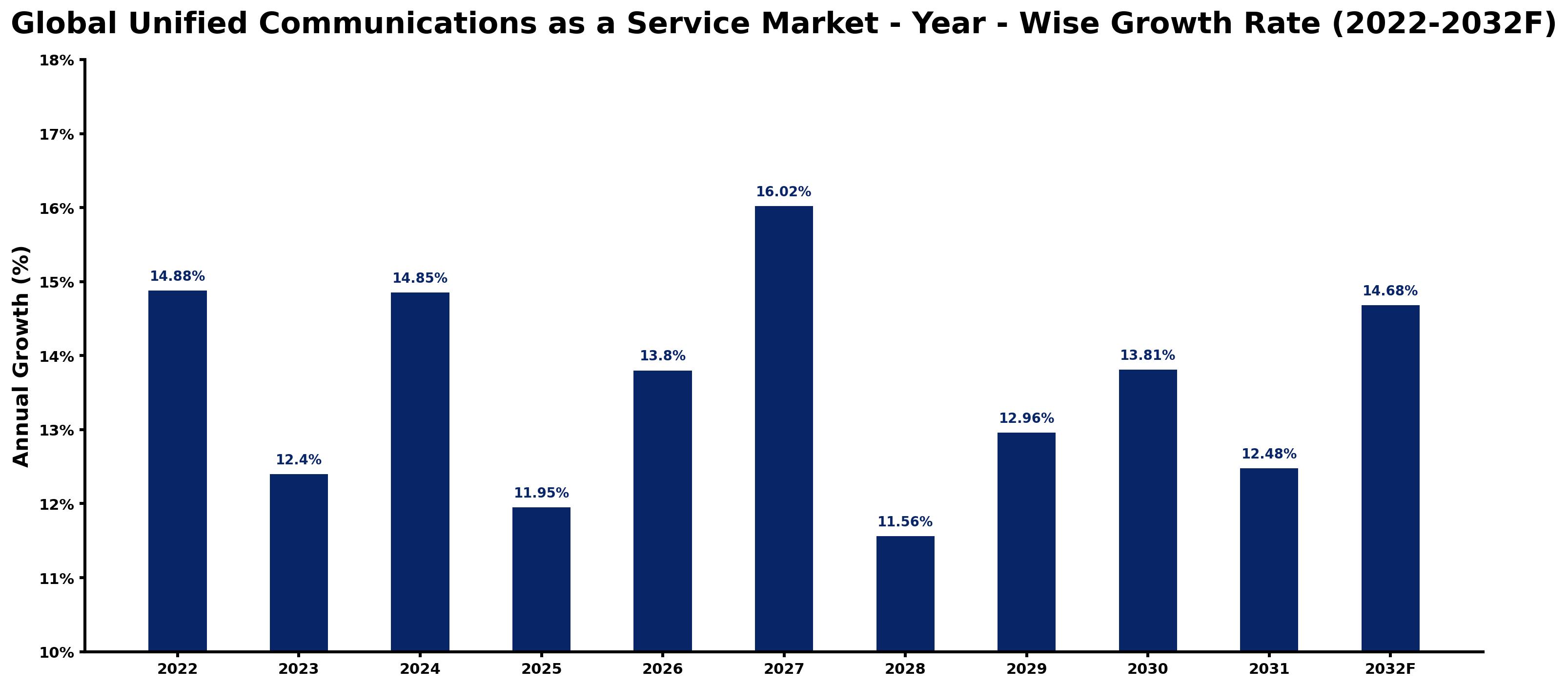
The table below presents the year‑wise growth rates along with the key drivers influencing the market
| Year | Growth Rate (%) | Major Drivers |
| 2022 | 14.88 | Unified Communications as a Service technology boosts collaboration in remote work environments. |
| 2023 | 12.4 | Telecom infrastructure providers adapt to new regulations enhancing UCaaS service delivery standards. |
| 2024 | 14.85 | In North America, supply chain improvements enable faster UCaaS deployment and integration. |
| 2025 | 11.95 | Growing labor shortages compel companies to adopt Unified Communications as a Service solutions. |
| 2026 | 13.8 | A shift toward cloud-based platforms enhances the demand for Unified Communications as a Service. |
| 2027 | 16.02 | Enterprises are investing heavily in UCaaS to streamline communication and collaboration tools. |
| 2028 | 11.56 | While competition intensifies, UCaaS providers focus on innovative features to retain clients. |
| 2029 | 12.96 | Rising fiber-optic material costs challenge UCaaS providers to optimize operational efficiency. |
| 2030 | 13.81 | Integrating sustainable practices in data centers is crucial for advancing UCaaS offerings. |
| 2031 | 12.48 | Companies increasingly prioritize user-friendly interfaces in Unified Communications as a Service solutions. |
| 2032 | 14.68 | Increasing global demand for remote collaboration drives UCaaS expansion into emerging markets. |
Note - Market size estimations and growth projections presented in this report are based on 6Wresearch's proprietary research methodology, combining internal industry data, secondary research, and primary validation, updated periodically to reflect current market conditions. As markets evolve rapidly, figures for certain industries may vary slightly and are intended as informed estimates rather than absolute figures. For the most current market sizing, we recommend validating figures with a 6Wresearch analyst.
Global Unified Communications as a Service Market Key Takeaways
Below are some of the specific key takeaways from the market, including:
- North America accounted for approximately 48% of the market share in 2025, underscoring its role as a primary hub for UCaaS adoption.
- Telephony continues to be the largest segment, holding about 40% of the total market share in 2025.
- The Collaboration Platforms segment is expected to experience remarkable growth, with a projected CAGR of 14.2% from 2026 to 2032.
- Cisco acquired Webex in 2019, significantly bolstering its position in the UCaaS landscape, integrating advanced features to attract new clients.
Evaluation of Restraints in Global Unified Communications as a Service Market
Despite the promising outlook for the Global Unified Communications as a Service market, several constraints hinder growth. Chief among these are security concerns related to data and privacy, especially as companies migrate sensitive information to the cloud. These issues can deter potential clients from fully committing to UCaaS solutions; for instance, research indicates that 60% of organizations express hesitation in switching to cloud-based communication due to concerns about vulnerabilities. Furthermore, integration complexities with legacy systems add another layer of challenge, complicating the transition for businesses that have invested heavily in traditional communication infrastructures.
Global Unified Communications as a Service Market Trends
Several trends currently define the Global Unified Communications as a Service market, rooted deeply in operational and technological shifts. The integration of artificial intelligence is particularly noteworthy, with companies like Microsoft implementing AI features in Teams to enhance user experience by automating routine tasks. Additionally, the rise of video conferencing has led firms such as Zoom to invest heavily in developing capabilities that support larger virtual meetings and enhance interactivity. According to data from 2022, the prevalence of video conferencing tools has surged by 75% compared to pre-pandemic levels, altering how companies engage with clients and employees alike.
Global Unified Communications as a Service Market Opportunities
Future revenue opportunities in the Global Unified Communications as a Service market center around emerging technologies and niche markets. For instance, advancements in security protocols present an enticing growth avenue; companies such as RingCentral are innovating to introduce enhanced security features that address data privacy concerns. Moreover, the surge in demand for seamless communication solutions tailored for specific industries, such as healthcare and finance, opens avenues for UCaaS providers to develop customized offerings and enhance market penetration. Industry estimates suggest that the healthcare sector could contribute an additional USD 5 Billion to the market by 2030 due to scalable communication solutions designed for telehealth.
Global Unified Communications as a Service Market by Component
Telephony leads the market segment with a commanding share of approximately 40% in 2025. Collaboration Platforms, rapidly gaining traction, are projected to see a CAGR of 14.2% from 2026 to 2032, driven by user demand for enhanced collaborative tools that facilitate remote and hybrid work environments. The performance advantages of these platforms, including ease of use and integration capabilities with other software, make them increasingly appealing to organizations seeking to modernize their communication strategies.
Global Unified Communications as a Service Market by Organization Size
In the Global Unified Communications as a Service market, Large Enterprises currently dominate, holding approximately 70% market share in 2025. However, SMEs are emerging as the fastest-growing segment, anticipated to expand at a robust CAGR of 15.5% from 2026 to 2032. The increased emphasis on cost-effective communication solutions and the flexibility offered by UCaaS platforms resonate well with SMEs, enabling them to adopt advanced communication infrastructures without the need for substantial upfront investments.
Global Unified Communications as a Service Market by Vertical
The BFSI sector emerges as the largest vertical in the Global Unified Communications as a Service market, commanding approximately 30% share in 2025. Conversely, the Healthcare vertical is set to grow at a noteworthy CAGR of 16.0% from 2026 to 2032. The increasing reliance on telehealth solutions and the demand for secure patient communication channels significantly drive this growth, as healthcare institutions prioritize effective coordination amid ongoing digital transformation initiatives.
Global Unified Communications as a Service Market by Region
North America leads the Global Unified Communications as a Service market with around 48% share in 2025, supported by a mature infrastructure and extensive technology adoption among enterprises. Meanwhile, the Asia-Pacific region is poised to be the fastest-growing area, expected to exhibit a CAGR of 15.0% from 2026 to 2032. The rapid digital transformation in countries like India and China, coupled with supportive government initiatives, positions this region as a hotbed for UCaaS demand.
Government Initiatives in the Global Unified Communications as a Service Market
The regulatory environment surrounding the Global Unified Communications as a Service Market is evolving, with various governments implementing initiatives to support technology adoption and improve communication infrastructure. These initiatives may include funding for cloud projects and partnerships promoting digital solutions across different sectors. The aim is to foster an environment conducive to innovation in communication technologies.
- Federal Communications Commission (FCC) - "Universal Service Fund Program," initiated in 2022 to improve internet access, particularly in rural areas, enabling better use of UCaaS solutions.
- European Commission - "European Digital Strategy," launched in 2020 with ongoing projects aimed at enhancing digital connectivity across EU member states, indirectly boosting UCaaS adoption.
- Department of Commerce - "Broadband Expansion Initiative," announced in 2023 with a funding proposal of USD 100 million aimed at enhancing the broadband infrastructure essential for UCaaS efficacy.
- Ministry of Electronics and Information Technology (India) - "Digital India Initiative," an ongoing effort started in 2015 promoting the adoption of digital technologies, including cloud-based communication systems.
Future Insights of the Global Unified Communications as a Service Market
Anticipated shifts within the Global Unified Communications as a Service Market are increasingly centered around the integration of advanced collaboration features and enhanced security protocols. As organizations increasingly rely on digital communication, trends show companies like Zoom enhancing their platforms to optimize user experience by leveraging AI. This focus aligns with the movement towards more tailored solutions across different sectors, especially healthcare, which could contribute significantly to overall market growth.
Global Unified Communications as a Service Market Latest Developments
The following recent developments within the Global Unified Communications as a Service market are noteworthy, as they highlight evolving strategies of key players aimed at enhancing service offerings and competitive positioning:
- In July 2023, Microsoft enhanced its Teams platform with new AI-driven collaboration tools, allowing for automated scheduling and real-time transcription, improving user workflows.
- RingCentral launched an upgraded API suite in August 2023, enabling seamless integration with third-party applications to improve operational efficiency and customer interactions.
- Cisco announced in September 2023 plans to expand its cloud capabilities through a significant investment into its Webex platform, enhancing features for hybrid work environments.
- 8x8 completed its acquisition of Fuze in October 2023, strategically positioning itself to offer enhanced solutions for large enterprises seeking integrated communication services.
Global Unified Communications as a Service Market Key Players and Industry Positioning
The competitive landscape of the Global Unified Communications as a Service market is characterized by both consolidation and innovation, with several key players actively seeking to differentiate their offerings. This dynamic environment encourages collaboration and technological advancements, enhancing the overall service quality.
| Leading Company | Core Strength | Strategic Focus |
|---|---|---|
| Zoom | User-friendly interface with vast scalability | Enhancing video conferencing capabilities and expanding to new markets |
| Microsoft | Integration of productivity tools within UCaaS platforms | Focus on AI technology for workflow automation |
| Cisco | Strong presence in enterprise solutions and security | Expanding cloud functionalities for hybrid workplace needs |
| RingCentral | Robust communication APIs for integration | Targeting mid-sized to large enterprises with tailored solutions |
| 8x8 | Broad service offering with emphasis on voice quality | Expanding offerings through strategic acquisitions |
The competitive strategies observed reflect a growing emphasis on technology integration and user-centric enhancements, particularly as businesses seek to refine their communication strategies in a digitally transformed environment.
Key Attractiveness of the Report
- 10 Years of Market Numbers
- Historical Data Starting from 2022 to 2025
- Base Year: 2025
- Forecast Data until 2032
- Key Performance Indicators Impacting the Market
- Major Upcoming Developments and Projects
Key Highlights of the Report:
- Global Unified Communications as a Service Market Outlook
- Market Size of Global Unified Communications as a Service Market, 2025
- Forecast of Global Unified Communications as a Service Market, 2032
- Historical Data and Forecast of Global Unified Communications as a Service Revenues & Volume for the Period 2022-2032
- Global Unified Communications as a Service Market Trend Evolution
- Global Unified Communications as a Service Market Drivers and Challenges
- Global Unified Communications as a Service Price Trends
- Global Unified Communications as a Service Porter's Five Forces
- Global Unified Communications as a Service Industry Life Cycle
- Historical Data and Forecast of Global Unified Communications as a Service Market Revenues & Volume
- Historical Data and Forecast of Global Unified Communications as a Service Market Revenues & Volume By Component for the Period 2022-2032
- Historical Data and Forecast of Global Unified Communications as a Service Market Revenues & Volume By Telephony for the Period 2022-2032
- Historical Data and Forecast of Global Unified Communications as a Service Market Revenues & Volume By Unified Messaging for the Period 2022-2032
- Historical Data and Forecast of Global Unified Communications as a Service Market Revenues & Volume By Conferencing for the Period 2022-2032
- Historical Data and Forecast of Global Unified Communications as a Service Market Revenues & Volume By Collaboration Platforms And Applications for the Period 2022-2032
- Historical Data and Forecast of Global Unified Communications as a Service Market Revenues & Volume By Organization Size for the Period 2022-2032
- Historical Data and Forecast of Global Unified Communications as a Service Market Revenues & Volume By SMEs for the Period 2022-2032
- Historical Data and Forecast of Global Unified Communications as a Service Market Revenues & Volume By Large Enterprises for the Period 2022-2032
- Historical Data and Forecast of Global Unified Communications as a Service Market Revenues & Volume By Vertical for the Period 2022-2032
- Historical Data and Forecast of Global Unified Communications as a Service Market Revenues & Volume By BFSI for the Period 2022-2032
- Historical Data and Forecast of Global Unified Communications as a Service Market Revenues & Volume By Telecom and IT for the Period 2022-2032
- Historical Data and Forecast of Global Unified Communications as a Service Market Revenues & Volume By Consumer Goods and Retail for the Period 2022-2032
- Historical Data and Forecast of Global Unified Communications as a Service Market Revenues & Volume By Healthcare for the Period 2022-2032
- Historical Data and Forecast of Global Unified Communications as a Service Market Revenues & Volume By Public Sector and Utilities for the Period 2022-2032
- Historical Data and Forecast of Global Unified Communications as a Service Market Revenues & Volume By Logistics and Transportation for the Period 2022-2032
- Historical Data and Forecast of Global Unified Communications as a Service Market Revenues & Volume By Travel and Hospitality for the Period 2022-2032
- Historical Data and Forecast of Global BFSI Unified Communications as a Service Market Revenues & Volume By Others (Education, Media and Entertainment, and Manufacturing) for the Period 2022-2032
- Historical Data and Forecast of North America Unified Communications as a Service Market Revenues & Volume By Component for the Period 2022-2032
- Historical Data and Forecast of North America Unified Communications as a Service Market Revenues & Volume By Telephony for the Period 2022-2032
- Historical Data and Forecast of North America Unified Communications as a Service Market Revenues & Volume By Unified Messaging for the Period 2022-2032
- Historical Data and Forecast of North America Unified Communications as a Service Market Revenues & Volume By Conferencing for the Period 2022-2032
- Historical Data and Forecast of North America Unified Communications as a Service Market Revenues & Volume By Collaboration Platforms And Applications for the Period 2022-2032
- Historical Data and Forecast of North America Unified Communications as a Service Market Revenues & Volume By Organization Size for the Period 2022-2032
- Historical Data and Forecast of North America Unified Communications as a Service Market Revenues & Volume By SMEs for the Period 2022-2032
- Historical Data and Forecast of North America Unified Communications as a Service Market Revenues & Volume By Large Enterprises for the Period 2022-2032
- Historical Data and Forecast of North America Unified Communications as a Service Market Revenues & Volume By Vertical for the Period 2022-2032
- Historical Data and Forecast of North America Unified Communications as a Service Market Revenues & Volume By BFSI for the Period 2022-2032
- Historical Data and Forecast of North America Unified Communications as a Service Market Revenues & Volume By Telecom and IT for the Period 2022-2032
- Historical Data and Forecast of North America Unified Communications as a Service Market Revenues & Volume By Consumer Goods and Retail for the Period 2022-2032
- Historical Data and Forecast of North America Unified Communications as a Service Market Revenues & Volume By Healthcare for the Period 2022-2032
- Historical Data and Forecast of North America Unified Communications as a Service Market Revenues & Volume By Public Sector and Utilities for the Period 2022-2032
- Historical Data and Forecast of North America Unified Communications as a Service Market Revenues & Volume By Logistics and Transportation for the Period 2022-2032
- Historical Data and Forecast of North America Unified Communications as a Service Market Revenues & Volume By Travel and Hospitality for the Period 2022-2032
- Historical Data and Forecast of North America BFSI Unified Communications as a Service Market Revenues & Volume By Others (Education, Media and Entertainment, and Manufacturing) for the Period 2022-2032
- Historical Data and Forecast of United States of America Unified Communications as a Service Market Revenues & Volume for the Period 2022-2032
- Historical Data and Forecast of Canada Unified Communications as a Service Market Revenues & Volume for the Period 2022-2032
- Historical Data and Forecast of Rest of North America Unified Communications as a Service Market Revenues & Volume for the Period 2022-2032
- Historical Data and Forecast of Latin America (LATAM) Unified Communications as a Service Market Revenues & Volume By Component for the Period 2022-2032
- Historical Data and Forecast of Latin America (LATAM) Unified Communications as a Service Market Revenues & Volume By Telephony for the Period 2022-2032
- Historical Data and Forecast of Latin America (LATAM) Unified Communications as a Service Market Revenues & Volume By Unified Messaging for the Period 2022-2032
- Historical Data and Forecast of Latin America (LATAM) Unified Communications as a Service Market Revenues & Volume By Conferencing for the Period 2022-2032
- Historical Data and Forecast of Latin America (LATAM) Unified Communications as a Service Market Revenues & Volume By Collaboration Platforms And Applications for the Period 2022-2032
- Historical Data and Forecast of Latin America (LATAM) Unified Communications as a Service Market Revenues & Volume By Organization Size for the Period 2022-2032
- Historical Data and Forecast of Latin America (LATAM) Unified Communications as a Service Market Revenues & Volume By SMEs for the Period 2022-2032
- Historical Data and Forecast of Latin America (LATAM) Unified Communications as a Service Market Revenues & Volume By Large Enterprises for the Period 2022-2032
- Historical Data and Forecast of Latin America (LATAM) Unified Communications as a Service Market Revenues & Volume By Vertical for the Period 2022-2032
- Historical Data and Forecast of Latin America (LATAM) Unified Communications as a Service Market Revenues & Volume By BFSI for the Period 2022-2032
- Historical Data and Forecast of Latin America (LATAM) Unified Communications as a Service Market Revenues & Volume By Telecom and IT for the Period 2022-2032
- Historical Data and Forecast of Latin America (LATAM) Unified Communications as a Service Market Revenues & Volume By Consumer Goods and Retail for the Period 2022-2032
- Historical Data and Forecast of Latin America (LATAM) Unified Communications as a Service Market Revenues & Volume By Healthcare for the Period 2022-2032
- Historical Data and Forecast of Latin America (LATAM) Unified Communications as a Service Market Revenues & Volume By Public Sector and Utilities for the Period 2022-2032
- Historical Data and Forecast of Latin America (LATAM) Unified Communications as a Service Market Revenues & Volume By Logistics and Transportation for the Period 2022-2032
- Historical Data and Forecast of Latin America (LATAM) Unified Communications as a Service Market Revenues & Volume By Travel and Hospitality for the Period 2022-2032
- Historical Data and Forecast of Latin America (LATAM) BFSI Unified Communications as a Service Market Revenues & Volume By Others (Education, Media and Entertainment, and Manufacturing) for the Period 2022-2032
- Historical Data and Forecast of Brazil Unified Communications as a Service Market Revenues & Volume for the Period 2022-2032
- Historical Data and Forecast of Mexico Unified Communications as a Service Market Revenues & Volume for the Period 2022-2032
- Historical Data and Forecast of Argentina Unified Communications as a Service Market Revenues & Volume for the Period 2022-2032
- Historical Data and Forecast of Rest of LATAM Unified Communications as a Service Market Revenues & Volume for the Period 2022-2032
- Historical Data and Forecast of Asia Unified Communications as a Service Market Revenues & Volume By Component for the Period 2022-2032
- Historical Data and Forecast of Asia Unified Communications as a Service Market Revenues & Volume By Telephony for the Period 2022-2032
- Historical Data and Forecast of Asia Unified Communications as a Service Market Revenues & Volume By Unified Messaging for the Period 2022-2032
- Historical Data and Forecast of Asia Unified Communications as a Service Market Revenues & Volume By Conferencing for the Period 2022-2032
- Historical Data and Forecast of Asia Unified Communications as a Service Market Revenues & Volume By Collaboration Platforms And Applications for the Period 2022-2032
- Historical Data and Forecast of Asia Unified Communications as a Service Market Revenues & Volume By Organization Size for the Period 2022-2032
- Historical Data and Forecast of Asia Unified Communications as a Service Market Revenues & Volume By SMEs for the Period 2022-2032
- Historical Data and Forecast of Asia Unified Communications as a Service Market Revenues & Volume By Large Enterprises for the Period 2022-2032
- Historical Data and Forecast of Asia Unified Communications as a Service Market Revenues & Volume By Vertical for the Period 2022-2032
- Historical Data and Forecast of Asia Unified Communications as a Service Market Revenues & Volume By BFSI for the Period 2022-2032
- Historical Data and Forecast of Asia Unified Communications as a Service Market Revenues & Volume By Telecom and IT for the Period 2022-2032
- Historical Data and Forecast of Asia Unified Communications as a Service Market Revenues & Volume By Consumer Goods and Retail for the Period 2022-2032
- Historical Data and Forecast of Asia Unified Communications as a Service Market Revenues & Volume By Healthcare for the Period 2022-2032
- Historical Data and Forecast of Asia Unified Communications as a Service Market Revenues & Volume By Public Sector and Utilities for the Period 2022-2032
- Historical Data and Forecast of Asia Unified Communications as a Service Market Revenues & Volume By Logistics and Transportation for the Period 2022-2032
- Historical Data and Forecast of Asia Unified Communications as a Service Market Revenues & Volume By Travel and Hospitality for the Period 2022-2032
- Historical Data and Forecast of Asia BFSI Unified Communications as a Service Market Revenues & Volume By Others (Education, Media and Entertainment, and Manufacturing) for the Period 2022-2032
- Historical Data and Forecast of China Unified Communications as a Service Market Revenues & Volume for the Period 2022-2032
- Historical Data and Forecast of India Unified Communications as a Service Market Revenues & Volume for the Period 2022-2032
- Historical Data and Forecast of Japan Unified Communications as a Service Market Revenues & Volume for the Period 2022-2032
- Historical Data and Forecast of Rest of Asia Unified Communications as a Service Market Revenues & Volume for the Period 2022-2032
- Historical Data and Forecast of Africa Unified Communications as a Service Market Revenues & Volume By Component for the Period 2022-2032
- Historical Data and Forecast of Africa Unified Communications as a Service Market Revenues & Volume By Telephony for the Period 2022-2032
- Historical Data and Forecast of Africa Unified Communications as a Service Market Revenues & Volume By Unified Messaging for the Period 2022-2032
- Historical Data and Forecast of Africa Unified Communications as a Service Market Revenues & Volume By Conferencing for the Period 2022-2032
- Historical Data and Forecast of Africa Unified Communications as a Service Market Revenues & Volume By Collaboration Platforms And Applications for the Period 2022-2032
- Historical Data and Forecast of Africa Unified Communications as a Service Market Revenues & Volume By Organization Size for the Period 2022-2032
- Historical Data and Forecast of Africa Unified Communications as a Service Market Revenues & Volume By SMEs for the Period 2022-2032
- Historical Data and Forecast of Africa Unified Communications as a Service Market Revenues & Volume By Large Enterprises for the Period 2022-2032
- Historical Data and Forecast of Africa Unified Communications as a Service Market Revenues & Volume By Vertical for the Period 2022-2032
- Historical Data and Forecast of Africa Unified Communications as a Service Market Revenues & Volume By BFSI for the Period 2022-2032
- Historical Data and Forecast of Africa Unified Communications as a Service Market Revenues & Volume By Telecom and IT for the Period 2022-2032
- Historical Data and Forecast of Africa Unified Communications as a Service Market Revenues & Volume By Consumer Goods and Retail for the Period 2022-2032
- Historical Data and Forecast of Africa Unified Communications as a Service Market Revenues & Volume By Healthcare for the Period 2022-2032
- Historical Data and Forecast of Africa Unified Communications as a Service Market Revenues & Volume By Public Sector and Utilities for the Period 2022-2032
- Historical Data and Forecast of Africa Unified Communications as a Service Market Revenues & Volume By Logistics and Transportation for the Period 2022-2032
- Historical Data and Forecast of Africa Unified Communications as a Service Market Revenues & Volume By Travel and Hospitality for the Period 2022-2032
- Historical Data and Forecast of Africa BFSI Unified Communications as a Service Market Revenues & Volume By Others (Education, Media and Entertainment, and Manufacturing) for the Period 2022-2032
- Historical Data and Forecast of South Africa Unified Communications as a Service Market Revenues & Volume for the Period 2022-2032
- Historical Data and Forecast of Nigeria Unified Communications as a Service Market Revenues & Volume for the Period 2022-2032
- Historical Data and Forecast of Egypt Unified Communications as a Service Market Revenues & Volume for the Period 2022-2032
- Historical Data and Forecast of Rest of Africa Unified Communications as a Service Market Revenues & Volume for the Period 2022-2032
- Historical Data and Forecast of Europe Unified Communications as a Service Market Revenues & Volume By Component for the Period 2022-2032
- Historical Data and Forecast of Europe Unified Communications as a Service Market Revenues & Volume By Telephony for the Period 2022-2032
- Historical Data and Forecast of Europe Unified Communications as a Service Market Revenues & Volume By Unified Messaging for the Period 2022-2032
- Historical Data and Forecast of Europe Unified Communications as a Service Market Revenues & Volume By Conferencing for the Period 2022-2032
- Historical Data and Forecast of Europe Unified Communications as a Service Market Revenues & Volume By Collaboration Platforms And Applications for the Period 2022-2032
- Historical Data and Forecast of Europe Unified Communications as a Service Market Revenues & Volume By Organization Size for the Period 2022-2032
- Historical Data and Forecast of Europe Unified Communications as a Service Market Revenues & Volume By SMEs for the Period 2022-2032
- Historical Data and Forecast of Europe Unified Communications as a Service Market Revenues & Volume By Large Enterprises for the Period 2022-2032
- Historical Data and Forecast of Europe Unified Communications as a Service Market Revenues & Volume By Vertical for the Period 2022-2032
- Historical Data and Forecast of Europe Unified Communications as a Service Market Revenues & Volume By BFSI for the Period 2022-2032
- Historical Data and Forecast of Europe Unified Communications as a Service Market Revenues & Volume By Telecom and IT for the Period 2022-2032
- Historical Data and Forecast of Europe Unified Communications as a Service Market Revenues & Volume By Consumer Goods and Retail for the Period 2022-2032
- Historical Data and Forecast of Europe Unified Communications as a Service Market Revenues & Volume By Healthcare for the Period 2022-2032
- Historical Data and Forecast of Europe Unified Communications as a Service Market Revenues & Volume By Public Sector and Utilities for the Period 2022-2032
- Historical Data and Forecast of Europe Unified Communications as a Service Market Revenues & Volume By Logistics and Transportation for the Period 2022-2032
- Historical Data and Forecast of Europe Unified Communications as a Service Market Revenues & Volume By Travel and Hospitality for the Period 2022-2032
- Historical Data and Forecast of Europe BFSI Unified Communications as a Service Market Revenues & Volume By Others (Education, Media and Entertainment, and Manufacturing) for the Period 2022-2032
- Historical Data and Forecast of United Kingdom Unified Communications as a Service Market Revenues & Volume for the Period 2022-2032
- Historical Data and Forecast of France Unified Communications as a Service Market Revenues & Volume for the Period 2022-2032
- Historical Data and Forecast of Germany Unified Communications as a Service Market Revenues & Volume for the Period 2022-2032
- Historical Data and Forecast of Rest of Europe Unified Communications as a Service Market Revenues & Volume for the Period 2022-2032
- Historical Data and Forecast of Middle East Unified Communications as a Service Market Revenues & Volume By Component for the Period 2022-2032
- Historical Data and Forecast of Middle East Unified Communications as a Service Market Revenues & Volume By Telephony for the Period 2022-2032
- Historical Data and Forecast of Middle East Unified Communications as a Service Market Revenues & Volume By Unified Messaging for the Period 2022-2032
- Historical Data and Forecast of Middle East Unified Communications as a Service Market Revenues & Volume By Conferencing for the Period 2022-2032
- Historical Data and Forecast of Middle East Unified Communications as a Service Market Revenues & Volume By Collaboration Platforms And Applications for the Period 2022-2032
- Historical Data and Forecast of Middle East Unified Communications as a Service Market Revenues & Volume By Organization Size for the Period 2022-2032
- Historical Data and Forecast of Middle East Unified Communications as a Service Market Revenues & Volume By SMEs for the Period 2022-2032
- Historical Data and Forecast of Middle East Unified Communications as a Service Market Revenues & Volume By Large Enterprises for the Period 2022-2032
- Historical Data and Forecast of Middle East Unified Communications as a Service Market Revenues & Volume By Vertical for the Period 2022-2032
- Historical Data and Forecast of Middle East Unified Communications as a Service Market Revenues & Volume By BFSI for the Period 2022-2032
- Historical Data and Forecast of Middle East Unified Communications as a Service Market Revenues & Volume By Telecom and IT for the Period 2022-2032
- Historical Data and Forecast of Middle East Unified Communications as a Service Market Revenues & Volume By Consumer Goods and Retail for the Period 2022-2032
- Historical Data and Forecast of Middle East Unified Communications as a Service Market Revenues & Volume By Healthcare for the Period 2022-2032
- Historical Data and Forecast of Middle East Unified Communications as a Service Market Revenues & Volume By Public Sector and Utilities for the Period 2022-2032
- Historical Data and Forecast of Middle East Unified Communications as a Service Market Revenues & Volume By Logistics and Transportation for the Period 2022-2032
- Historical Data and Forecast of Middle East Unified Communications as a Service Market Revenues & Volume By Travel and Hospitality for the Period 2022-2032
- Historical Data and Forecast of Middle East BFSI Unified Communications as a Service Market Revenues & Volume By Others (Education, Media and Entertainment, and Manufacturing) for the Period 2022-2032
- Historical Data and Forecast of Saudi Arabia Unified Communications as a Service Market Revenues & Volume for the Period 2022-2032
- Historical Data and Forecast of UAE Unified Communications as a Service Market Revenues & Volume for the Period 2022-2032
- Historical Data and Forecast of Turkey Unified Communications as a Service Market Revenues & Volume for the Period 2022-2032
- Historical Data and Forecast of Rest of Middle East Unified Communications as a Service Market Revenues & Volume for the Period 2022-2032
- Global Unified Communications as a Service Market - Key Performance Indicators
- Global Unified Communications as a Service Market - Import Export Trade Statistics
- Global Unified Communications as a Service Market - Opportunity Assessment By Countries
- Global Unified Communications as a Service Market - Opportunity Assessment By Component
- Global Unified Communications as a Service Market - Opportunity Assessment By Organization Size
- Global Unified Communications as a Service Market - Opportunity Assessment By Vertical
- Global Unified Communications as a Service Market - Top Companies Market Share
- Global Unified Communications as a Service Market - Top Companies Profiles
- Global Unified Communications as a Service Market - Comparison of Players in Technical and Operating Parameters
- Global Unified Communications as a Service Market - Strategic Recommendations
Markets Covered
The Global Unified Communications as a Service Market report provides a detailed analysis of the following market segments:
By Regions and Countries:
- North America
- Europe
- LATAM
- Middle East
- Asia
- Africa
By Component:
- Telephony
- Unified Messaging
- Conferencing
- Collaboration Platforms And Applications
By Organization Size:
- SMEs
- Large Enterprises
By Vertical:
- BFSI
- Telecom
- IT
- Consumer Goods
- Retail
- Healthcare
- Public Sector
- Utilities
- Logistics
- Transportation
- Travel
- Hospitality
- Others (Education
- Media
- Entertainment
- Manufacturing)






































