France Unified Communications as a Service Market Size, Share & Growth Rate
The France Unified Communications as a Service Market was estimated at USD 173 Million in 2025 and is projected to reach USD 193 Million by 2032, growing at a CAGR of 1.6% from 2026 to 2032. This growth trajectory is significantly influenced by the increasing shift towards cloud-based solutions as organizations seek more integrated communication platforms. The rise of remote work and the demand for seamless collaboration tools further accentuate the necessity for UCaaS, allowing businesses to enhance connectivity while reducing operational costs.
France Unified Communications as a Service Market Year-wise Growth Rate and Key Drivers
This graph highlights how the France Unified Communications as a Service Market has steadily grown over the years, supported by major growth factors.
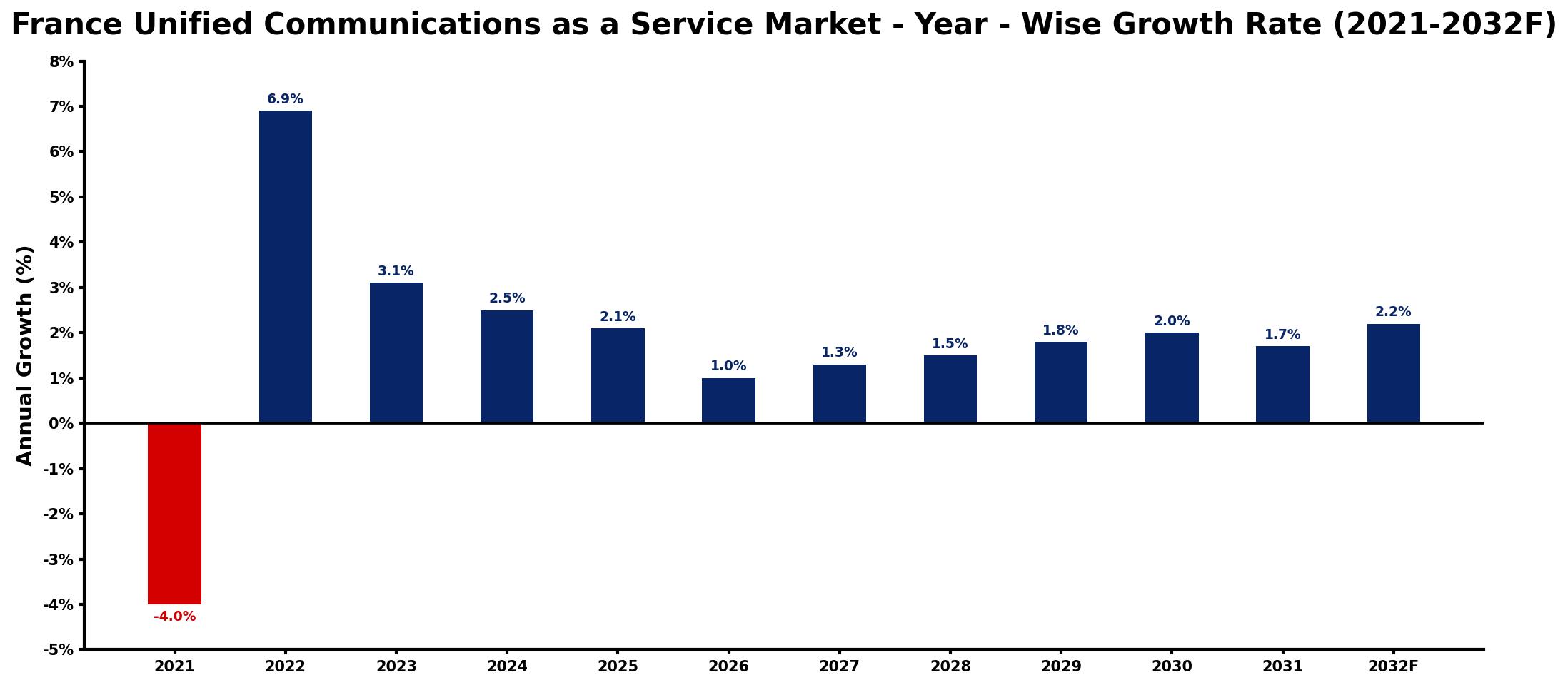
The table below presents the year‑wise growth rates along with the key drivers influencing the market
| Year | Growth Rate | Major Drivers |
| 2021 | -4.0% | decrease in corporate investments |
| 2022 | 6.9% | rise in remote work adoption |
| 2023 | 3.1% | expansion of digital collaboration tools |
| 2024 | 2.5% | increased demand for cloud solutions |
| 2025 | 2.1% | growth in hybrid work environments |
| 2026 | 1.0% | enhanced focus on employee engagement |
| 2027 | 1.3% | uptick in small business technology |
| 2028 | 1.5% | surge in mobile workforce solutions |
| 2029 | 1.8% | broadening of enterprise digital strategies |
| 2030 | 2.0% | development of AI integration applications |
| 2031 | 1.7% | innovation in user experience design |
| 2032 | 2.2% | growing importance of cybersecurity measures |
Note: Market size estimations and growth projections presented in this report are based on 6Wresearch's proprietary forecasting methodology, utilizing the latest available industry data, government publications, and primary research inputs.
France Unified Communications as a Service Market Synopsis
The most substantial force currently shaping the France UCaaS market is the surge in remote and hybrid work arrangements. As companies transition towards these models, the demand for reliable, flexible, and scalable communication solutions has never been higher. Unified Communications as a Service is increasingly seen as vital for facilitating effective collaboration across various locations.
Another critical factor is the continuous emphasis on cost-efficiency in communication infrastructures. Organizations, regardless of size, are turning to UCaaS to streamline their operations and cut down on the complexities and expenses associated with traditional on-premises systems. This trend underscores the value of adopting a holistic approach to communication and collaboration in the modern workplace.
France Unified Communications as a Service Market Key Takeaways
- The UCaaS market is primarily driven by the growing need for integrated communication solutions among enterprises.
- Remote work dynamics are amplifying the demand for scalable and flexible UCaaS offerings.
- Data security and privacy concerns are becoming focal points in the deployment of UCaaS solutions.
- Government policies favoring digital transformation bolster the UCaaS market's growth potential.
- Technological advancements continue to enhance the functionality and user experience of UCaaS platforms.
Evaluation of Restraints in France Unified Communications as a Service Market
Despite its robust growth prospects, the France UCaaS market faces significant restraints, particularly in data security and user adoption. With heightened scrutiny around data privacy regulations like GDPR, organizations are often hesitant to fully embrace cloud-based solutions without guarantees of compliance and security. Additionally, the challenge of integrating UCaaS with existing communication infrastructures complicates the decision-making process for many companies. These factors create a cautious market environment, wherein organizations weigh the benefits of UCaaS against perceived risks and integration complexities.
France Unified Communications as a Service Market Trends
Current trends in the France UCaaS market reflect an increasing convergence of communication technologies. Businesses are not just looking for standalone voice or video solutions; they seek comprehensive platforms that seamlessly integrate multiple communication channels. Moreover, the incorporation of advanced features like artificial intelligence in UCaaS solutions is enhancing functionality, offering businesses innovative tools to improve customer interactions and internal collaboration.
There is also a growing emphasis on user-friendly interfaces and enhanced mobile capabilities, reflecting a broader shift towards mobile-first communication strategies. Organizations are recognizing the value of enabling their workforce to connect anytime, anywhere, thereby fostering a culture of flexibility and productivity.
France Unified Communications as a Service Market Opportunities
The future landscape of the France UCaaS market presents significant opportunities for growth and investment. Companies looking to enhance their communication infrastructure can leverage the increasing demand for cloud-native solutions, particularly those that prioritize security and interoperability. Additionally, as industries undergo digital transformation, businesses can capitalize on the need for customized UCaaS offerings tailored to specific operational requirements, creating a niche for specialized providers to thrive.
Government Initiatives in the France Unified Communications as a Service Market
The French government plays a proactive role in fostering the adoption of UCaaS solutions through various initiatives aimed at enhancing business efficiency. Policies are focused on ensuring data privacy and security, promoting fair competition among service providers, and expanding broadband infrastructure to facilitate high-quality communication services. Furthermore, the government may provide incentives to support businesses as they transition to cloud-based communication platforms as part of broader digital transformation initiatives, ultimately aiming to improve national competitiveness.
Future Insights of the France Unified Communications as a Service Market
Looking ahead to the years 2026-2032, the France UCaaS market is poised for steady growth driven by the ongoing evolution of workplace dynamics. The demand for flexible, scalable communication tools will likely continue to rise, as more organizations embrace hybrid work environments. Innovations in technology, particularly in AI and analytics, are expected to further enhance UCaaS offerings, enabling businesses to operate more efficiently and respond to customer needs more effectively. As companies navigate this changing landscape, the value of robust, integrated communication systems will become increasingly apparent.
France Unified Communications as a Service Market Latest Developments (2025 - 2026)
In recent months, the France UCaaS market has seen notable shifts towards adopting more sophisticated security features, driven by rising concerns over data breaches and compliance issues. Businesses are prioritizing solutions that offer enhanced data protection and privacy measures. Additionally, the development of hybrid communication models is gaining traction, as organizations seek to blend in-person and digital interactions seamlessly. Finally, partnerships among technology providers are becoming increasingly common, aimed at expanding service offerings and enhancing user experience.
France Unified Communications as a Service Market - Key Attractiveness of the Report
- 10 Years of Market Numbers
- Historical Data Starting from 2022 to 2025
- Base Year: 2025
- Forecast Data until 2032
- Key Performance Indicators Impacting the Market
- Major Upcoming Developments and Projects
Key Highlights of the Report:
- France Unified Communications as a Service Market Outlook
- Market Size of France Unified Communications as a Service Market, 2025
- Forecast of France Unified Communications as a Service Market, 2032
- Historical Data and Forecast of France Unified Communications as a Service Revenues & Volume for the Period 2022-2032F
- France Unified Communications as a Service Market Trend Evolution
- France Unified Communications as a Service Market Drivers and Challenges
- France Unified Communications as a Service Price Trends
- France Unified Communications as a Service Porter's Five Forces
- France Unified Communications as a Service Industry Life Cycle
- Historical Data and Forecast of France Unified Communications as a Service Market Revenues & Volume By Component for the Period 2022-2032F
- Historical Data and Forecast of France Unified Communications as a Service Market Revenues & Volume By Telephony for the Period 2022-2032F
- Historical Data and Forecast of France Unified Communications as a Service Market Revenues & Volume By Unified Messaging for the Period 2022-2032F
- Historical Data and Forecast of France Unified Communications as a Service Market Revenues & Volume By Conferencing for the Period 2022-2032F
- Historical Data and Forecast of France Unified Communications as a Service Market Revenues & Volume By Collaboration Platforms And Applications for the Period 2022-2032F
- Historical Data and Forecast of France Unified Communications as a Service Market Revenues & Volume By Organization Size for the Period 2022-2032F
- Historical Data and Forecast of France Unified Communications as a Service Market Revenues & Volume By SMEs for the Period 2022-2032F
- Historical Data and Forecast of France Unified Communications as a Service Market Revenues & Volume By Large Enterprises for the Period 2022-2032F
- Historical Data and Forecast of France Unified Communications as a Service Market Revenues & Volume By Vertical for the Period 2022-2032F
- Historical Data and Forecast of France Unified Communications as a Service Market Revenues & Volume By BFSI for the Period 2022-2032F
- Historical Data and Forecast of France Unified Communications as a Service Market Revenues & Volume By Telecom and IT for the Period 2022-2032F
- Historical Data and Forecast of France Unified Communications as a Service Market Revenues & Volume By Consumer Goods and Retail for the Period 2022-2032F
- Historical Data and Forecast of France Unified Communications as a Service Market Revenues & Volume By Healthcare for the Period 2022-2032F
- Historical Data and Forecast of France Unified Communications as a Service Market Revenues & Volume By Public Sector and Utilities for the Period 2022-2032F
- Historical Data and Forecast of France Unified Communications as a Service Market Revenues & Volume By Logistics and Transportation for the Period 2022-2032F
- Historical Data and Forecast of France Unified Communications as a Service Market Revenues & Volume By Travel and Hospitality for the Period 2022-2032F
- Historical Data and Forecast of France Unified Communications as a Service Market Revenues & Volume By Others (Education, Media and Entertainment, and Manufacturing) for the Period 2022-2032F
- France Unified Communications as a Service Import Export Trade Statistics
- Market Opportunity Assessment By Component
- Market Opportunity Assessment By Organization Size
- Market Opportunity Assessment By Vertical
- France Unified Communications as a Service Top Companies Market Share
- France Unified Communications as a Service Competitive Benchmarking By Technical and Operational Parameters
- France Unified Communications as a Service Company Profiles
- France Unified Communications as a Service Key Strategic Recommendations






































