Qatar Unified Communications as a Service Market Size, Share & Growth Rate
The Qatar Unified Communications as a Service Market was estimated at USD 381 Million in 2025 and is projected to reach USD 514 Million by 2032, growing at a CAGR of 4.4% from 2026 to 2032. This growth trajectory reflects a significant shift in how organizations in Qatar manage their communication needs, with a particular focus on the integration of cloud-based solutions. The rising demand for scalable communication tools, coupled with a cultural shift towards digital transformation, is further fueling this market's expansion.
Qatar Unified Communications as a Service Market Year-wise Growth Rate and Key Drivers
This graph highlights how the Qatar Unified Communications as a Service Market has steadily grown over the years, supported by major growth factors.
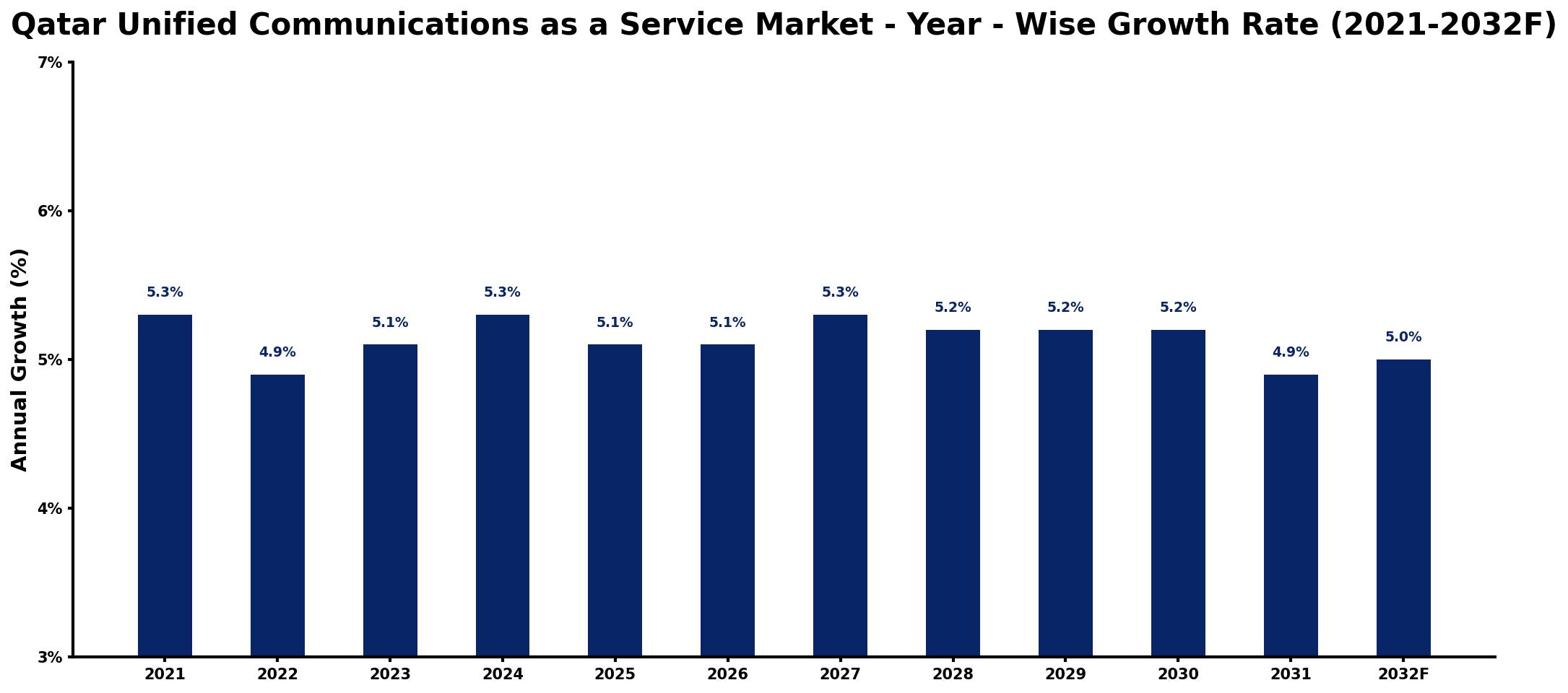
The table below presents the year‑wise growth rates along with the key drivers influencing the market
| Year | Growth Rate | Major Drivers |
| 2021 | 5.3% | Rising remote work adoption rates |
| 2022 | 4.9% | Increased investment in technology |
| 2023 | 5.1% | Growing demand for collaboration tools |
| 2024 | 5.3% | Expansion of digital transformation initiatives |
| 2025 | 5.1% | Higher reliance on cloud solutions |
| 2026 | 5.1% | Emerging startups fostering innovation |
| 2027 | 5.3% | Widespread integration of AI technologies |
| 2028 | 5.2% | Strengthening cybersecurity measures enhancing trust |
| 2029 | 5.2% | Demand for seamless user experiences |
| 2030 | 5.2% | Focus on cost-effective operational models |
| 2031 | 4.9% | Adoption of hybrid work environments |
| 2032 | 5.0% | Ongoing evolution of workplace strategies |
Note: Market size estimations and growth projections presented in this report are based on 6Wresearch's proprietary forecasting methodology, utilizing the latest available industry data, government publications, and primary research inputs.
Qatar Unified Communications as a Service Market Synopsis
The strongest force currently shaping the Qatar Unified Communications as a Service Market is the widespread adoption of cloud technologies. As companies strive to enhance efficiency and collaboration, UCaaS platforms provide the flexibility and integration necessary to facilitate seamless communication across various channels.
Additionally, businesses are increasingly recognizing the importance of cost-effective solutions that ensure operational agility. The shift from traditional systems to a more unified communication approach is not merely a trend but a strategic move to streamline workflows and enhance productivity across all sectors in Qatar.
Qatar Unified Communications as a Service Market Key Takeaways
- The market is driven by the increasing demand for integrated and scalable communication solutions.
- Organizations are moving away from traditional systems towards cloud-based UCaaS platforms.
- Enhanced productivity and operational efficiency are primary motivators for adoption.
- Data security and privacy concerns are significant factors influencing market dynamics.
- Integration challenges with legacy systems are key obstacles for businesses transitioning to UCaaS.
Evaluation of Restraints in Qatar Unified Communications as a Service Market
While the Qatar Unified Communications as a Service Market is poised for growth, several restraints are impeding its progress. One major issue is the integration complexity faced by organizations that have heavily invested in traditional communication infrastructure. Transitioning to UCaaS requires not only a seamless integration process but also a significant amount of training and change management to ensure that employees can utilize the new systems effectively. Furthermore, concerns regarding data security and privacy—especially in sectors dealing with sensitive information—continue to pose challenges for widespread adoption. Organizations must navigate these issues carefully to avoid disruptions and maintain operational integrity.
Qatar Unified Communications as a Service Market Trends
The market is experiencing several notable trends that are shaping both demand and technology. There is a marked increase in the customization of UCaaS solutions to meet specific industry needs, which enhances usability and integration with existing business applications. Moreover, the surge in remote work has accelerated the need for reliable and versatile communication tools, pushing organizations to adopt UCaaS more swiftly. As businesses increasingly prioritize collaboration tools that facilitate both voice and video communication, we can expect a more significant shift towards integrated platforms that offer a comprehensive suite of services.
Qatar Unified Communications as a Service Market Opportunities
The Qatar Unified Communications as a Service Market presents various growth opportunities that savvy investors and businesses can exploit. With the ongoing digital transformation in various sectors, there is a substantial demand for innovative communication solutions that enhance collaboration and operational efficiency. Moreover, as organizations increasingly prioritize customization in their communication solutions, providers that can offer tailored UCaaS products are well-positioned to capture market share. Additionally, the emphasis on data security and compliance offers avenues for solutions that address these concerns, paving the way for further investment in the sector.
Government Initiatives in the Qatar Unified Communications as a Service Market
The Qatari government has been proactive in supporting initiatives that foster digital transformation and innovation in the telecommunications sector. Various public spending programs and incentives are aimed at enhancing the countrys technological infrastructure, thereby facilitating the growth of services such as UCaaS. Efforts to promote smart city projects and improve overall digital communication capabilities indicate a commitment to advancing the nations communication landscape, ultimately encouraging businesses to adopt unified communications technologies.
Future Insights of the Qatar Unified Communications as a Service Market
Looking ahead to 2026-2032, the Qatar Unified Communications as a Service Market is expected to continue its upward trajectory, largely driven by technological advancements and the growing need for flexible communication solutions. Organizations are likely to focus on integrating artificial intelligence and machine learning into UCaaS platforms, enhancing functionalities such as automated customer interactions and data analytics. The emphasis on collaboration and efficiency will encourage companies to invest further in UCaaS, solidifying its position as a critical component of business operations in the region.
Qatar Unified Communications as a Service Market Latest Developments (2025 - 2026)
In the recent months, the Qatar Unified Communications as a Service Market has seen notable developments as businesses increasingly turn to integrated communication solutions. Companies are launching new features and capabilities within their platforms to improve user experience and functionality. Additionally, partnerships are being formed to enhance product offerings, focusing on seamless integration and enhanced data security measures, as organizations aim to address the evolving challenges of communication in a rapidly changing business environment.
Qatar Unified Communications as a Service Market - Key Attractiveness of the Report
- 10 Years of Market Numbers
- Historical Data Starting from 2022 to 2025
- Base Year: 2025
- Forecast Data until 2032
- Key Performance Indicators Impacting the Market
- Major Upcoming Developments and Projects
Key Highlights of the Report:
- Qatar Unified Communications as a Service Market Outlook
- Market Size of Qatar Unified Communications as a Service Market, 2025
- Forecast of Qatar Unified Communications as a Service Market, 2032
- Historical Data and Forecast of Qatar Unified Communications as a Service Revenues & Volume for the Period 2022-2032F
- Qatar Unified Communications as a Service Market Trend Evolution
- Qatar Unified Communications as a Service Market Drivers and Challenges
- Qatar Unified Communications as a Service Price Trends
- Qatar Unified Communications as a Service Porter's Five Forces
- Qatar Unified Communications as a Service Industry Life Cycle
- Historical Data and Forecast of Qatar Unified Communications as a Service Market Revenues & Volume By Component for the Period 2022-2032F
- Historical Data and Forecast of Qatar Unified Communications as a Service Market Revenues & Volume By Telephony for the Period 2022-2032F
- Historical Data and Forecast of Qatar Unified Communications as a Service Market Revenues & Volume By Unified Messaging for the Period 2022-2032F
- Historical Data and Forecast of Qatar Unified Communications as a Service Market Revenues & Volume By Conferencing for the Period 2022-2032F
- Historical Data and Forecast of Qatar Unified Communications as a Service Market Revenues & Volume By Collaboration Platforms And Applications for the Period 2022-2032F
- Historical Data and Forecast of Qatar Unified Communications as a Service Market Revenues & Volume By Organization Size for the Period 2022-2032F
- Historical Data and Forecast of Qatar Unified Communications as a Service Market Revenues & Volume By SMEs for the Period 2022-2032F
- Historical Data and Forecast of Qatar Unified Communications as a Service Market Revenues & Volume By Large Enterprises for the Period 2022-2032F
- Historical Data and Forecast of Qatar Unified Communications as a Service Market Revenues & Volume By Vertical for the Period 2022-2032F
- Historical Data and Forecast of Qatar Unified Communications as a Service Market Revenues & Volume By BFSI for the Period 2022-2032F
- Historical Data and Forecast of Qatar Unified Communications as a Service Market Revenues & Volume By Telecom and IT for the Period 2022-2032F
- Historical Data and Forecast of Qatar Unified Communications as a Service Market Revenues & Volume By Consumer Goods and Retail for the Period 2022-2032F
- Historical Data and Forecast of Qatar Unified Communications as a Service Market Revenues & Volume By Healthcare for the Period 2022-2032F
- Historical Data and Forecast of Qatar Unified Communications as a Service Market Revenues & Volume By Public Sector and Utilities for the Period 2022-2032F
- Historical Data and Forecast of Qatar Unified Communications as a Service Market Revenues & Volume By Logistics and Transportation for the Period 2022-2032F
- Historical Data and Forecast of Qatar Unified Communications as a Service Market Revenues & Volume By Travel and Hospitality for the Period 2022-2032F
- Historical Data and Forecast of Qatar Unified Communications as a Service Market Revenues & Volume By Others (Education, Media and Entertainment, and Manufacturing) for the Period 2022-2032F
- Qatar Unified Communications as a Service Import Export Trade Statistics
- Market Opportunity Assessment By Component
- Market Opportunity Assessment By Organization Size
- Market Opportunity Assessment By Vertical
- Qatar Unified Communications as a Service Top Companies Market Share
- Qatar Unified Communications as a Service Competitive Benchmarking By Technical and Operational Parameters
- Qatar Unified Communications as a Service Company Profiles
- Qatar Unified Communications as a Service Key Strategic Recommendations






































