United Kingdom (UK) Unified Communications as a Service Market Size, Share & Growth Rate
The United Kingdom (UK) Unified Communications as a Service Market was estimated at USD 338 Million in 2025 and is projected to reach USD 419 Million by 2032, growing at a CAGR of 3.1% from 2026 to 2032. This growth trajectory is primarily fueled by the ongoing digital transformation across various sectors, enhancing workplace productivity and enabling seamless remote collaboration. The shift towards cloud-based solutions and the increasing demand for cost-effective communication tools further solidify this market's promising outlook.
United Kingdom (UK) Unified Communications as a Service Market Year-wise Growth Rate and Key Drivers
This graph highlights how the United Kingdom (UK) Unified Communications as a Service Market has steadily grown over the years, supported by major growth factors.
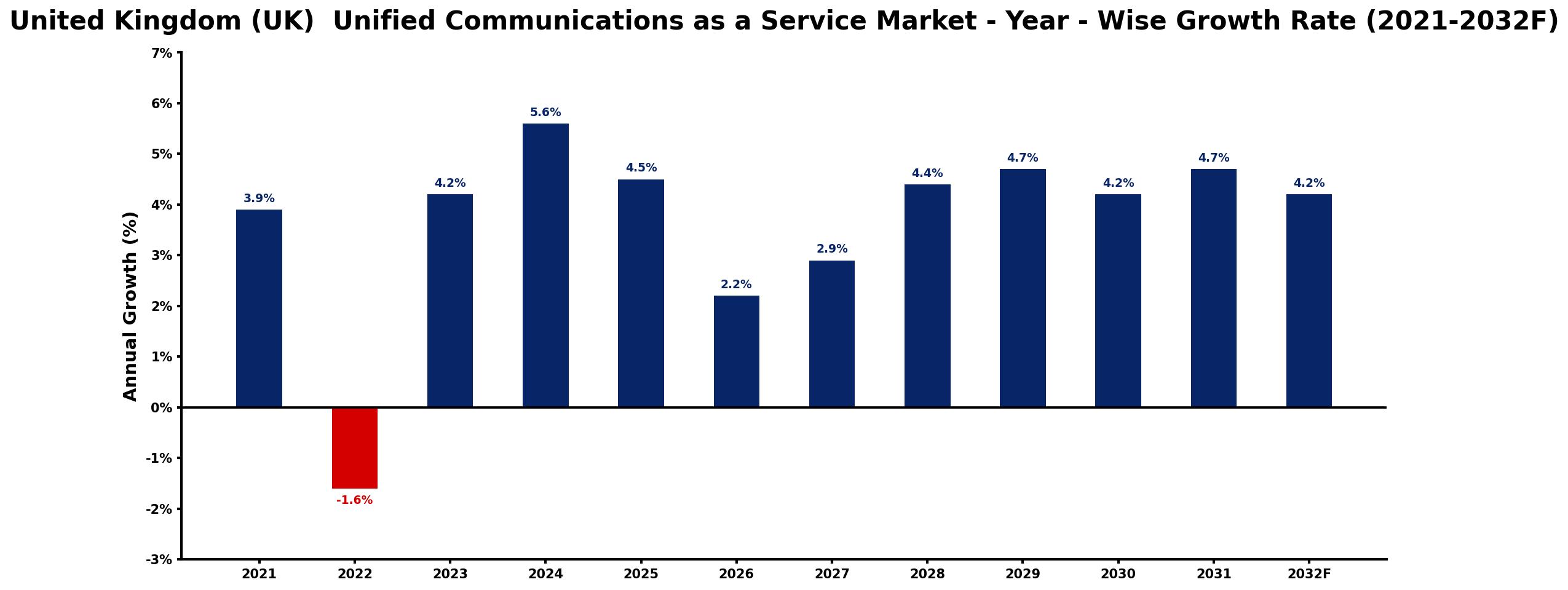
The table below presents the year‑wise growth rates along with the key drivers influencing the market
| Year | Growth Rate | Major Drivers |
| 2021 | 3.9% | Increased remote work adoption rates |
| 2022 | -1.6% | Reduced investment in technology |
| 2023 | 4.2% | Higher demand for collaboration tools |
| 2024 | 5.6% | Expansion of broadband infrastructure projects |
| 2025 | 4.5% | Growth in small business adoption |
| 2026 | 2.2% | Rising interest in digital transformation |
| 2027 | 2.9% | Increased focus on employee engagement |
| 2028 | 4.4% | Integration of AI in applications |
| 2029 | 4.7% | Surge in mobile workforce solutions |
| 2030 | 4.2% | Growing emphasis on cybersecurity measures |
| 2031 | 4.7% | Increased demand for analytics tools |
| 2032 | 4.2% | expanding healthcare application demand |
Note: Market size estimations and growth projections presented in this report are based on 6Wresearch's proprietary forecasting methodology, utilizing the latest available industry data, government publications, and primary research inputs.
United Kingdom (UK) Unified Communications as a Service Market Synopsis
At the heart of the UK Unified Communications as a Service market is the integration of diverse communication channels into a single, coherent platform. This integration is pivotal for businesses striving for enhanced operational efficiency and streamlined communication among dispersed teams.
As remote work continues to reshape the corporate landscape, UCaaS solutions offer organizations the flexibility and scalability required to adapt swiftly to changing demands. This growing trend significantly influences organizations to invest in unified communication technologies to remain competitive.
United Kingdom (UK) Unified Communications as a Service Market Key Takeaways
- The UK UCaaS market is on a robust growth path, with a forecasted CAGR of 3.1% from 2026 to 2032.
- Digital transformation initiatives are the main catalysts driving market expansion.
- Cloud-based deployments are favored for their scalability, flexibility, and cost-effectiveness.
- AI-driven integrations and real-time analytics are shaping the future of communication solutions.
- Regulatory frameworks ensure compliance with data security standards, impacting service provider strategies.
Evaluation of Restraints in United Kingdom (UK) Unified Communications as a Service Market
Despite the positive growth outlook, several restraints impede the UK UCaaS market's full potential. Organizations often face challenges when integrating UCaaS solutions with their existing systems, raising concerns about compatibility and functionality. Security and privacy issues surrounding data handling also remain significant, especially in industries with stringent compliance requirements. Additionally, the costs associated with the adoption and implementation of new technologies, along with the need for comprehensive employee training, can be substantial barriers for some businesses.
United Kingdom (UK) Unified Communications as a Service Market Trends
Current trends indicate a shift towards hybrid deployment models, allowing organizations to combine on-premises infrastructure with cloud solutions for enhanced flexibility. Furthermore, the integration of artificial intelligence into UCaaS platforms is revolutionizing user experiences, facilitating intelligent routing and predictive analytics. As remote work continues to be a fixture in many organizations, demand for mobile-first communication tools is also on the rise, reshaping how employees collaborate.
United Kingdom (UK) Unified Communications as a Service Market Opportunities
Significant opportunities lie in enhancing the customer experience through integrated communication solutions that foster greater engagement. As businesses increasingly recognize the value of personalized communication, solutions offering real-time analytics and user-driven features are in high demand. Additionally, investments in energy-efficient data centers and sustainable communication practices are becoming attractive to organizations focused on corporate social responsibility.
Government Initiatives in the United Kingdom (UK) Unified Communications as a Service Market
The UK government plays a crucial role in fostering a conducive environment for the UCaaS market through various initiatives aimed at enhancing digital infrastructure. Policies are focused on promoting workplace collaboration and ensuring compliance with telecommunications regulations. Investments in robust cybersecurity measures and sustainable practices are also prioritized, bolstering the overall market ecosystem for cloud-based communication solutions.
Future Insights of the United Kingdom (UK) Unified Communications as a Service Market
Looking ahead to 2026-2032, the UK UCaaS market is set to undergo significant transformations driven by evolving business needs and technological advancements. Increased focus on hybrid work models and the demand for seamless communication tools will likely push organizations towards more integrated and user-friendly solutions. Moreover, continuous innovations in AI and real-time analytics will redefine user experiences, paving the way for increased adoption of UCaaS technologies across various sectors.
United Kingdom (UK) Unified Communications as a Service Market Latest Developments (2025 - 2026)
Recent developments in the UK UCaaS market indicate a heightened emphasis on security features and compliance capabilities to address growing concerns around data privacy. Innovations in AI are beginning to permeate service offerings, enhancing functionality and user engagement. Additionally, partnerships between technology providers and businesses are fostering collaborative developments aimed at creating tailored solutions that cater to the unique needs of various industries.
United Kingdom (UK) Unified Communications as a Service Market - Key Attractiveness of the Report
- 10 Years of Market Numbers
- Historical Data Starting from 2022 to 2025
- Base Year: 2025
- Forecast Data until 2032
- Key Performance Indicators Impacting the Market
- Major Upcoming Developments and Projects
Key Highlights of the Report:
- United Kingdom (UK) Unified Communications as a Service Market Outlook
- Market Size of United Kingdom (UK) Unified Communications as a Service Market, 2025
- Forecast of United Kingdom (UK) Unified Communications as a Service Market, 2032
- Historical Data and Forecast of United Kingdom (UK) Unified Communications as a Service Revenues & Volume for the Period 2022-2032F
- United Kingdom (UK) Unified Communications as a Service Market Trend Evolution
- United Kingdom (UK) Unified Communications as a Service Market Drivers and Challenges
- United Kingdom (UK) Unified Communications as a Service Price Trends
- United Kingdom (UK) Unified Communications as a Service Porter's Five Forces
- United Kingdom (UK) Unified Communications as a Service Industry Life Cycle
- Historical Data and Forecast of United Kingdom (UK) Unified Communications as a Service Market Revenues & Volume By Component for the Period 2022-2032F
- Historical Data and Forecast of United Kingdom (UK) Unified Communications as a Service Market Revenues & Volume By Telephony for the Period 2022-2032F
- Historical Data and Forecast of United Kingdom (UK) Unified Communications as a Service Market Revenues & Volume By Unified Messaging for the Period 2022-2032F
- Historical Data and Forecast of United Kingdom (UK) Unified Communications as a Service Market Revenues & Volume By Conferencing for the Period 2022-2032F
- Historical Data and Forecast of United Kingdom (UK) Unified Communications as a Service Market Revenues & Volume By Collaboration Platforms And Applications for the Period 2022-2032F
- Historical Data and Forecast of United Kingdom (UK) Unified Communications as a Service Market Revenues & Volume By Organization Size for the Period 2022-2032F
- Historical Data and Forecast of United Kingdom (UK) Unified Communications as a Service Market Revenues & Volume By SMEs for the Period 2022-2032F
- Historical Data and Forecast of United Kingdom (UK) Unified Communications as a Service Market Revenues & Volume By Large Enterprises for the Period 2022-2032F
- Historical Data and Forecast of United Kingdom (UK) Unified Communications as a Service Market Revenues & Volume By Vertical for the Period 2022-2032F
- Historical Data and Forecast of United Kingdom (UK) Unified Communications as a Service Market Revenues & Volume By BFSI for the Period 2022-2032F
- Historical Data and Forecast of United Kingdom (UK) Unified Communications as a Service Market Revenues & Volume By Telecom and IT for the Period 2022-2032F
- Historical Data and Forecast of United Kingdom (UK) Unified Communications as a Service Market Revenues & Volume By Consumer Goods and Retail for the Period 2022-2032F
- Historical Data and Forecast of United Kingdom (UK) Unified Communications as a Service Market Revenues & Volume By Healthcare for the Period 2022-2032F
- Historical Data and Forecast of United Kingdom (UK) Unified Communications as a Service Market Revenues & Volume By Public Sector and Utilities for the Period 2022-2032F
- Historical Data and Forecast of United Kingdom (UK) Unified Communications as a Service Market Revenues & Volume By Logistics and Transportation for the Period 2022-2032F
- Historical Data and Forecast of United Kingdom (UK) Unified Communications as a Service Market Revenues & Volume By Travel and Hospitality for the Period 2022-2032F
- Historical Data and Forecast of United Kingdom (UK) Unified Communications as a Service Market Revenues & Volume By Others (Education, Media and Entertainment, and Manufacturing) for the Period 2022-2032F
- United Kingdom (UK) Unified Communications as a Service Import Export Trade Statistics
- Market Opportunity Assessment By Component
- Market Opportunity Assessment By Organization Size
- Market Opportunity Assessment By Vertical
- United Kingdom (UK) Unified Communications as a Service Top Companies Market Share
- United Kingdom (UK) Unified Communications as a Service Competitive Benchmarking By Technical and Operational Parameters
- United Kingdom (UK) Unified Communications as a Service Company Profiles
- United Kingdom (UK) Unified Communications as a Service Key Strategic Recommendations






































