Brazil Unified Communications as a Service Market Size, Share & Growth Rate
The Brazil Unified Communications as a Service Market was estimated at USD 152 Million in 2025 and is projected to reach USD 180 Million by 2032, growing at a CAGR of 2.4% from 2026 to 2032. This growth is propelled by a rising preference for cloud-based communication solutions, as organizations increasingly seek flexible and scalable methods of interaction. Additionally, the integration of diverse communication channels, including video, voice, and messaging, is becoming essential for organizations aiming to enhance collaboration and productivity.
Brazil Unified Communications as a Service Market Year-wise Growth Rate and Key Drivers
This graph highlights how the Brazil Unified Communications as a Service Market has steadily grown over the years, supported by major growth factors.
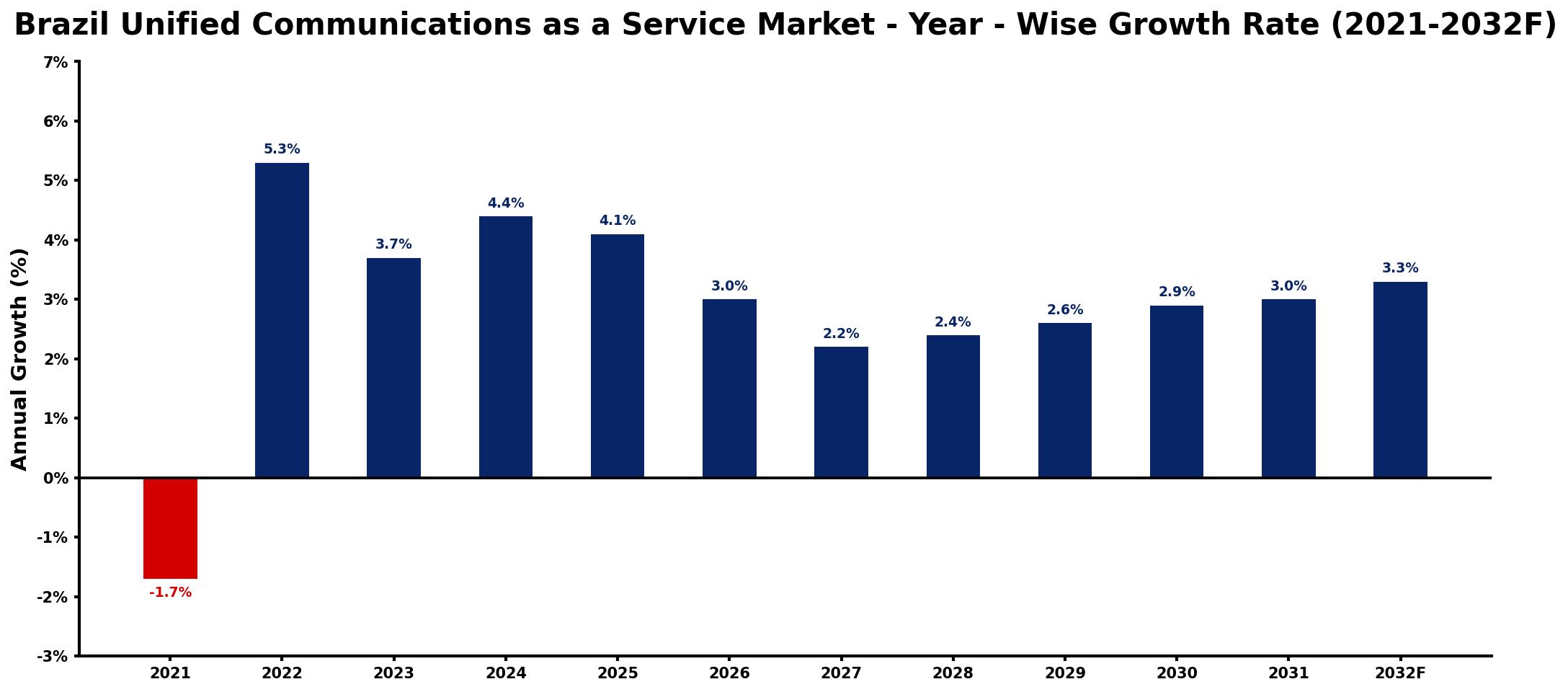
The table below presents the year‑wise growth rates along with the key drivers influencing the market
| Year | Growth Rate | Major Drivers |
| 2021 | -1.7% | lower industrial activity overall |
| 2022 | 5.3% | rise in remote workforce solutions |
| 2023 | 3.7% | increased investment in cloud technologies |
| 2024 | 4.4% | growth in mobile application usage |
| 2025 | 4.1% | expansion of collaborative software tools |
| 2026 | 3.0% | enhanced focus on cybersecurity measures |
| 2027 | 2.2% | adoption of hybrid work models |
| 2028 | 2.4% | growing demand for video conferencing |
| 2029 | 2.6% | integration of AI in workflows |
| 2030 | 2.9% | development of 5G infrastructure capabilities |
| 2031 | 3.0% | emphasis on digital transformation initiatives |
| 2032 | 3.3% | innovation in user experience design |
Note: Market size estimations and growth projections presented in this report are based on 6Wresearch's proprietary forecasting methodology, utilizing the latest available industry data, government publications, and primary research inputs.
Brazil Unified Communications as a Service Market Synopsis
The most powerful driver reshaping the Brazil Unified Communications as a Service market today is the accelerated shift towards cloud-based platforms. Companies are not just looking for communication tools; they desire integrated solutions that allow seamless collaboration across multiple channels, significantly enhancing operational efficiency.
Furthermore, the increasing demand for remote and hybrid work arrangements is pushing organizations to adopt UCaaS solutions. By offering greater flexibility and scalability, these services are becoming vital for businesses that wish to remain competitive in an evolving digital landscape.
Brazil Unified Communications as a Service Market Key Takeaways
- Growing adoption of cloud-based solutions is a major growth driver for the UCaaS market in Brazil.
- Seamless integration of various communication channels enhances collaborative capabilities for businesses.
- Data security and service reliability remain key concerns that must be addressed for wider adoption.
- Government policies related to communication services directly influence market dynamics.
- Strategic partnerships and continuous innovation are crucial for overcoming market challenges.
Evaluation of Restraints in Brazil Unified Communications as a Service Market
Despite the positive growth trajectory, the Brazil UCaaS market faces significant hurdles that could impede its expansion. Data security concerns are at the forefront, as businesses remain wary of potential breaches in sensitive communications. Additionally, the challenge of integrating these cloud solutions with existing legacy systems creates friction in adoption rates. Furthermore, many organizations require education on the benefits and capabilities of UCaaS to fully embrace its potential, which adds another layer to the market's complexity.
Brazil Unified Communications as a Service Market Trends
Key trends influencing the Brazil UCaaS market include a growing reliance on mobile communication, as employees demand access to collaboration tools from any device. Moreover, AI-driven features are gaining traction, providing businesses with enhanced analytics and improved user experience. The focus on user-friendly interfaces and customizable solutions is also on the rise, empowering organizations to tailor their communication strategies to specific needs.
Brazil Unified Communications as a Service Market Opportunities
As the demand for UCaaS continues to rise, significant growth opportunities lie within small to medium enterprises (SMEs) that are yet to adopt these solutions. Investing in educational initiatives to inform businesses about the benefits of UCaaS can expand market penetration. Furthermore, leveraging advanced technologies like AI and machine learning to enhance service offerings presents a unique opportunity for providers aiming to differentiate themselves in a competitive landscape.
Government Initiatives in the Brazil Unified Communications as a Service Market
Government policies play an influential role in shaping the Brazil UCaaS market, particularly concerning data storage and cybersecurity standards. Compliance with regulations is essential for service providers to gain trust and offer secure communication solutions. Additionally, public spending on technology infrastructure can bolster the growth of the UCaaS sector by facilitating broader access to reliable internet services.
Future Insights of the Brazil Unified Communications as a Service Market
Looking ahead to 2026-2032, the Brazil UCaaS market is expected to evolve with heightened focus on security and data protection as businesses seek assurance amidst growing cybersecurity threats. The integration of emerging technologies will likely transform the functionality of UCaaS solutions, making them more intuitive and adaptive to user needs. Moreover, as regulatory landscapes evolve, UCaaS providers must remain agile to meet compliance requirements while delivering enhanced communication capabilities.
Brazil Unified Communications as a Service Market Latest Developments (2025 - 2026)
The industry is witnessing a trend towards more robust partnerships between technology providers and enterprises. Innovative pilot programs are being initiated to test new features and enhance user engagement. As businesses continue to prioritize remote work, there is an increased focus on developing applications that support hybrid work models effectively. Additionally, awareness campaigns are being launched to educate businesses on the benefits of transitioning to UCaaS solutions.
Brazil Unified Communications as a Service Market - Key Attractiveness of the Report
- 10 Years of Market Numbers
- Historical Data Starting from 2022 to 2025
- Base Year: 2025
- Forecast Data until 2032
- Key Performance Indicators Impacting the Market
- Major Upcoming Developments and Projects
Key Highlights of the Report:
- Brazil Unified Communications as a Service Market Outlook
- Market Size of Brazil Unified Communications as a Service Market, 2025
- Forecast of Brazil Unified Communications as a Service Market, 2032
- Historical Data and Forecast of Brazil Unified Communications as a Service Revenues & Volume for the Period 2022-2032F
- Brazil Unified Communications as a Service Market Trend Evolution
- Brazil Unified Communications as a Service Market Drivers and Challenges
- Brazil Unified Communications as a Service Price Trends
- Brazil Unified Communications as a Service Porter's Five Forces
- Brazil Unified Communications as a Service Industry Life Cycle
- Historical Data and Forecast of Brazil Unified Communications as a Service Market Revenues & Volume By Component for the Period 2022-2032F
- Historical Data and Forecast of Brazil Unified Communications as a Service Market Revenues & Volume By Telephony for the Period 2022-2032F
- Historical Data and Forecast of Brazil Unified Communications as a Service Market Revenues & Volume By Unified Messaging for the Period 2022-2032F
- Historical Data and Forecast of Brazil Unified Communications as a Service Market Revenues & Volume By Conferencing for the Period 2022-2032F
- Historical Data and Forecast of Brazil Unified Communications as a Service Market Revenues & Volume By Collaboration Platforms And Applications for the Period 2022-2032F
- Historical Data and Forecast of Brazil Unified Communications as a Service Market Revenues & Volume By Organization Size for the Period 2022-2032F
- Historical Data and Forecast of Brazil Unified Communications as a Service Market Revenues & Volume By SMEs for the Period 2022-2032F
- Historical Data and Forecast of Brazil Unified Communications as a Service Market Revenues & Volume By Large Enterprises for the Period 2022-2032F
- Historical Data and Forecast of Brazil Unified Communications as a Service Market Revenues & Volume By Vertical for the Period 2022-2032F
- Historical Data and Forecast of Brazil Unified Communications as a Service Market Revenues & Volume By BFSI for the Period 2022-2032F
- Historical Data and Forecast of Brazil Unified Communications as a Service Market Revenues & Volume By Telecom and IT for the Period 2022-2032F
- Historical Data and Forecast of Brazil Unified Communications as a Service Market Revenues & Volume By Consumer Goods and Retail for the Period 2022-2032F
- Historical Data and Forecast of Brazil Unified Communications as a Service Market Revenues & Volume By Healthcare for the Period 2022-2032F
- Historical Data and Forecast of Brazil Unified Communications as a Service Market Revenues & Volume By Public Sector and Utilities for the Period 2022-2032F
- Historical Data and Forecast of Brazil Unified Communications as a Service Market Revenues & Volume By Logistics and Transportation for the Period 2022-2032F
- Historical Data and Forecast of Brazil Unified Communications as a Service Market Revenues & Volume By Travel and Hospitality for the Period 2022-2032F
- Historical Data and Forecast of Brazil Unified Communications as a Service Market Revenues & Volume By Others (Education, Media and Entertainment, and Manufacturing) for the Period 2022-2032F
- Brazil Unified Communications as a Service Import Export Trade Statistics
- Market Opportunity Assessment By Component
- Market Opportunity Assessment By Organization Size
- Market Opportunity Assessment By Vertical
- Brazil Unified Communications as a Service Top Companies Market Share
- Brazil Unified Communications as a Service Competitive Benchmarking By Technical and Operational Parameters
- Brazil Unified Communications as a Service Company Profiles
- Brazil Unified Communications as a Service Key Strategic Recommendations






































