Mexico Unified Communications as a Service Market Size, Share & Growth Rate
The Mexico Unified Communications as a Service Market was estimated at USD 108 Million in 2025 and is projected to reach USD 125 Million by 2032, growing at a CAGR of 2.1% from 2026 to 2032. This growth trajectory is fueled by businesses increasingly seeking integrated communication solutions to enhance collaboration and productivity amid a shifting landscape towards remote work. Additionally, digital transformation initiatives across various sectors are solidifying the demand for robust and adaptable cloud-based communication platforms.
Mexico Unified Communications as a Service Market Year-wise Growth Rate and Key Drivers
This graph highlights how the Mexico Unified Communications as a Service Market has steadily grown over the years, supported by major growth factors.
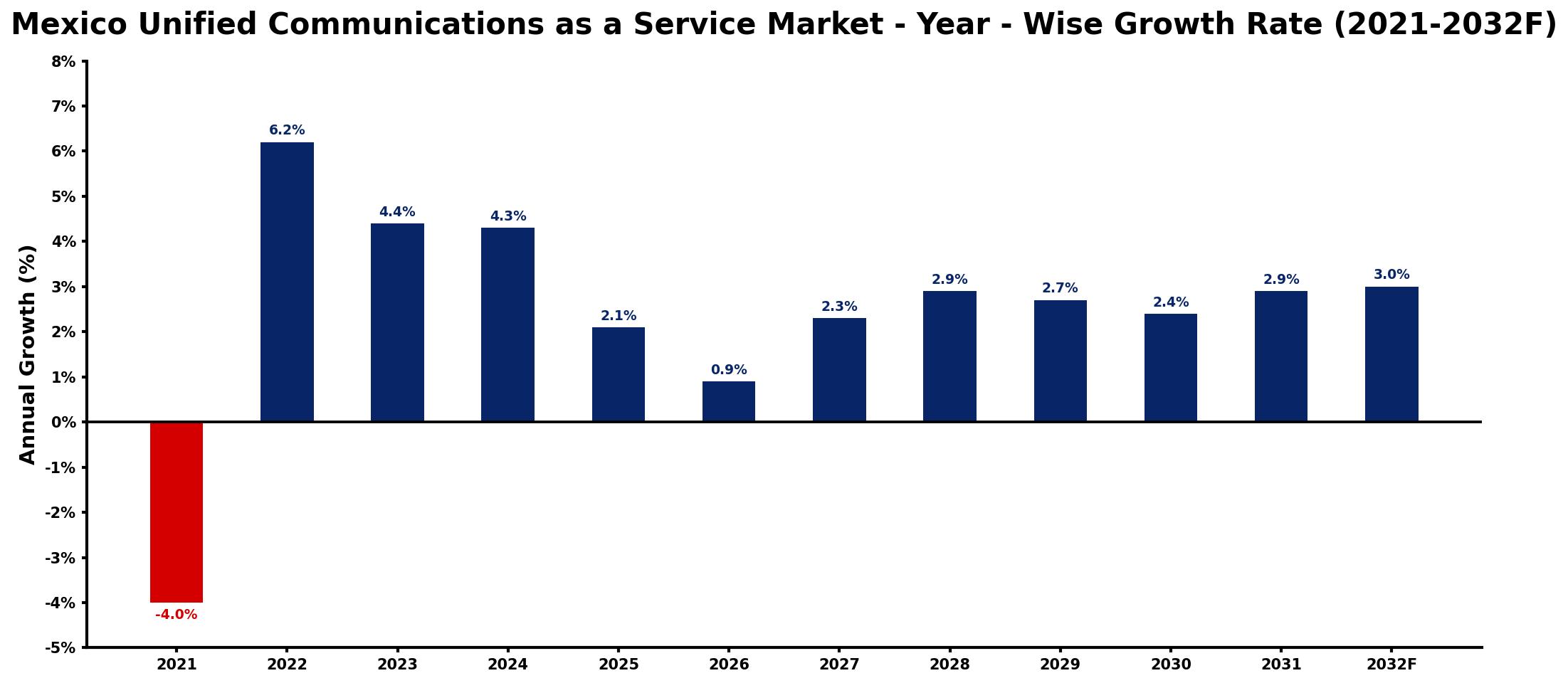
The table below presents the year‑wise growth rates along with the key drivers influencing the market
| Year | Growth Rate | Major Drivers |
| 2021 | -4.0% | decreased corporate technology investments |
| 2022 | 6.2% | growing remote work adoption |
| 2023 | 4.4% | increased digital transformation initiatives |
| 2024 | 4.3% | expansion of cloud infrastructure |
| 2025 | 2.1% | rising demand for collaboration tools |
| 2026 | 0.9% | enhanced focus on cybersecurity solutions |
| 2027 | 2.3% | growing mobile workforce requirements |
| 2028 | 2.9% | increased integration of AI technologies |
| 2029 | 2.7% | higher investments in digital platforms |
| 2030 | 2.4% | increased capital investment inflows |
| 2031 | 2.9% | growing need for real-time collaboration |
| 2032 | 3.0% | increased focus on customer engagement |
Note: Market size estimations and growth projections presented in this report are based on 6Wresearch's proprietary forecasting methodology, utilizing the latest available industry data, government publications, and primary research inputs.
Mexico Unified Communications as a Service Market Synopsis
Recently, the Mexico Unified Communications as a Service (UCaaS) market has seen significant momentum, driven by the rapid digitalization and the transition to remote working models. However, as businesses continue to evolve, the focus is shifting towards comprehensive solutions that foster collaboration across diverse teams and locations, indicating a promising future for the sector.
The market's landscape is characterized by an increasing integration of communication tools into unified platforms that offer seamless access regardless of location or device. This shift not only enhances productivity but also provides organizations with the agility needed to adapt to changing market demands and technological advancements.
Mexico Unified Communications as a Service Market Key Takeaways
- The market is poised for steady growth, emphasizing the shift towards remote work and digital collaboration.
- Cloud-based solutions offer scalability and cost-effectiveness, addressing diverse business communication needs.
- Companies are increasingly prioritizing security and infrastructure upgrades to facilitate smoother UCaaS integration.
- Government support for digital infrastructure plays a crucial role in accelerating market adoption.
- Ongoing technological advancements are driving innovation in communication tools and platforms.
Evaluation of Restraints in Mexico Unified Communications as a Service Market
While the Mexico UCaaS market is on an upward trajectory, several restraints continue to impede its growth. A primary concern is the existing network infrastructure, which may not support the robust demands of cloud-based services. Security concerns remain prevalent as organizations navigate the complexities of data protection in a cloud environment. Furthermore, integration challenges with legacy systems can hinder seamless transitions to unified communications platforms, leaving some businesses hesitant to fully commit to UCaaS solutions.
Mexico Unified Communications as a Service Market Trends
Current trends indicate a growing emphasis on artificial intelligence and automation within UCaaS platforms, enhancing user experience and operational efficiency. The rise of hybrid work models is pushing companies to adopt more flexible communication solutions that integrate various tools. Additionally, video conferencing is becoming an increasingly vital component as organizations focus on maintaining engagement and collaboration among distributed teams.
Mexico Unified Communications as a Service Market Opportunities
Investment opportunities abound as businesses recognize the value of enhanced communication capabilities. Companies that offer tailored solutions catering to specific industry needs stand to benefit significantly. Furthermore, the integration of analytics and reporting tools into UCaaS platforms presents a major opportunity for firms to leverage data for improved decision-making and strategy development.
Government Initiatives in the Mexico Unified Communications as a Service Market
The Mexican government is actively promoting digital transformation policies aimed at boosting the information and communication technology (ICT) sector. Initiatives encouraging the development of digital infrastructure and remote work solutions foster a conducive environment for UCaaS market growth. Public spending on technology advancement and digital literacy programs further underscores the government's commitment to enhancing the country's communication capabilities.
Future Insights of the Mexico Unified Communications as a Service Market
Looking ahead to 2026-2032, the Mexico UCaaS market is expected to experience continued growth as businesses adapt to an increasingly digital landscape. The demand for flexible, scalable, and integrated communication solutions will drive further innovation and investment in the sector. With ongoing governmental support and an accelerating pace of digital transformation, organizations that prioritize UCaaS will be well-positioned to thrive in this evolving market.
Mexico Unified Communications as a Service Market Latest Developments (2025 - 2026)
Recent developments in the Mexico UCaaS market indicate a strong shift towards enhancing user experience through advanced technology integrations. Companies are focusing on developing more intuitive interfaces and incorporating artificial intelligence to streamline workflows. Additionally, new partnerships and collaborations are emerging to provide comprehensive solutions that address the specific needs of varied industries, further propelling market growth.
Mexico Unified Communications as a Service Market - Key Attractiveness of the Report
- 10 Years of Market Numbers
- Historical Data Starting from 2022 to 2025
- Base Year: 2025
- Forecast Data until 2032
- Key Performance Indicators Impacting the Market
- Major Upcoming Developments and Projects
Key Highlights of the Report:
- Mexico Unified Communications as a Service Market Outlook
- Market Size of Mexico Unified Communications as a Service Market, 2025
- Forecast of Mexico Unified Communications as a Service Market, 2032
- Historical Data and Forecast of Mexico Unified Communications as a Service Revenues & Volume for the Period 2022-2032F
- Mexico Unified Communications as a Service Market Trend Evolution
- Mexico Unified Communications as a Service Market Drivers and Challenges
- Mexico Unified Communications as a Service Price Trends
- Mexico Unified Communications as a Service Porter's Five Forces
- Mexico Unified Communications as a Service Industry Life Cycle
- Historical Data and Forecast of Mexico Unified Communications as a Service Market Revenues & Volume By Component for the Period 2022-2032F
- Historical Data and Forecast of Mexico Unified Communications as a Service Market Revenues & Volume By Telephony for the Period 2022-2032F
- Historical Data and Forecast of Mexico Unified Communications as a Service Market Revenues & Volume By Unified Messaging for the Period 2022-2032F
- Historical Data and Forecast of Mexico Unified Communications as a Service Market Revenues & Volume By Conferencing for the Period 2022-2032F
- Historical Data and Forecast of Mexico Unified Communications as a Service Market Revenues & Volume By Collaboration Platforms And Applications for the Period 2022-2032F
- Historical Data and Forecast of Mexico Unified Communications as a Service Market Revenues & Volume By Organization Size for the Period 2022-2032F
- Historical Data and Forecast of Mexico Unified Communications as a Service Market Revenues & Volume By SMEs for the Period 2022-2032F
- Historical Data and Forecast of Mexico Unified Communications as a Service Market Revenues & Volume By Large Enterprises for the Period 2022-2032F
- Historical Data and Forecast of Mexico Unified Communications as a Service Market Revenues & Volume By Vertical for the Period 2022-2032F
- Historical Data and Forecast of Mexico Unified Communications as a Service Market Revenues & Volume By BFSI for the Period 2022-2032F
- Historical Data and Forecast of Mexico Unified Communications as a Service Market Revenues & Volume By Telecom and IT for the Period 2022-2032F
- Historical Data and Forecast of Mexico Unified Communications as a Service Market Revenues & Volume By Consumer Goods and Retail for the Period 2022-2032F
- Historical Data and Forecast of Mexico Unified Communications as a Service Market Revenues & Volume By Healthcare for the Period 2022-2032F
- Historical Data and Forecast of Mexico Unified Communications as a Service Market Revenues & Volume By Public Sector and Utilities for the Period 2022-2032F
- Historical Data and Forecast of Mexico Unified Communications as a Service Market Revenues & Volume By Logistics and Transportation for the Period 2022-2032F
- Historical Data and Forecast of Mexico Unified Communications as a Service Market Revenues & Volume By Travel and Hospitality for the Period 2022-2032F
- Historical Data and Forecast of Mexico Unified Communications as a Service Market Revenues & Volume By Others (Education, Media and Entertainment, and Manufacturing) for the Period 2022-2032F
- Mexico Unified Communications as a Service Import Export Trade Statistics
- Market Opportunity Assessment By Component
- Market Opportunity Assessment By Organization Size
- Market Opportunity Assessment By Vertical
- Mexico Unified Communications as a Service Top Companies Market Share
- Mexico Unified Communications as a Service Competitive Benchmarking By Technical and Operational Parameters
- Mexico Unified Communications as a Service Company Profiles
- Mexico Unified Communications as a Service Key Strategic Recommendations






































