Egypt Unified Communications as a Service Market Size, Share & Growth Rate
The Egypt Unified Communications as a Service Market was estimated at USD 428 Million in 2025 and is projected to reach USD 598 Million by 2032, growing at a CAGR of 4.9% from 2026 to 2032. This upward trajectory is primarily fueled by a rapid adoption of cloud-based solutions as organizations navigate the challenges of hybrid and remote work. Furthermore, the Egyptian government's digital transformation initiatives are acting as a catalyst, encouraging a shift towards more advanced communication technologies across various sectors.
Egypt Unified Communications as a Service Market Year-wise Growth Rate and Key Drivers
This graph highlights how the Egypt Unified Communications as a Service Market has steadily grown over the years, supported by major growth factors.
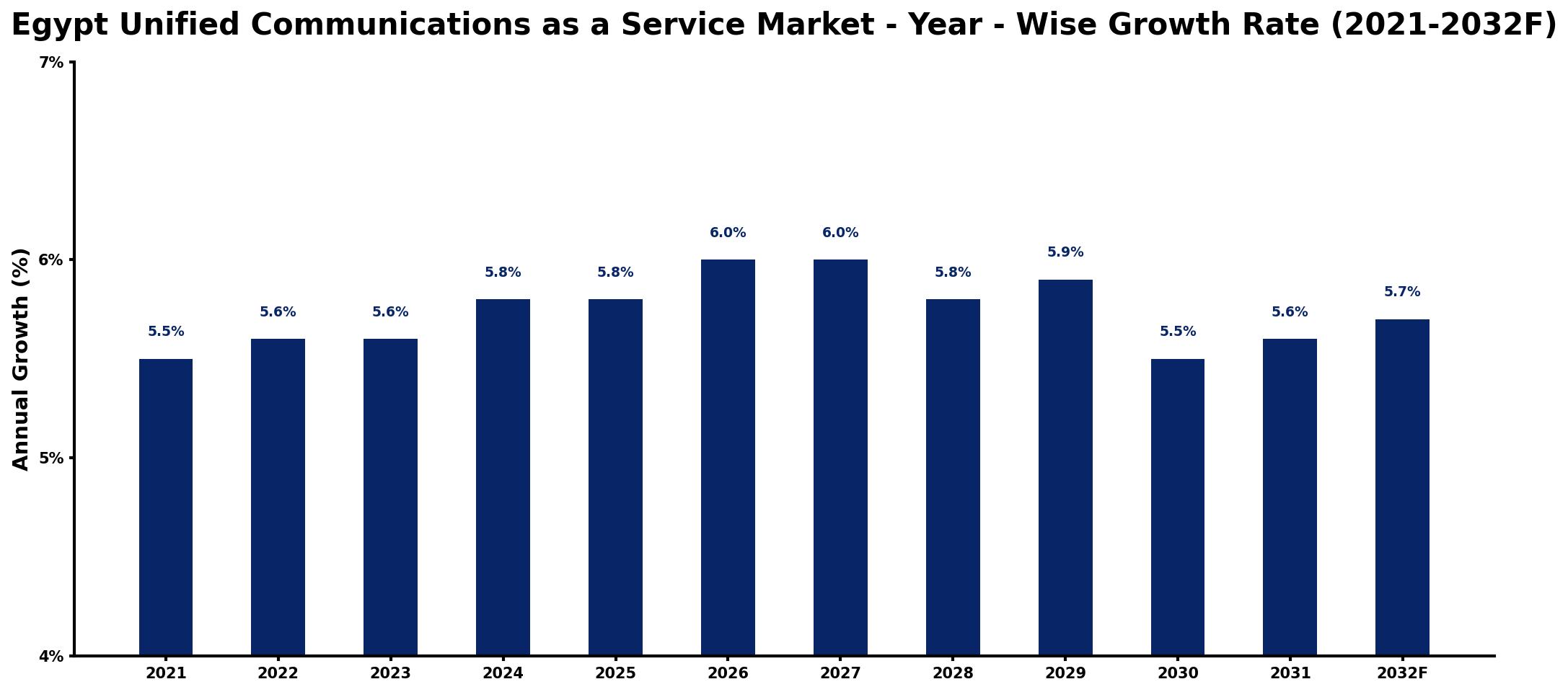
The table below presents the year‑wise growth rates along with the key drivers influencing the market
| Year | Growth Rate | Major Drivers |
| 2021 | 5.5% | Rising demand for remote collaboration |
| 2022 | 5.6% | Increased investment in digital transformation |
| 2023 | 5.6% | Growth in cloud adoption trends |
| 2024 | 5.8% | Expansion of mobile workforce solutions |
| 2025 | 5.8% | Surge in cybersecurity awareness initiatives |
| 2026 | 6.0% | Emergence of AI-driven technologies |
| 2027 | 6.0% | Advancements in broadband infrastructure |
| 2028 | 5.8% | Growing emphasis on employee engagement |
| 2029 | 5.9% | Increased focus on operational efficiency |
| 2030 | 5.5% | Development of smart city projects |
| 2031 | 5.6% | Higher consumer expectations for connectivity |
| 2032 | 5.7% | Enhanced integration with emerging technologies |
Note: Market size estimations and growth projections presented in this report are based on 6Wresearch's proprietary forecasting methodology, utilizing the latest available industry data, government publications, and primary research inputs.
Egypt Unified Communications as a Service Market Synopsis
While the Egypt Unified Communications as a Service market has gained momentum recently, largely due to the pandemic's impact on work models, it is poised for significant expansion in the coming years. The transition to hybrid work environments has necessitated the integration of voice, video, and messaging solutions into cohesive platforms, prompting a surge in demand for UCaaS.
As businesses increasingly recognize the importance of digital communication tools, sectors such as healthcare and education are leading the charge. However, for the market to realize its full potential, it must overcome challenges related to awareness and infrastructure, paving the way for a robust future.
Egypt Unified Communications as a Service Market Key Takeaways
- The market is set for considerable growth, driven by a need for integrated communication solutions.
- Government policies supporting digital transformation initiatives are accelerating market adoption.
- Challenges related to data security perceptions still hinder smaller businesses from transitioning to UCaaS.
- Healthcare and education sectors are emerging as key areas of growth for UCaaS solutions.
- Technological advancements are improving the reliability and appeal of cloud-based communication tools.
Evaluation of Restraints in Egypt Unified Communications as a Service Market
Despite the growing interest in UCaaS solutions, several key restraints continue to hinder the market's expansion. A lack of awareness about the advantages of cloud-based communication often leaves smaller businesses clinging to outdated traditional phone systems. Concerns regarding data security and the reliability of cloud infrastructure further exacerbate this reluctance. Moreover, the insufficient local infrastructure for cloud services and the significant costs associated with transitioning to UCaaS platforms pose additional barriers, particularly for companies that may not have the resources for staff training and system integration. Navigating the complex regulatory landscape concerning data privacy and cloud storage also adds a layer of difficulty for potential adopters.
Egypt Unified Communications as a Service Market Trends
A growing trend within the Egypt UCaaS market is the increased focus on cybersecurity measures, driven by heightened awareness of data protection. Businesses are prioritizing secure communication platforms that not only facilitate efficient collaboration but also safeguard sensitive information. Additionally, the integration of Artificial Intelligence (AI) in UCaaS offerings is emerging, enhancing features such as customer support through chatbots and improving overall user experience.
As more organizations embrace hybrid work models, the demand for scalable and flexible communication solutions continues to rise. This trend is further underscored by the growing emphasis on employee engagement and collaboration tools, highlighting the need for seamless integration of various communication channels.
Egypt Unified Communications as a Service Market Opportunities
The potential for growth in the Egypt UCaaS market is substantial, particularly as organizations across various sectors seek to modernize their communication infrastructures. Key opportunities lie in targeted investments in digital infrastructure, which can enhance the reliability of cloud-based services. Moreover, with the government's commitment to improving broadband connectivity, there is a ripe environment for UCaaS providers to flourish. Additionally, focusing on education and training for businesses can alleviate concerns regarding the transition to cloud-based platforms, opening avenues for wider market penetration.
Government Initiatives in the Egypt Unified Communications as a Service Market
The Egyptian government is playing a pivotal role in bolstering the UCaaS market through strategic initiatives aimed at enhancing digital infrastructure. Policies that promote broadband expansion and improve public sector communication systems are crucial components of this strategy. The governments push for digital transformation across sectors such as education and healthcare further underscores the importance of adopting cloud-based communication solutions. Regulatory frameworks focusing on cybersecurity and data privacy are also being established to foster a secure environment for businesses to transition to UCaaS.
Future Insights of the Egypt Unified Communications as a Service Market
Looking ahead to the period of 2026-2032, the Egypt UCaaS market is set to evolve significantly as organizations continue to embrace digital transformation. The ongoing emphasis on hybrid work environments will sustain demand for integrated communication solutions. Additionally, advancements in technology will likely drive more businesses to recognize the benefits of UCaaS, such as cost savings and improved collaboration. With a favorable regulatory landscape and ongoing government support, the UCaaS market has the potential to become a cornerstone of Egypt's business communications landscape, paving the way for a more connected and efficient future.
Egypt Unified Communications as a Service Market Latest Developments (2025 - 2026)
Recent developments in the Egypt UCaaS market reflect a growing alignment between businesses and government initiatives aimed at enhancing digital capabilities. Companies are increasingly launching solutions that cater specifically to the needs of remote work and collaborative tasks, demonstrating an adaptability to market demands. Furthermore, partnerships between tech firms and local businesses are beginning to emerge, fostering innovation and improving service delivery in the UCaaS space. This collaborative approach is expected to set the stage for further advancements and a more integrated communication ecosystem.
Egypt Unified Communications as a Service Market - Key Attractiveness of the Report
- 10 Years of Market Numbers
- Historical Data Starting from 2022 to 2025
- Base Year: 2025
- Forecast Data until 2032
- Key Performance Indicators Impacting the Market
- Major Upcoming Developments and Projects
Key Highlights of the Report:
- Egypt Unified Communications as a Service Market Outlook
- Market Size of Egypt Unified Communications as a Service Market, 2025
- Forecast of Egypt Unified Communications as a Service Market, 2032
- Historical Data and Forecast of Egypt Unified Communications as a Service Revenues & Volume for the Period 2022-2032F
- Egypt Unified Communications as a Service Market Trend Evolution
- Egypt Unified Communications as a Service Market Drivers and Challenges
- Egypt Unified Communications as a Service Price Trends
- Egypt Unified Communications as a Service Porter's Five Forces
- Egypt Unified Communications as a Service Industry Life Cycle
- Historical Data and Forecast of Egypt Unified Communications as a Service Market Revenues & Volume By Component for the Period 2022-2032F
- Historical Data and Forecast of Egypt Unified Communications as a Service Market Revenues & Volume By Telephony for the Period 2022-2032F
- Historical Data and Forecast of Egypt Unified Communications as a Service Market Revenues & Volume By Unified Messaging for the Period 2022-2032F
- Historical Data and Forecast of Egypt Unified Communications as a Service Market Revenues & Volume By Conferencing for the Period 2022-2032F
- Historical Data and Forecast of Egypt Unified Communications as a Service Market Revenues & Volume By Collaboration Platforms And Applications for the Period 2022-2032F
- Historical Data and Forecast of Egypt Unified Communications as a Service Market Revenues & Volume By Organization Size for the Period 2022-2032F
- Historical Data and Forecast of Egypt Unified Communications as a Service Market Revenues & Volume By SMEs for the Period 2022-2032F
- Historical Data and Forecast of Egypt Unified Communications as a Service Market Revenues & Volume By Large Enterprises for the Period 2022-2032F
- Historical Data and Forecast of Egypt Unified Communications as a Service Market Revenues & Volume By Vertical for the Period 2022-2032F
- Historical Data and Forecast of Egypt Unified Communications as a Service Market Revenues & Volume By BFSI for the Period 2022-2032F
- Historical Data and Forecast of Egypt Unified Communications as a Service Market Revenues & Volume By Telecom and IT for the Period 2022-2032F
- Historical Data and Forecast of Egypt Unified Communications as a Service Market Revenues & Volume By Consumer Goods and Retail for the Period 2022-2032F
- Historical Data and Forecast of Egypt Unified Communications as a Service Market Revenues & Volume By Healthcare for the Period 2022-2032F
- Historical Data and Forecast of Egypt Unified Communications as a Service Market Revenues & Volume By Public Sector and Utilities for the Period 2022-2032F
- Historical Data and Forecast of Egypt Unified Communications as a Service Market Revenues & Volume By Logistics and Transportation for the Period 2022-2032F
- Historical Data and Forecast of Egypt Unified Communications as a Service Market Revenues & Volume By Travel and Hospitality for the Period 2022-2032F
- Historical Data and Forecast of Egypt Unified Communications as a Service Market Revenues & Volume By Others (Education, Media and Entertainment, and Manufacturing) for the Period 2022-2032F
- Egypt Unified Communications as a Service Import Export Trade Statistics
- Market Opportunity Assessment By Component
- Market Opportunity Assessment By Organization Size
- Market Opportunity Assessment By Vertical
- Egypt Unified Communications as a Service Top Companies Market Share
- Egypt Unified Communications as a Service Competitive Benchmarking By Technical and Operational Parameters
- Egypt Unified Communications as a Service Company Profiles
- Egypt Unified Communications as a Service Key Strategic Recommendations






































