Vietnam Unified Communications as a Service Market Size, Share & Growth Rate
The Vietnam Unified Communications as a Service Market was estimated at USD 152 Million in 2025 and is projected to reach USD 214 Million by 2032, growing at a CAGR of 5.0% from 2026 to 2032. This steady growth trajectory is being propelled by the increasing adoption of remote and hybrid work models, which necessitate efficient and integrated communication tools. Furthermore, as businesses strive to enhance operational efficiency, the flexibility and scalability of UCaaS solutions are increasingly appealing, ensuring broad market appeal across various sectors.
Vietnam Unified Communications as a Service Market Year-wise Growth Rate and Key Drivers
This graph highlights how the Vietnam Unified Communications as a Service Market has steadily grown over the years, supported by major growth factors.
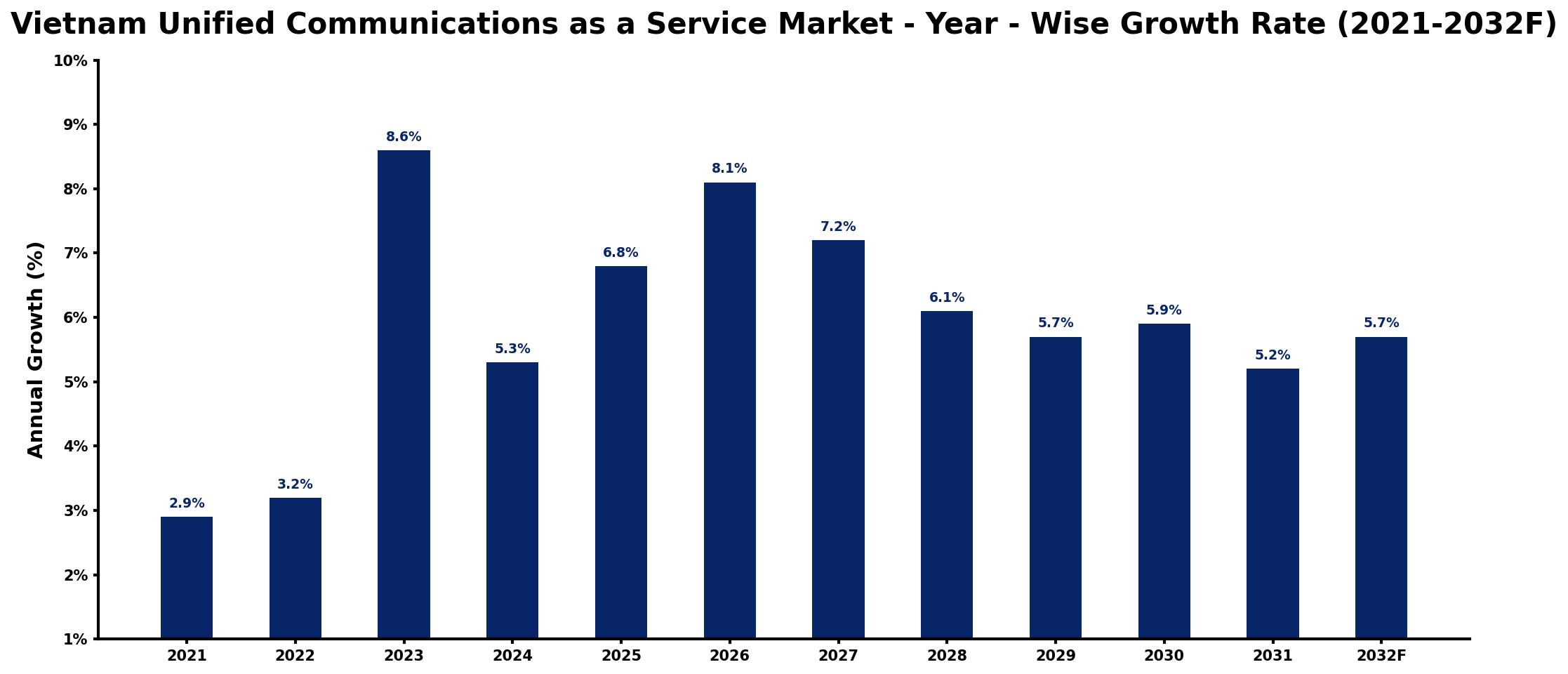
The table below presents the year‑wise growth rates along with the key drivers influencing the market
| Year | Growth Rate | Major Drivers |
| 2021 | 2.9% | increased remote work adoption |
| 2022 | 3.2% | growing digital transformation initiatives |
| 2023 | 8.6% | expanding cloud infrastructure investments |
| 2024 | 5.3% | rising demand for collaboration tools |
| 2025 | 6.8% | enhanced focus on cybersecurity measures |
| 2026 | 8.1% | higher interest in mobile solutions |
| 2027 | 7.2% | broadening use of AI technologies |
| 2028 | 6.1% | strengthening business continuity planning |
| 2029 | 5.7% | growing emphasis on cost efficiency |
| 2030 | 5.9% | increased integration of IoT devices |
| 2031 | 5.2% | growing need for flexible workspaces |
| 2032 | 5.7% | heightened interest in employee engagement |
Note: Market size estimations and growth projections presented in this report are based on 6Wresearch's proprietary forecasting methodology, utilizing the latest available industry data, government publications, and primary research inputs.
Vietnam Unified Communications as a Service Market Synopsis
The most significant force currently shaping the Vietnam Unified Communications as a Service Market is the rapid digital transformation among organizations. Companies are prioritizing seamless communication solutions to foster collaboration, especially in a landscape increasingly defined by remote and distributed workforces.
Additionally, the integration of advanced technologies such as AI and IoT into UCaaS offerings is enhancing the effectiveness of communication solutions. This evolution not only boosts user engagement but also provides businesses with the tools they need to navigate the complexities of modern workflows.
Vietnam Unified Communications as a Service Market Key Takeaways
- The market is experiencing a significant shift towards remote and hybrid work solutions.
- Flexible and scalable UCaaS offerings are driving adoption among organizations of all sizes.
- The integration of AI and IoT technologies is enhancing the value proposition of UCaaS.
- Increased awareness of the benefits of UCaaS is necessary for accelerating market growth.
- Challenges related to infrastructure and data privacy must be addressed for broader acceptance.
Evaluation of Restraints in Vietnam Unified Communications as a Service Market
Despite the promising growth, the Vietnam Unified Communications as a Service Market faces notable restraints that could hinder its expansion. One primary challenge is the inconsistent quality of internet infrastructure, which is crucial for the reliable functioning of UCaaS solutions. Poor connectivity can lead to service disruptions, adversely affecting user experience and satisfaction. Moreover, a general lack of awareness regarding the benefits of UCaaS among potential users further limits market growth. Educational initiatives targeting businesses are vital to bridge this gap. Additionally, the need for tailored solutions that address local language and cultural nuances remains essential for successful adoption.
Vietnam Unified Communications as a Service Market Trends
Currently, the market is witnessing several key trends that are shaping both demand and technology within the UCaaS landscape. The rise of artificial intelligence is increasingly being leveraged to optimize communication processes, offering features like chatbots and smart analytics. Furthermore, as businesses prioritize sustainability, eco-friendly communication solutions are gaining traction, pushing providers to innovate with greener technologies. Lastly, the trend towards all-in-one platforms is prompting UCaaS vendors to enhance their offerings, providing a comprehensive suite of tools for collaboration and productivity.
Vietnam Unified Communications as a Service Market Opportunities
The evolving business environment presents multiple opportunities for growth within the Vietnam Unified Communications as a Service Market. There is a strong potential for investment in infrastructure improvements to bolster internet connectivity, which would significantly enhance user experience. Additionally, companies that specialize in creating localized solutions tailored to Vietnamese businesses can find a receptive market. As digital transformation continues to accelerate, service providers that integrate UCaaS with other emerging technologies will likely gain a competitive advantage, ensuring their offerings meet the growing demands of modern workplaces.
Government Initiatives in the Vietnam Unified Communications as a Service Market
Government initiatives aimed at promoting digital transformation in Vietnam are crucial for the growth of the UCaaS market. Efforts to improve the national telecommunications infrastructure and increase internet penetration are paramount. Additionally, public sector programs focused on enhancing technological adoption in businesses contribute significantly to the overall market environment. Policymaking that encourages innovation and facilitates partnerships between tech companies and enterprises can further bolster the UCaaS ecosystem.
Future Insights of the Vietnam Unified Communications as a Service Market
Looking ahead to the period between 2026 and 2032, the Vietnam Unified Communications as a Service Market is poised for substantial growth driven by increasing demand for cohesive communication solutions. As companies continue to adopt remote working practices, the need for versatile and integrated UCaaS solutions will only intensify. Furthermore, the rising trend of digital transformation across sectors will create opportunities for innovative providers to deliver tailored solutions. This landscape, supported by improved internet infrastructure and heightened awareness among businesses, is set to foster a robust UCaaS ecosystem.
Vietnam Unified Communications as a Service Market Latest Developments (2025 - 2026)
In recent months, the Vietnamese UCaaS market has seen significant shifts as providers enhance their offerings to better cater to the evolving demands of businesses. Innovations in service delivery models, such as increased integration with artificial intelligence, are becoming commonplace. Additionally, there has been a notable focus on improving customer support and user experience, ensuring that organizations can fully leverage UCaaS solutions for their communication needs. The market is also responding to the call for more robust security measures to address data privacy concerns.
Vietnam Unified Communications as a Service Market - Key Attractiveness of the Report
- 10 Years of Market Numbers
- Historical Data Starting from 2022 to 2025
- Base Year: 2025
- Forecast Data until 2032
- Key Performance Indicators Impacting the Market
- Major Upcoming Developments and Projects
Key Highlights of the Report:
- Vietnam Unified Communications as a Service Market Outlook
- Market Size of Vietnam Unified Communications as a Service Market, 2025
- Forecast of Vietnam Unified Communications as a Service Market, 2032
- Historical Data and Forecast of Vietnam Unified Communications as a Service Revenues & Volume for the Period 2022-2032F
- Vietnam Unified Communications as a Service Market Trend Evolution
- Vietnam Unified Communications as a Service Market Drivers and Challenges
- Vietnam Unified Communications as a Service Price Trends
- Vietnam Unified Communications as a Service Porter's Five Forces
- Vietnam Unified Communications as a Service Industry Life Cycle
- Historical Data and Forecast of Vietnam Unified Communications as a Service Market Revenues & Volume By Component for the Period 2022-2032F
- Historical Data and Forecast of Vietnam Unified Communications as a Service Market Revenues & Volume By Telephony for the Period 2022-2032F
- Historical Data and Forecast of Vietnam Unified Communications as a Service Market Revenues & Volume By Unified Messaging for the Period 2022-2032F
- Historical Data and Forecast of Vietnam Unified Communications as a Service Market Revenues & Volume By Conferencing for the Period 2022-2032F
- Historical Data and Forecast of Vietnam Unified Communications as a Service Market Revenues & Volume By Collaboration Platforms And Applications for the Period 2022-2032F
- Historical Data and Forecast of Vietnam Unified Communications as a Service Market Revenues & Volume By Organization Size for the Period 2022-2032F
- Historical Data and Forecast of Vietnam Unified Communications as a Service Market Revenues & Volume By SMEs for the Period 2022-2032F
- Historical Data and Forecast of Vietnam Unified Communications as a Service Market Revenues & Volume By Large Enterprises for the Period 2022-2032F
- Historical Data and Forecast of Vietnam Unified Communications as a Service Market Revenues & Volume By Vertical for the Period 2022-2032F
- Historical Data and Forecast of Vietnam Unified Communications as a Service Market Revenues & Volume By BFSI for the Period 2022-2032F
- Historical Data and Forecast of Vietnam Unified Communications as a Service Market Revenues & Volume By Telecom and IT for the Period 2022-2032F
- Historical Data and Forecast of Vietnam Unified Communications as a Service Market Revenues & Volume By Consumer Goods and Retail for the Period 2022-2032F
- Historical Data and Forecast of Vietnam Unified Communications as a Service Market Revenues & Volume By Healthcare for the Period 2022-2032F
- Historical Data and Forecast of Vietnam Unified Communications as a Service Market Revenues & Volume By Public Sector and Utilities for the Period 2022-2032F
- Historical Data and Forecast of Vietnam Unified Communications as a Service Market Revenues & Volume By Logistics and Transportation for the Period 2022-2032F
- Historical Data and Forecast of Vietnam Unified Communications as a Service Market Revenues & Volume By Travel and Hospitality for the Period 2022-2032F
- Historical Data and Forecast of Vietnam Unified Communications as a Service Market Revenues & Volume By Others (Education, Media and Entertainment, and Manufacturing) for the Period 2022-2032F
- Vietnam Unified Communications as a Service Import Export Trade Statistics
- Market Opportunity Assessment By Component
- Market Opportunity Assessment By Organization Size
- Market Opportunity Assessment By Vertical
- Vietnam Unified Communications as a Service Top Companies Market Share
- Vietnam Unified Communications as a Service Competitive Benchmarking By Technical and Operational Parameters
- Vietnam Unified Communications as a Service Company Profiles
- Vietnam Unified Communications as a Service Key Strategic Recommendations






































