Indonesia Vegetable and Fruit Processing Machinery Market Size, Share & Growth Rate
The Indonesia Vegetable and Fruit Processing Machinery Market was estimated at USD 355 Million in 2025 and is projected to reach USD 470 Million by 2032, growing at a CAGR of 4.1% from 2026 to 2032. This growth trajectory is largely attributed to a health-conscious population that is increasingly leaning towards processed food products. Urbanization, combined with changing lifestyles and the demand for convenient food options, drives manufacturers to adopt advanced processing machinery, enhancing production efficiency and quality.
Indonesia Vegetable and Fruit Processing Machinery Market Year-wise Growth Rate and Key Drivers
This graph highlights how the Indonesia Vegetable and Fruit Processing Machinery Market has steadily grown over the years, supported by major growth factors.
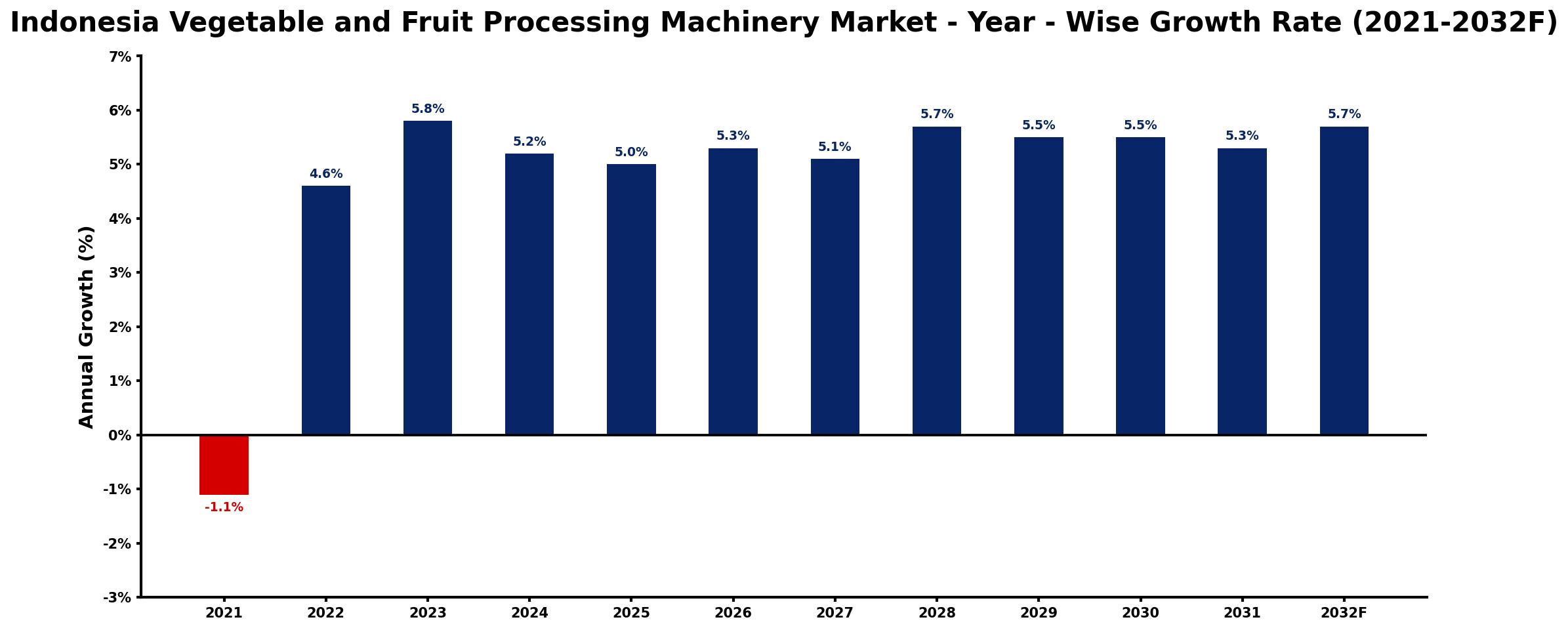
The table below presents the year‑wise growth rates along with the key drivers influencing the market
| Year | Growth Rate | Major Drivers |
| 2021 | -1.1% | Decline in agricultural investments |
| 2022 | 4.6% | Rising consumer health consciousness |
| 2023 | 5.8% | Expansion of export markets |
| 2024 | 5.2% | Increased automation adoption rates |
| 2025 | 5.0% | Growing urban population demands |
| 2026 | 5.3% | Technological advancements in production |
| 2027 | 5.1% | Strengthening local supply chains |
| 2028 | 5.7% | Surge in organic product demand |
| 2029 | 5.5% | Government incentives for innovation |
| 2030 | 5.5% | Increased sustainability initiatives adopted |
| 2031 | 5.3% | Emergence of new market players |
| 2032 | 5.7% | Rising international trade partnerships |
Note: Market size estimations and growth projections presented in this report are based on 6Wresearch's proprietary forecasting methodology, utilizing the latest available industry data, government publications, and primary research inputs.
Indonesia Vegetable and Fruit Processing Machinery Market Synopsis
The demand for vegetable and fruit processing machinery in Indonesia is gaining momentum, as consumers are increasingly interested in healthier food options. With a rising trend in functional foods and ready-to-eat products, processing machinery that can efficiently handle post-harvest operations—such as peeling, sorting, and slicing—is becoming essential for producers looking to maintain quality and meet market expectations.
In recent years, Indonesia has seen a notable rise in investment in food processing technology. This trend is driven by both domestic needs and the global demand for processed fruits and vegetables. Local manufacturers are now prioritizing investment in state-of-the-art machinery to optimize production processes, ultimately leading to an increase in both product quality and supply chain efficiency.
Indonesia Vegetable and Fruit Processing Machinery Market Key Takeaways
- The market is projected to grow from USD 355 Million in 2025 to USD 470 Million by 2032.
- Urbanization and the increasing health consciousness among consumers significantly impact market dynamics.
- Technological advancements are vital for improving efficiency and sustainability in processing operations.
- Producers are rapidly adapting to changing consumer preferences for convenient, ready-to-eat products.
- Government support and initiatives play a crucial role in fostering market growth and sustainability.
Evaluation of Restraints in Indonesia Vegetable and Fruit Processing Machinery Market
Despite the robust growth prospects, certain limitations exist within the Indonesian vegetable and fruit processing machinery market. A significant challenge is the constant need for technological advancements, as outdated machinery can hinder production efficiency. Additionally, the demand for sustainable processing methods is increasing, pressuring manufacturers to innovate and adopt greener technologies. Navigating these constraints will be crucial for stakeholders aiming to enhance their competitive edge and market presence.
Indonesia Vegetable and Fruit Processing Machinery Market Trends
A number of current and emerging trends are shaping the landscape of the vegetable and fruit processing machinery market in Indonesia. Automation is becoming increasingly prevalent, with manufacturers investing in high-tech solutions to enhance operational efficiency. Additionally, the trend toward organic and locally sourced produce is influencing machinery design to accommodate specific processing needs. There's also a marked shift towards digital technologies, enabling real-time monitoring and data analysis in processing operations.
Indonesia Vegetable and Fruit Processing Machinery Market Opportunities
The market holds considerable opportunities for growth, particularly in catering to the evolving demands for processed foods among Indonesia's urban population. Manufacturers can capitalize on the rising demand for innovative processing solutions by investing in machinery that enhances productivity and maintains high standards of quality. Additionally, there is a growing market for eco-friendly processing technologies, which aligns with global sustainability goals and can attract a wider customer base.
Government Initiatives in the Indonesia Vegetable and Fruit Processing Machinery Market
The Indonesian government has been actively promoting the modernization of the agricultural sector, which includes initiatives aimed at enhancing the food processing industry. Programs to support technology adoption and financial incentives for manufacturers investing in sustainable practices are encouraging innovation. Public spending on infrastructure improvements and research into agricultural processing technology further bolsters the market, creating a more favorable environment for industry players.
Future Insights of the Indonesia Vegetable and Fruit Processing Machinery Market
Looking ahead to the period between 2026 and 2032, the Indonesian vegetable and fruit processing machinery market is expected to flourish, driven by an increasingly discerning consumer base and a growing emphasis on healthy eating. With an ongoing push for technological innovation and efficiency improvements, manufacturers who prioritize sustainability will likely find themselves at the forefront of the market. The continued urbanization and rising disposable incomes will further fuel demand, positioning the market for substantial growth.
Indonesia Vegetable and Fruit Processing Machinery Market Latest Developments (2025 - 2026)
Recent industry developments indicate a strong focus on integrating automation and artificial intelligence within processing operations. Companies are exploring partnerships with technology firms to enhance their capabilities. Moreover, there is a noticeable shift towards adopting sustainability measures, such as energy-efficient machinery and recyclable materials. This evolution reflects broader consumer preferences and regulatory frameworks aimed at reducing environmental impact in food processing.
Indonesia Vegetable and Fruit Processing Machinery Market - Key Attractiveness of the Report
- 10 Years of Market Numbers
- Historical Data Starting from 2022 to 2025
- Base Year: 2025
- Forecast Data until 2032
- Key Performance Indicators Impacting the Market
- Major Upcoming Developments and Projects
Key Highlights of the Report:
- Indonesia Vegetable and Fruit Processing Machinery Market Outlook
- Market Size of Indonesia Vegetable and Fruit Processing Machinery Market, 2025
- Forecast of Indonesia Vegetable and Fruit Processing Machinery Market, 2032
- Historical Data and Forecast of Indonesia Vegetable and Fruit Processing Machinery Revenues & Volume for the Period 2022-2032F
- Indonesia Vegetable and Fruit Processing Machinery Market Trend Evolution
- Indonesia Vegetable and Fruit Processing Machinery Market Drivers and Challenges
- Indonesia Vegetable and Fruit Processing Machinery Price Trends
- Indonesia Vegetable and Fruit Processing Machinery Porter's Five Forces
- Indonesia Vegetable and Fruit Processing Machinery Industry Life Cycle
- Historical Data and Forecast of Indonesia Vegetable and Fruit Processing Machinery Market Revenues & Volume By Product Type for the Period 2022-2032F
- Historical Data and Forecast of Indonesia Vegetable and Fruit Processing Machinery Market Revenues & Volume By Fresh for the Period 2022-2032F
- Historical Data and Forecast of Indonesia Vegetable and Fruit Processing Machinery Market Revenues & Volume By Fresh-cut for the Period 2022-2032F
- Historical Data and Forecast of Indonesia Vegetable and Fruit Processing Machinery Market Revenues & Volume By Canned for the Period 2022-2032F
- Historical Data and Forecast of Indonesia Vegetable and Fruit Processing Machinery Market Revenues & Volume By Frozen for the Period 2022-2032F
- Historical Data and Forecast of Indonesia Vegetable and Fruit Processing Machinery Market Revenues & Volume By Dried & Dehydrated for the Period 2022-2032F
- Historical Data and Forecast of Indonesia Vegetable and Fruit Processing Machinery Market Revenues & Volume By Convenience for the Period 2022-2032F
- Historical Data and Forecast of Indonesia Vegetable and Fruit Processing Machinery Market Revenues & Volume By Equipment Type for the Period 2022-2032F
- Historical Data and Forecast of Indonesia Vegetable and Fruit Processing Machinery Market Revenues & Volume By Pre-processing for the Period 2022-2032F
- Historical Data and Forecast of Indonesia Vegetable and Fruit Processing Machinery Market Revenues & Volume By Peeling/inspection/slicing for the Period 2022-2032F
- Historical Data and Forecast of Indonesia Vegetable and Fruit Processing Machinery Market Revenues & Volume By Washing & Dewatering for the Period 2022-2032F
- Historical Data and Forecast of Indonesia Vegetable and Fruit Processing Machinery Market Revenues & Volume By Fillers for the Period 2022-2032F
- Historical Data and Forecast of Indonesia Vegetable and Fruit Processing Machinery Market Revenues & Volume By Packaging & Handling for the Period 2022-2032F
- Historical Data and Forecast of Indonesia Vegetable and Fruit Processing Machinery Market Revenues & Volume By Seasoning Systems for the Period 2022-2032F
- Historical Data and Forecast of Indonesia Vegetable and Fruit Processing Machinery Market Revenues & Volume By Others for the Period 2022-2032F
- Historical Data and Forecast of Indonesia Vegetable and Fruit Processing Machinery Market Revenues & Volume By Operation for the Period 2022-2032F
- Historical Data and Forecast of Indonesia Vegetable and Fruit Processing Machinery Market Revenues & Volume By Automatic for the Period 2022-2032F
- Historical Data and Forecast of Indonesia Vegetable and Fruit Processing Machinery Market Revenues & Volume By Semi-automatic for the Period 2022-2032F
- Historical Data and Forecast of Indonesia Vegetable and Fruit Processing Machinery Market Revenues & Volume By Processing System for the Period 2022-2032F
- Historical Data and Forecast of Indonesia Vegetable and Fruit Processing Machinery Market Revenues & Volume By Small Scale for the Period 2022-2032F
- Historical Data and Forecast of Indonesia Vegetable and Fruit Processing Machinery Market Revenues & Volume By Intermediate Scale for the Period 2022-2032F
- Indonesia Vegetable and Fruit Processing Machinery Import Export Trade Statistics
- Market Opportunity Assessment By Product Type
- Market Opportunity Assessment By Equipment Type
- Market Opportunity Assessment By Operation
- Market Opportunity Assessment By Processing System
- Indonesia Vegetable and Fruit Processing Machinery Top Companies Market Share
- Indonesia Vegetable and Fruit Processing Machinery Competitive Benchmarking By Technical and Operational Parameters
- Indonesia Vegetable and Fruit Processing Machinery Company Profiles
- Indonesia Vegetable and Fruit Processing Machinery Key Strategic Recommendations






































