Indonesia Warm Air Heating and Air Conditioning Market Summary
The indonesia warm air heating and air conditioning market was estimated at USD 551 Million in 2025 and is projected to reach USD 844 Million by 2032, growing at a CAGR of 8.0% from 2026 to 2032.
Indonesia Warm Air Heating and Air Conditioning Market Year-wise Growth Rate and Key Drivers
This graph highlights how the Indonesia Warm Air Heating and Air Conditioning Market has steadily grown over the past five years, supported by major growth factors.
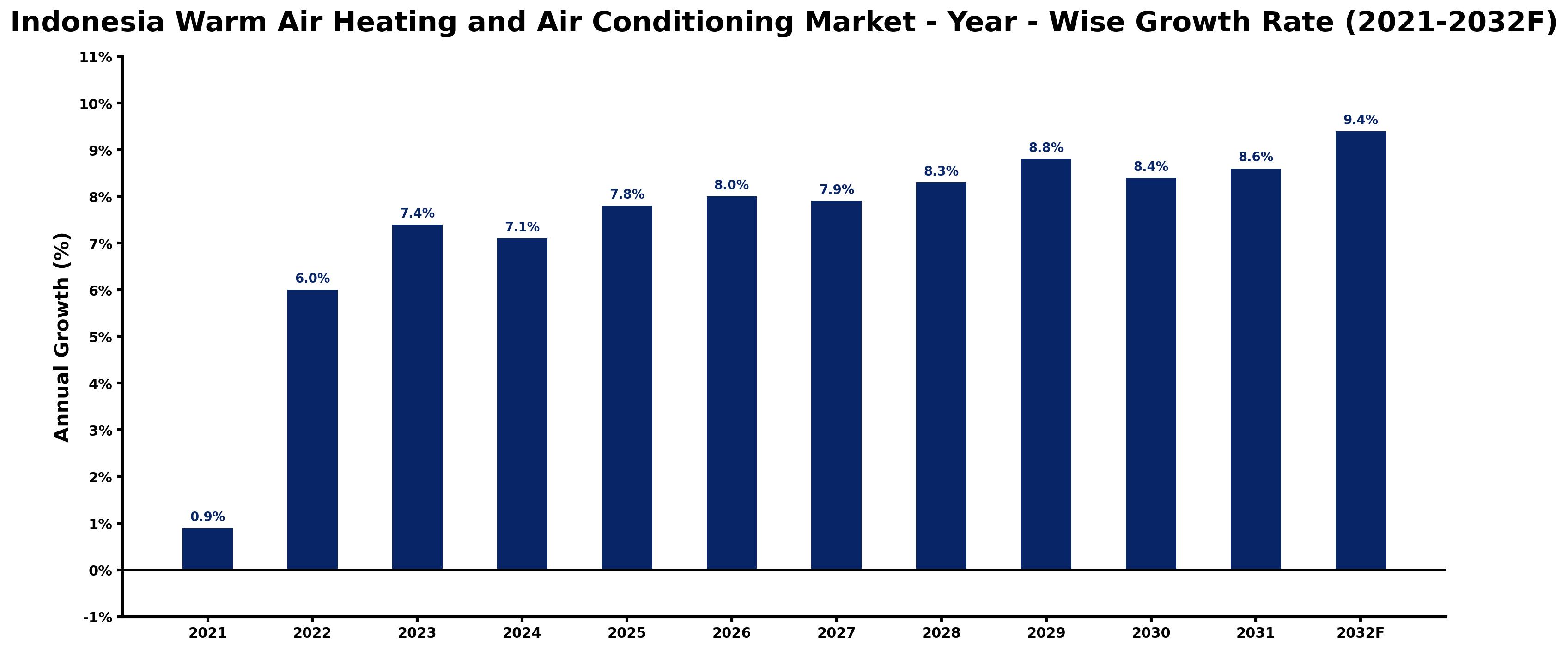
The table below presents the year wise growth rates along with the key drivers influencing the market
| Year | Growth Rate | Major Drivers |
| 2021 | 0.9% | Post-lockdown retail projects led to increased infrastructure investments in urban areas. |
| 2022 | 6.0% | Rapid urbanization trends resulted in higher demand for residential cooling solutions. |
| 2023 | 7.4% | Technological improvements in air conditioning efficiency attracted environmentally conscious consumers. |
| 2024 | 7.1% | Shifting consumer preferences favoring smart home integrations influenced market dynamics significantly. |
| 2025 | 7.8% | Emerging middle class seeks enhanced comfort, driving both air conditioning and heating needs. |
| 2026 | 8.0% | Localized climate challenges necessitated innovative HVAC solutions tailored for Indonesian weather. |
| 2027 | 7.9% | Integration of IoT technology improved maintenance services, enhancing overall customer satisfaction. |
| 2028 | 8.3% | Foreign investments surged, spurring competition among local and multinational HVAC manufacturers. |
| 2029 | 8.8% | Increased disposable income allowed consumers to upgrade to more efficient HVAC systems. |
| 2030 | 8.4% | Sustainability trends encouraged manufacturers to explore eco-friendly refrigerants and technologies. |
| 2031 | 8.6% | Greater awareness of indoor air quality propelled demand for advanced filtration systems. |
| 2032 | 9.4% | Expansion of e-commerce platforms made HVAC products more accessible to rural markets. |
Note - Market size estimations and growth projections presented in this report are based on 6Wresearch's advanced forecasting approach, validated with industry datasets as of June 2026.
Indonesia Warm Air Heating and Air Conditioning Market Synopsis
The Indonesia Warm Air Heating and Air Conditioning Market is projected to reach 8.0% and witness significant growth during the forecast period (2026-2032). This growth trajectory is primarily driven by the exponential rise in construction activities and the escalating demand for robust air conditioning systems across both commercial and residential sectors. The increase in urbanization in Indonesia has been a catalyst for the need for efficient cooling solutions, particularly in key end-use industries such as hospitality, industrial, retail, and office spaces.
Indonesia Warm Air Heating and Air Conditioning Market Growth Drivers
The market is poised for substantial growth, influenced by several critical factors:
- Urbanization is one of the primary growth drivers, as burgeoning populations in urban areas necessitate effective temperature control in residential and commercial establishments.
- The ongoing construction boom in Indonesia expands the scope for air conditioning installations, thereby elevating market demand.
- Innovative technologies in air conditioning systems, aimed at enhancing energy efficiency and performance, contribute significantly to market expansion.
- Government initiatives supporting energy-efficient products encourage adoption among consumers and businesses alike, fostering growth.
- The increasing awareness of environmental sustainability propels demand for eco-friendly heating and cooling solutions.
Indonesia Warm Air Heating and Air Conditioning Market Trends and Opportunities
As the Indonesia Warm Air Heating and Air Conditioning Market evolves, several trends are shaping its future:
- The shift towards smart home technologies is influencing consumer preferences, with greater demand for intelligent heating and cooling systems that offer enhanced control and efficiency.
- Integration of renewable energy sources in HVAC systems is gaining traction, aligning with global sustainability objectives.
- Customization of heating and air conditioning solutions to meet specific consumer needs presents opportunities for market players.
- The growth of e-commerce platforms facilitates easier access to various heating and cooling products, significantly impacting purchasing behaviors.
- Expansion of service and maintenance sectors dedicated to heating and air conditioning systems ensures sustained market engagement post-installation.
Indonesia Warm Air Heating and Air Conditioning Market Challenges and Restraints
However, several challenges could impede market growth:
- High initial costs associated with the installation of advanced heating and air conditioning systems may deter potential consumers.
- Limited awareness regarding the benefits of modern HVAC technologies could hinder adoption rates in less urbanized areas.
- Stringent environmental regulations may impose challenges on manufacturers in terms of product compliance and innovation.
- Seasonal demand fluctuations can create market volatility, affecting supply chain stability.
- The reliance on imported components for manufacturing could introduce risks related to supply chain disruptions and market pricing.
Indonesia Warm Air Heating and Air Conditioning Market Government Investment and Initiatives
The Indonesian government plays a pivotal role in catalyzing the growth of the warm air heating and air conditioning market through various investments and policy initiatives. By instituting energy efficiency policies, the government promotes sustainable practices within the HVAC sector.
Incentives such as tax exemptions on energy-efficient heating and cooling systems encourage both manufacturers and consumers to opt for environmentally friendly options. Additionally, public spending within the housing and infrastructure sectors helps bolster the demand for effective heating and air conditioning solutions, strategically supporting market development.
Indonesia Warm Air Heating and Air Conditioning Market Latest Developments (May 2025 - June 2026)
Recent developments within the Indonesia Warm Air Heating and Air Conditioning Market indicate a dynamic shift toward sustainability and technology integration. Industry players are increasingly focusing on the development of energy-efficient HVAC systems as regulatory pressures mount to reduce carbon emissions. Innovative product launches integrating smart technologies have also been observed, aimed at enhancing user experience and operational efficiency.
Furthermore, the market has seen collaborative efforts between public and private sectors to invest in research and development of advanced heating and cooling technologies. These initiatives are designed to improve system performance while minimizing environmental impacts, positioning the market towards a more sustainable future.
Indonesia Warm Air Heating and Air Conditioning Market - Key Attractiveness of the Report
- 10 Years of Market Numbers
- Historical Data Starting from 2022 to 2025
- Base Year: 2025
- Forecast Data until 2032
- Key Performance Indicators Impacting the Market
- Major Upcoming Developments and Projects
Key Highlights of the Report:
- Indonesia Warm Air Heating and Air Conditioning Market Outlook
- Market Size of Indonesia Warm Air Heating and Air Conditioning Market, 2025
- Forecast of Indonesia Warm Air Heating and Air Conditioning Market, 2032F
- Historical Data and Forecast of Indonesia Warm Air Heating and Air Conditioning Revenues & Volume for the Period 2022-2032F
- Indonesia Warm Air Heating and Air Conditioning Market Trend Evolution
- Indonesia Warm Air Heating and Air Conditioning Market Drivers and Challenges
- Indonesia Warm Air Heating and Air Conditioning Price Trends
- Indonesia Warm Air Heating and Air Conditioning Porter's Five Forces
- Indonesia Warm Air Heating and Air Conditioning Industry Life Cycle
- Historical Data and Forecast of Indonesia Warm Air Heating and Air Conditioning Market Revenues & Volume By Components for the Period 2022-2032F
- Historical Data and Forecast of Indonesia Warm Air Heating and Air Conditioning Market Revenues & Volume By Sensors for the Period 2022-2032F
- Historical Data and Forecast of Indonesia Warm Air Heating and Air Conditioning Market Revenues & Volume By Controllers & Constrolled Devices for the Period 2022-2032F
- Historical Data and Forecast of Indonesia Warm Air Heating and Air Conditioning Market Revenues & Volume By Applications for the Period 2022-2032F
- Historical Data and Forecast of Indonesia Warm Air Heating and Air Conditioning Market Revenues & Volume By Residential for the Period 2022-2032F
- Historical Data and Forecast of Indonesia Warm Air Heating and Air Conditioning Market Revenues & Volume By Commercial for the Period 2022-2032F
- Historical Data and Forecast of Indonesia Warm Air Heating and Air Conditioning Market Revenues & Volume By Industrial for the Period 2022-2032F
- Indonesia Warm Air Heating and Air Conditioning Import Export Trade Statistics
- Market Opportunity Assessment By Components
- Market Opportunity Assessment By Applications
- Indonesia Warm Air Heating and Air Conditioning Top Companies Market Share
- Indonesia Warm Air Heating and Air Conditioning Competitive Benchmarking By Technical and Operational Parameters
- Indonesia Warm Air Heating and Air Conditioning Company Profiles
- Indonesia Warm Air Heating and Air Conditioning Key Strategic Recommendations






































