Indonesia Welding Equipment Market Size, Share & Growth Rate
The Indonesia Welding Equipment Market was estimated at USD 337 Million in 2025 and is projected to reach USD 448 Million by 2032, growing at a CAGR of 4.2% from 2026 to 2032. This growth trajectory is underpinned by the escalating demand for welding services across pivotal sectors such as automotive, construction, and manufacturing. Notably, the influx of investments from both public and private sectors is bolstering market expansion, while government initiatives aimed at enhancing industrial automation further amplify this positive outlook.
Indonesia Welding Equipment Market Year-wise Growth Rate and Key Drivers
This graph highlights how the Indonesia Welding Equipment Market has steadily grown over the years, supported by major growth factors.
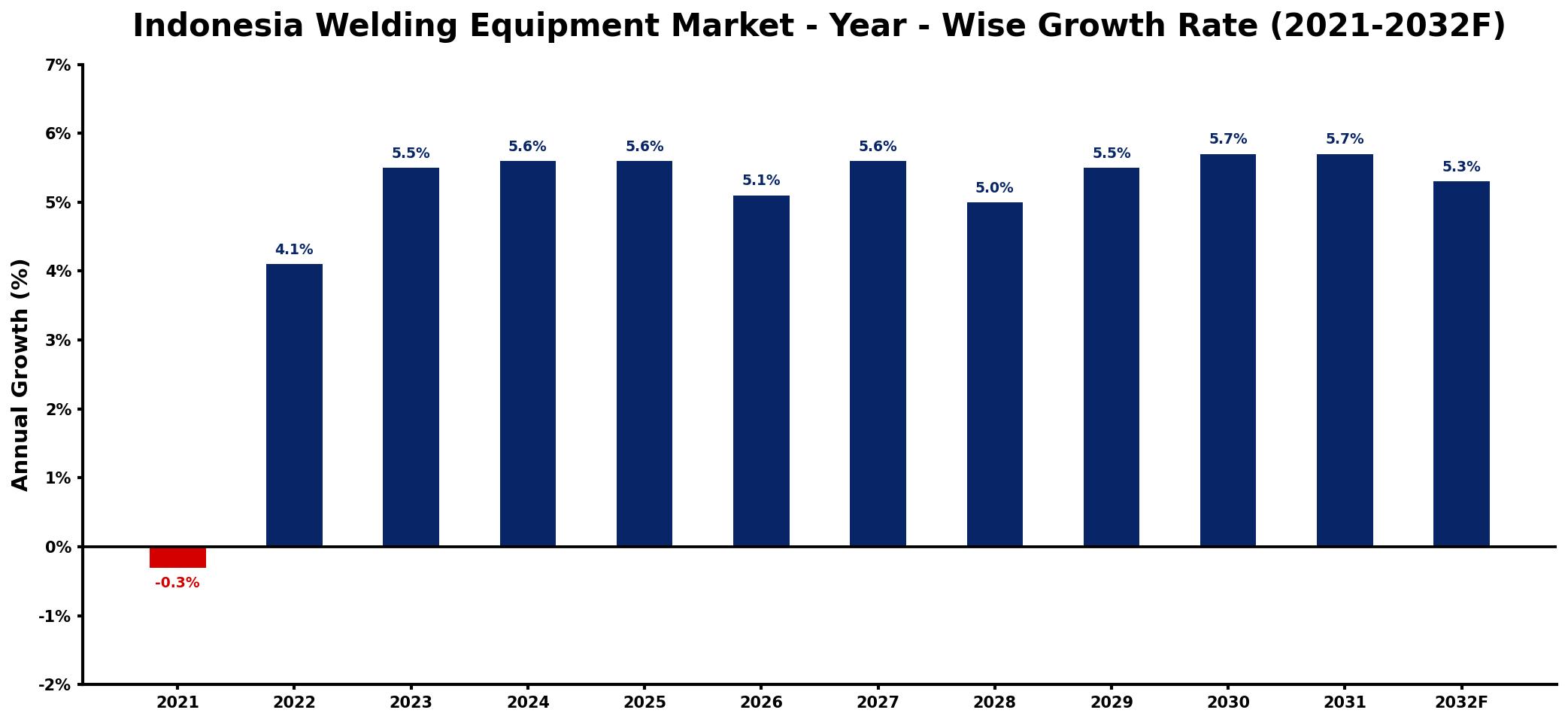
The table below presents the year‑wise growth rates along with the key drivers influencing the market
| Year | Growth Rate | Major Drivers |
| 2021 | -0.3% | construction sector experiencing slow demand |
| 2022 | 4.1% | manufacturing sector showing strong recovery |
| 2023 | 5.5% | infrastructure projects gaining momentum |
| 2024 | 5.6% | automotive industry expanding rapidly |
| 2025 | 5.6% | renewable energy investments increasing significantly |
| 2026 | 5.1% | shipbuilding sector witnessing growth |
| 2027 | 5.6% | heavy machinery demand on rise |
| 2028 | 5.0% | export markets opening up further |
| 2029 | 5.5% | technological advancements driving innovation |
| 2030 | 5.7% | construction projects ramping up nationwide |
| 2031 | 5.7% | maintenance services demand increasing steadily |
| 2032 | 5.3% | regional trade agreements enhancing opportunities |
Note: Market size estimations and growth projections presented in this report are based on 6Wresearch's proprietary forecasting methodology, utilizing the latest available industry data, government publications, and primary research inputs.
Indonesia Welding Equipment Market Synopsis
A primary catalyst for the Indonesia Welding Equipment Market is the ongoing infrastructure development across the archipelago. Robust construction projects and a thriving manufacturing sector are generating sustained demand for advanced welding equipment, which is indispensable for fabricating and joining metal components effectively.
In addition to infrastructural growth, the Indonesian government's focus on enhancing industrial automation is significantly influencing market dynamics. This push towards modernization necessitates the adoption of sophisticated welding technologies, thereby driving the industry's evolution and ensuring alignment with global standards.
Indonesia Welding Equipment Market Key Takeaways
- Robust growth driven by infrastructure development and manufacturing demands.
- Government initiatives in industrial automation are creating a conducive environment for market expansion.
- Investments from public and private entities are pivotal for the industry's sustainability.
- Technological advancements will shape future equipment offerings and operational efficiencies.
- Worker safety and compliance standards remain critical considerations for the market's progression.
Evaluation of Restraints in Indonesia Welding Equipment Market
Despite the promising growth potential, the Indonesia Welding Equipment Market faces several constraints. Chief among these is the need for rigorous adherence to worker safety protocols and compliance with stringent welding standards, which can complicate operational efficiency and cost management. Furthermore, the sector is grappling with a shortage of skilled operators adept in advanced technologies. Addressing these challenges will be essential to leverage the market's full potential and maintain competitiveness.
Indonesia Welding Equipment Market Trends
Currently, there is a significant trend toward automation and digitization in the welding sector, driven by the desire for enhanced precision and efficiency. Companies are increasingly investing in robotic welding systems that integrate Artificial Intelligence to optimize production processes. Furthermore, eco-friendly welding solutions are gaining traction, responding to global sustainability goals and regulatory pressures. This trend is likely to continue as manufacturers seek to reduce emissions and improve overall operational sustainability.
Indonesia Welding Equipment Market Opportunities
The Indonesian market presents several growth opportunities, particularly in sectors poised for expansion, such as renewable energy and automotive manufacturing. Investments in green technologies and infrastructure projects present a fertile ground for innovative welding solutions. Additionally, the growing trend towards local manufacturing and exports is likely to fuel demand for high-quality welding equipment and services, making this a prime area for investment and development.
Government Initiatives in the Indonesia Welding Equipment Market
The Indonesian government has instituted a range of initiatives aimed at enhancing the competitiveness of the manufacturing sector, which indirectly supports the welding equipment market. Efforts include increasing public spending on infrastructure projects and incentivizing private investments in industrial automation. These policies are designed to stimulate economic growth and ensure the sector's alignment with global manufacturing standards, thus fostering a more favorable environment for welding equipment demand.
Future Insights of the Indonesia Welding Equipment Market
Looking ahead, the Indonesia Welding Equipment Market is poised for continued growth from 2026 to 2032. The anticipated rise in construction and infrastructure development, alongside the government's commitment to industrial modernization, will be critical in shaping the market landscape. As businesses increasingly prioritize efficiency and quality, the adoption of advanced welding technologies will likely accelerate, ensuring that Indonesia remains competitive within the global manufacturing arena.
Indonesia Welding Equipment Market Latest Developments (2025 - 2026)
Recent developments in the Indonesia Welding Equipment Market indicate a strong inclination towards the integration of automation in welding processes. Companies are exploring partnerships for technology transfers to enhance capabilities. Additionally, several industry conferences have taken place, focusing on sustainability and innovation in welding techniques, reflecting the sector's evolving dynamics and the ongoing commitment to meeting international standards.
Indonesia Welding Equipment Market - Key Attractiveness of the Report
- 10 Years of Market Numbers
- Historical Data Starting from 2022 to 2025
- Base Year: 2025
- Forecast Data until 2032
- Key Performance Indicators Impacting the Market
- Major Upcoming Developments and Projects
Key Highlights of the Report:
- Indonesia Welding Equipment Market Outlook
- Market Size of Indonesia Welding Equipment Market, 2025
- Forecast of Indonesia Welding Equipment Market, 2032
- Historical Data and Forecast of Indonesia Welding Equipment Revenues & Volume for the Period 2022-2032F
- Indonesia Welding Equipment Market Trend Evolution
- Indonesia Welding Equipment Market Drivers and Challenges
- Indonesia Welding Equipment Price Trends
- Indonesia Welding Equipment Porter's Five Forces
- Indonesia Welding Equipment Industry Life Cycle
- Historical Data and Forecast of Indonesia Welding Equipment Market Revenues & Volume By Equipment for the Period 2022-2032F
- Historical Data and Forecast of Indonesia Welding Equipment Market Revenues & Volume By Electrodes & Filler Metal Equipment for the Period 2022-2032F
- Historical Data and Forecast of Indonesia Welding Equipment Market Revenues & Volume By Oxy-fuel Gas Equipment for the Period 2022-2032F
- Historical Data and Forecast of Indonesia Welding Equipment Market Revenues & Volume By Other Equipment for the Period 2022-2032F
- Historical Data and Forecast of Indonesia Welding Equipment Market Revenues & Volume By Accessory for the Period 2022-2032F
- Historical Data and Forecast of Indonesia Welding Equipment Market Revenues & Volume By Protective Gear for the Period 2022-2032F
- Historical Data and Forecast of Indonesia Welding Equipment Market Revenues & Volume By Gas Manifolds for the Period 2022-2032F
- Historical Data and Forecast of Indonesia Welding Equipment Market Revenues & Volume By Flow Controllers for the Period 2022-2032F
- Historical Data and Forecast of Indonesia Welding Equipment Market Revenues & Volume By Gas Panels for the Period 2022-2032F
- Historical Data and Forecast of Indonesia Welding Equipment Market Revenues & Volume By Gas Flow Meters for the Period 2022-2032F
- Historical Data and Forecast of Indonesia Welding Equipment Market Revenues & Volume By Gas Regulators for the Period 2022-2032F
- Historical Data and Forecast of Indonesia Welding Equipment Market Revenues & Volume By Gas Cabinets for the Period 2022-2032F
- Historical Data and Forecast of Indonesia Welding Equipment Market Revenues & Volume By Gas Filters for the Period 2022-2032F
- Historical Data and Forecast of Indonesia Welding Equipment Market Revenues & Volume By Consumable for the Period 2022-2032F
- Historical Data and Forecast of Indonesia Welding Equipment Market Revenues & Volume By Electrodes & Filler Materials for the Period 2022-2032F
- Historical Data and Forecast of Indonesia Welding Equipment Market Revenues & Volume By Gases for the Period 2022-2032F
- Historical Data and Forecast of Indonesia Welding Equipment Market Revenues & Volume By Fluxes & Wires for the Period 2022-2032F
- Historical Data and Forecast of Indonesia Welding Equipment Market Revenues & Volume By Technology for the Period 2022-2032F
- Historical Data and Forecast of Indonesia Welding Equipment Market Revenues & Volume By Arc Welding for the Period 2022-2032F
- Historical Data and Forecast of Indonesia Welding Equipment Market Revenues & Volume By Oxy-fuel Welding for the Period 2022-2032F
- Historical Data and Forecast of Indonesia Welding Equipment Market Revenues & Volume By Others for the Period 2022-2032F
- Historical Data and Forecast of Indonesia Welding Equipment Market Revenues & Volume By End-Use Industry for the Period 2022-2032F
- Historical Data and Forecast of Indonesia Welding Equipment Market Revenues & Volume By General Fabrication for the Period 2022-2032F
- Historical Data and Forecast of Indonesia Welding Equipment Market Revenues & Volume By Power Generation for the Period 2022-2032F
- Historical Data and Forecast of Indonesia Welding Equipment Market Revenues & Volume By Automotive for the Period 2022-2032F
- Historical Data and Forecast of Indonesia Welding Equipment Market Revenues & Volume By Construction & Infrastructure for the Period 2022-2032F
- Historical Data and Forecast of Indonesia Welding Equipment Market Revenues & Volume By Heavy Fabrication for the Period 2022-2032F
- Historical Data and Forecast of Indonesia Welding Equipment Market Revenues & Volume By Shipbuilding for the Period 2022-2032F
- Historical Data and Forecast of Indonesia Welding Equipment Market Revenues & Volume By Maintenance & Repair for the Period 2022-2032F
- Historical Data and Forecast of Indonesia Welding Equipment Market Revenues & Volume By Offshore for the Period 2022-2032F
- Indonesia Welding Equipment Import Export Trade Statistics
- Market Opportunity Assessment By Equipment
- Market Opportunity Assessment By Accessory
- Market Opportunity Assessment By Consumable
- Market Opportunity Assessment By Technology
- Market Opportunity Assessment By End-Use Industry
- Indonesia Welding Equipment Top Companies Market Share
- Indonesia Welding Equipment Competitive Benchmarking By Technical and Operational Parameters
- Indonesia Welding Equipment Company Profiles
- Indonesia Welding Equipment Key Strategic Recommendations






































