Indonesia Wheel Loader Market Size, Share & Growth Rate
The Indonesia Wheel Loader Market was estimated at USD 246 Million in 2025 and is projected to reach USD 326 Million by 2032, growing at a CAGR of 4.1% from 2026 to 2032. The trajectory of this market is being propelled by escalating government investments in public infrastructure and ongoing construction projects. These factors, combined with urbanization trends and increasing disposable incomes, are expected to significantly enhance demand for wheel loaders across various sectors.
Indonesia Wheel Loader Market Year-wise Growth Rate and Key Drivers
This graph highlights how the Indonesia Wheel Loader Market has steadily grown over the years, supported by major growth factors.
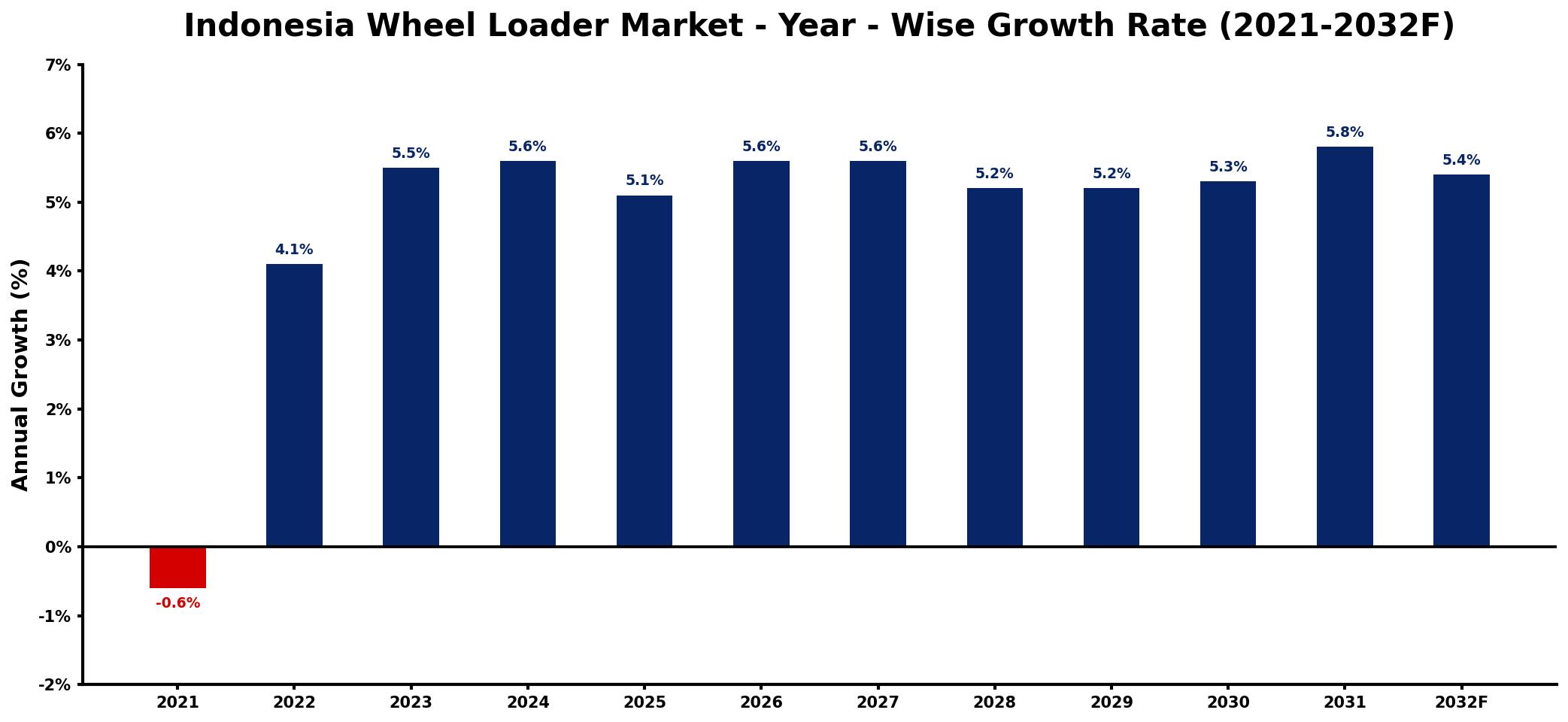
The table below presents the year‑wise growth rates along with the key drivers influencing the market
| Year | Growth Rate | Major Drivers |
| 2021 | -0.6% | construction sector activity declines |
| 2022 | 4.1% | increased infrastructure investment initiatives |
| 2023 | 5.5% | growing mining sector demand |
| 2024 | 5.6% | expansion of agricultural operations |
| 2025 | 5.1% | rising construction project approvals |
| 2026 | 5.6% | enhanced urban development projects |
| 2027 | 5.6% | growing demand for rental services |
| 2028 | 5.2% | increased focus on sustainability |
| 2029 | 5.2% | advancements in technology adoption |
| 2030 | 5.3% | higher exports of raw materials |
| 2031 | 5.8% | expanding manufacturing base activity |
| 2032 | 5.4% | rising foreign direct investments |
Note: Market size estimations and growth projections presented in this report are based on 6Wresearch's proprietary forecasting methodology, utilizing the latest available industry data, government publications, and primary research inputs.
Indonesia Wheel Loader Market Synopsis
The recent momentum in the Indonesia wheel loader market reflects a strong recovery following pandemic-induced disruptions. As infrastructure projects regain traction and economic activities stabilize, the market is positioning itself for robust growth fueled by essential sectors such as construction, mining, and agriculture.
Looking ahead, the landscape is characterized by both opportunities and challenges. While demand remains strong, manufacturers must navigate economic fluctuations and the evolving preferences for eco-friendly machinery. Continued urbanization and infrastructure investments will be pivotal in shaping the markets future trajectory.
Indonesia Wheel Loader Market Key Takeaways
- Government spending on infrastructure is a primary growth driver for the market.
- Urbanization and increasing disposable incomes are significantly impacting wheel loader sales.
- The construction, mining, and agriculture sectors are the main demand drivers for wheel loaders.
- Manufacturers face pressure to innovate, focusing on fuel-efficient and environmentally friendly machines.
- Economic recovery post-COVID-19 has initiated a resurgence in construction activities, contributing to market growth.
Evaluation of Restraints in Indonesia Wheel Loader Market
Despite its positive outlook, the Indonesia wheel loader market faces certain restraints that could impact growth. Fluctuating economic conditions create uncertainty for manufacturers, particularly in terms of investment in new machinery. Additionally, rising consumer preferences for fuel-efficient and eco-friendly models present a challenge for traditional manufacturers who must adapt to these shifting demands. As regulations around emissions tighten, companies may find it difficult to keep up without significant investment in research and development, which could slow down overall market advancement.
Indonesia Wheel Loader Market Trends
Key trends currently shaping the Indonesia wheel loader market include a significant shift towards automation and smart technologies in machinery. This evolution not only enhances efficiency but also addresses labor shortages in construction and agriculture. Additionally, a growing focus on sustainability is prompting manufacturers to innovate toward fuel-efficient and environmentally friendly solutions. Enhanced telematics and connectivity features are becoming increasingly prevalent, allowing for real-time monitoring and operational efficiencies that appeal to consumers.
Indonesia Wheel Loader Market Opportunities
Genuine growth opportunities in the Indonesia wheel loader market lie within the expanding infrastructure projects and the ongoing urbanization process across major cities. As the government prioritizes infrastructure development, demand for wheel loaders is set to increase significantly. Furthermore, the agricultural sector's modernization, driven by technological advancements, offers substantial potential for growth. Manufacturers who can provide tailored solutions to meet specific industry needs will likely capitalize on these opportunities effectively.
Government Initiatives in the Indonesia Wheel Loader Market
The Indonesian government has initiated various policies aimed at stimulating economic growth through substantial investments in public infrastructure. These initiatives include increased budget allocations for construction projects, which directly influences demand for wheel loaders. Additionally, government programs focusing on agricultural development and mining sector improvements further promote the acquisition of heavy machinery, reinforcing the need for efficient wheel loaders in the market.
Future Insights of the Indonesia Wheel Loader Market
Looking toward the period of 2026-2032, the Indonesia wheel loader market is expected to witness steady growth underpinned by continued infrastructure investments and a focus on sustainability. As sectors like construction and mining evolve, the demand for advanced wheel loader models with enhanced features will rise. The interplay of urbanization and technological advancements will further shape market dynamics, creating an environment ripe for innovation and investment.
Indonesia Wheel Loader Market Latest Developments (2025 - 2026)
Recent developments in the Indonesia wheel loader market indicate a shift towards integrating advanced technologies and sustainability-focused designs in machinery. Companies are increasingly investing in research and development to create more fuel-efficient models. Additionally, there has been an uptick in public-private partnerships aimed at driving infrastructure projects, which bodes well for the demand for wheel loaders as these projects progress.
Indonesia Wheel Loader Market - Key Attractiveness of the Report
- 10 Years of Market Numbers
- Historical Data Starting from 2022 to 2025
- Base Year: 2025
- Forecast Data until 2032
- Key Performance Indicators Impacting the Market
- Major Upcoming Developments and Projects
Key Highlights of the Report:
- Indonesia Wheel Loader Market Outlook
- Market Size of Indonesia Wheel Loader Market, 2025
- Forecast of Indonesia Wheel Loader Market, 2032
- Historical Data and Forecast of Indonesia Wheel Loader Revenues & Volume for the Period 2022-2032F
- Indonesia Wheel Loader Market Trend Evolution
- Indonesia Wheel Loader Market Drivers and Challenges
- Indonesia Wheel Loader Price Trends
- Indonesia Wheel Loader Porter's Five Forces
- Indonesia Wheel Loader Industry Life Cycle
- Historical Data and Forecast of Indonesia Wheel Loader Market Revenues & Volume By Types for the Period 2022-2032F
- Historical Data and Forecast of Indonesia Wheel Loader Market Revenues & Volume By Armored Wheel Loaders for the Period 2022-2032F
- Historical Data and Forecast of Indonesia Wheel Loader Market Revenues & Volume By Tractor Front Loaders for the Period 2022-2032F
- Historical Data and Forecast of Indonesia Wheel Loader Market Revenues & Volume By Compact Front End Loaders for the Period 2022-2032F
- Historical Data and Forecast of Indonesia Wheel Loader Market Revenues & Volume By Skid Loaders & Track Loaders for the Period 2022-2032F
- Historical Data and Forecast of Indonesia Wheel Loader Market Revenues & Volume By Operating Power for the Period 2022-2032F
- Historical Data and Forecast of Indonesia Wheel Loader Market Revenues & Volume By 20 ?? 40 Hp for the Period 2022-2032F
- Historical Data and Forecast of Indonesia Wheel Loader Market Revenues & Volume By 40 ?? 80 Hp for the Period 2022-2032F
- Historical Data and Forecast of Indonesia Wheel Loader Market Revenues & Volume By 80 ?? 120 Hp for the Period 2022-2032F
- Historical Data and Forecast of Indonesia Wheel Loader Market Revenues & Volume By 120 ?? 160 Hp for the Period 2022-2032F
- Historical Data and Forecast of Indonesia Wheel Loader Market Revenues & Volume By 160 Hp for the Period 2022-2032F
- Historical Data and Forecast of Indonesia Wheel Loader Market Revenues & Volume By Above for the Period 2022-2032F
- Historical Data and Forecast of Indonesia Wheel Loader Market Revenues & Volume By Types Of Bucket for the Period 2022-2032F
- Historical Data and Forecast of Indonesia Wheel Loader Market Revenues & Volume By Bottom Bucket for the Period 2022-2032F
- Historical Data and Forecast of Indonesia Wheel Loader Market Revenues & Volume By Flat Bottom Bucket for the Period 2022-2032F
- Historical Data and Forecast of Indonesia Wheel Loader Market Revenues & Volume By Backhoe Bucket for the Period 2022-2032F
- Historical Data and Forecast of Indonesia Wheel Loader Market Revenues & Volume By Demolition Bucket for the Period 2022-2032F
- Historical Data and Forecast of Indonesia Wheel Loader Market Revenues & Volume By Excavating Buckets for the Period 2022-2032F
- Historical Data and Forecast of Indonesia Wheel Loader Market Revenues & Volume By Others for the Period 2022-2032F
- Historical Data and Forecast of Indonesia Wheel Loader Market Revenues & Volume By End-use Application for the Period 2022-2032F
- Historical Data and Forecast of Indonesia Wheel Loader Market Revenues & Volume By Stone Quarries for the Period 2022-2032F
- Historical Data and Forecast of Indonesia Wheel Loader Market Revenues & Volume By Mining Zones for the Period 2022-2032F
- Historical Data and Forecast of Indonesia Wheel Loader Market Revenues & Volume By Construction Sites for the Period 2022-2032F
- Historical Data and Forecast of Indonesia Wheel Loader Market Revenues & Volume By Military & Defense for the Period 2022-2032F
- Historical Data and Forecast of Indonesia Wheel Loader Market Revenues & Volume By Public Sectors for the Period 2022-2032F
- Indonesia Wheel Loader Import Export Trade Statistics
- Market Opportunity Assessment By Types
- Market Opportunity Assessment By Operating Power
- Market Opportunity Assessment By Types Of Bucket
- Market Opportunity Assessment By End-use Application
- Indonesia Wheel Loader Top Companies Market Share
- Indonesia Wheel Loader Competitive Benchmarking By Technical and Operational Parameters
- Indonesia Wheel Loader Company Profiles
- Indonesia Wheel Loader Key Strategic Recommendations






































