Indonesia Whipping Cream Market Size, Share & Growth Rate
The Indonesia Whipping Cream Market was estimated at USD 217 Million in 2025 and is projected to reach USD 288 Million by 2032, growing at a CAGR of 4.1% from 2026 to 2032. This growth trajectory is primarily fueled by rising disposable incomes, coupled with a growing penchant for desserts and decorative cakes, driven in part by the burgeoning fast-food sector. The shift towards premium products with diverse flavor offerings also plays a significant role in enhancing market dynamics.
Indonesia Whipping Cream Market Year-wise Growth Rate and Key Drivers
This graph highlights how the Indonesia Whipping Cream Market has steadily grown over the years, supported by major growth factors.
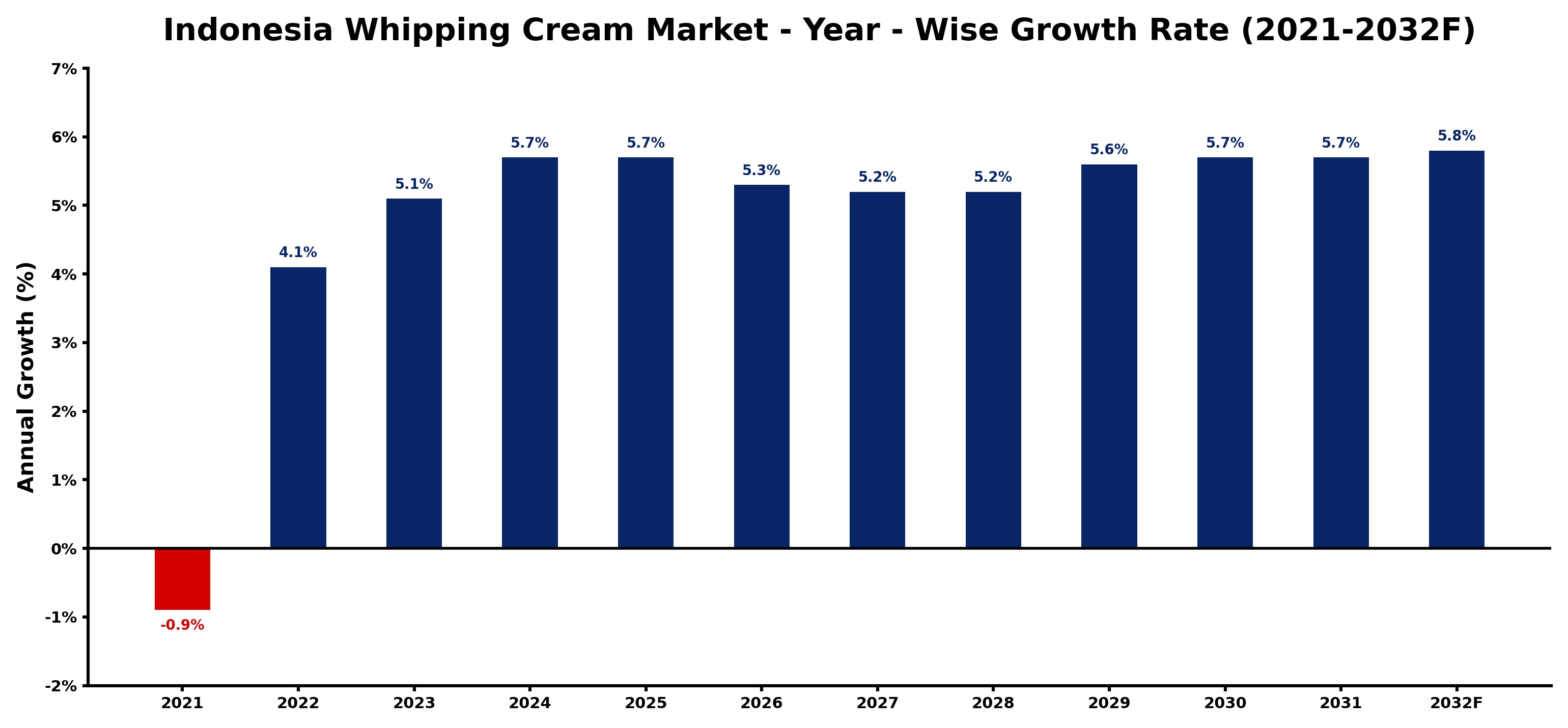
The table below presents the year‑wise growth rates along with the key drivers influencing the market
| Year | Growth Rate | Major Drivers |
| 2021 | -0.9% | Consumer spending decreased on luxuries |
| 2022 | 4.1% | Increased baking trends drove demand |
| 2023 | 5.1% | Café culture expanded rapidly nationwide |
| 2024 | 5.7% | Home baking popularity surged significantly |
| 2025 | 5.7% | Dairy alternatives gained market traction |
| 2026 | 5.3% | Food innovation attracted new customers |
| 2027 | 5.2% | Social media influence boosted sales |
| 2028 | 5.2% | Health-conscious products gained popularity |
| 2029 | 5.6% | Seasonal product launches attracted attention |
| 2030 | 5.7% | E-commerce growth enhanced market reach |
| 2031 | 5.7% | Sustainability trends influenced purchasing behavior |
| 2032 | 5.8% | Culinary education programs increased interest |
Note - Market size estimations and growth projections presented in this report are based on 6Wresearch’s advanced forecasting approach, validated with industry datasets as of June 2026.
Indonesia Whipping Cream Market Synopsis
In Indonesia, the market for whipping cream has emerged as a significant player in the broader culinary landscape, largely attributed to the increasing demand for visually appealing desserts. The growing popularity of cake decorating, spurred by social media trends and the rise of home baking, has resulted in a marked uptick in consumption.
Moreover, the recent economic upturn has enabled consumers to spend more on premium food items, thus fostering innovation among manufacturers. New entrants are now introducing flavored variations such as chocolate and strawberry whipping creams, which enhance the overall appeal and diversify options available to consumers.
Indonesia Whipping Cream Market Key Takeaways
- The market is experiencing robust growth due to an increase in disposable incomes and consumer spending.
- Western culinary influences have facilitated a cultural shift towards dessert consumption post-meals.
- Emerging trends include organic whipping cream varieties catering to health-conscious consumers.
- Convenience packaging solutions such as aerosol cans are becoming increasingly popular among home bakers.
- The pandemic posed challenges, yet resilience and adaptability within the industry persist.
Evaluation of Restraints in Indonesia Whipping Cream Market
While the Indonesia whipping cream market is poised for growth, several restraints hinder its full potential. The COVID-19 pandemic has left a lasting impact, particularly within the hospitality sector, which significantly reduced demand for whipping cream in restaurants and cafes. Furthermore, supply chain disruptions have resulted in raw material shortages, leading to increased prices and reduced availability. These constraints create fluctuations in market stability, thus necessitating strategic planning among stakeholders.
Indonesia Whipping Cream Market Trends
Current trends in the Indonesia whipping cream market reflect a shift towards flavor enhancement and product differentiation. Manufacturers are focusing on introducing new varieties, including organic options that boast cleaner ingredients. Additionally, the convenience factor is paramount, with aerosol cans and ready-to-use formats gaining traction among busy consumers. There is also a noticeable move towards environmentally friendly packaging, aligning with global sustainability trends.
Indonesia Whipping Cream Market Opportunities
The market for whipping cream in Indonesia presents numerous growth opportunities. Innovations in product development, especially in organic and low-calorie segments, stand to attract health-conscious consumers. Additionally, the rise of e-commerce platforms provides an avenue for increased market penetration and accessibility for consumers across diverse regions. Collaborations with local bakeries and cafes can also facilitate brand expansion and increased product usage.
Government Initiatives in the Indonesia Whipping Cream Market
The Indonesian government has been fostering a favorable environment for food manufacturing through various policy measures aimed at boosting local industries. Initiatives promoting food safety and quality assurance standards are driving manufacturers to comply with hygiene regulations, enhancing consumer trust. Furthermore, programs aimed at supporting small and medium enterprises in the food sector can facilitate the growth of local whipping cream producers.
Future Insights of the Indonesia Whipping Cream Market
Looking ahead from 2026 to 2032, the Indonesia whipping cream market is expected to continue its upward momentum. Factors such as rising urbanization and increased westernization of eating habits are likely to sustain the demand for whipping cream. As consumers grow more adventurous with culinary experimentation, the need for diverse and premium products will drive market innovations. Investing in marketing strategies that highlight unique flavor profiles and health benefits will be crucial for market participants aiming to capture an expanding consumer base.
Indonesia Whipping Cream Market Latest Developments (May 2025 - June 2026)
Recent developments in the Indonesia whipping cream market have included a focus on expanding distribution channels, particularly through online platforms. As consumer preferences shift, manufacturers are also prioritizing the introduction of healthier options to cater to a more health-conscious demographic. In response to challenges posed by the pandemic, companies have been enhancing their safety protocols and diversifying their product lines to maintain market relevance.
Indonesia Whipping Cream Market - Key Attractiveness of the Report
- 10 Years of Market Numbers
- Historical Data Starting from 2022 to 2025
- Base Year: 2025
- Forecast Data until 2032
- Key Performance Indicators Impacting the Market
- Major Upcoming Developments and Projects
Key Highlights of the Report:
- Indonesia Whipping Cream Market Outlook
- Market Size of Indonesia Whipping Cream Market, 2025
- Forecast of Indonesia Whipping Cream Market, 2032
- Historical Data and Forecast of Indonesia Whipping Cream Revenues & Volume for the Period 2022-2032F
- Indonesia Whipping Cream Market Trend Evolution
- Indonesia Whipping Cream Market Drivers and Challenges
- Indonesia Whipping Cream Price Trends
- Indonesia Whipping Cream Porter's Five Forces
- Indonesia Whipping Cream Industry Life Cycle
- Historical Data and Forecast of Indonesia Whipping Cream Market Revenues & Volume By Product for the Period 2022-2032F
- Historical Data and Forecast of Indonesia Whipping Cream Market Revenues & Volume By Dairy for the Period 2022-2032F
- Historical Data and Forecast of Indonesia Whipping Cream Market Revenues & Volume By Non-Dairy for the Period 2022-2032F
- Historical Data and Forecast of Indonesia Whipping Cream Market Revenues & Volume By Application for the Period 2022-2032F
- Historical Data and Forecast of Indonesia Whipping Cream Market Revenues & Volume By B2B for the Period 2022-2032F
- Historical Data and Forecast of Indonesia Whipping Cream Market Revenues & Volume By B2C for the Period 2022-2032F
- Historical Data and Forecast of Indonesia Whipping Cream Market Revenues & Volume By Distribution Channel for the Period 2022-2032F
- Historical Data and Forecast of Indonesia Whipping Cream Market Revenues & Volume By Warehouse Clubs for the Period 2022-2032F
- Historical Data and Forecast of Indonesia Whipping Cream Market Revenues & Volume By Variety Stores for the Period 2022-2032F
- Historical Data and Forecast of Indonesia Whipping Cream Market Revenues & Volume By Department Stores for the Period 2022-2032F
- Historical Data and Forecast of Indonesia Whipping Cream Market Revenues & Volume By Online Retail for the Period 2022-2032F
- Historical Data and Forecast of Indonesia Whipping Cream Market Revenues & Volume By Convenience Stores for the Period 2022-2032F
- Historical Data and Forecast of Indonesia Whipping Cream Market Revenues & Volume By Supermarkets and Hypermarket for the Period 2022-2032F
- Historical Data and Forecast of Indonesia Whipping Cream Market Revenues & Volume By Specialist Retailers for the Period 2022-2032F
- Historical Data and Forecast of Indonesia Whipping Cream Market Revenues & Volume By Others for the Period 2022-2032F
- Indonesia Whipping Cream Import Export Trade Statistics
- Market Opportunity Assessment By Product
- Market Opportunity Assessment By Application
- Market Opportunity Assessment By Distribution Channel
- Indonesia Whipping Cream Top Companies Market Share
- Indonesia Whipping Cream Competitive Benchmarking By Technical and Operational Parameters
- Indonesia Whipping Cream Company Profiles
- Indonesia Whipping Cream Key Strategic Recommendations






































