Indonesia Wind Energy Market Size, Share & Growth Rate
The Indonesia Wind Energy Market was estimated at USD 198 Million in 2025 and is projected to reach USD 262 Million by 2032, growing at a CAGR of 4.1% from 2026 to 2032. This growth is primarily driven by the nation's increasing commitment to renewable energy sources, reinforced by government policies that favor sustainable energy development. In addition, heightened awareness among local investors about the viability of wind energy projects contributes to a growing market landscape.
Indonesia Wind Energy Market Year-wise Growth Rate and Key Drivers
This graph highlights how the Indonesia Wind Energy Market has steadily grown over the years, supported by major growth factors.
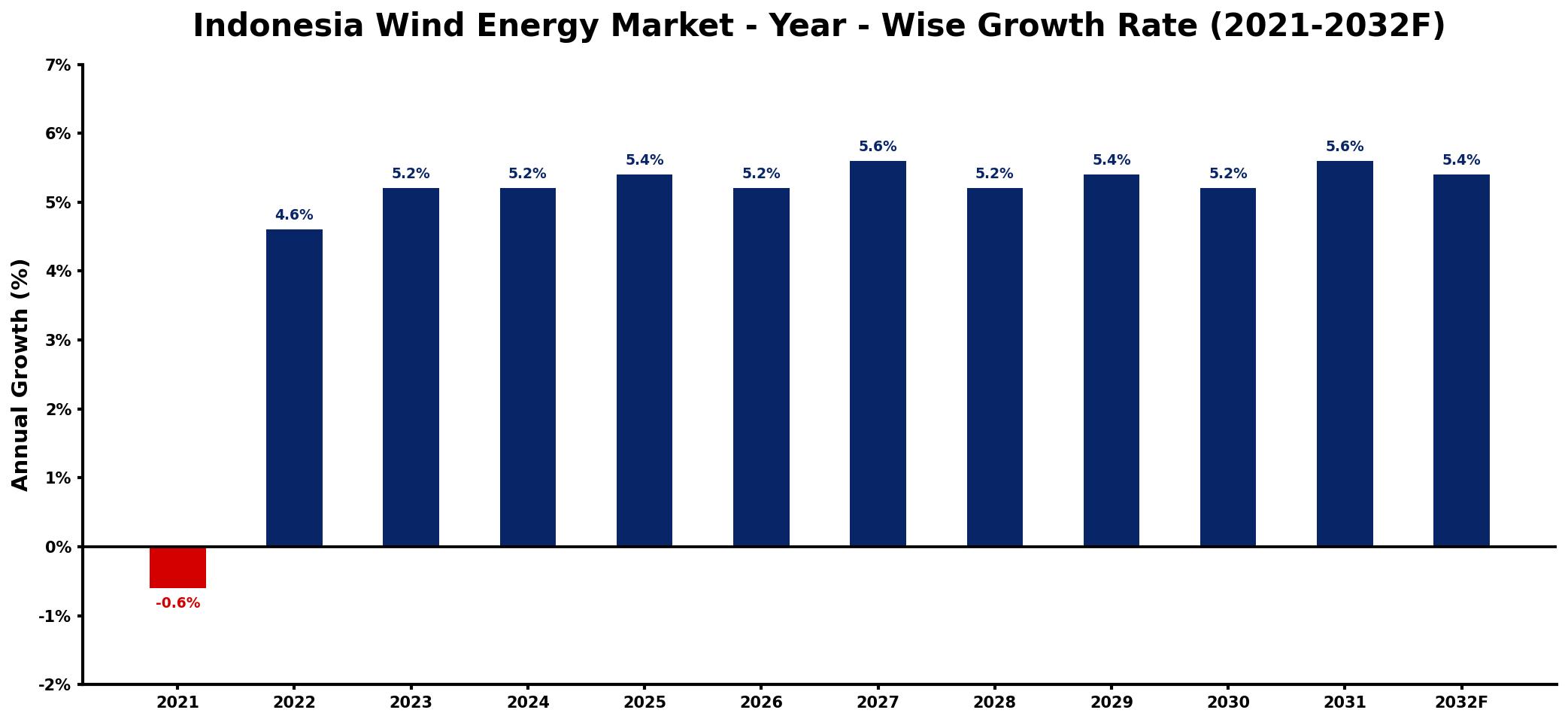
The table below presents the year‑wise growth rates along with the key drivers influencing the market
| Year | Growth Rate | Major Drivers |
| 2021 | -0.6% | decreased investment in renewables |
| 2022 | 4.6% | rising demand for sustainable solutions |
| 2023 | 5.2% | increased government incentives available |
| 2024 | 5.2% | growing interest from private sector |
| 2025 | 5.4% | expansion of manufacturing capabilities |
| 2026 | 5.2% | enhanced infrastructure for deployment |
| 2027 | 5.6% | new technological advancements introduced |
| 2028 | 5.2% | strengthened international partnerships formed |
| 2029 | 5.4% | increased public awareness initiatives launched |
| 2030 | 5.2% | growing corporate sustainability commitments |
| 2031 | 5.6% | greater integration with local economies |
| 2032 | 5.4% | emerging financing models adopted widely |
Note: Market size estimations and growth projections presented in this report are based on 6Wresearch's proprietary forecasting methodology, utilizing the latest available industry data, government publications, and primary research inputs.
Indonesia Wind Energy Market Synopsis
The wind energy market in Indonesia has witnessed significant momentum recently, propelled by government incentives and a rising shift towards sustainability. With numerous projects underway, the landscape is evolving; however, challenges remain that could influence the market trajectory.
As the market matures, the push for technological advancements and improved efficiency becomes increasingly critical. The intersection of policy support and innovation holds promise for continued growth, positioning Indonesia as a notable player in the renewable energy sector.
Indonesia Wind Energy Market Key Takeaways
- Significant market growth driven by government incentives and investment in technology.
- Wind energy is a key component of Indonesia's strategy for sustainable development.
- Emerging awareness among local investors enhances project viability.
- Technological advancements are crucial for improving efficiency in wind energy generation.
- Despite growth potential, challenges related to infrastructure and initial investments remain prominent.
Evaluation of Restraints in Indonesia Wind Energy Market
The Indonesia Wind Energy Market faces notable restraints that may hinder its growth. One of the primary challenges is the high initial investment required for the establishment and maintenance of wind farms. Additionally, issues surrounding land acquisition and the adequacy of transmission infrastructure can pose significant barriers to entry for new projects. Furthermore, the intermittency of wind resources adds another layer of complexity, impacting the consistency of energy generation and making it essential to address these concerns for the market to thrive.
Indonesia Wind Energy Market Trends
Emerging trends in the Indonesia Wind Energy Market indicate a strong focus on technological innovation aimed at improving turbine efficiency and reducing operational costs. Moreover, the integration of energy storage solutions is becoming increasingly important to mitigate the intermittency of wind resources. Additionally, the growing emphasis on public-private partnerships is fostering collaborative approaches to project funding and implementation, enhancing the overall investment climate in the sector.
Indonesia Wind Energy Market Opportunities
Significant growth opportunities lie in the enhancement of local manufacturing capabilities for wind turbine components, which could reduce import dependencies and stimulate economic growth. The untapped potential of offshore wind energy is also garnering interest, providing an avenue for expansion as technology progresses. Furthermore, the increasing capacity of smaller-scale wind projects holds promise for attracting more investors looking for lower-risk opportunities within the market.
Government Initiatives in the Indonesia Wind Energy Market
The Indonesian government has introduced various initiatives aimed at bolstering the wind energy sector as part of its broader renewable energy strategy. Policies incentivizing investment in renewable technologies, coupled with long-term energy planning that incorporates wind resources, are crucial to establishing a sustainable energy framework. Furthermore, the government is working to enhance regulations that facilitate smoother land acquisition processes and strengthen the necessary infrastructure for wind projects.
Future Insights of the Indonesia Wind Energy Market
Looking ahead to 2026-2032, the Indonesia Wind Energy Market is poised for steady growth as the government continues to prioritize renewable energy sources in its development agenda. The focus on improved efficiency and cost-effectiveness, alongside ongoing investments in R&D, will drive innovations in turbine technology. As market participants adapt to the evolving landscape and address existing barriers, the foundation for a robust wind energy sector is set to strengthen, aligning with both national energy goals and global sustainability commitments.
Indonesia Wind Energy Market Latest Developments (2025 - 2026)
In the latest developments, there has been a notable uptick in wind farm installations, driven by favorable government policies and increasing private sector interest. Various stakeholders are collaborating to streamline processes related to land acquisition and grid connection, enhancing the overall project execution timeline. Additionally, ongoing discussions regarding public funding for renewable energy initiatives have sparked interest among international investors, signaling a positive outlook for future project financing and implementation.
Indonesia Wind Energy Market - Key Attractiveness of the Report
- 10 Years of Market Numbers
- Historical Data Starting from 2022 to 2025
- Base Year: 2025
- Forecast Data until 2032
- Key Performance Indicators Impacting the Market
- Major Upcoming Developments and Projects
Key Highlights of the Report:
- Indonesia Wind Energy Market Outlook
- Market Size of Indonesia Wind Energy Market, 2025
- Forecast of Indonesia Wind Energy Market, 2032
- Historical Data and Forecast of Indonesia Wind Energy Revenues & Volume for the Period 2022-2032F
- Indonesia Wind Energy Market Trend Evolution
- Indonesia Wind Energy Market Drivers and Challenges
- Indonesia Wind Energy Price Trends
- Indonesia Wind Energy Porter's Five Forces
- Indonesia Wind Energy Industry Life Cycle
- Historical Data and Forecast of Indonesia Wind Energy Market Revenues & Volume By Type for the Period 2022-2032F
- Historical Data and Forecast of Indonesia Wind Energy Market Revenues & Volume By Offshore for the Period 2022-2032F
- Historical Data and Forecast of Indonesia Wind Energy Market Revenues & Volume By Onshore for the Period 2022-2032F
- Historical Data and Forecast of Indonesia Wind Energy Market Revenues & Volume By End User for the Period 2022-2032F
- Historical Data and Forecast of Indonesia Wind Energy Market Revenues & Volume By Industrial for the Period 2022-2032F
- Historical Data and Forecast of Indonesia Wind Energy Market Revenues & Volume By Commercial for the Period 2022-2032F
- Historical Data and Forecast of Indonesia Wind Energy Market Revenues & Volume By Residential for the Period 2022-2032F
- Indonesia Wind Energy Import Export Trade Statistics
- Market Opportunity Assessment By Type
- Market Opportunity Assessment By End User
- Indonesia Wind Energy Top Companies Market Share
- Indonesia Wind Energy Competitive Benchmarking By Technical and Operational Parameters
- Indonesia Wind Energy Company Profiles
- Indonesia Wind Energy Key Strategic Recommendations






































