Indonesia Wire Harness Market Size, Share & Growth Rate
The Indonesia Wire Harness Market was estimated at USD 227 Million in 2025 and is projected to reach USD 300 Million by 2032, growing at a CAGR of 4.1% from 2026 to 2032. This growth trajectory is primarily driven by the increasing demand for electronic products across various sectors, particularly automotive and consumer electronics, coupled with an upward trend in disposable income among the middle class. The rise in infrastructure projects and the expansion of industrial activities further solidify the market's robust prospects.
Indonesia Wire Harness Market Year-wise Growth Rate and Key Drivers
This graph highlights how the Indonesia Wire Harness Market has steadily grown over the years, supported by major growth factors.
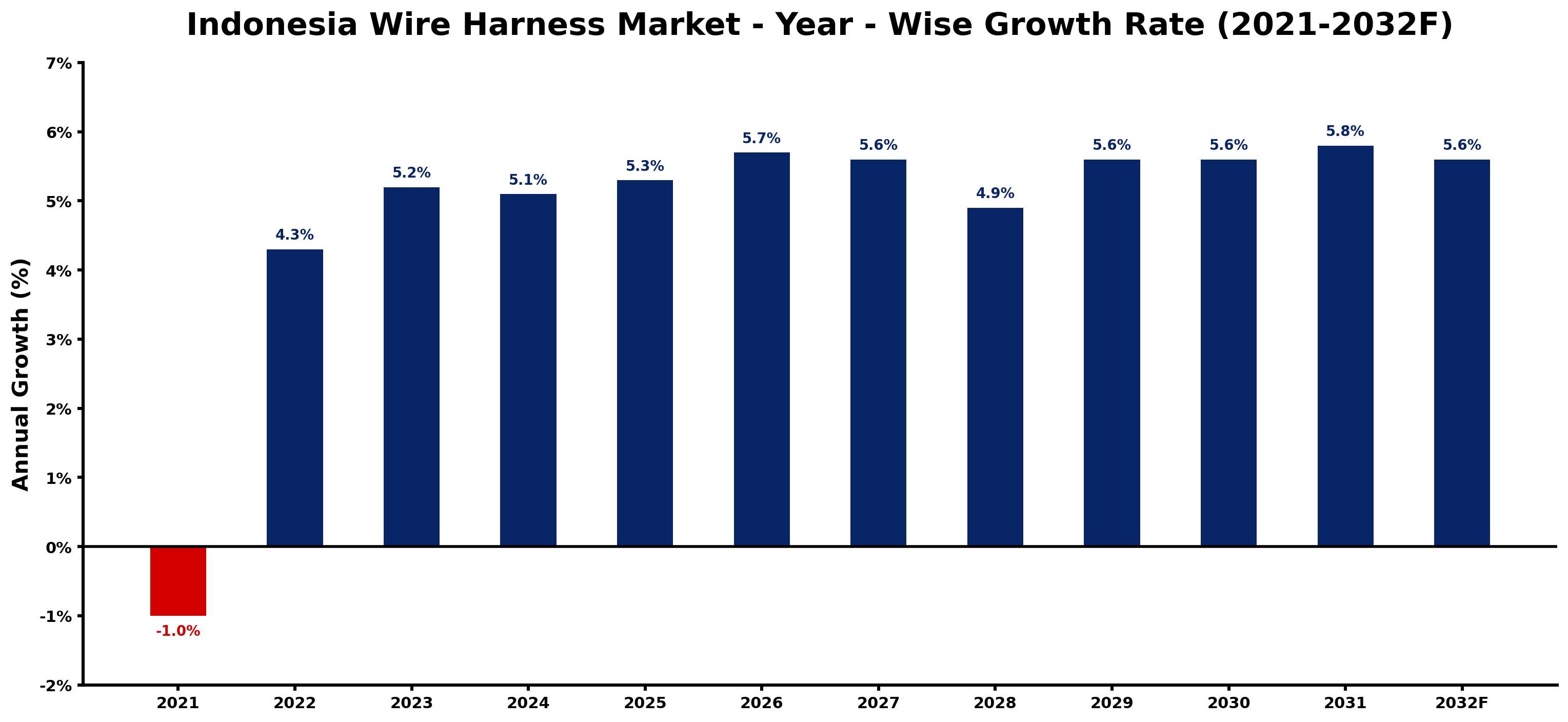
The table below presents the year‑wise growth rates along with the key drivers influencing the market
| Year | Growth Rate | Major Drivers |
| 2021 | -1.0% | Expansion of commercial construction activities |
| 2022 | 4.3% | Growing renewable energy integration projects |
| 2023 | 5.2% | Government infrastructure modernization initiatives |
| 2024 | 5.1% | Growing urbanization and commercial development |
| 2025 | 5.3% | Expansion of commercial construction activities |
| 2026 | 5.7% | Growing urbanization and commercial development |
| 2027 | 5.6% | Increasing smart city development projects |
| 2028 | 4.9% | Government infrastructure modernization initiatives |
| 2029 | 5.6% | Government infrastructure modernization initiatives |
| 2030 | 5.6% | Growing urbanization and commercial development |
| 2031 | 5.8% | Rising electricity demand across industries |
| 2032 | 5.6% | Government infrastructure modernization initiatives |
Note - Market size estimations and growth projections presented in this report are based on 6Wresearch's advanced forecasting approach, validated with industry datasets as of June 2026.
Indonesia Wire Harness Market Synopsis
The most significant force shaping the Indonesia Wire Harness Market today is the burgeoning automotive sector, which is witnessing rapid expansion. With stringent safety regulations and a marked increase in vehicle production, the demand for high-quality wire harnesses is at an all-time high, prompting manufacturers to enhance their offerings.
Additionally, urbanization and industrialization trends are elevating the need for advanced electrical components. The government's initiatives to bolster infrastructure are also acting as a catalyst, stimulating growth in this pivotal market, as various industries strive to meet evolving consumer demands.
Indonesia Wire Harness Market Key Takeaways
- The market is fueled by rising disposable income levels and increased consumer spending.
- Government regulations are pushing manufacturers toward higher safety standards in automotive applications.
- Technological advancements are prompting continuous product innovations within the wire harness domain.
- Indonesia's attractive labor costs create a competitive edge over other countries in wire harness manufacturing.
- Growing infrastructure projects are set to increase the demand for wiring harnesses significantly.
Evaluation of Restraints in Indonesia Wire Harness Market
While the Indonesia Wire Harness Market is positioned for growth, several challenges impede its full potential. Notably, the lack of standardized quality assurance processes remains a significant concern, affecting product reliability and performance. Furthermore, a shortage of skilled professionals hampers the efficiency of design and manufacturing processes. The high initial investment needed for modern manufacturing facilities also poses a barrier, as companies must balance cost with competitiveness in the global market.
Indonesia Wire Harness Market Trends
Several current trends are shaping the Indonesia Wire Harness Market. One of the most significant is the move towards automation and the Internet of Things (IoT), which demands more sophisticated wiring solutions. Additionally, sustainability trends are pushing manufacturers to consider eco-friendly materials and production techniques. The integration of smart technologies in automotive applications is also driving demand for high-performance wire harnesses, presenting a substantial opportunity for innovation.
Indonesia Wire Harness Market Opportunities
Investment opportunities abound in the Indonesia Wire Harness Market, especially in the automotive and consumer electronics sectors. The ongoing urbanization efforts present an avenue for wiring harness manufacturers to supply electrical components to new infrastructure projects. Moreover, partnerships with local OEMs can leverage the regional supply chain, opening doors to lucrative contracts and long-term growth. The rising trend of electric vehicles also creates a niche market for specialized wire harness applications.
Government Initiatives in the Indonesia Wire Harness Market
The Indonesian government is actively promoting initiatives aimed at enhancing infrastructure and technology advancements. Public spending in transportation and utilities is creating a conducive environment for the wire harness market. Various government programs aim to support foreign investments and encourage local manufacturing capabilities, which are crucial for the growth of the wire harness sector. These initiatives are designed to enhance the country's manufacturing ecosystem and improve overall productivity.
Future Insights of the Indonesia Wire Harness Market
Looking ahead to 2026-2032, the Indonesia Wire Harness Market is poised for sustained growth. The continued rise of the automotive industry, coupled with increased investment in infrastructure projects, is expected to drive demand for high-quality wiring solutions. As the market evolves, technological advancements will be critical, with manufacturers likely to focus on smart wiring harnesses equipped with IoT capabilities. This evolution will create new avenues for growth and diversification within the sector.
Indonesia Wire Harness Market Latest Developments (May 2025 - June 2026)
Recent developments in the Indonesia Wire Harness Market reflect a clear trajectory towards innovation and efficiency. There has been a marked increase in collaborations between local manufacturers and international firms aimed at enhancing product quality and reducing lead times. Additionally, many companies are investing in advanced manufacturing technologies to optimize their operations. These trends indicate a robust adaptation to market demands and an emphasis on competitive advantage.
Indonesia Wire Harness Market - Key Attractiveness of the Report
- 10 Years of Market Numbers
- Historical Data Starting from 2022 to 2025
- Base Year: 2025
- Forecast Data until 2032
- Key Performance Indicators Impacting the Market
- Major Upcoming Developments and Projects
Key Highlights of the Report:
- Indonesia Wire Harness Market Outlook
- Market Size of Indonesia Wire Harness Market, 2025
- Forecast of Indonesia Wire Harness Market, 2032F
- Historical Data and Forecast of Indonesia Wire Harness Revenues & Volume for the Period 2022-2032F
- Indonesia Wire Harness Market Trend Evolution
- Indonesia Wire Harness Market Drivers and Challenges
- Indonesia Wire Harness Price Trends
- Indonesia Wire Harness Porter's Five Forces
- Indonesia Wire Harness Industry Life Cycle
- Historical Data and Forecast of Indonesia Wire Harness Market Revenues & Volume By Product Type for the Period 2022-2032F
- Historical Data and Forecast of Indonesia Wire Harness Market Revenues & Volume By Wire Harness Connector for the Period 2022-2032F
- Historical Data and Forecast of Indonesia Wire Harness Market Revenues & Volume By Wire Harness Terminal for the Period 2022-2032F
- Historical Data and Forecast of Indonesia Wire Harness Market Revenues & Volume By Material for the Period 2022-2032F
- Historical Data and Forecast of Indonesia Wire Harness Market Revenues & Volume By PVC for the Period 2022-2032F
- Historical Data and Forecast of Indonesia Wire Harness Market Revenues & Volume By Vinyl for the Period 2022-2032F
- Historical Data and Forecast of Indonesia Wire Harness Market Revenues & Volume By Thermoplast Elastomer for the Period 2022-2032F
- Historical Data and Forecast of Indonesia Wire Harness Market Revenues & Volume By Polyurethane for the Period 2022-2032F
- Historical Data and Forecast of Indonesia Wire Harness Market Revenues & Volume By Polyethylene for the Period 2022-2032F
- Historical Data and Forecast of Indonesia Wire Harness Market Revenues & Volume By Application for the Period 2022-2032F
- Historical Data and Forecast of Indonesia Wire Harness Market Revenues & Volume By Automotive for the Period 2022-2032F
- Historical Data and Forecast of Indonesia Wire Harness Market Revenues & Volume By Marine and Marine Engine for the Period 2022-2032F
- Historical Data and Forecast of Indonesia Wire Harness Market Revenues & Volume By Aerospace & Defense for the Period 2022-2032F
- Historical Data and Forecast of Indonesia Wire Harness Market Revenues & Volume By Military Machines for the Period 2022-2032F
- Historical Data and Forecast of Indonesia Wire Harness Market Revenues & Volume By Gaming & Amusements for the Period 2022-2032F
- Historical Data and Forecast of Indonesia Wire Harness Market Revenues & Volume By Medical Equipment & Devices for the Period 2022-2032F
- Historical Data and Forecast of Indonesia Wire Harness Market Revenues & Volume By Commercial Refrigeration & Food Machines for the Period 2022-2032F
- Historical Data and Forecast of Indonesia Wire Harness Market Revenues & Volume By Others for the Period 2022-2032F
- Indonesia Wire Harness Import Export Trade Statistics
- Market Opportunity Assessment By Product Type
- Market Opportunity Assessment By Material
- Market Opportunity Assessment By Application
- Indonesia Wire Harness Top Companies Market Share
- Indonesia Wire Harness Competitive Benchmarking By Technical and Operational Parameters
- Indonesia Wire Harness Company Profiles
- Indonesia Wire Harness Key Strategic Recommendations






































